Zeus
First Appearance
Zeus first appears as the youngest child of the Titans Cronus and Rhea. Warned by Gaia and Uranus that he was doomed to be overthrown by his own son, Cronus swallowed each child at birth. Rhea, following her parents' counsel, bore Zeus in secret in the rich land of Crete and hid him in a deep cave; to Cronus she gave a great stone wrapped in swaddling-clothes, which he swallowed whole, never suspecting that his conqueror had escaped him.
— Hesiod, Theogony 453–491
Who They Are
Zeus is the king of the gods and the sky-father of the Greek pantheon — lord of the bright heavens, of the thunderhead and the lightning-stroke, and of the ordered world beneath them. From his throne on Mount Olympus he governs gods and mortals alike, not merely as the strongest of the immortals but as the guarantor of the cosmic and moral order that his victory in the Titanomachy established. His name descends from the Proto-Indo-European root *dyeu-, "the bright sky," making him the direct heir of the oldest sky-god of the Indo-European peoples.
His power is most vividly the storm: the eagle, the oak struck from above, and above all the thunderbolt forged for him by the Cyclopes. Yet the Greeks did not honour him chiefly for his violence. They called on him as the keeper of justice (Dike), the defender of the suppliant and the stranger, the witness who punishes the breaking of oaths, and the presence at the boundary of every household and city. To swear "by Zeus" was to place a promise under the eye of the god who sees all and forgets nothing.
His character in myth is grand and contradictory — sovereign and lawgiver, yet restless in his loves and endlessly fathering the gods and heroes who fill the world. From his unions spring Athena, Apollo and Artemis, Hermes, Dionysus, Persephone and many more, so that the divine order he rules is very largely his own progeny. He is at once the remote king of heaven and the near god of the courtyard hearth, the thunderer feared in the mountains and the gracious Meilichios who can be soothed with honeyed offerings.
Mythology
The overthrow of Cronus
Grown to strength in his Cretan hiding-place, Zeus returned to compel his father Cronus to disgorge the children he had swallowed — first the stone, then Hestia, Demeter, Hera, Hades and Poseidon, reborn full-grown. To wage war on the Titans, Zeus went down into the earth and freed the beings Cronus had imprisoned: the three Cyclopes, who in gratitude forged for him the thunder and the lightning-bolt, and the three Hundred-Handers, Cottus, Briareus and Gyges, whose hurled boulders darkened the sky. The war raged ten years from Olympus against the Titans entrenched on Othrys, until Zeus loosed his full fury and the earth, sea and heavens groaned with it. The Titans were overwhelmed, bound in chains, and cast down into Tartarus as far beneath the earth as heaven is above it, with the Hundred-Handers set as their eternal guards. So Zeus won the kingship of gods and men, and the three brothers cast lots for their portions — sky to Zeus, sea to Poseidon, the underworld to Hades.
The swallowing of Metis and the birth of Athena
Zeus's first wife was Metis, wisest of gods and mortals. When she was pregnant, Gaia and Uranus warned him of a fate that mirrored his own rise: Metis was destined to bear first a daughter, and then a son who would seize the kingship of heaven from his father. To break the succession of usurpers at its root, Zeus coaxed Metis with cunning words and swallowed her whole, taking her wisdom into himself so that she might counsel him from within for good and ill. In time the child she had conceived came to term inside him; his head was split — by Hephaestus's axe, some say — and out sprang Athena, full-grown and clad in gleaming armour, with a war-cry that shook Olympus. By devouring wisdom itself, Zeus made his rule the last, and no son was ever born to overthrow him.
Typhon
The final challenge to Zeus's order came from Typhon (Typhoeus), the monstrous youngest child of Gaia and Tartarus — a creature of colossal size with a hundred serpent-heads flickering fire from their eyes and voicing every dreadful sound. Had he come to power, Hesiod says, he would have ruled gods and men. But Zeus saw the danger, and thunder answered thunder: he struck Typhon with an unceasing storm of bolts until the monster's heads were scorched and the very earth melted around him. Blasted and crippled, Typhon was hurled down into Tartarus with the Titans — though from him still blow the wild and destructive storm-winds that trouble the sailor's sea. With this last victory the cosmos was secured, and Zeus's sovereignty over it made complete.
The thunderbolt, the eagle, and the oak
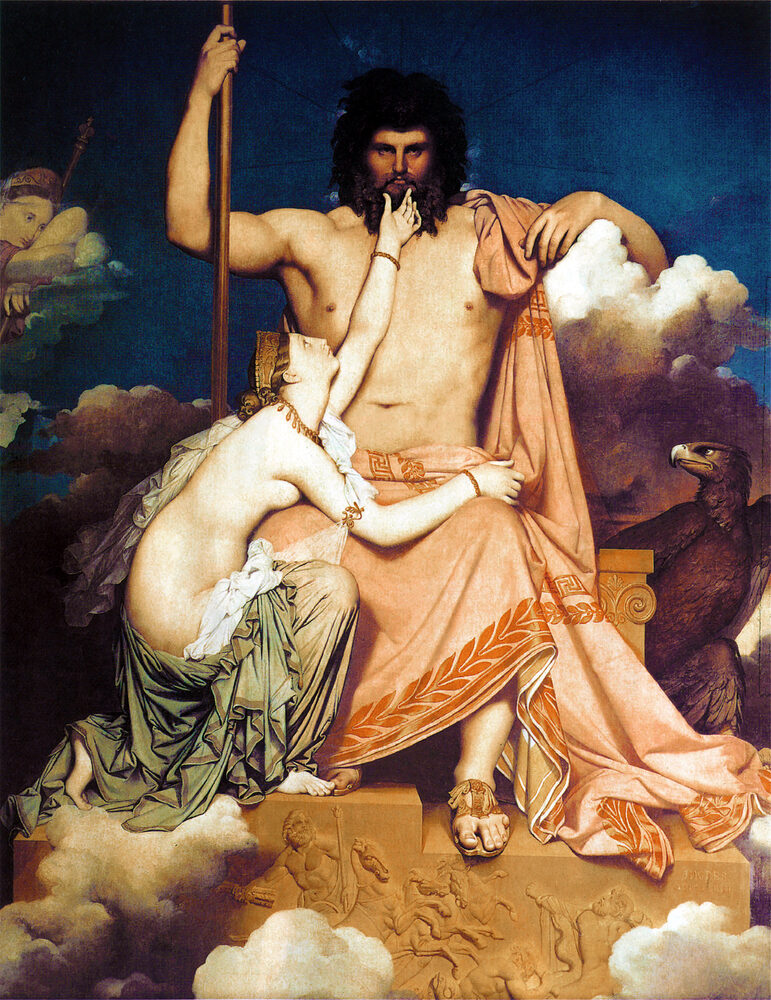
Zeus is known by the objects that surround him, and each one speaks of a part of his power. Foremost is the thunderbolt (keraunos), forged for him by the three Cyclopes in gratitude for their release (Hesiod, Theogony 139–141, 501–506): it is at once his weapon, with which he overthrew the Titans and crushed Typhon, and the visible sign of a justice that falls from above, so that the Greeks called him Keraunios, "of the thunderbolt." The eagle is his bird — the highest-flying of birds, closest to the heavens — and above all his messenger and omen: in Homer an eagle sent from the right is Zeus's answer to prayer and a portent of what is to come (Iliad 8.247, 24.310–321). The oak, the tree most often struck by lightning, was held sacred to him and became the medium of his oldest voice, for at Dodona his will was read in the rustling of its leaves. Two further emblems mark his kingship: the aegis, his terrible storm-shield, tasselled and crowned with the head of Gorgo, which he shakes to rout armies and sometimes lends to Athena or Apollo (Iliad 17.593–596), so that he is Aegis-bearer, aigiochos; and the sceptre, the staff of rule that Hephaestus wrought and that passed from Zeus down the line of kings as the token of a sovereignty granted from heaven (Iliad 2.101–108). Together they portray him whole: the storm-king who strikes, the watcher who sends signs, and the enthroned lord from whom all lawful rule descends.
Worship — Ancient
Cult centres
Zeus was worshipped across the whole Greek world, but two sanctuaries stood above the rest. At Olympia in the western Peloponnese lay his greatest cult site, home to the vast Temple of Zeus and to the gold-and-ivory (chryselephantine) enthroned statue made by Pheidias around the 430s BCE — some twelve metres high, holding a Nike in one hand and an eagle-topped sceptre in the other, and counted among the Seven Wonders of the ancient world (described in detail by Pausanias, Book 5). Before the temple rose the great Altar of Zeus, a mound built up over centuries from the ash of burnt thighbones. It was in Zeus's honour that the Olympic Games were held every four years. Far to the northwest, at Dodona in Epirus, stood his oldest oracle: here Zeus Naios was consulted through the rustling leaves of a sacred oak, read by the barefoot Selloi priests who slept on the bare ground, and later by three priestesses called the Peleiades, "Doves"; his consort there was Dione.
Rites
The central rite of Olympian Zeus was animal sacrifice — above all the ox — in which the thighbones wrapped in fat were burnt on the altar as the god's portion while the worshippers shared the meat, an arrangement Hesiod traces to the trickery of Prometheus. Offerings of wine and barley cakes accompanied the burning, with frankincense cast into the flames. Because Zeus was the guardian of oaths, solemn vows were sworn in his name as Zeus Horkios, and the perjurer feared his punishment. In his gentler, chthonic aspect as Zeus Meilichios he received holocausts burnt whole and given wholly to the god, in nocturnal and propitiatory rites quite unlike the bright Olympian feasts. As Zeus Herkeios he held an altar in the courtyard of the Greek house, and as Zeus Xenios he watched over every act of hospitality between host and guest.
Worship — Modern
Honouring Zeus today
A modern devotee of Zeus can keep the practice simple and sincere. A small altar or shrine — a clean shelf will serve — bearing an image of the eagle or the thunderbolt, a sprig or leaf of oak, and a lamp or candle is enough to give the god a place in the home. Approach him standing, with hands raised (the traditional Hellenic posture toward the sky-gods), and address him with respect as the king of the gods and the keeper of justice. Cleanliness of hands and intention matters more than any elaborate ritual.
Offerings
Where the ancients gave burnt sacrifice, a household devotee today most naturally offers libations and shared food. Pour a libation of wine — or of spring water, milk, or honey if wine is not wished — onto the earth or into a bowl set aside for the god. Barley or a barley cake, a little olive oil, honey, and incense (frankincense is traditional) are all fitting. Present the offering with a few words of praise and thanks, and afterward pour out or set aside what was given so that it is truly the god's and not taken back.
Prayer & epithets
Call on Zeus by the epithet that fits your need. Invoke Zeus Xenios when welcoming a guest or travelling as one, that the bond of hospitality be kept. Swear or seal a promise before Zeus Horkios, the guardian of oaths, mindful that he does not forget. Give thanks to Zeus Soter, the Saviour, after deliverance from danger or illness. In grief or when seeking calm and reconciliation, turn to the gentle Zeus Meilichios, the Gracious, who can be soothed. And in daily reverence honour Zeus Olympios, king of the bright heavens, whose order upholds the world.
Epithets & Cult Titles
- Olympios — Of Mount Olympus — king enthroned above the gods
- Xenios — Of the stranger — protector of guests and the sacred guest-host bond
- Horkios — Of the oath — guardian and avenger of sworn promises
- Keraunios — Of the thunderbolt — wielder of the descending fire
- Nephelegereta (Νεφεληγερέτα) — Cloud-gatherer — Homer's standing epithet for the storm-bringing sky-king
- Soter — Saviour, deliverer — invoked in thanksgiving for rescue
- Meilichios — The Gracious, the one who can be soothed — his gentle, propitiable, chthonic aspect
- Herkeios — Of the courtyard — protector of the household enclosure and its hearth
Sources & Variants
- Hesiod, Theogony 453–506 (birth and the swallowed stone), 617–735 (Titanomachy), 820–880 (Typhon), 886–900 (swallowing of Metis, birth of Athena)
- Homeric Hymn 23 to Zeus
- Homer, Iliad 2.101–108 (the sceptre of Zeus); 8.247 and 24.310–321 (the eagle as omen-bird); 17.593–596 (Zeus shakes the aegis)
- Pausanias, Description of Greece 5.10–11 (Temple and statue of Zeus at Olympia); 1.17.5 (oak of Dodona)
- Apollodorus, Bibliotheca 1.1–2 (Titanomachy and division of the cosmos)
- Thucydides 1.126 and the Erchia sacrificial calendar (the Diasia of Zeus Meilichios)
Gallery
Explore Related Figures
- Aphrodite
- Apollon
- Ares
- Artemis
- Athena
- Calliope
- Charites / the Graces
- Cheirōn (Chiron)
- Clio
- Cronus
- Danaë
- Demeter
- Dione
- Dionysus
- Dioskouroi / the Dioscuri
- Eileithyia
- Erato
- Europa
- Euterpe
- Ganymēdēs
- Hades
- Hebe
- Helenē
- Hephaestus
- Hēra
- Herakles
- Hermes
- Hestia
- Horai
- Io
- Kritai tōn Nekrōn / the Judges of the Dead
- Leto
- Maia
- Melpomene
- Metis
- Mnemosyne
- Mousai / Muses
- Persephone
- Perseus
- Polyhymnia
- Poseidon
- Rhea
- Semele
- Terpsichore
- Thalia
- Themis
- Urania