Herakles
First Appearance
Herakles is already an ancient and famous figure by the time of our earliest poetry. In the Iliad, Agamemnon tells how even Zeus was once deceived by Hera on the day Herakles was to be born: Zeus swore that a child of his blood born that day would rule his neighbours, and Hera hastened the birth of Eurystheus and delayed Herakles', so binding the greater man to serve the lesser. Hesiod's Theogony closes with Herakles completing his labours and, raised to the gods, taking Hebe as his bride on Olympus — the earliest witness to his apotheosis.
— Homer, Iliad 19.95–133 (the birth of Herakles and Hera's trick) and Hesiod, Theogony 943–944, 950–955
Who They Are
Herakles (HAIR-uh-kleez; the Latin form is Hercules, and the older English "Heracles" is the same hero) is the greatest of the Greek heroes — the strong man of myth, son of Zeus by a mortal woman, whose life was one long ordeal of labour, suffering, and endurance. More stories cling to him than to any other mortal in Greek myth, and he was worshipped more widely than any other hero; alone among heroes he crossed the boundary between man and god and was received onto Olympus. His name means "glory of Hera," yet Hera was the enemy who shadowed him from the cradle, and the whole shape of his life is the working-out of that hatred into greatness.
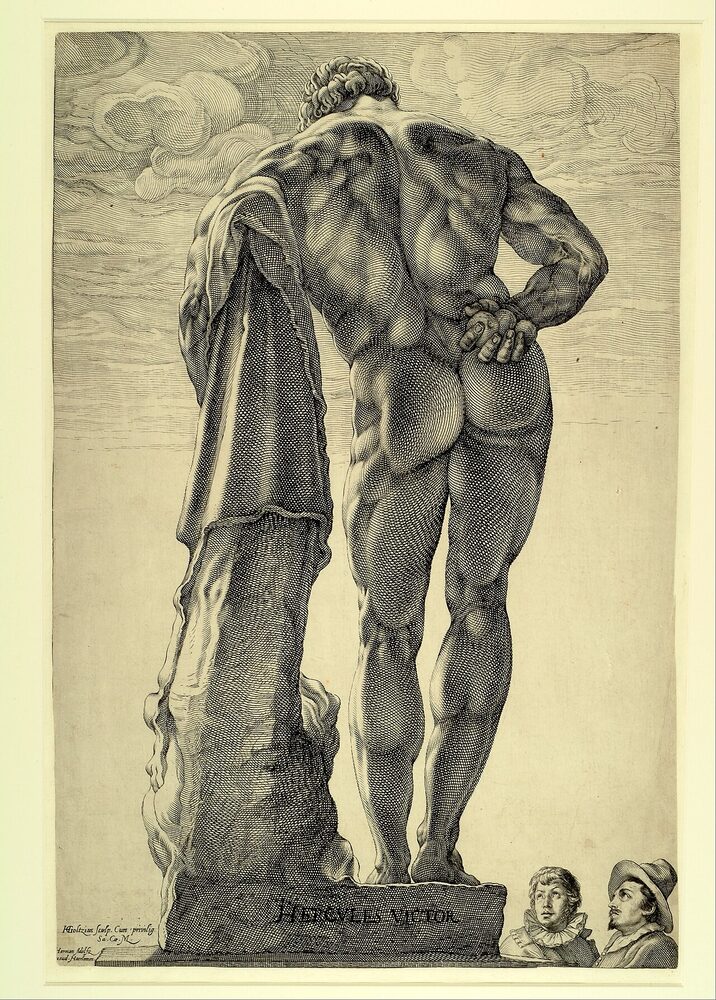
He is above all the hero of strength and endurance — not clever like Odysseus nor beautiful like Achilles, but the man who bears what cannot be borne and defeats what cannot be defeated. His weapons are the great club and the bow, and he wears the skin of the Nemean lion he strangled with his bare hands, its head drawn over his own like a hood. Yet the Greeks did not remember him only as a brute of muscle. He was the clearer of monsters and the maker of the safe world, the benefactor who rid the earth of the beasts and tyrants that plagued it, and by the classical age he had become the very emblem of moral choice and hard-won virtue.
His nature is double, as his cult was double: he is at once a suffering mortal and a god. (Content note: his story includes a fit of divinely-sent madness in which he kills his own children, told below as the cause of his labours.) The Greeks felt both truths at once and worshipped him in both ways — grieving the man who endured so much and was driven to such horror, and honouring the god who overcame it all and now feasts among the immortals. To follow Herakles through his labours and to his pyre is to watch a mortal earn, through sheer endurance, a place he was not born to.
Mythology
Birth, the serpents, and the trick of Hera
Herakles was the son of Zeus and the mortal princess Alcmene of Thebes, conceived on the night Zeus came to her in the shape of her absent husband Amphitryon — a night, the poets said, that Zeus stretched to the length of three, so that the hero is called Triesperos, "of the three nights." Because Zeus had sworn that a descendant of his born on the appointed day would rule over his neighbours, the jealous Hera delayed Alcmene's labour and hurried the birth of the sickly Eurystheus, so that Herakles came into the world already bound to serve a lesser man. The goddess's hatred struck at once: while he was still an infant in the cradle she sent two great serpents to kill him, but the child seized one in each fist and throttled them, and was found laughing with the dead snakes in his hands. He was raised in all the arts of a hero — wrestling, archery, the chariot, and the lyre — though of the lyre he had little patience, and in a fit of temper killed his music-master Linus with the instrument itself, an early flash of the terrible strength that would both make and ruin him.
The madness and the killing of the children — the cause of the Labours
(Content note: this passage concerns the killing of children, told plainly but without dwelling on horror.) In his young manhood Herakles won glory for Thebes and was given the princess Megara as his wife, and by her he had children whom he loved. But Hera's malice was not done. She sent upon him a fit of raving madness, and in that god-sent frenzy — not knowing what he did — Herakles killed his own children, and in some tellings Megara with them. When his sanity returned and he saw what his hands had done, he was broken by grief and horror, and went to the oracle at Delphi to ask how he might be cleansed of so great a pollution. The god's answer set the whole course of his life: he was to go to Tiryns and serve his cousin Eurystheus for a term of years, performing whatever tasks the king should set him, and by these labours he would be purified of the blood of his children — and, the oracle added, would win immortality. So the Twelve Labours are not merely feats of strength but a penance: the atonement of a man for the worst thing he ever did, laid on him as the price of cleansing and the road to the gods.
The Twelve Labours (ἆθλοι, athloi), in order
Eurystheus set Herakles twelve tasks — the canonical Twelve Labours — and though the king meant each to be his death, Herakles accomplished them all. In their traditional order they are: (1) the Nemean Lion; (2) the Lernaean Hydra; (3) the Ceryneian Hind, the golden-horned deer of Artemis, taken alive after a year's pursuit; (4) the Erymanthian Boar, carried back alive on his shoulders; (5) the Augean Stables, whose years of filth he cleansed in a single day by turning two rivers through them; (6) the Stymphalian Birds, the man-eating bronze-feathered birds he startled aloft and shot down; (7) the Cretan Bull, captured and brought back from Crete; (8) the Mares of Diomedes, the man-eating horses of the Thracian king; (9) the Belt of Hippolyta, the girdle of the queen of the Amazons; (10) the Cattle of Geryon; (11) the Apples of the Hesperides; and (12) Cerberus, the hound of Hades. Five of these deserve the fuller telling that follows.
First Labour — the Nemean Lion
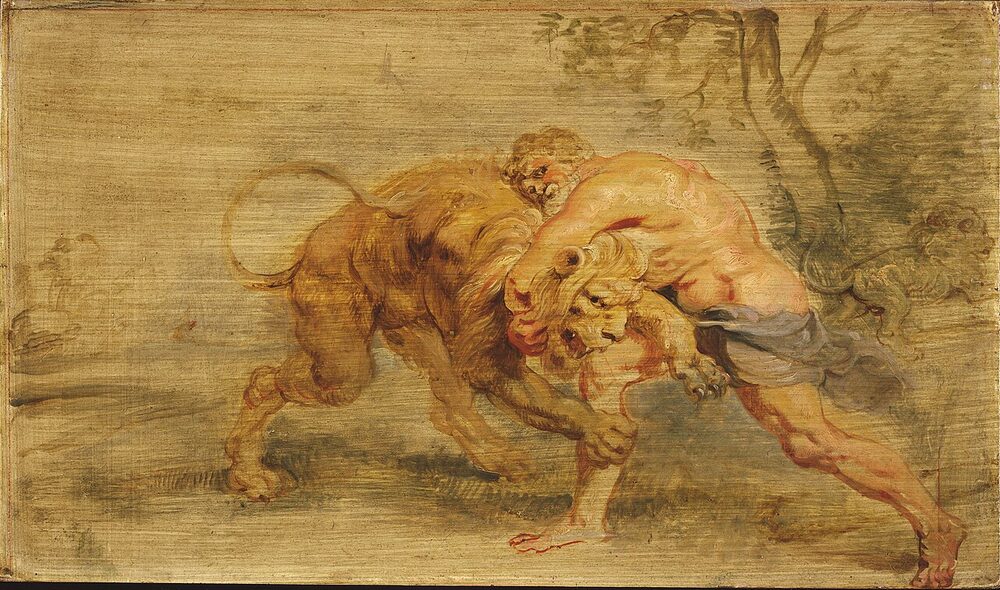
The lion of Nemea was a monstrous beast whose hide no weapon could pierce. Herakles' arrows glanced off it and his club shattered on its skull, so at last he wrestled it, cornered it in its cave, and strangled the creature to death with his bare arms. Finding no blade could cut the impenetrable hide, he skinned it with the lion's own claws, and thereafter wore the pelt as his armour and his emblem — the great head drawn over his own like a helm, so that in art he is known at a glance by the lion-skin. It is the first labour and the making of his image.
Second Labour — the Lernaean Hydra
In the swamps of Lerna lived the Hydra, a many-headed water-serpent whose breath was poison, and whose heads were worse than deadly: for every one that Herakles struck off, two grew in its place, so that the fight only made the monster stronger. Seeing this, he called on his nephew and charioteer Iolaus, who took a burning brand and seared each neck the moment a head was cut away, so that the stumps could not sprout again. One head was immortal; that one Herakles buried under a great rock. He dipped his arrows in the Hydra's venomous blood, and those poisoned arrows would return, again and again, through the rest of his story — including, at the last, into his own death. (Eurystheus refused to count this labour, because Herakles had been helped.) (A fuller account lives on the Hydra's own page.)
Tenth Labour — the Cattle of Geryon
For the tenth labour Herakles had to fetch the cattle of Geryon, a three-bodied giant who dwelt on the island of Erytheia at the far western edge of the world, beyond the stream of Ocean. The journey itself was legendary: at the western limit of his travels he set up the two Pillars of Herakles that flank the strait of Gibraltar, marking the edge of the known world. Scorched by the sun on his march, he even drew his bow against Helios himself, and the Sun, admiring his boldness, lent him the golden cup or bowl in which he sailed across Ocean to the island. There he slew the herdsman and the two-headed dog Orthrus, and finally Geryon himself, bringing the red cattle home across Europe through a long train of further adventures.
Eleventh Labour — the Apples of the Hesperides (and holding up the sky)
The eleventh labour sent him to fetch the golden apples of the Hesperides, which grew at the world's western edge in a garden guarded by the nymphs called the Hesperides and by the dragon Ladon. Not knowing the way, Herakles sought out Atlas, the Titan condemned to hold up the sky, whose daughters the Hesperides were. He offered to bear the burden of the heavens himself if Atlas would fetch the apples — and so, for a while, Herakles stood in the Titan's place and held up the sky upon his shoulders. Atlas gladly went and returned with the apples, but, glad to be free, tried to leave Herakles holding the weight forever. Herakles agreed to keep it — only, he said, let Atlas take it back for a moment while he padded his shoulders with a cushion; and when the Titan shouldered the sky again, Herakles picked up the apples and walked away.
Twelfth Labour — Cerberus
The last and greatest labour was to descend into the underworld itself and bring back Cerberus, the many-headed hound that guards the gates of Hades — a task meant to be impossible, since it asked a living man to conquer death's own kingdom and return. Guided in the mysteries and helped by Hermes and Athena, Herakles went down into the land of the dead, and Hades granted that he might take the hound if he could master it using no weapons. So Herakles seized Cerberus with his bare hands and, for all its writhing and its serpent-tail, wrestled it into submission and dragged it up into the light. He showed the terrified Eurystheus the beast — who is said to have hidden in a storage jar at the sight — and then carried Cerberus back down to its master. With this the twelve labours were done. (Cerberus has a page of his own.)
Further deeds — Prometheus, Alcestis, and the Gigantomachy
Around and beyond the Labours cluster many of the greatest deeds in Greek myth. On his way to the Hesperides Herakles came upon Prometheus, chained to his rock in the Caucasus where an eagle tore daily at his liver; Herakles shot the eagle from the sky with one of his arrows and freed the Titan from his ages of torment — a rescue the poets loved, for it is the hero of endurance putting an end to another's endless pain. He wrestled Thanatos, the very god of Death, at the tomb of Alcestis: when that faithful queen had given her own life to save her husband Admetus, Herakles lay in wait, seized Death in his arms, and would not let go until Death gave the woman back — winning her return to the living by main strength. And in the Gigantomachy, the great war of the gods against the earth-born Giants, Herakles was indispensable: for a prophecy held that the Giants could not be killed by the gods alone but only with the help of a mortal, and so it was Herakles, the son of Zeus born of a mortal mother, whose arrows finished the Giants the gods had struck down. In him the two natures meet: the mortal who alone could win the gods their victory.
Sidebar — The Choice of Herakles
The philosopher Prodicus told a parable that the Greeks never forgot (preserved for us by Xenophon in the Memorabilia). When Herakles was a youth coming to manhood, he went out to a quiet place to consider what path his life should take, and there two women, tall and grave, came to him where the road forked. One was Vice (Kakia), gorgeously adorned and painted, who promised him a life of ease, pleasure and shortcuts, with every appetite fed and no hardship borne. The other was Virtue (Arete), plain and modest and clear-eyed, who promised him nothing easy: only that the good is won through toil, that the gods give no true prize without labour, and that honour must be earned. Herakles chose the harder road of Virtue — and his whole life of labour is the choosing of it, over and over. The Choice of Herakles at the crossroads became one of the most enduring images of the ancient world, a byword for the moral decision every person faces between the easy wrong and the difficult right.
Death and apotheosis — the shirt of Nessus and the pyre on Oeta
Herakles' end came, as so much of his life did, through the poison of the Hydra returning upon him. He had taken a later wife, Deianira, and while carrying her across a river the centaur Nessus tried to assault her; Herakles shot the centaur with one of his Hydra-poisoned arrows. As Nessus died he told Deianira a lie disguised as a gift: to keep her the blood from his wound, he said, would be a charm to hold her husband's love forever. Long after, fearing Herakles' affection was straying, Deianira soaked a robe in the centaur's blood — not knowing it was steeped in the Hydra's venom — and sent it to him. When Herakles put on the shirt of Nessus, the poison burned into his flesh and could not be removed, tearing at him with agony no strength could master. Knowing he could not be healed, he had a great pyre built on Mount Oeta, climbed onto it, and asked to be burned — and when at last a passing hero (Philoctetes, who received the great bow for the kindness) set it alight, the flames took his mortal part. But the immortal part of him, the divine inheritance of Zeus, did not die. Herakles was taken up to Olympus in a chariot, made a god among the gods, and there at last he was reconciled with Hera, whose enmity had driven his whole life; in token of the peace between them he was given her daughter Hebe, the goddess of eternal youth, as his immortal bride. So the hero named "glory of Hera" came, through all her hatred and all his suffering, to be her son-in-law and a deathless god — the one mortal who endured his way onto Olympus.
Worship — Ancient
Hero and god — a double cult
What sets Herakles apart in Greek religion is that he was worshipped in two ways at once — both as a hero and as a god. The distinction mattered deeply to the Greeks: heroes were honoured with chthonic rites at their tombs, with offerings poured downward into the earth for a powerful dead man, while the Olympian gods received burnt sacrifice on raised altars with the smoke rising to heaven. Herakles alone was regularly given both. Herodotus already notes the practice (2.44): the wisest course, he was told, was to sacrifice to Herakles in two manners — to the one Herakles as to an immortal god, and to the other as to a hero. This twofold cult is the ritual face of the truth his myth tells: he is the mortal who became divine, and the worshipper meets him on both sides of that threshold.
Wide worship and the founding of cities
No hero was honoured more widely. Herakles was worshipped across the whole Greek world and beyond it, and many cities named Heraclea were founded in his honour or claimed him as their protector and founder-hero. The Dorian Greeks in particular traced their royal houses and their very presence in the Peloponnese to him, through the legend of the Return of the Heraclidae, his descendants reclaiming their inheritance. As the strong man and the patron of bodily excellence he was the god of the gymnasion and the palaistra (the wrestling-ground), where young men trained; athletes and youths sacrificed to him, and his festivals, the Herakleia, were marked by athletic contests and great feasts befitting a hero of legendary appetite. He was also invoked at the threshold as a guardian — Herakles Alexikakos, "averter of evil" — set to turn away harm from the house, and as a ready helper in trouble.
The moral exemplar of the philosophers
In the classical and Hellenistic ages Herakles took on a further, philosophical life. The image of his labours and above all the Choice of Herakles made him the pattern of the man who wins virtue through toil, and the Cynics claimed him as their patron saint: for Diogenes and his followers Herakles was the model of self-sufficiency and endurance, the hero who needed nothing, feared nothing, and cleansed the world of monsters as the philosopher cleanses the soul of vice. The Stoics likewise held him up as the exemplar of the sage who bears every hardship for the sake of the good and is untroubled by pain. So the strong man of the old myths became, for the thinkers, a figure of the moral hero — proof that excellence is earned through suffering freely chosen.
Worship — Modern
Honouring Herakles today
Modern Hellenic polytheists honour Herakles as both hero and god, keeping his double nature in mind. A simple home shrine — a clean shelf bearing an image of the club or the lion-skin, perhaps a small figure of the hero, with a lamp or candle — gives him a place in the house. He is a natural patron for those who labour and endure: athletes and those who train the body, people carrying a heavy burden or working through a long ordeal, anyone standing at a hard crossroads and choosing the difficult right over the easy wrong. As Alexikakos, the averter of evil, he is called on to guard the home and turn away harm.
Offerings
Where the ancients gave burnt sacrifice — and Herakles, the great Buphagos or "ox-eater," was given generous ones — a devotee today most fittingly offers libations and shared food. Pour a libation of wine (his was a hearty cult, and wine suits it), or of water or honey if wine is not wished. Because his festivals were feasts, an offering of good, abundant food is especially fitting to him: bread, meat, fruit, the first-fruits of a meal set aside for the god. Honour his endurance by offering him the fruit of your own hard effort — a labour completed, a training well done, a difficult task seen through — for to Herakles the work itself is a kind of worship.
Prayer & epithets
Call on Herakles by the title that suits your need. Invoke Herakles Alexikakos, the averter of evil, to guard your home and turn away harm. Hail him as Kallinikos, the glorious victor, in thanksgiving after a hard-won success or the end of a long struggle. Turn to him for strength and endurance when a burden feels past bearing, remembering that he bore the sky itself and came through his labours to the gods. And when you stand at your own fork in the road, remember the Choice of Herakles, and ask the hero for the resolve to take the harder, better path — the road of Arete, virtue won through toil.
Epithets & Cult Titles
- Alexikakos (Ἀλεξίκακος) — Averter of evil — the protector who wards off harm, plague and ill fortune from those who call on him
- Kallinikos (Καλλίνικος) — Gloriously triumphant, the beautiful victor — the standing acclamation of Herakles after his conquests
- Triesperos (Τριέσπερος) — Of the three nights — recalling the tale that Zeus stretched the night of his begetting to three, so great a hero was to be made
- Melampygos (Μελάμπυγος) — Black-buttocked — a rough proverbial title marking him as a true, virile, formidable man (the opposite of the cowardly 'white-rumped')
- Buphagos (Βουφάγος) — Ox-eater — the hero of vast appetite who could devour a whole ox at a sitting, celebrated in his gluttonous, comic aspect
- Alexeter / Soter — Defender and saviour — invoked at the threshold to guard the household and city from danger
Sources & Variants
- Homer, Iliad 19.95–133 (Hera's trick and the delayed birth); 8.362–369 and 15.639–640 (Herakles' labours and Eurystheus)
- Hesiod, Theogony 313–318 (the Hydra of Lerna), 943–944 and 950–955 (apotheosis and marriage to Hebe); Shield of Heracles (Herakles' arms and combats)
- Apollodorus, Bibliotheca 2.4.8–2.7.7 (the fullest connected narrative: the madness, the Twelve Labours in order, the further deeds, and the death on Oeta)
- Euripides, Herakles (the madness and the killing of the children) and Alcestis (Herakles wrestling Death for Alcestis)
- Sophocles, Trachiniae (Deianira, the shirt of Nessus, and the pyre on Mount Oeta)
- Xenophon, Memorabilia 2.1.21–34 (the Choice of Herakles, from Prodicus of Ceos)
- Herodotus, Histories 2.43–44 (the double cult of Herakles, sacrificed to both as god and as hero)
- Pindar, Olympian and Nemean Odes (Herakles as founder of the Olympic Games and hero of the Dorians); Diodorus Siculus 4.8–39 (a systematic account of his deeds and cult)
- Ovid, Metamorphoses 9.1–272 (Nessus, the poisoned robe, the death and deification) — a later Roman retelling
Gallery