Thalia
First Appearance
Thalia first appears, as the individual Muses first appear, in the roll-call of the nine in Hesiod's Theogony. Having told of their birth to Zeus and Mnemosyne in Pieria, Hesiod names all nine daughters in a single breathless list: "Clio and Euterpe and Thalia and Melpomene and Terpsichore and Erato and Polyhymnia and Urania and Calliope, who is the chief of them all." That is the whole of Thalia in the oldest poetry — a name in a sacred list, one voice in the choir of Memory's daughters, with no myth yet attached to her alone. The division of the nine among the separate arts, and the assigning of comedy to Thalia, all came centuries later.
— Hesiod, Theogony 77–79 (the naming of the nine Muses in the proem)
Who They Are
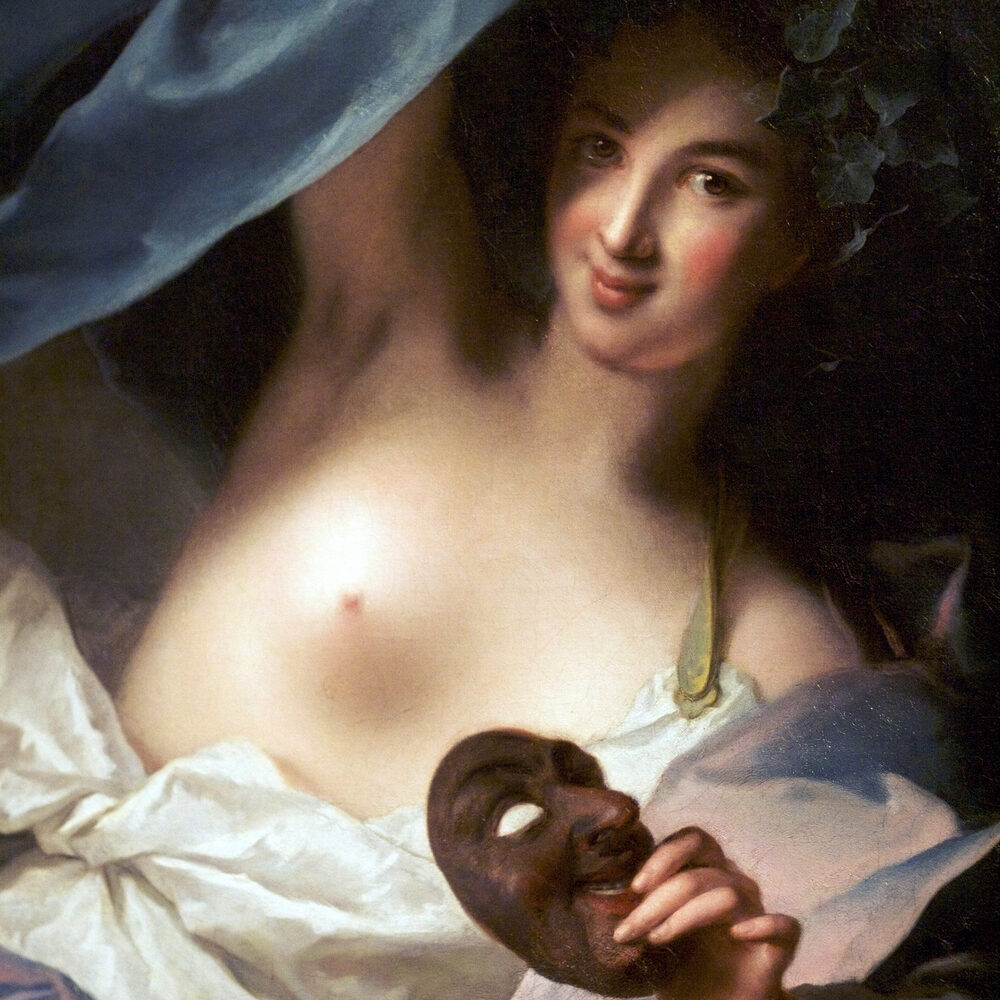
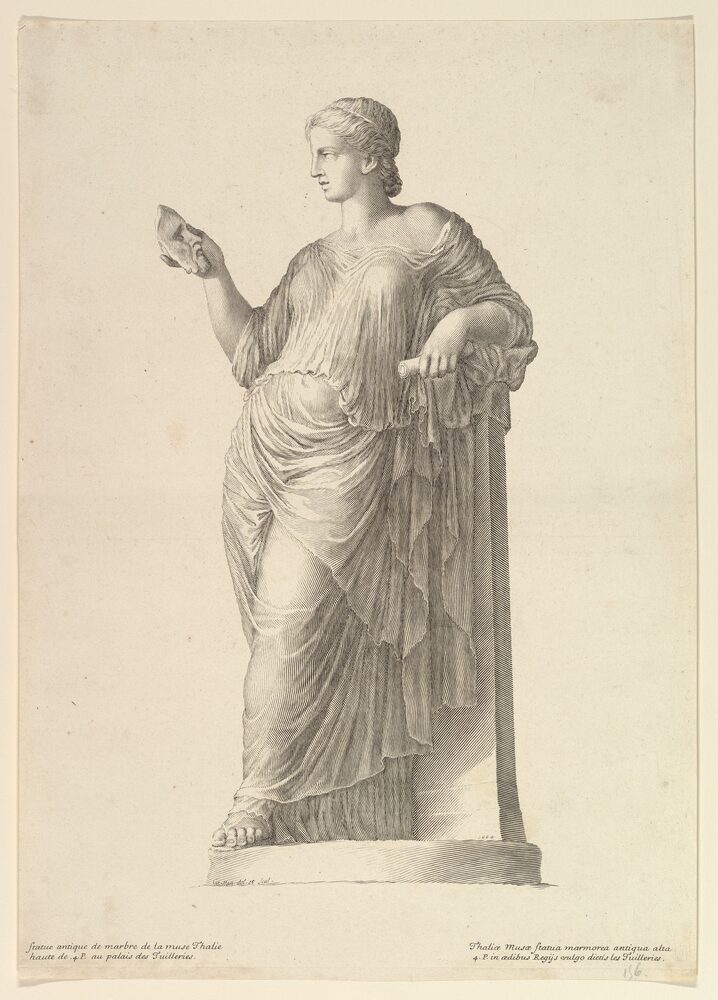
Thalia (thuh-LY-uh), in Greek Θάλεια (Thaleia), is one of the nine Muses, the daughters of Zeus and Mnemosyne (Memory), and in the systematised tradition of the later ancient world she is the Muse of comedy — and, in the fuller scheme, of idyllic, bucolic, or pastoral poetry, the green verse of shepherds and the countryside. Her name means "the blooming, festive one," from the verb thallein, "to bloom, to flourish, to be luxuriant": she is the flourishing sister, the one of growth and good cheer, and no art suited that name better than the festive, life-affirming art of comedy. Her emblem is the one by which she is still known — the grinning comic mask, held up as the laughing counterpart to the tragic mask of her sister Melpomene — together with the shepherd's crook and a wreath of ivy that mark her patronage of pastoral song.
Like each of her sisters, Thalia has her own page in this encyclopedia, but it should be said plainly at the outset that the individual Muses are sparely attested: the early poets treat the nine as a single choir and tell no separate stories of Thalia alone, and the neat assignment of comedy to her is a late systematisation (clearest in Diodorus Siculus). What little myth attaches to her name as a person is a single genealogical thread — she is named as the mother of the Corybantes by Apollo — and that is nearly all. A caution belongs here too: the name Thalia was borne by at least two other, entirely separate figures of Greek myth — one of the three Graces and one of the sea-nymphs called Nereids — and the three are often confused. They are set apart clearly below.
Mythology
Her name, and the late scheme of one art each
In the oldest poetry Thalia is simply a name among the nine. Hesiod names her in the Theogony (77) with no office of her own, and for centuries the Muses were sung as one choir with one voice, not as nine specialists each with her instrument and emblem. The familiar picture — Calliope with her writing-tablet, Clio with her scroll, Melpomene with the tragic mask, and Thalia with the comic mask — is a later systematisation, set out most clearly by Diodorus Siculus (4.7) and elaborated by the grammarians and artists of the Hellenistic and Roman ages. It is to that late scheme that Thalia owes her identity as the Muse of comedy; the early tradition would not have known it.
But the assignment, late as it is, was beautifully apt, and that is why it stuck. Her name, Thaleia, comes from thallein, "to bloom, to flourish, to abound" — the word of green shoots and luxuriant growth and festive plenty. A goddess so named was the natural patron of the festive, flourishing, life-affirming kind of poetry: of comedy, which ends not in death but in feasting and marriage and the renewal of the world, and of the bucolic or pastoral verse of shepherds and the green countryside. So "the flourishing one" became the Muse of laughter and of the growing world, and took as her emblems the laughing comic mask, the shepherd's crook, and the wreath of ivy — the ivy that is green through the year, and that belonged also to Dionysus, in whose festivals comedy was performed.
Her one thread of myth: mother of the Corybantes
Set apart from her role among the nine, Thalia the Muse has essentially one story of her own, and it is a matter of genealogy rather than narrative. Apollodorus (Bibliotheca 1.3.4) records that the Corybantes — the armed, dancing, clashing attendants of the great mother-goddess Cybele (identified with Rhea), who leapt and drummed and beat their shields in her ecstatic rites — were the children of Apollo and the Muse Thalia. It is a brief and isolated notice, giving no tale of courtship or of the sons' deeds under their mother's name, only the parentage; but it is the one genealogical thread that belongs to this Muse as an individual, and it ties the festive, flourishing goddess, fittingly, to the wild dancing worship of the mountain mother. Beyond this, Thalia the Muse is known chiefly and almost only as one of the nine, and honesty requires saying so: her myth, as a separate person, very nearly begins and ends here.
The three Thalias — a caution against confusion
The name Thalia (Thaleia) — "the blooming, flourishing one," a natural name of plenty and good cheer — was borne by at least three entirely separate figures of Greek myth, who are constantly confused precisely because they share it. They should be kept apart:
Thalia the Muse — the subject of this page: one of the nine daughters of Zeus and Mnemosyne, the Muse of comedy and of pastoral verse, named by Hesiod in the Theogony (77).
Thalia the Grace (Charis) — one of the three Charites or Graces, the goddesses of beauty, joy, and festivity. Apollodorus (1.3.1) names the three Graces as Aglaia, Euphrosyne, and Thalia, daughters of Zeus and the Oceanid Eurynome (so Hesiod, Theogony 907–911). This Thalia is a sister of the Graces, not of the Muses, and has a different mother; she shares with the Muse only the lovely, flourishing name.
Thalia the Nereid — one of the fifty daughters of the sea-god Nereus and the Oceanid Doris, the sea-nymphs called Nereids. A Thaleia appears among the Nereids listed by Hesiod (Theogony 245) and Homer (Iliad 18.39–49). She is a creature of the sea, wholly distinct from both the Muse and the Grace.
These are three different goddesses with three different parentages — a Muse, a Grace, and a sea-nymph — and nothing but the shared name connects them. Where an ancient source or a modern writer speaks of "Thalia," it is worth asking which one is meant; this page is about the first, the Muse.
Worship — Ancient
Honoured among the nine
Thalia had little or no cult of her own apart from her sisters; she was worshipped as one of the nine Muses, within the shared cult of the choir. That worship clustered on the Muses' sacred mountains and in the places where song and learning were pursued — above all in the Valley of the Muses on Mount Helicon in Boeotia, below the springs Hippocrene and Aganippe, where the town of Thespiae kept the sanctuary and held the great festival of the Mouseia, with its contests of poetry and music (Pausanias 9.29–31 describes the grove and the statues of the nine). The offerings were the Muses' gentle ones: libations of clear spring-water, honey and first-fruits, and above all a song or poem made and performed in their honour. Her worship was also the daily invocation with which poets opened their work, calling on the Muse to sing, and the keeping of a shrine of the Muses — a mouseion — at the heart of the philosophical schools and, grandest of all, in the great Museum of Alexandria.
The comic stage and the festivals of Dionysus
Thalia had, besides, one particular tie that was hers more than her sisters': her bond with comedy drew her into the orbit of the theatre and so of the festivals of Dionysus, at which comedy was performed. In classical Athens comic plays were staged in the god's great civic festivals — the City Dionysia and especially the Lenaia — as formal contests between poets, in the very theatre sacred to Dionysus. Though it was Dionysus, not Thalia, who presided over those festivals, the later tradition that made her the Muse of comedy set her, in spirit and in the imagination of the poets, as the inspiring presence behind the comic stage; and the ivy that was her emblem was Dionysus's own plant. To honour the comic art was, in the systematised understanding, to honour Thalia.
Worship — Modern
The enduring mask of comedy
Thalia's clearest legacy is an image the whole world still reads at a glance: the smiling comic mask, paired with the weeping tragic mask of her sister Melpomene, as the universal symbol of the theatre itself. The two masks together — "comedy and tragedy" — mark playhouses, drama schools, programmes, and awards across the world, and in them Thalia survives as the very personification of comedy: of laughter, of the festive and life-affirming kind of drama that ends in reconciliation and renewal rather than in ruin. Few of the individual Muses kept so vivid and so recognisable an afterlife; wherever the grinning mask hangs beside the grieving one, Thalia is there.
Honouring Thalia today
A modern devotee drawn to Thalia honours her best in the key of her own art — the festive and the flourishing. To write, perform, or simply enjoy a comedy; to make something that lifts the heart and ends in laughter rather than grief; to take delight in the green and growing world her name describes — any of these is a truer offering to her than incense alone. Following the ancient shape of the Muses' cult, one might pour a libation of clear water (recalling their springs), light a candle, and dedicate the work — the play, the joke, the light verse, the pastoral — to Thalia before beginning, asking the blooming one for good cheer and a sure comic touch. To keep faith with Thalia is to keep making things that flourish and that make others glad.
Epithets & Cult Titles
- Θάλεια (Thaleia) — "the blooming, festive one" — Her name is her nature: from thallein, "to bloom and flourish," she is the green and abundant Muse, the one of flowering good cheer. It is a name of growth and plenty, and when the nine came to be assigned their several arts it was fitting that the flourishing sister took comedy, the festive and life-affirming kind of song
- Heliconian / Pierian Maiden, daughter of Memory — Like all her sisters she is a Muse of Mount Helicon in Boeotia and of Pieria north of Olympus, a daughter of Zeus and of Mnemosyne (Memory); in the earliest poetry she is named not as a separate goddess with her own myths but simply as one of the nine, the choir born of memory that makes song possible (Hesiod, Theogony 77)
- Muse of Comedy (and of pastoral verse) — By the systematised reckoning of the later age (Diodorus Siculus 4.7), Thalia is the Muse who presides over comedy — and, in the fuller scheme, over idyllic, bucolic, or pastoral poetry, the green poetry of shepherds and the countryside. Her emblems are the laughing comic mask, the shepherd's crook, and the wreath of ivy
Sources & Variants
- Hesiod, Theogony 77–79 (the naming of the nine Muses, Thalia among them); 1–115 (the birth of the Muses to Zeus and Mnemosyne in Pieria, and their office of song); 245 (a Thaleia among the Nereids); 907–911 (the three Graces, daughters of Zeus and Eurynome)
- Apollodorus, Bibliotheca 1.3.1 (the nine Muses, daughters of Zeus and Mnemosyne; and separately the three Graces — Aglaia, Euphrosyne, and Thalia — daughters of Zeus and Eurynome)
- Apollodorus, Bibliotheca 1.3.4 (the Corybantes as the children of Apollo and the Muse Thalia)
- Diodorus Siculus, Library of History 4.7 (the systematic account of the nine Muses and the several arts assigned to each — the source for Thalia as Muse of comedy)
- Homer, Iliad 18.39–49 (the catalogue of the Nereids, a Thaleia among them)
- Pausanias, Description of Greece 9.29–31 (the Valley of the Muses and the sanctuary on Helicon; the springs; the statues and number of the nine Muses)
Gallery