Euterpe
First Appearance
Euterpe first appears, with her sisters, in the oldest poem about the gods, where Hesiod names all nine of the Muses in a single breath. Having told how Mnemosyne bore them to Zeus in Pieria, he lists them in order (Theogony 77–79): "Kleio and Euterpe and Thalia and Melpomene, Terpsichore and Erato and Polymnia and Urania, and Kalliope — she is the chiefest of them all." Euterpe is named second, between Clio and Thalia; Hesiod gives her no separate story and no single art, for in the earliest tradition the nine sing together as one choir. Her name alone speaks: Euterpe, "the well-pleasing," the giver of delight.
— Hesiod, Theogony 77–79 (the naming of the nine Muses)
Who They Are
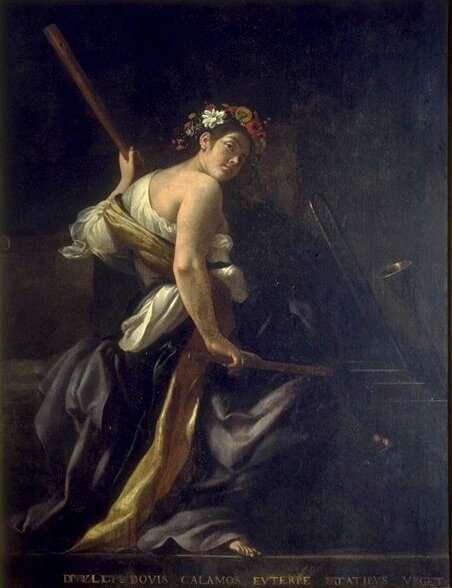
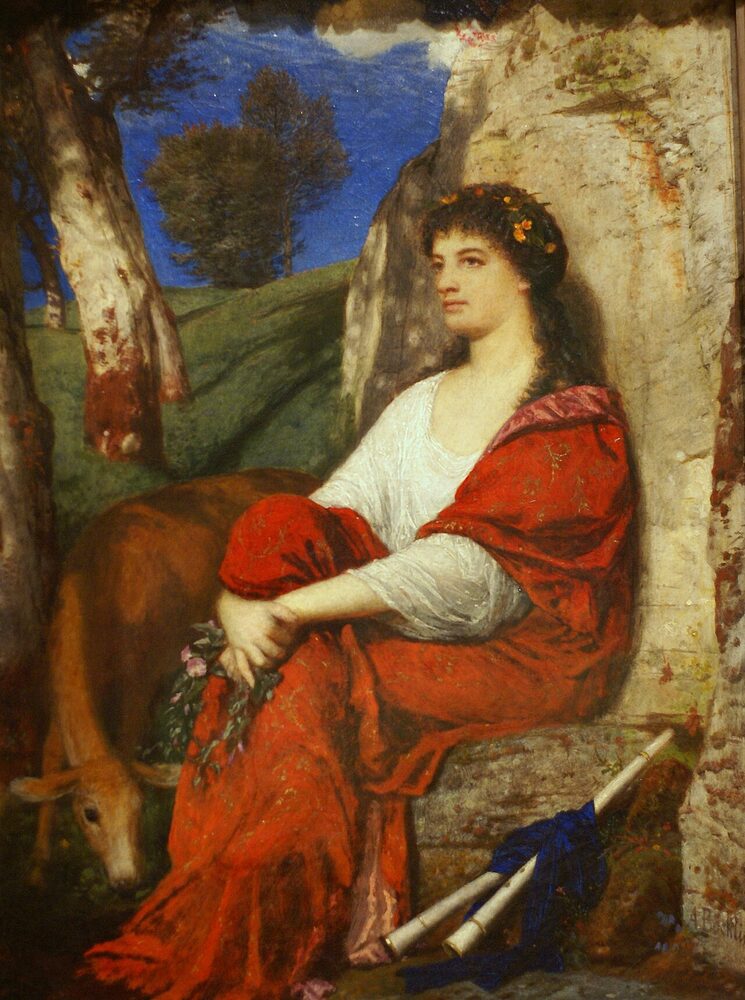
Euterpe (yoo-TUR-pee), in Greek Εὐτέρπη, is one of the nine Muses, the goddesses of poetry, song, and the arts born to Zeus and Mnemosyne (Memory). Her name means "the well-pleasing one" or "giver of delight" — from eu, "well," and terpein, "to please" — and in the later tradition that assigned each of the nine her own province, she became the Muse of music and of lyric song, associated above all with the aulos, the double flute or double-pipe. In art she is the flower-crowned Muse who holds or sounds the paired reeds, and her gift is named in her name: the sweet pleasure that well-made music gives to the ear and the heart.
It is worth saying plainly, as it must be said of each of the nine, that Euterpe as an individual is a sparse figure. The early poets, from Hesiod onward, treat the Muses as a single choir and tell no separate tale of her; the tidy "one art each" scheme by which she owns the flute is a late systematisation, firmest in the Roman age. Apart from that emblem she has only a single, uncertain genealogical thread — the tradition that names her, in some accounts, as the mother of the Thracian king Rhesus. She is known, honestly, chiefly as one of the nine, and this page keeps that honesty: her fuller story is the story of the Muses together, to which this is a companion. (For the choir as a whole — their birth, their springs on Helicon and in Pieria, their contests, and the invocation — see the Muses' own page.)
Mythology
Her name, and the late division of the arts
In the beginning Euterpe has no art of her own. Hesiod names her second of the nine (Theogony 77), but neither he nor any early poet gives her a separate domain; the Muses sing together, "all of one mind," and their gift is undivided. The familiar scheme by which each Muse owns a particular art — Calliope epic, Clio history, Euterpe music and the flute, and so on — is a later systematisation, not found whole until the Hellenistic and Roman ages; Diodorus Siculus (4.7) gives an early systematic account of the nine and their assigned arts, and the full, fixed scheme belongs to Roman handbooks and later. What held Euterpe to music was her name: Εὐτέρπη, "the well-pleasing," the giver of delight — a name so clearly made for the sweet pleasure of song that the later arrangers could hardly have given her any other province. So the etymology became the office: she who delights became the Muse of the music that delights.
The Muse of the aulos — and the question of who made it
Euterpe's chief emblem is the aulos, the double flute or double-pipe — not a soft breathy flute like ours but a pair of reed-pipes played together, the keen, carrying wind-music of the Greek festival, the drinking-party, and the theatre. In the painted and sculpted tradition she is shown crowned with flowers, the paired pipes in her hands or at her lips, and she stands for the pleasure that such music gives. Some later sources go further and credit Euterpe herself with inventing the aulos, or the double-pipe — a late and attributed tradition rather than an old or firm one, and it sits awkwardly beside the much better-known myths of the instrument's origin. For the standard tale was quite different: the aulos was said to have been invented by Athena, who then threw it away in disgust when she saw in a reflection how it puffed and distorted her cheeks; the discarded pipes were taken up by the satyr Marsyas, whose over-proud mastery of them led to his fatal musical contest with Apollo. The attribution to Euterpe is best understood as a product of the later system — the natural wish to give the Muse of flute-music a share in the flute's beginning — and is flagged here as the minor, late tradition it is.
The one thread: mother of Rhesus?
Euterpe's single genealogical story — and even this is disputed — is that she may be the mother of Rhesus, the Thracian king who came late to the Trojan War as an ally of Troy and was killed in a night raid by Diomedes and Odysseus (the famous "Doloneia," Iliad 10). The tradition made Rhesus the son of the river-god Strymon of Thrace by one of the Muses, but it could not agree which Muse: Apollodorus (Bibliotheca 1.3.4) records the uncertainty directly, naming Euterpe — or, as some said, Calliope, or again Terpsichore — as his mother. In Euripides' tragedy Rhesus, his mother is a Muse who appears at the play's end to mourn her slain son and lift his body away, but the play leaves her unnamed, so that the specific identification with Euterpe rests on the mythographers and scholia rather than on the drama. This is the one place the individual Euterpe steps, faintly, into narrative — and even here the sources name more than one mother, so her claim to Rhesus is only one reading among several. Beyond it she has no consorts and no children that the tradition firmly assigns her; she is, in the end, one of the nine.
Worship — Ancient
Worshipped among the nine
Euterpe had no separate cult of her own: she was honoured, as each of the Muses was, as part of the choir of nine. Their worship clustered on their sacred mountain — the Valley of the Muses on Mount Helicon in Boeotia, below the springs Hippocrene and Aganippe, where the town of Thespiae kept a sanctuary set with statues of all nine and held the great festival of the Mouseia, with its contests of poetry and music. Pausanias (Description of Greece 9.29–31) saw the grove, the springs, and the statues of the Muses when he toured Boeotia, our best witness to the living cult. Beyond the mountain the Muses were honoured wherever learning and the arts were pursued — in the mouseion, the shrine of the Muses at the heart of a philosophical school or library — and above all in the poet's and musician's invocation, the calling-upon of the Muse at the start of a song. To these shared rites Euterpe belonged with her sisters, receiving the offerings fitting to the givers of song: libations of clear spring-water, honey, and the dedication of music and verse.
The Muse of pipers and musicians
If Euterpe had a special constituency within that shared worship, it was among musicians and pipers — the players of the aulos whose art she came, in the later scheme, to preside over. The aulos was the instrument of the festival procession, the sacrifice, the drinking-song, and the theatre chorus, and the countless professional pipers of the Greek world looked, in the ordered later understanding, to the Muse of the flute. To honour Euterpe was to honour the sweet pleasure of played music itself — the particular delight, named in her name, that a well-sounded pipe gives to those who hear it.
Worship — Modern
Euterpe, emblem of music
Euterpe's lasting legacy is as a personification: she has become, across European art and letters, a standing emblem of music itself. Where her sisters came to signify tragedy, history, or astronomy, Euterpe with her double flute signifies song and melody, and her figure recurs — flower-crowned, pipes in hand — on title-pages, in concert halls, in painting and poetry, wherever the art of music is to be given a face. Her name has lent itself to musical societies, choral and operatic companies, and concert series down the centuries; to invoke "Euterpe" is, by a convention centuries old, simply to invoke music under its oldest and loveliest name.
Honouring her today
A modern devotee drawn to Euterpe honours her best in the key of her own art — through music. One might play or compose a piece, sing, or take up an instrument in her name; following the ancient shape, one might pour a libation of clear water (recalling the Muses' springs), and dedicate the work — the tune made, the song learned, the playing practised — to her before beginning. The offering most fitting to the giver of delight is delight made and shared: a melody played with care, given as the daughters of Memory were always given song in return for song. To keep faith with Euterpe is to keep making music, and to let it please.
Epithets & Cult Titles
- Εὐτέρπη (Euterpe) — "the Giver of Delight" — Her name is itself her truest title: "the well-pleasing one," she who delights and gladdens through music. To the Greek ear the name promised exactly what the Muse gives — the sweet pleasure of a tune well played
- Μοῦσα αὐλῶν (Mousa aulōn) — "Muse of the Flute," Muse of Music — In the later scheme that gave each of the nine her own art, Euterpe became the Muse of music and especially of the aulos, the double-pipe; so she is shown in art crowned with flowers and holding or sounding the double flute
- Heliconian and Pierian Maiden, daughter of Memory — Like all her sisters she bears the shared titles of the choir: one of the Ἑλικωνιάδες (Heliconiades), the Muses of Mount Helicon, and of the Πιερίδες (Pierides), the Muses of Pieria where they were born — a daughter of Mnemosyne (Memory) and of Zeus, and so a sister of song
Sources & Variants
- Hesiod, Theogony 77–79 (the naming of the nine Muses, Euterpe second in the list); 1–115 (the birth of the Muses to Zeus and Mnemosyne in Pieria, and the undivided choir of the early tradition)
- Apollodorus, Bibliotheca 1.3.4 (the Muses; Rhesus as son of Strymon and a Muse — named as Euterpe, or by some Calliope, or again Terpsichore — recording the disputed parentage)
- Euripides, Rhesus (esp. 890–982) (Rhesus the Thracian ally of Troy, slain by Diomedes and Odysseus; his mother, an unnamed Muse, appears to mourn him — the drama behind the variant parentage)
- Homer, Iliad 10 (the 'Doloneia': the night raid of Diomedes and Odysseus and the killing of Rhesus and his men); 2.594–600 and scholia (the Muses and Thracian singers)
- Diodorus Siculus 4.7 (a systematic account of the nine Muses and the arts assigned to each) — the source for the later 'division of labour' by which Euterpe became the Muse of music and the flute
- Pausanias, Description of Greece 9.29–31 (the Valley of the Muses and the sanctuary on Helicon; the springs, and the statues of all nine Muses; the number and names of the Muses)
- Pseudo-Plutarch, On Music, and the Marsyas tradition (the aulos as the invention of Athena, cast aside and taken up by Marsyas) — the standard counter-tradition to the late attribution of the double-pipe to Euterpe
Gallery