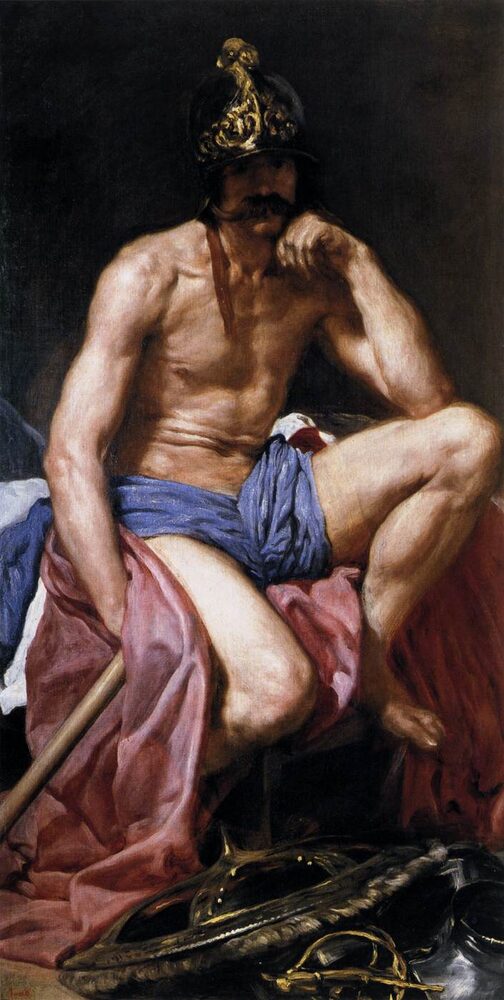
Ares
First Appearance
Ares first appears in the catalogue of Zeus's marriages, where Hesiod names him among the three children born to the king of gods and men by his lawful wife Hera: "she, joined in love with the lord of gods and men, brought forth Hebe and Ares and Eileithyia." So the war-god enters the tradition not as a Titan's spawn or a monster, but as the trueborn son of the two highest Olympians — a legitimacy that makes the gods' later contempt for him all the sharper.
— Hesiod, Theogony 921–923
Who They Are
Ares (AIR-eez) is the Greek god of war — but of a particular face of war: the raw fury of the melee, the courage that carries a man into the spear-line, and the blood-lust of the killing-ground itself. Where his half-sister Athena presides over strategy, discipline and the just defence of the city, Ares is battle in its rawest form: the roar, the press of shields, the wound. Hesiod makes him the trueborn son of Zeus and Hera, and his children Phobos ("Rout, Fear") and Deimos ("Terror") ride at his chariot-wheels, with grim Enyo and Eris ("Strife") for company, so that dread itself attends him onto the field.
The Greeks were famously wary of him. In the Iliad his own father Zeus tells him to his face that he is the most hateful of all the gods of Olympus, and the poets dwell on his recklessness — a god who can be wounded by a mortal and who bellows in pain like ten thousand men. Yet this disdain is only half the portrait. In cult Ares wears a very different aspect: at Tegea he is Gynaikothoinas, the god the women honoured for their own victory, and Aphneios, "the abundant," who nursed his orphaned child. His defining myth is not a rampage but a father's defence of his daughter against a rapist — the act that gave Athens its ancient murder-court its name.
He is, then, a god of two faces: the hated bringer of slaughter the Greeks prayed to be spared, and the fierce protector and avenger — above all of women — whose courage they could not do without when the enemy was at the gate. (Rome would take a very different view: where the Greeks largely disdained Ares, Rome revered his counterpart Mars as a dignified father of the nation and second only to Jupiter.)
Mythology
The most hated of the gods
Hesiod names Ares among the trueborn children of Zeus and Hera (Theogony 921–923), yet from his first great appearance the tradition marks him as an outsider on Olympus. In the Iliad he fights for Troy, changes sides on a whim, and revels in slaughter for its own sake. When at last he is wounded and comes wailing to his father for sympathy, Zeus turns on him with open loathing: "To me you are the most hateful of all the gods who hold Olympus, for ever strife is dear to you, and wars and battles" (Iliad 5.890–891). No other Olympian is spoken to so bitterly by the king of heaven. This is the paradox the Greeks built into their war-god: legitimate son of the two highest gods, and yet the one they could least bring themselves to love.
Caught in the invisible net
The most famous humiliation of Ares is sung by the bard Demodocus at the Phaeacian court (Odyssey 8.266–366). Ares and golden Aphrodite, wife of the lame smith-god Hephaestus, became lovers in secret — until Helios the all-seeing sun told Hephaestus of the affair. The craftsman forged a net of chains finer than spider-silk and invisible even to the gods, and hung it over his marriage-bed. When the lovers lay down together, the mesh dropped and bound them fast, naked and helpless. Hephaestus summoned the other gods to witness his shame and demanded his bride-price back; the male gods crowded in and burst into unquenchable laughter at the sight of the two most warlike and beautiful of immortals trapped in the smith's cunning snare. Only when Poseidon pledged to pay the fine was Ares released, to flee in disgrace to Thrace.
Wounded by a mortal at Troy
For all his ferocity, Ares is strikingly vulnerable in Homer. In the great fifth book of the Iliad, the hero Diomedes — with the goddess Athena herself climbing into his chariot and guiding his hand — drives a bronze spear into the war-god's belly (Iliad 5.855–863). Ares roars with the voice of ten thousand men, and both armies shudder; but rather than press on, the god flees bellowing up to Olympus to show Zeus his wound and complain of Athena's meddling. That a mortal, even god-aided, can spear the lord of war and send him weeping home is the poem's sharpest verdict on him: courage and fury are not the same as wisdom, and undisciplined violence can be brought low.
Bound in the bronze jar
An older tale of the war-god's helplessness is told by the goddess Dione (Iliad 5.385–391). The giant twins Otus and Ephialtes, the Aloadae, sons of Poseidon, once overpowered Ares and shut him up in a bronze jar, where he lay bound for thirteen months. He would have wasted away and perished there — even the god of war — had not the giants' stepmother Eriboea told Hermes what they had done. Hermes stole him out of the jar in secret, already worn down by his cruel imprisonment. It is a strange, telling story: the immortal embodiment of battle, undone not in open war but by cunning and confinement.
The first murder trial — the Areopagus
Ares's defining myth is the defence of his daughter. (Content note: this story turns on an attempted sexual assault.) By Agraulos he had a daughter, Alcippe. Halirrhothius, a son of Poseidon, tried to rape her; Ares caught him in the act and killed him (Apollodorus 3.14.2). Poseidon, enraged at his son's death, hauled Ares before a tribunal of the twelve gods on a hill in Athens. There Ares was tried — and acquitted — in what the Greeks remembered as the very first trial for bloodshed, the founding of justice over vendetta. The hill kept his name ever after: the Areopagus, the "Hill of Ares," where Athens's most solemn homicide court would sit for centuries. It is the myth that most complicates the one-note war-god: here Ares is a father and an avenger, a killer in defence of his child rather than for slaughter's sake.
A father to his own
The defence of Alcippe is the sharpest instance of a wider pattern: for all his cruelty on the field, Ares is fierce in the protection of his children. When his son Cycnus was slain, the war-god did not go to a tribunal but turned his fury on the killer himself — to avenge Cycnus he rushed against Heracles in single combat, and was wounded in the thigh and carried up to Olympus by his own sons (Hesiod, Shield of Heracles 416–466). His blood ran, too, in children set at the wild edges of the Greek world: Harmonia, his daughter by Aphrodite, whom he gave in marriage to Cadmus; the warrior-queens of the Amazons — Hippolyta and Penthesilea among them — whom tradition counted his daughters; and hard sons such as Diomedes of Thrace, keeper of the man-eating mares, and his dread attendants Phobos and Deimos. Grim as his brood could be, one thread runs unbroken through the myths: to wrong a child of Ares was to answer to Ares, and above all it was his daughters he rose to avenge.
The dragon of Thebes
Ares's shadow also falls across the founding of Thebes (Apollodorus 3.4.1). When Cadmus sought water to found his city, he sent his men to a spring guarded by a great serpent — the offspring of Ares — which devoured them. Cadmus slew the dragon, and on Athena's advice sowed its teeth in the earth; from the furrows sprang up armed men, the Spartoi ("Sown Men"), who fell at once to fighting and killed all but five of their own number. Because the serpent had been sacred to Ares, Cadmus had to atone for the killing by serving the war-god as a bondsman for what Apollodorus calls an "everlasting year" — reckoned in antiquity as eight of ours (Apollodorus 3.4.2). From Cadmus and Harmonia — the daughter of Ares and Aphrodite — the royal line of Thebes descended, so that the war-god's blood ran in the city he had cursed.
Worship — Ancient
Ares and the women of Tegea
Ares was worshipped unevenly across Greece, but nowhere more strikingly than in Arcadian Tegea, where his cult is bound up with the deeds of women. In the marketplace stood a relief image of Ares called Gynaikothoinas, "Feaster of Women." Pausanias explains the name (8.48): when Charillus, king of Sparta, first invaded Tegean territory, the women armed themselves and lay in ambush; when the armies met, the women fell on the Spartans and routed them. Afterward the women offered a victory sacrifice to Ares on their own account, and gave the men no share of the meat. This is a wholly different Ares from Homer's hated brawler — a war-god claimed by women as the patron of their own courage. Nearby, on Mount Kresios, he was honoured as Aphneios, "the Abundant" (Pausanias 8.44): the god had loved Aerope, daughter of Cepheus, and when she died bearing his son Aëropus, Ares caused the dead mother's breast to give milk so the child might live — a myth of the war-god as an unexpected sustainer of life.
The Areopagus at Athens
At Athens, Ares's chief association was with the rocky hill beside the Acropolis that bore his name — the Areopagus, the "Hill of Ares," where the god had stood trial for the killing of Halirrhothius (Apollodorus 3.14.2). The ancient homicide council that met there was felt to descend from that first divine tribunal, tying the raw war-god, however loosely, to the origins of Athenian justice and the replacement of blood-vengeance by law.
Ares Theritas at Sparta
Where Athens kept him at arm's length, warlike Sparta gave Ares a place more fitting his nature. On the road to Therapne outside Sparta stood a very old sanctuary of Ares Theritas, "the Brutal" (Pausanias 3.19.7–8), holding an archaic cult-image the Spartans believed the Dioscuri had carried home from Colchis. The surname, Pausanias suggests, was given because a man facing an enemy in battle must cast aside all gentleness — a fitting creed for the city that made war its whole way of life. Elsewhere his offerings befitted his domain: a share of the spoils of victory, the blood of sacrifice, and burnt meat shared among fighting men.
Ares in Thrace
Beyond the Greek mainland, Ares was most at home among the Thracians of the wild north, whom Homer names as especially dear to him and to whose land the god withdrew after his humiliations on Olympus (Odyssey 8.361). Herodotus records that the Thracians worshipped only three gods — Ares, Dionysus, and Artemis (Herodotus 5.7) — so that the Greeks came to imagine Thrace as the true homeland of the lord of battle, and Ares himself was often called a Thracian god.
Worship — Modern
Honouring Ares today
A modern Hellenic devotee can honour Ares while setting aside the caricature of the mindless war-god. He is called upon today not for aggression but for courage — the steadiness to face what must be faced, the strength to defend oneself and those in one's care. A simple shrine bearing a spear, a helmet, or a plain image of the god, with a lamp or candle, gives him a place in the home. Approach him with honesty and firmness rather than fear; he is a god who respects directness. Many modern worshippers are drawn especially to his aspect as protector and avenger of the wronged — the father who defended Alcippe, the god the women of Tegea claimed as their own.
Offerings
Where the ancients gave the blood of sacrifice and a share of the spoils, a household devotee today offers what stands in for them: a libation of wine (or of water), and a portion of a shared meal, especially of meat — for Ares was a god honoured among comrades who feasted together. Present the offering plainly, with a few words of respect for his courage and his protection, and set it aside afterward so that it is truly the god's.
Prayer & epithets
Call on Ares by the aspect that fits your need. Invoke him as Enyalios, the warlike, when you must summon courage for a hard confrontation. Turn to Ares Gynaikothoinas, the god the women claimed, in honouring the strength and defence of women. Call on him as the avenger of the Areopagus when seeking justice against those who have done harm. And in daily reverence, honour the fierce, maligned, but faithful protector who stands between his own and the enemy at the gate.
Epithets & Cult Titles
- Enyalios (Ἐνυάλιος) — The warlike — an ancient battle-title so bound to Ares that it often stood as a name for the god in its own right
- Brotoloigos (Βροτολοιγός) — Bane of mortals — Homer's standing epithet for the war-god as the destroyer of men
- Andreiphontes (Ἀνδρειφόντης) — Slayer of men — the manslaughtering lord of the killing-ground
- Miaiphonos (Μιαιφόνος) — Blood-stained, defiled with slaughter — Homer's name for the polluting butchery of war
- Gynaikothoinas (Γυναικοθοίνας) — Feaster of women — honoured at Tegea by the women who once routed the Spartans and sacrificed to him alone
- Aphneios (Ἀφνειός) — The abundant, giver of plenty — worshipped on Mount Kresios near Tegea, where he nourished his infant son at a dead mother's breast
- Theritas (Θηρίτας) — The brutal, the beastly — his ancient Spartan title, said to be named for Thero, the nurse who reared him
Sources & Variants
- Hesiod, Theogony 921–923 (Ares born to Zeus and Hera); 933–937 (Ares and Aphrodite parents of Phobos, Deimos, and Harmonia)
- Homer, Iliad 5.385–391 (Ares bound in the bronze jar by the Aloadae); 5.855–863 (Diomedes wounds Ares with Athena's help); 5.890–891 (Zeus calls Ares the most hateful of the gods)
- Homer, Odyssey 8.266–366 (Demodocus' song: Ares and Aphrodite caught in Hephaestus's net)
- Apollodorus, Bibliotheca 3.14.2 (Ares kills Halirrhothius, is tried on the Areopagus); 3.4.1–2 (Cadmus, the dragon of Ares, the Spartoi, and the years of servitude)
- Pausanias, Description of Greece 8.48 (Ares Gynaikothoinas and the women of Tegea); 8.44 (Ares Aphneios on Mount Kresios); 3.19 (Ares Theritas at Sparta)
- Hesiod, Shield of Heracles 416–466 (Ares fights Heracles to avenge his slain son Cycnus, and is wounded)
- Herodotus, Histories 5.7 (the Thracians worship only Ares, Dionysus, and Artemis; their kings, by contrast, honour Hermes above all); Homer, Odyssey 8.361 (Ares withdraws to Thrace)
- Homeric Hymn 8 to Ares
Gallery