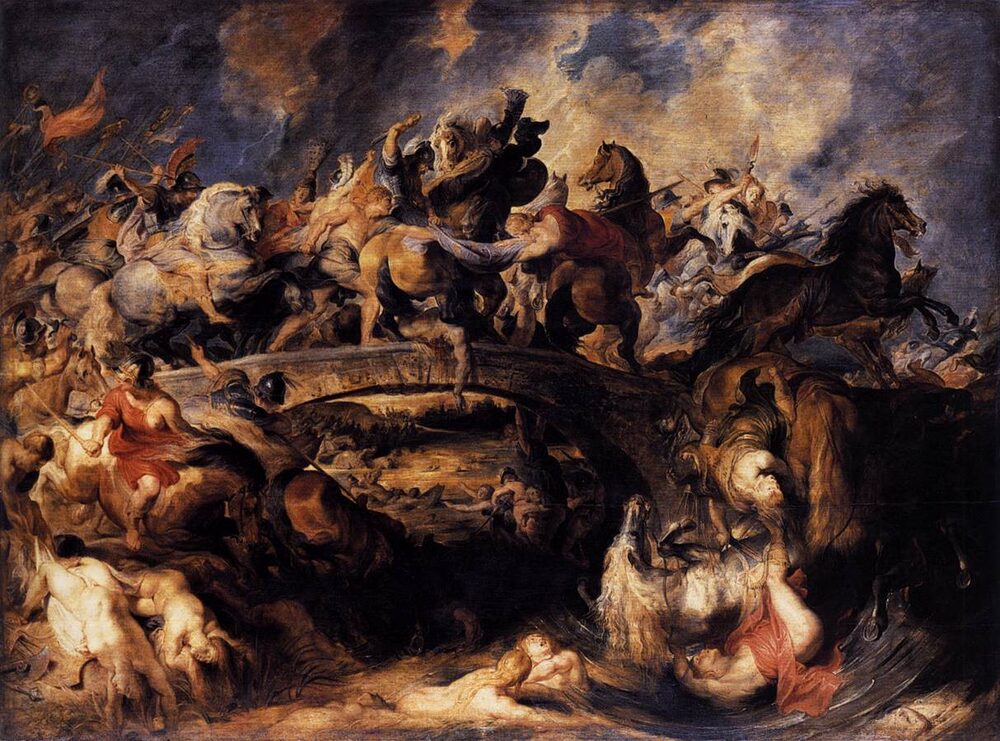
Amazones
First Appearance
The Amazons enter Greek literature already as a byword for women who fight. In the Iliad the aged Priam recalls how in his youth he marched with the Phrygians on the river Sangarios in the day "when the Amazons came, the equals of men" (Amazones antianeirai, 3.189); and Glaucus tells how his ancestor Bellerophon was sent to fight and slaughter "the Amazons, the equals of men" (6.186). Homer never describes them further — he assumes his audience already knows the warrior-women of the edge of the world — and it is that standing epithet, antianeirai, "the equals of men," that fixes their place in Greek imagination from the very beginning.
— Homer, Iliad 3.189 and 6.186
Who They Are
The Amazons (AM-uh-zonz; Greek Ἀμαζόνες, Amazones) are the warrior-women of Greek myth — a whole nation of women who governed themselves, rode to war, and lived at the far edge of the world the Greeks knew, on the river Thermodon by the Black Sea in what is now northern Turkey. They are the great mythic image of women who do what Greek women were forbidden to do: bear arms, rule without kings, and meet men in battle as equals. Homer already calls them antianeirai, "the equals of men," and every later Greek treated them as a real people once encountered on the rim of the map, daughters of the war-god Ares himself. (Roman writers keep the Greek name unchanged, Amazones.)
A warning about the most famous "fact" about the Amazons, because it is false. The Greeks themselves invented a folk-etymology for the name, splitting it into a-mazos, "without breast," and telling a story to match: that the Amazons seared or cut off one breast in girlhood so it would not hinder the drawing of a bow or the throwing of a spear. This is almost certainly wrong. Greek artists, who painted and carved the Amazons in their thousands, always show them with both breasts intact; no ancient image supports the mutilation the etymology imagines. The name is far more likely non-Greek in origin — many scholars connect it to an Iranian word meaning something like "warriors" or "fighting together" — and the "one breast" story is a false explanation the Greeks built backward out of a foreign word they did not understand. It deserves to be named and set aside.
What the Amazons truly were, in the Greek imagination, is the great test-piece of the male hero and the great mirror held up to Greek society. Almost every major hero proves himself against them: Bellerophon fights them, Heracles is sent to take the war-belt of their queen, Theseus carries one of them off and must then defend Athens from their invasion, and Achilles kills their queen Penthesilea beneath the walls of Troy. Whether they stand for a real historical memory of the horse-riding, weapon-bearing women of the Scythian steppe — whose graves archaeologists have since found, buried with their bows — or for a purely mythical inversion of the Greek order of things, the Amazons have never stopped fascinating. They gave their name to a river and to an age's arguments about what women can be.
Mythology
Who they were: the nation on the Thermodon
(Content note: the Amazon myths are war-stories, and turn throughout on killing in battle; this account is frank about that without dwelling on gore.) The Amazons were imagined as a self-governing nation of women, most often placed at Themiskyra on the river Thermodon, on the southern shore of the Black Sea in the region of Pontus (northern Turkey). They were said to be the daughters of Ares, the god of war, and the tradition gave them a divine mother too: Apollonius of Rhodius (Argonautica 2.990–992), sailing his Argonauts past their coast, calls them the daughters of Ares and the nymph Harmonia (Harmonie of the Acmonian wood) — while other tellings make the mother the Amazon queen Otrere. They lived, the Greeks said, without husbands: they consorted with the men of neighbouring peoples only to conceive, kept and raised their daughters, and (in the harsher versions of the story) sent the sons away or did not rear them. They devoted themselves to the two pursuits Greek custom reserved for men — war and the hunt — and honoured Ares and Artemis the huntress above the other gods. Their weapons were the light crescent shield (the pelta), the bow, the short spear, the battle-axe, and above all the horse; the Greeks pictured them in the patterned trousers and pointed caps of the eastern "barbarian," a people of the frontier.
The war-belt of Hippolyta: the Ninth Labour of Heracles
The Amazons enter the great hero-cycles first through Heracles (whose own story is told elsewhere). For his Ninth Labour, Eurystheus sent Heracles to fetch the war-belt — the golden girdle or zoster, a badge of sovereignty given her by Ares — of Hippolyta, queen of the Amazons, because Eurystheus's daughter Admete desired it. Apollodorus (Bibliotheca 2.5.9) tells it thus: Heracles sailed to Themiskyra with a band of companions, and at first the meeting was peaceful. Hippolyta came down to his ship, was taken with the hero, and promised him the belt freely. But Hera, forever Heracles's enemy, went among the Amazons in the disguise of one of their own and spread the alarm that these strangers were carrying off their queen. The Amazons armed and charged down on the ship; Heracles, believing Hippolyta had betrayed him, killed her, took the belt, and fought his way clear. So a bargain that began in goodwill ended, through Hera's malice, in the death of the queen — a pattern the Amazon stories return to again and again, the warrior-woman undone at the moment of meeting a hero.
Theseus and Antiope, and the invasion of Attica
On that same expedition, or on one of his own, Theseus (whose story is told elsewhere) carried off an Amazon — named Antiope in most accounts, though some call her Hippolyta — taking her back with him to Athens. The Amazons did not let the abduction stand. Plutarch (Theseus 26–28), gathering the traditions, tells how a great Amazon army marched all the way from the Thermodon around the Black Sea and down through Greece to Attica itself, and encamped in the very heart of Athens — the fighting, he says, ranged across ground within the later city, near the Areopagus and the Pnyx. This was the Amazonomachy, the battle of Greeks against Amazons, fought this time not on the frontier but at the center of the Greek world. After hard fighting a peace was made, and the Amazons withdrew; Antiope, in the poignant version Plutarch preserves, is said to have fought at Theseus's side against her own people and to have died in the battle. Plutarch adds that in his own day the Athenians still pointed out an Amazon tomb in the city and made offerings to the fallen — the myth left its mark on the map of Athens.
Penthesilea at Troy, and the grief of Achilles
The most moving of all the Amazon stories comes at Troy, and it is not in Homer's Iliad but in the epic tradition that continued it — told fully by Quintus of Smyrna in the Posthomerica (Book 1) and summarized by Apollodorus (Epitome 5.1–2). After Hector was killed, the Amazon queen Penthesilea — daughter of Ares and Otrere — came to Troy with her warriors to fight for the city. She had come, the poets said, partly to be cleansed of the blood of a sister, Hippolyta, whom she had accidentally killed while hunting; she sought death in battle as much as glory. For a day she was terrible in the field, driving the Greeks back, until she came against Achilles (whose story is told elsewhere). He met her in single combat and ran her through with his spear — and then, as he stripped the armour from the warrior he had killed and looked for the first time on her face, Achilles fell in love with her in the very instant of her death, and was pierced with grief for the beautiful, brave woman he had slain by his own hand. The foul-mouthed Thersites jeered at him for mourning an enemy, and Achilles, in a rage, struck Thersites dead. It is one of the strangest and most human moments in all of Greek epic: the greatest of warriors weeping over his greatest victim, love and death arriving together in the same stroke.
The Libyan Amazons and Queen Myrina
Beside the famous Amazons of the Thermodon, Diodorus Siculus (3.52–55) preserves a separate and older tradition of Libyan Amazons in North Africa, ruled by the great queen Myrina. In this account the Libyan Amazons were a nation of women warriors even before the Trojan-era Amazons of Pontus; Myrina led an army of many thousands, conquered widely across North Africa and into the eastern Mediterranean and the Aegean islands, and founded cities that bore the names of her Amazons — including, Diodorus says, a city called Myrina. The island of Lemnos and other places kept traditions tying their foundations to these women. Whether or not any of it is history, it shows that the Greeks did not imagine the Amazons as a single band but as a recurring kind — a whole category of the world's women who lived and ruled and fought as men did, at more than one edge of the known earth.
Herodotus and the making of the Sauromatians
The soberest ancient writer on the Amazons is the historian Herodotus, who tells (4.110–117) not a myth of gods and heroes but what he offers as an ethnographic origin-story. After the Greeks defeated the Amazons at the Thermodon, he says, they carried a shipload of captive Amazons away by sea — but the women rose, killed their captors, and, unable to sail, drifted to the land of the Scythians north of the Black Sea. There the young Scythian men, at first wary, gradually courted them; the Amazons agreed to join them only on the condition that they would not live like ordinary Scythian women, shut to household work, but would keep riding, hunting, and bearing arms as they always had. From that union, Herodotus says, sprang the Sauromatae (Sarmatians) — a real steppe people among whom, he reports, the women still rode to war and hunted alongside the men, and a girl could not marry until she had killed an enemy. It is the ancient world's most striking attempt to ground the Amazon myth in a real people, and modern archaeology of armed female graves on the steppe has given it a startling second life.
Worship — Ancient
Not gods, but a charter-myth in stone
The Amazons were not worshipped as deities — they were a foreign nation of the mythic past, not immortals — but they held a place in Greek civic and religious life out of all proportion to that, because their defeat became one of the master-images of Greek self-understanding. The battle of Greeks against Amazons, the Amazonomachy, was carved and painted on the most important public monuments of Greece as a charter-myth: the victory of Greek order — the city, the law, the rule of men in the polis — over the "barbarian" and the world-turned-upside-down that the Amazons represented. Alongside the battle of gods and Giants (Gigantomachy) and of Lapiths and Centaurs, the Amazonomachy stood for civilization's triumph over chaos, and after the Persian Wars it took on a sharp new charge as a mythic mirror of Greeks-versus-Persians, Europe-versus-Asia.
The Amazonomachy on the great temples
The Amazon battle appears on the flagship monuments of Classical Greece. On the Parthenon at Athens it filled the metopes of the west front and was worked in relief on the outside of the shield of Pheidias's colossal gold-and-ivory statue of Athena Parthenos; it ran along the frieze of the temple of Apollo Epikourios at Bassae, and filled a pediment of the temple of Athena Nike; it was one of the great subjects of the Mausoleum at Halikarnassos. At Athens the painted Stoa Poikile ("Painted Porch") in the Agora showed the Athenians fighting the invading Amazons among its handful of chosen national victories (Pausanias 1.15.2), and Pausanias found images and memorials of them across the Greek world. To carve an Amazonomachy was to make a public statement about who the Greeks were and what they had overcome.
Tombs at Athens and the founding of Ephesus
Because the Amazons had (in the myth) actually invaded Attica, Athens kept physical memorials of them: Plutarch (Theseus 27) records a place called the Amazoneion, a tomb of Antiope, and offerings made to the Amazon dead, along with Amazon graves shown at Megara and in Thessaly and Boeotia — the hero-honours of a war remembered. Further east, a strong and ancient tradition made the Amazons the founders of Ephesus and the first to establish the cult and image of Artemis there (Pindar; Callimachus, Hymn to Artemis; Pausanias 4.31.8, 7.2.7). Several cities of Asia Minor — Ephesus, Smyrna, Myrina, Kyme — claimed Amazon foundresses and bore their names, weaving the warrior-women into the origin-stories of real and important places.
Worship — Modern
Reception, not cult
The Amazons are honoured today not by worship but by an extraordinarily long afterlife in language, art, and argument. They are perhaps the most productive of all Greek myths for the modern imagination of women and power, and they surface everywhere from the map of the world to the comics page — a mythic people who never had a temple but have never gone away.
The word, the river, and "matriarchy"
The very word Amazon has become part of everyday speech, used since antiquity for any tall, strong, or martial woman. In 1542 the Spanish explorer Francisco de Orellana, descending the greatest river of South America, reported being attacked by fierce women warriors on its banks and named the river the Amazon after the Greek myth — so that the largest river system on earth now carries the Amazons' name (and, in the internet age, so does the world's largest online retailer, named for that river). In the nineteenth century the Amazon myth fed the influential and now-discredited theory of a primeval matriarchy (associated with J. J. Bachofen), the idea that human society had passed through an early stage of female rule — a theory that shaped later feminism and anthropology even though the evidence for it does not hold.
Feminism, Wonder Woman, and the graves on the steppe
In the twentieth century the Amazons became a central symbol of female strength and independence. Most famously, the comic-book heroine Wonder Woman — created in 1941 by William Moulton Marston — is an Amazon princess of Themyscira, and through her the Amazons entered global popular culture as an emblem of women's power; the name is claimed by feminist bookstores, presses, and movements to this day. And in a remarkable convergence of myth and evidence, modern archaeology of the Eurasian steppe has excavated the graves of the Scythian and Sarmatian peoples Herodotus described, and found that a substantial share of the weapon-burials — bows, arrows, spears, armour, war-horses — belong to women. The horse-riding, bow-shooting armed women of the frontier that the Greeks turned into the Amazons appear, after all, to have been real. The myth that began as the "equals of men" has turned out to rest on a truth the Greeks half-remembered and wholly transformed.
Epithets & Cult Titles
- Amazones (Ἀμαζόνες) — The Amazons — the collective name of the warrior-women; the ancient breast-etymology (a-mazos) attached to it is a folk-etymology and almost certainly wrong (see overview)
- antianeirai (ἀντιάνειραι) — The equals of men — Homer's standing epithet for them (Iliad 3.189, 6.186); in epic diction it means those who match or rival men in war, not (as later misread) those who oppose or hate men
- daughters of Ares (Ἄρηος θυγατέρες) — Descriptive title of their divine descent — the tradition (Apollonius, Apollodorus, others) that the Amazons were fathered by the war-god Ares, whose fierceness they inherited
- the man-less / the husbandless — A descriptive byname for a people of women who governed themselves and admitted men only to beget children — one strand of the tradition making them wholly self-ruling apart from men
- named queens as bynames — Hippolyta, Penthesilea, Antiope, Otrere, Myrina — The Amazons were remembered chiefly through their queens: Hippolyta (Ἱππολύτη) of the war-belt; Penthesilea (Πενθεσίλεια) who fell at Troy; Antiope (Ἀντιόπη) carried off by Theseus; Otrere (Ὀτρήρη), mother of queens by Ares; and Myrina (Μύρινα), queen of the Libyan Amazons
Sources & Variants
- Homer, Iliad 3.189 (Priam recalls fighting 'the Amazons, the equals of men') and 6.186 (Bellerophon sent against them); the epithet antianeirai
- Apollonius of Rhodes, Argonautica 2.985–1000 (the Amazons on the Thermodon; daughters of Ares and the nymph Harmonia; their three tribes)
- Herodotus, Histories 4.110–117 (the Amazons and the young Scythians, and the origin of the Sauromatae/Sarmatians, among whom women bear arms)
- Apollodorus, Bibliotheca 2.5.9 (Ninth Labour: the war-belt of Hippolyta; Hera's deception and the queen's death)
- Apollodorus, Epitome 1.16 (Theseus carries off Antiope; the Amazon invasion of Attica) and 5.1–2 (Penthesilea at Troy, killed by Achilles; Thersites and his death)
- Diodorus Siculus, Bibliotheca Historica 2.45–46 (the Amazons of the Thermodon) and 3.52–55 (the Libyan Amazons and Queen Myrina)
- Plutarch, Life of Theseus 26–28 (Antiope; the Amazonomachy at Athens; the Amazoneion and the Amazon tombs)
- Quintus of Smyrna, Posthomerica 1 (Penthesilea's arrival, aristeia, and death; Achilles' love and grief; the slaying of Thersites)
- Pausanias, Description of Greece 1.2.1 and 1.15.2 (Amazon memorials at Athens and the Amazonomachy in the Stoa Poikile); 4.31.8 and 7.2.7 (the Amazons and the founding of the Artemis cult at Ephesus)
- Note on the name: the ancient a-mazos ('without breast') etymology is a folk-etymology, rejected by modern scholarship, which favours a non-Greek (probably Iranian) origin such as *ha-mazan-, 'fighting together'; Greek art consistently shows the Amazons with both breasts
Gallery