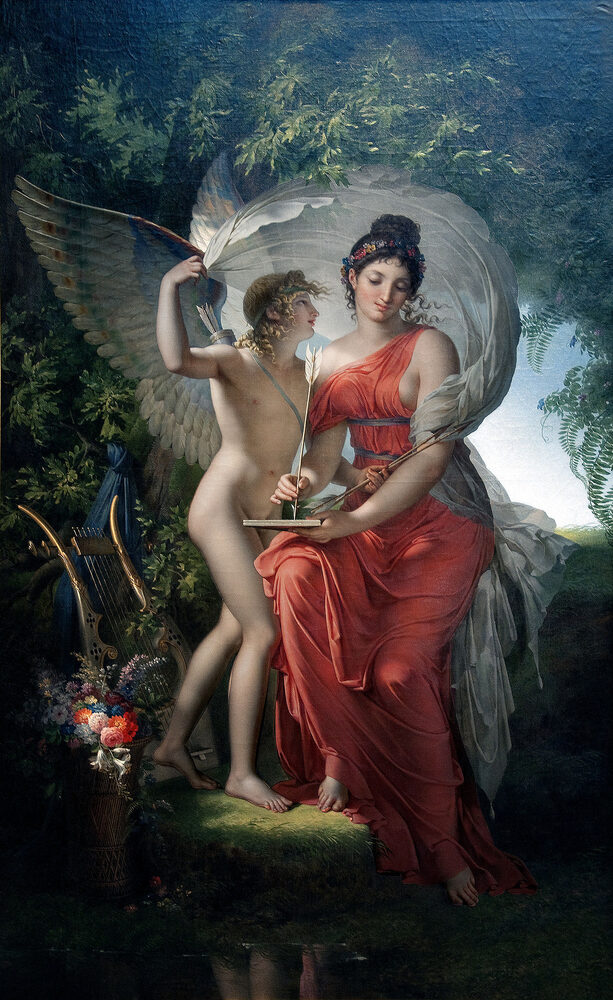
Erato
First Appearance
Erato first appears, with no story of her own, simply as a name in the roll of the nine. Hesiod, naming the daughters of Mnemosyne in the proem of the Theogony, lists her among her sisters: "Clio and Euterpe and Thalia and Melpomene and Terpsichore and Erato and Polymnia and Urania and Calliope" (Theogony 77–79). She is one name in the choir, given no separate office — for in the oldest poetry the nine sing with one voice, and the parcelling-out of the arts among them, which makes Erato the Muse of love-poetry, lay centuries in the future.
— Hesiod, Theogony 77–79 (the naming of the nine Muses)
Who They Are
Erato (ERR-uh-toh), in Greek Ἐρατώ, is one of the nine Muses, the daughters of Zeus and Mnemosyne (Memory), and in the later tradition she is the Muse of love-poetry and lyric verse — the song of desire and longing, of the beloved praised and the heart in flight. Her name is her meaning: Erato is "the lovely," "the beloved," "the longed-for," built on the same root as erōs, desire, so that alone among her sisters she carries the sound of love in her very name. It is a small accident of Greek — the Muse happened to be called "lovely" — but the poets made it a destiny, and Erato became, in time, the goddess a poet called upon when the subject was love. Her usual emblem is the lyre, often shown golden, and in later art she is frequently given the small winged figure of Eros standing at her side, to leave no doubt which Muse she is.
Like each of the nine she has her own page here, but she must be read against the choir to which she belongs, for the individual Muses are sparse: the early poets treat the nine as a single company, and the division that assigns love-poetry to Erato, epic to Calliope, tragedy to Melpomene and the rest is a later systematisation, fixed only in the Roman age (see the Muses' own page for the shared story — their birth in Pieria, the springs of Helicon, the invocation, and the contests). Erato has, honestly, almost no myth of her own. What she has instead is her name and the tradition that grew from it: the long and lovely habit by which the poets of love, hearing erōs in "Erato," called on her to help them sing.
Mythology
Her name, and the late division of the arts
In the beginning Erato is only a name. Hesiod names her among the nine in the Theogony (77–79), and gives her no office; Homer and the oldest poetry know the Muses as a single choir, calling on "the Muse" or "the Muses" without distinction, so that no one of them is yet the goddess of this art or that. The tidy scheme by which each of the nine presides over a particular art — Calliope over epic, Clio over history, Melpomene over tragedy, Urania over astronomy, and Erato over love-poetry and lyric verse — is a late systematisation, worked out in the Hellenistic and Roman periods and fixed in handbooks such as that of Diodorus Siculus (4.7). When the arts were at last parcelled out among the sisters, the assignment of love-poetry to Erato was all but inevitable, for her name already sounded of love. Diodorus, indeed, says as much: she was given her sphere, he notes, because her name answers to the power that makes those who are praised in verse "longed-for and desired." The office was chosen to fit the name.
The pun the poets loved — erōs in "Erato"
Because her name echoes erōs, desire, the poets could never resist it, and Erato's real life in literature is the life of a pun made reverent. To invoke "Erato" in a poem of love was to call at once on a Muse and on love itself, and the Greek and Roman poets used the chime deliberately and with delight. The name that in Hesiod had been an empty slot in a list became, for the poets of love, exactly the right mouth to sing from — and so a Muse with no myth acquired a vivid literary afterlife, invoked by name wherever the subject turned to longing. It is one of the clearest cases in all of Greek poetry of a divine figure shaped not by story but by the sound and sense of a name.
Apollonius calls on Erato for the love of Medea
The most famous and most beautiful instance is the opening of the third book of the Argonautica of Apollonius of Rhodes (3rd century BC). Having told in two books of the voyage of the Argonauts, Apollonius pauses as he comes to the heart of his poem — the love of the Colchian princess Medea for Jason, without which the Golden Fleece could never be won — and turns, strikingly, from Calliope and the Muses of epic to Erato alone: "Come now, Erato, stand by my side, and tell me how from Colchis Jason brought the fleece home to Iolcus by the love of Medea. For you too have your share in the power of Kypris (Aphrodite), and with your cares you bewitch unwedded maidens; wherefore to you too a lovely name is attached" (Argonautica 3.1–5). The reasoning is laid bare: he calls on Erato, and no other Muse, because her name is lovely and shares in the work of love — she, of all the nine, is the fit patroness of a song whose mainspring is a girl falling in love. It is the single most important passage for Erato, and it shows the whole mechanism of her fame: not a deed of hers, but a poet reaching for the Muse whose name means love, to tell a story of love.
Ovid, too, calls on Erato for love
The Roman poet Ovid, master of love-poetry, kept the tradition alive and made the reasoning explicit. In the Ars Amatoria, his handbook of love, he invokes her by name as he turns to his theme: "Now Erato shall be my guide, for her name is the name of love" (Ars Amatoria 2.15–16) — openly joining the Muse to amor because the name demands it. And in the Fasti, his poem on the Roman calendar, when he comes to April and the month of Venus, it is Erato he questions about the goddess and her rites, "Erato, the Muse who has her name from Love" (Fasti 4.195–196). In both places Ovid does just what Apollonius did: faced with a subject of love, he reaches past the other eight and calls the one Muse whose name is desire. Between them, Apollonius and Ovid fixed Erato forever as the Muse of love-song — on the strength, almost entirely, of her name.
A Muse with few myths of her own
It should be said plainly, in keeping with the honesty this encyclopedia owes its readers: Erato has almost no myth of her own. She fights no battles, bears (in the mainstream tradition) no children, suffers no transformation; the scattered late genealogies that now and then attach a name to one or another Muse are thin and contradictory, and nothing certain or central hangs on them. She is known, essentially, as one of the nine — a sister in the choir of Memory — and as the name the love-poets invoke. This is not a gap to be filled with invention but the true shape of her: a figure who lives in her name, in her emblem the lyre, and in the long devotion of poets who, meaning to sing of love, found that the Muse of love was already called "the lovely." For the great common story of the Muses — their birth, their mountains, their springs, their contests, and the invocation that is their truest worship — see the Muses' own page; Erato's own page is, fittingly and honestly, mostly about a name and the love it drew.
Worship — Ancient
Honoured among the nine
Erato received no separate cult of her own; she was worshipped as one of the nine, wherever the Muses were honoured. That worship clustered on their sacred mountains — the Valley of the Muses on Mount Helicon in Boeotia, with its sanctuary and its great festival the Mouseia, and the Pierian uplands north of Olympus — and in every place where poetry, music, and learning were pursued (the full account is on the Muses' page). Where the nine were set up together in sculpture and painting, Erato stood among them with her lyre, and later art gave her the little figure of Eros at her side to mark her out as the Muse of love; but her honours were the honours of the choir, not of a goddess worshipped apart.
The invocation — and a special place with the love-poets
The truest worship of any Muse was the poet's invocation, the calling-upon at the head of a song, and here Erato held a particular and special place in the hearts of the poets of lyric and love. A poet setting out to sing of desire, of the beloved, of the heart's longing, had in Erato a Muse whose very name answered his theme, and so — as Apollonius did for the love of Medea, and Ovid for the arts of love and the month of Venus — he could call on her by name and mean both the goddess and the love he sang. For the makers of love-poetry she was the fitting patroness, the one of the nine whose name was already a word for longing; and to invoke her was both to honour a daughter of Memory and to confess that the song of love, like all song, came as a gift and not from the self alone.
Worship — Modern
The lovely name
Erato's modern legacy is, fittingly, a matter of the name and the art it was joined to. The word "erotic" and the figure of Eros share her root, and wherever love-poetry and lyric song are spoken of, Erato remains their classical patroness — the Muse whose name the poets of love invoked. Her name itself endures as a given name and a poetic byword for the lyric of desire, and in galleries across Europe she keeps her ancient emblems: the painter's and sculptor's Erato holds a golden lyre, often with the winged boy Eros beside her, so that the Muse of love is known at a glance. She survives less through story — she never had much — than through this quiet, persistent association of a lovely name with the song of love.
Honouring Erato today
A modern devotee drawn to Erato honours her in the key of her art: by making or receiving love-poetry and lyric verse. To write a poem of love and read it aloud, to set down or sing a song of longing, to copy out and dwell on a lyric that moves the heart — any of these is a truer offering to her than incense. Following the ancient shape, one might pour a simple libation of clear water (recalling the Muses' springs), perhaps lay a sprig of myrtle or a rose, the flowers of love, and dedicate the work to Erato before beginning — asking, as Apollonius and Ovid asked, that the Muse whose name is love stand by and help the song of love come true. To keep faith with Erato is to keep making and keeping the words of love, for her name means "the lovely," and loveliness held in verse is her joy.
Epithets & Cult Titles
- Ἐρατώ (Eratō) — "the Lovely" — Her own name read as a meaning: "the lovely one, the longed-for, the beloved." Built on the root of erōs (desire) and eratos ("that which awakens love"), the name marks her as the Muse whose gift and whose nature is loveliness itself — and it is this chime with love that drew the poets of love to call on her by name
- Ἑλικωνιάς / Πιερίς (Heliconian / Pierian Maiden) — Like all her sisters she is a maiden of Mount Helicon in Boeotia and of Pieria north of Olympus, dancing about the springs and born in the Pierian uplands; the titles that belong to the nine as a choir belong to her as one of them (see the Muses' own page for the full account of Helicon, Pieria, and the inspiring springs)
- Daughter of Memory (Mnemosynis) — A descriptive title marking her mother: Erato is one of the nine daughters of Mnemosyne (Memory) by Zeus, and so her song, like all the Muses', is memory made beautiful — the past and the beloved held fast in verse against forgetting
- Muse of Love-Poetry and Lyric Verse — Her later and most familiar office. In the systematised division of the arts among the nine, Erato became the Muse of erotic and lyric poetry — the song of love and longing — a natural assignment given the sound of her name; Diodorus and the handbook tradition fix her in this role
Sources & Variants
- Hesiod, Theogony 77–79 (Erato named in the roll of the nine Muses, with no separate office) and 1–115 (the proem: the Muses of Helicon, their birth to Zeus and Mnemosyne in Pieria, the naming of all nine, and their office of song) — the earliest attestation of her name
- Apollonius of Rhodes, Argonautica 3.1–5 (the invocation of Erato, and her alone, to tell of the love of Medea for Jason, because her name is lovely and she shares in the work of Aphrodite) — the central passage for Erato
- Ovid, Ars Amatoria 2.15–16 (Erato invoked as guide because her name is the name of love)
- Ovid, Fasti 4.195–196 (Erato questioned about Venus and April, 'the Muse who has her name from Love')
- Diodorus Siculus, Bibliotheca Historica 4.7 (the systematic account of the nine Muses and the art assigned to each; Erato's name explained as making the praised 'longed-for and desired') — the handbook source for the later division of labour among the nine
- Pausanias, Description of Greece 9.29–31 (the Valley of the Muses and the sanctuary on Helicon; the number and names of the Muses; the traditions of the mountain) — the setting of the shared cult
Gallery