Sarpēdōn
First Appearance
Sarpedon enters Greek poetry in the Iliad's catalogue of Troy's allies (2.876–877), named with Glaukos as leader of the Lycians, come from far-off Lycia and the eddying river Xanthos. He grows across the poem into one of its noblest figures: in Book 5 he is wounded fighting and prays to his father; in Book 12 he speaks the great speech on why a king must risk his life in the front rank; and in Book 16 he meets Patroclus in the fighting and is killed — his death the occasion of one of Homer's most moving scenes, as Zeus weeps for a son he may not save and sends Sleep and Death to carry him home.
— Homer, Iliad 2.876–877; 5.471–492; 12.290–429; 16.419–683
Who They Are
Sarpedon (sar-PEE-don) is the mortal son of Zeus who led the Lycians to the Trojan War and became, in Homer's hands, the greatest of all the foreign allies who fought for Troy — a king come from the farthest land, brave past any blame, and loved above all others by the father of gods and men. He is counted here among the heroes because he began and ended as a mortal man, a warrior who bled and died on the plain of Troy; but he is a hero whose story turns on the one thing no hero can escape and no god, not even Zeus, can finally overturn: that a man born of a mortal mother must die when his fated day has come.
His myth has two centres. The first and greatest is his death in the sixteenth book of the Iliad — his fighting-glory (aristeia) and his fall at the hands of Patroclus, the moment when Zeus his father agonises over whether to snatch him alive from the battle, is reminded by Hera that fate must stand, and weeps tears of blood for the son he must let die, sending down a rain of blood upon the earth in his honour and then dispatching Sleep and Death, the twin brothers, to bear the body gently home to Lycia for burial. It is one of the most searching passages in all Homer, where the power of the king of the gods is measured against the order of fate and found, in the end, to bow to it.
The second centre lies behind the first. There was also an older Sarpedon — the Cretan, a son of Zeus and Europa and brother of Minos and Rhadamanthys — who was driven from Crete and came to rule in Lycia. The ancients, troubled that one name should belong to two men a war apart, reconciled them by reckoning three generations between the Cretan founder and the Trojan warrior, making the elder the grandfather (or ancestor) of the younger. This page leads with the Homeric hero, and then sets out the Cretan Sarpedon and how the old writers joined the two.
Mythology
The lord of the Lycians, son of Zeus
In the Iliad Sarpedon is the king and leader of the Lycians, a people of the south-western coast of Asia Minor, come to Troy from the farthest of all the allied lands, from beside the eddying river Xanthos (Homer, Iliad 2.876–877; 5.479). He shares the Lycian command with his kinsman and companion Glaukos, but it is Sarpedon who stands out as the greater — "best of the allies" (aristos epikourōn), set in Homer's esteem beside Hector and the noblest of the Trojans themselves. His mother in this telling is Laodamia, daughter of Bellerophon, the hero who tamed Pegasus and ruled in Lycia; and his father is Zeus himself (Iliad 6.198–199), so that Sarpedon is a mortal son of the king of the gods — the single fact that will make his story the one the poem lingers over most.
The great speech: why a king must fight (Iliad 12)
Sarpedon's noblest moment in life comes in the twelfth book of the Iliad, as he leads the Lycians against the Greek wall. Turning to Glaukos, he speaks what has become perhaps the most famous statement in Greek epic of the warrior's bargain (Iliad 12.310–328). Why, he asks, are the two of them honoured above others in Lycia — given the best seats, the fullest cups, the richest land — if not that they must now stand in the front rank where the fighting is worst, and earn that honour with their lives? And then the heart of it: if only, by fleeing this battle, they could live forever, ageless and immortal, he would not fight in the front himself nor send Glaukos there; "but since the fates of death stand over us in their thousands, which no mortal can escape or avoid — let us go forward, and win glory for ourselves, or yield it to another." It is the clearest voice in Homer of the heroic creed: that because death is certain, honour is the only thing worth spending a life on. With that he and the Lycians storm the wall, and Sarpedon is the first to tear down a section of the Greek rampart (12.397–399).
Wounded and praying (Iliad 5)
Already in the fifth book Homer had marked Sarpedon as a figure of special weight. Fighting in the thick of battle, he is wounded in the thigh by the spear of Tlepolemos, a son of Heracles — whom Sarpedon kills in the same exchange (Iliad 5.627–662). Carried out of the press by his companions, faint with pain, he prays — and significantly, he prays not to Zeus by name as his father but is tended by his men, the spear still in his thigh, until it is drawn out. Homer keeps the reader aware throughout that this is Zeus's own son in the fighting, so that the danger closing around him gathers a weight no ordinary warrior's peril could carry.
The death of Sarpedon (Iliad 16)
The great scene comes in the sixteenth book. When Patroclus, wearing the armour of Achilles, drives the Trojans back from the ships in a storm of killing, Sarpedon alone turns to face him, stepping down from his chariot to meet the Greek champion hand to hand (Iliad 16.419–425). And as father watches son go to his death, Homer gives us the most extraordinary moment in the poem: Zeus, looking down, is torn, and says to Hera his wife that his heart is divided — whether to snatch Sarpedon living out of the battle and set him down safe in his own rich land of Lycia, or to let him be killed now beneath Patroclus (16.431–438).
Hera answers him sternly (16.440–457): most dread son of Kronos, what is this? A mortal man, long ago doomed by fate — do you mean to loose him back from death? Do it if you will, she says, but not all the other gods will praise you; and think of this — if you save your own son from the war, some other god will want to save his own dear son too, and where will it end? Rather let Sarpedon die; and when his life has left him, send Death and gentle Sleep to carry him to the broad land of Lycia, where his kinsmen will give him burial with mound and standing-stone, "for that is the privilege of the dead." Zeus, the father of gods and men, does not refuse her — but his grief breaks out in a sign seen over all the field: he weeps tears of blood (or sheds bloody raindrops upon the earth), a rain of blood falling to the ground in honour of the dear son he is about to lose on the soil of a foreign land (16.458–461).
Then Patroclus and Sarpedon close. Patroclus kills Sarpedon's charioteer and companion first; Sarpedon casts and misses, striking instead one of Achilles' immortal horses; and then Patroclus drives his spear home through Sarpedon's midriff, "where the lungs enclose the throbbing heart," and the Lycian king falls like an oak, or a poplar, or a pine felled on the mountain by shipwrights (16.462–491). Dying, Sarpedon calls to Glaukos: do not let the Greeks strip my armour; rally the Lycians and the Trojans and fight over my body — I shall be your shame and reproach forever if they take my gear by the ships (16.492–501). With that the breath leaves him, and a great struggle rages over his corpse, Greeks and Trojans hauling at it until the dust and blood cover him past knowing.
Carried home by Sleep and Death (Iliad 16)
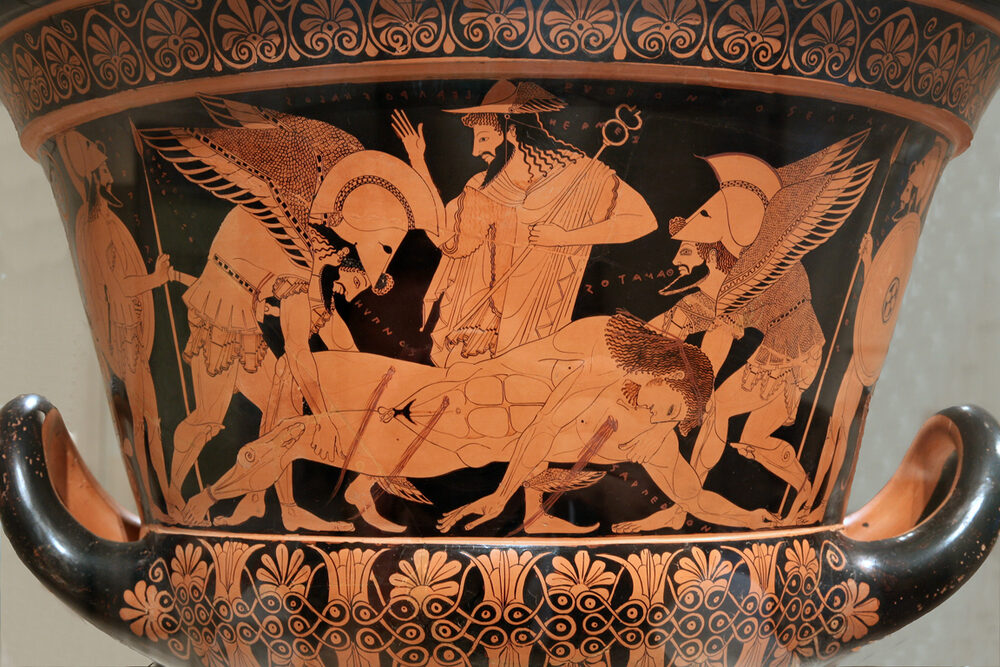
At last Zeus acts as Hera had counselled, in the one way left open to a father who may not keep his son from death but may keep him from dishonour. He turns the tide so the body is recovered, and then sends Apollo down with a charge: take Sarpedon out from under the weapons, carry him far off, wash the dark blood from him in the running river, anoint him with ambrosia, wrap him in garments that never decay — and give him to the two swift bearers to carry (Iliad 16.666–675). Apollo does so; he cleanses the body of the fallen king, and hands it to Hypnos (Sleep) and Thanatos (Death), the twin brothers, who bear Sarpedon swiftly and gently to the rich broad land of Lycia, where his people will bury him with the mound and the pillar that are the dead man's due (16.676–683). So the son of Zeus, killed on a foreign plain, is brought home at the last to rest among his own — a grace the poem grants him that it grants to no other fallen warrior, and one of the tenderest closes to a death-scene in all of Homer.
The other Sarpedon: the Cretan, son of Europa
Beside the Trojan hero the Greeks remembered an older Sarpedon — a son of Zeus and Europa, the Phoenician princess whom Zeus carried to Crete in the shape of a bull, and so a brother of Minos and Rhadamanthys (Apollodorus, Bibliotheca 3.1.1–2). The three brothers, raised on Crete, fell out — in the usual telling, over the love of a beautiful youth, and more broadly over who should rule the island. Minos drove his brothers out and took the kingship for himself; and Sarpedon fled to Asia Minor, where he came to the land that would be called Lycia and ruled there (Herodotus 1.173; Apollodorus 3.1.2). Herodotus, writing of the origins of the Lycians, says plainly that they came originally from Crete, driven out in a quarrel between Sarpedon and Minos, the sons of Europa, and that Sarpedon led them to the land of the Milyae in Asia, which afterward took the name Lycia from Lykos son of Pandion. In this older strand Sarpedon is less a warrior than a founder — the royal ancestor who brought a Cretan people to the Lycian coast.
Reconciling the two: the grandfather and the grandson
The ancients were well aware that they had, in effect, two men of one name: a son of Europa who left Crete in the generation of Minos, and a son of Laodamia who fought at Troy generations later. The chronology could not be squeezed into a single lifetime — Europa's son belonged to the age before the Trojan War, Laodamia's to the war itself. So the old writers reconciled them by three generations, making the Cretan Sarpedon the grandfather (or more distant ancestor) of the Trojan one: Zeus, they said, granted the first Sarpedon a life of three generations, or else the name simply passed down the royal Lycian line from the founder to his descendant, the son of Bellerophon's daughter (so Apollodorus, 3.1.2, who notes the difficulty and the three-generation solution; and Diodorus Siculus 5.79). Whether one treats them as two distinct heroes whom later poets confused, or as grandfather and grandson of a single Lycian house, the double Sarpedon is a clear case of how the Greeks worked to harmonise the local legends of Lycia and Crete with the Panhellenic story of Troy.
Worship — Ancient
A hero of the tomb, in Lycia
Sarpedon was honoured not as an Olympian god with temples across Greece but in the way proper to a hero — at and through his tomb. Homer's own close points the way: Sleep and Death carry the body to Lycia precisely so that his kinsmen may raise over him the mound and the standing-stone (tymbos and stēlē), "for that is the privilege of the dead" (Iliad 16.456–457, 674–675). In Greek religion the grave of a hero was a place of cult, where the dead man received libations, laments, and tendance as a power still able to help or harm the living; and Sarpedon, a king and a son of Zeus laid in Lycian earth, was exactly the kind of figure such hero-cult gathered around.
The Lycian memory
Because the Lycians traced their own royal line and even their origin to him — whether to the Cretan founder who led them out of Crete (Herodotus 1.173) or to the Trojan champion who was their greatest king — Sarpedon belonged to Lycia in a way few heroes belonged to any one land. He was their ancestor and their defender, the local hero through whom a people on the edge of the Greek world claimed a place in the great story of Troy and a descent from Zeus himself. His memory was a matter of civic and dynastic pride, the root of a royal house, and the kind of figure whose name and tomb anchored a people's sense of who they were.
In the poets and the painters
Beyond Lycia, Sarpedon lived chiefly through the Iliad, where his death is among the scenes the Greeks most loved and retold. The moment of Sleep and Death bearing the body became a favourite in art — most famously on the great painted wine-bowl (the "Euphronios krater," painted around 515 BC) that shows winged Hypnos and Thanatos lifting the bleeding body of Sarpedon while Hermes directs them, one of the masterpieces of Greek vase-painting. That the scene was chosen again and again shows how deeply the image of the honoured dead carried gently home had entered the Greek imagination, a pattern of the good death and the dignity owed to a fallen king.
Worship — Modern
A patron of the honoured death
Sarpedon is remembered today less through any continuing cult than through the Iliad, where he speaks and dies more memorably than almost any other secondary figure. A modern reader or devotee drawn to him finds in him a patron of courage freely chosen — of the warrior's clear-eyed bargain in his great speech to Glaukos (Iliad 12.310–328), that because no one escapes death, the only question is whether one meets it with honour. He stands too for the dignity owed to the dead: the fallen carried home, washed clean, wrapped in garments that do not decay, and laid in the earth of his own land with the rites that are "the privilege of the dead."
The limit of power, even for Zeus
His story carries one of the gravest themes in all Greek thought — that there is an order, call it fate, to which even the king of the gods must bow. Zeus can weep tears of blood and rain blood upon the earth for his dying son; he can see him carried home with honour by Sleep and Death; but he cannot keep him from dying when his day has come. For a modern honouring, Sarpedon is thus a figure of the hard wisdom that grief and love do not override necessity, and that the most one may do for the beloved dead is to give them honour, not to keep them. It is a bleak comfort, but a true one, and Homer gave it some of his most beautiful lines.
Sleep and Death, the gentle brothers
Finally, Sarpedon's close has given later ages one of the most consoling of all images of dying — not as violence or horror but as Sleep and Death, twin brothers, bearing the body swiftly and gently home. Poets and artists from antiquity onward have returned to it as a picture of death made kindly, the last journey taken in the arms of Sleep's own brother. Those drawn to Sarpedon often keep this image above all: the honoured dead carried home, cleansed and at peace, out of the dust of the battlefield into the quiet of his own country.
Epithets & Cult Titles
- anax Lykiōn (ἄναξ Λυκίων) — Lord of the Lycians — his standing office in the Iliad, where he leads the Lycian contingent, the farthest-come and among the bravest of all Troy's allies
- pais Dios (παῖς Διός) — Son of Zeus — the title that shadows his whole story, for it is as the mortal son of the king of the gods that his death becomes the hardest of all fates for Zeus to bear
- aristos epikourōn (ἄριστος ἐπικούρων) — Best of the allies — his place of honour among the foreign champions who fought for Troy, set beside Hector and the Trojans' own
Sources & Variants
- Homer, Iliad 2.876–877 (Sarpedon and Glaukos lead the Lycians, come from far Lycia and the river Xanthos)
- Homer, Iliad 5.471–492 (Sarpedon rebukes Hector and rallies the allies) and 5.627–662 (wounded by Tlepolemos, whom he kills)
- Homer, Iliad 6.198–199 (Sarpedon the son of Zeus and Laodamia, daughter of Bellerophon)
- Homer, Iliad 12.290–429 (Sarpedon leads the assault on the Greek wall; the great speech to Glaukos on honour and death, 12.310–328; he breaches the rampart)
- Homer, Iliad 16.419–683 (the death of Sarpedon at the hands of Patroclus: Zeus's grief and Hera's counsel, 431–461; the fall, 462–507; the fight over the body; Apollo cleanses him and Sleep and Death carry him home to Lycia, 666–683)
- Hesiod (attrib.), Catalogue of Women / Ehoiai, frr. on the Lycian and Cretan lines (Sarpedon among the descendants of Zeus)
- Apollodorus, Bibliotheca 3.1.1–2 (the Cretan Sarpedon, son of Zeus and Europa, brother of Minos and Rhadamanthys, driven from Crete to Lycia; the three-generation reconciliation of the two Sarpedons) and Epitome (the Lycians at Troy)
- Herodotus, Histories 1.173 (the Lycians originally from Crete, led out by Sarpedon son of Europa after his quarrel with Minos; the land afterward called Lycia)
- Diodorus Siculus, Library 5.79 (the Cretan Sarpedon and the descent of the Lycian royal house)
Gallery