Persephone
First Appearance
Persephone stands in the very oldest Greek poetry already as a figure of dread. In the Odyssey (10.491–495) Circe warns Odysseus that he must go down to the house of Hades and "dread Persephone" (epaine Persephoneia) to consult the ghost of the seer Teiresias, and in Book 11 she is the queen who rules the swarming dead and who can send up or drive back the shades — Homer calls her "dread Persephone" again and again, never lightly. Her fuller story, the great narrative of how the Maiden became that queen, is told in the Homeric Hymn to Demeter: the abduction from the flowering meadow, Demeter's world-wide grief, and the bargain of the pomegranate that binds her to the world below for a portion of every year.
— Homer, Odyssey 10.491–495 and 11.213–226; the Homeric Hymn to Demeter (Hymn 2), 7th–6th c. BCE
Who They Are
Persephone (per-SEF-uh-nee) is the two-natured goddess at the still centre of the Greek imagination of death — at once Kore, "the Maiden," the innocent girl gathering flowers in a spring meadow, and the dread queen of the underworld, the sovereign of the swarming dead beside whom even heroes tremble. No other Greek deity holds two such opposite faces so completely: she is the daughter and she is the queen, the spring flower and the grave, the girl her mother weeps for and the terrible lady whose name the living were half-afraid to speak. Her whole meaning lives in the passage between those two — in the story of how the one became the other.
She is the daughter of Zeus, king of the gods, and Demeter, goddess of the grain and the harvest, and her myth is bound up with her mother's more tightly than any other pair in Greek religion; for a thousand years the two were worshipped together simply as "the Mother and the Maiden." Her husband is Hades, lord of the dead, who carried her off to be his bride and his queen — and the story of that abduction, and of the pomegranate seeds that fixed her fate, is one of the oldest and most beloved of all the myths, because in it the Greeks read the death and return of the green world itself, the seed that must go down into the dark ground before the grain can rise.
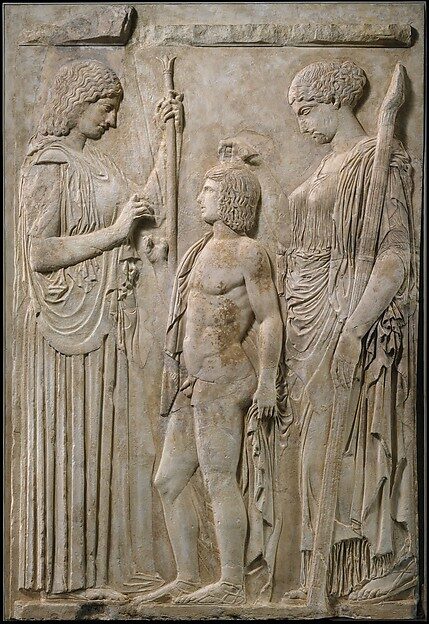
Above all, Persephone is the goddess of the great secret at Eleusis. The Eleusinian Mysteries, the most revered initiation-cult of the ancient world, were built upon her story, and to the initiates who kept its silence she offered what no other cult so clearly promised: a better hope on the far side of death. To follow her is to trace the deepest thing the Greeks tried to say about mortality — that the girl who goes down into the dark is also the queen who reigns there, and that the descent is not the end of the story but the turning of it.
Mythology
Kore, the Maiden in the meadow
Before she is ever queen, she is the girl. In the oldest and tenderest thought of her she is Kore — simply "the daughter, the maiden" — the beloved and only child of Demeter, so bound to her mother that the two are almost one being. She has no story of her own yet, no dread, no crown; she is the young goddess of the growing things her mother rules, a figure of pure springtime. The most famous picture of her is the one that opens the great myth: Kore in a soft meadow with the daughters of Ocean, her companions, gathering flowers — roses and crocuses and violets and sweet-smelling irises — reaching, in the fateful instant, for the loveliest bloom of all. This is the innocence that the story exists to break, and the Greeks never forgot it: even when they knelt before the terrible queen of the dead, they remembered that she had once been the girl in the field of flowers.
The abduction and the narcissus (the Homeric Hymn to Demeter)
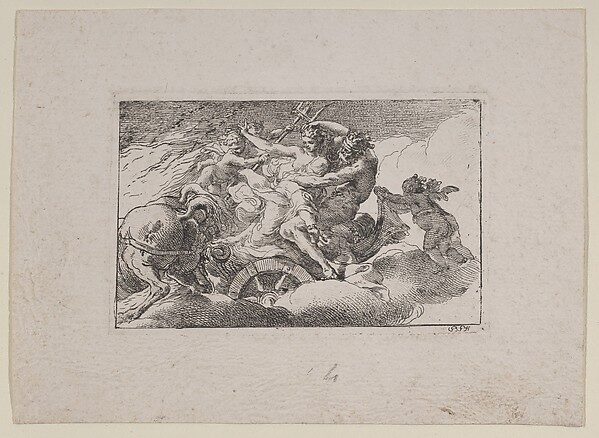
(Content note: the central myth turns on the abduction of a young goddess into a forced marriage; it is told here frankly but not graphically, as the ancients told it.) The fullest and earliest telling is the Homeric Hymn to Demeter, and it begins with a conspiracy. Hades, lord of the dead, desired Kore for his queen, and Zeus, her father, quietly consented to give her to his brother — without telling Demeter, who would never have agreed. To lure the girl, Earth, at Zeus's wish, put forth a snare: a single wondrous narcissus, a flower of unearthly beauty with a hundred blooms on one stem, its scent reaching the whole sky and sea. Kore, wandering a little apart from her companions, saw it and reached out both hands to pluck the lovely thing — and in that moment the earth split open. Up from the chasm burst Hades in his golden chariot drawn by immortal horses, and before she could do more than cry out he had seized her and swept her down, screaming for her father, into the dark. The Hymn says she cried aloud to Zeus, but he did not hear, or would not; and only two others caught her cry — the goddess Hekate in her cave, and Helios the Sun, who sees everything.
Demeter's grief and the barren world
Demeter heard the far echo of her daughter's scream and a sharp pain seized her heart. For nine days she roamed the whole earth searching, a torch in each hand, tasting neither food nor drink nor bathing, calling for Kore and finding no answer, for no god or mortal would tell her the truth. On the tenth day Hekate came to her, and together they went to Helios, who alone had seen; and the Sun told her the whole of it — that Zeus had given the girl to Hades to be his wife, and it was Hades who had carried her below. Then a terrible grief and anger took Demeter. She withdrew from the company of the gods and went among mortals in disguise, and at last, in her sorrow and her rage at Zeus, she made the whole earth barren: no seed sprouted, the ploughing was in vain, the grain would not grow, and the human race began to starve — and with them died the sacrifices that fed the gods. The world itself went into mourning with the mother, and this is the Greeks' image of winter: the frozen, fruitless season is the grief of the goddess for her stolen child.
The pomegranate and the compromise
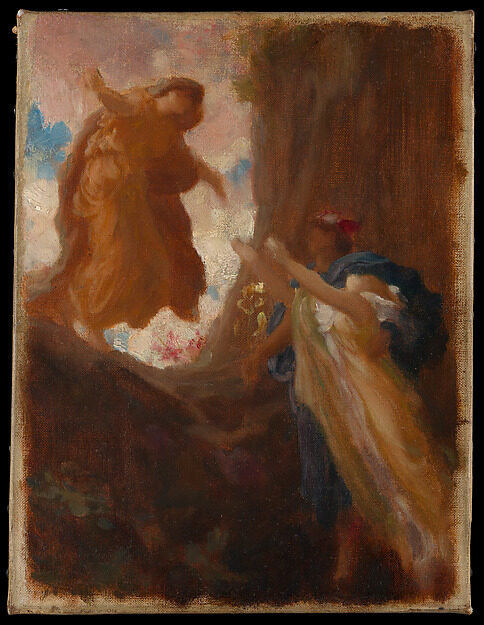
Faced with a dying world and the loss of all worship, Zeus at last relented and sent Hermes down into the underworld to bring Kore back to her mother. Hades did not refuse his brother — but he was cunning, and before he let her go he gave his unwilling bride a parting gift: he pressed on her, or coaxed her to eat, the seeds of a pomegranate, the red fruit of the world below. And whether by trick or by hunger she swallowed a few of the seeds — the Hymn says a single one, later tellings say three or four — and that small act sealed her fate, for whoever tastes the food of the dead belongs to the dead and cannot wholly leave. So when she was carried up and mother and daughter fell into each other's arms in a rapture of joy, Demeter's first fearful question was whether she had eaten anything below; and when she learned of the pomegranate, she knew her daughter could not be hers alone. The compromise Zeus decreed is the heart of the myth: for a portion of every year — one-third in the Hymn, half in the common later version, one season for each seed — Persephone must dwell below as queen beside Hades, and for the rest she rises to the light with her mother. When she comes up, Demeter in joy lets the earth flower and the grain grow; when she goes down, the mother grieves and the world turns cold and bare. So the girl's fate became the turning of the seasons themselves, the seed that must go down into the dark ground and die before the spring can lift it green again.
The dread queen of the dead
What the abduction makes of Kore is the queen of the underworld, and here the myth turns from tenderness to awe. Once she has eaten the pomegranate she is no longer only the Maiden; she is Persephone, the dark-robed sovereign who sits enthroned beside Hades and rules the numberless dead. The Greeks held her in a very particular kind of fear. Homer never names her without the word epaine — "dread Persephone" — and her power over the shades is real and absolute: she can send a ghost up to the living or drive it back down, she governs the geography of the world below, and it is to her, as much as to her husband, that the dying and the mourning turned. So great was the awe around her that people were reluctant to speak her name aloud at all, calling her instead simply Kore, "the Maiden," or Despoina, "the Lady," or by roundabout titles — a name-taboo of the sort the Greeks reserved for powers too dangerous to summon carelessly. To speak of "dread Persephone" was to touch the edge of death itself, and the living did so carefully.
Her own myths: Adonis, Pirithous, and Orpheus
As queen in her own right, Persephone has stories where she, not her mother, is the mover. In the tale of Adonis, the beautiful mortal youth beloved of Aphrodite, it was Persephone to whom Aphrodite entrusted the infant for safekeeping in a chest — and Persephone, opening it and seeing his beauty, refused to give him back. The two goddesses, love and death, fell into a bitter dispute over Adonis, each claiming him, until Zeus (or the Muse Calliope as judge) ruled that the boy should divide his year: a part with Aphrodite in the light and a part with Persephone below — a bargain that echoes her own, and marks her as a power that even the goddess of love could not simply overrule.
A darker story is that of Pirithous. This hero, with his friend Theseus, conceived the mad and impious scheme of carrying off Persephone herself to be Pirithous's wife, and the two went down living into the underworld to seize the queen of the dead from her own throne. Hades received them with grim courtesy and bade them sit — and the Chairs of Forgetfulness to which they sat grew fast to their flesh, or coiling serpents bound them, and they were trapped there, unable to rise. Theseus was in some tellings later rescued by Heracles, but Pirithous remained fixed forever in the underworld, the price of his insane suit for its queen — a warning of what it meant to lay hands on Persephone.
Against that, her single great act of mercy shines the brighter: the story of Orpheus. When the singer Orpheus lost his wife Eurydice to a snakebite, he went down alive into the underworld and sang before the thrones of the dead, and his song of grief was so beautiful that the whole realm stood still to hear it — the tormented rested from their torments, and, the poets say, for the first and only time the cheeks of the iron queen were wet with tears. It was Persephone, moved by the song, who granted what had never been granted: that Orpheus might lead Eurydice back up to the light, on the one condition that he not look back at her until they had reached the world above. That he failed, and turned, and lost her at the last step, is the tragedy of Orpheus — but the mercy was Persephone's, and it shows the Maiden still living inside the queen, the girl who was herself taken from the light and who alone, of all the powers of death, could be moved to give someone back.
Worship — Ancient
The Mother and the Maiden
Persephone was almost never worshipped alone. Across the Greek world she and her mother Demeter were honoured together as a pair so close that they were called simply to theo, "the Two Goddesses," or "the Mother and the Maiden" (Demeter and Kore). Their joint cult was one of the most widespread in Greece, rooted in the life of the grain — for the goddesses of the harvest and of the seed that goes down into the earth and rises again were the natural patrons of the farmer and of every household that lived by bread. Where Demeter was the ripe grain and the giving mother, Kore was the seed-corn buried and reborn, and the descent and return of the daughter was the myth every sower acted out with his own hands.
The Eleusinian Mysteries
The greatest of all her cults was the Eleusinian Mysteries, kept at Eleusis near Athens for well over a thousand years and reckoned by many ancients the most solemn and precious of Greek rites. The Mysteries were built directly upon Persephone's story — the loss of the Maiden, the grief of the Mother, and the return — and the Homeric Hymn to Demeter is in part a sacred charter for them, ending with Demeter teaching the people of Eleusis her rites. What made the Mysteries unlike ordinary Greek religion was their promise about death itself: the Hymn says plainly that whoever among mortals has seen these rites is blessed, but the one who has no part in them has no share of like good things once dead, down in the mouldering dark. To be initiated was to gain a better hope, a better lot, on the far side of the grave — and this is why philosophers and emperors alike sought initiation.
What actually happened in the innermost hall, the Telesterion, is genuinely unknown, and this is not a gap in our knowledge to be filled but the point itself: the initiates swore an oath of absolute silence, and — extraordinarily — they kept it, for centuries, so faithfully that no full account survives from anyone who was there. What can honestly be said is the outward shape. There were Lesser Mysteries in spring and Greater Mysteries in autumn; a great procession of thousands walked the Sacred Way from Athens to Eleusis carrying torches and sacred things; the initiates fasted in imitation of the grieving Demeter and then broke the fast with the kykeon, a drink of barley-water and mint that Demeter herself, in the Hymn, had accepted in her sorrow. Inside, by torchlight, there were dromena (things done), legomena (things said), and deiknymena (things shown) — and later hostile Christian writers claimed the climax was the silent showing of a single cut ear of grain, though we cannot be sure. Whatever was revealed, those who saw it came away believing they need not fear death, and that is Persephone's deepest gift.
The Thesmophoria and the women's rites
Alongside the Mysteries stood the Thesmophoria, a great autumn festival of Demeter and Kore kept by married women only, from which men were strictly barred. Tied to the sowing, it enacted the descent and return in ritual form: women descended into underground pits (megara) to bring up the rotted remains of piglets thrown in at an earlier festival, and mixed this decayed matter with the seed-grain to quicken the fields — a rite that says, in the plainest possible ritual language, that death and rot are what feed the new life, the whole lesson of Persephone's going down and coming up. The middle day was one of fasting and mourning, the women seated on the bare ground in sympathy with the sorrowing mother, and the last was Kalligeneia, "fair birth," turning at the end toward fertility and hope.
Persephone the queen, honoured for herself
Beyond the joint cult, Persephone was also worshipped as queen of the dead in her own right, and this worship wore a darker dress. As a chthonic (underworld) power she received offerings of the kind proper to the gods below: sacrifices of black victims, often given at night, and libations poured wholly onto the earth — honey, water, wine given to the ground and never tasted by the giver, for they were meant for the world below. In Sicily, where her cult was especially strong and where the abduction was often located, and in Arcadia at Lycosura, where she was worshipped under the awesome secret name Despoina, "the Mistress," she stood as a great goddess to be approached with fear. It is to Persephone that the dead and the mourners appealed, her name that was written on curse-tablets buried in graves to carry a plea to the powers below, and her mercy, as in the tale of Orpheus, that the desperate hoped against hope to move.
Worship — Modern
A goddess of descent and return, honoured again
Among modern Hellenic polytheists (practitioners of the revived worship of the Greek gods, sometimes called Hellenism or Hellenismos) Persephone is one of the most beloved and widely honoured of all the deities — and often one of the most personally felt. Devotees are drawn to her precisely for the two natures the ancients gave her: the Maiden who was taken into the dark, and the Queen who learned to reign there. Many who have known grief, loss, depression, or great change find in her a goddess who understands the descent — who did not merely visit the underworld but became its sovereign — and who returns, every year, to the light. She is honoured as a patron of transformation, of the passage through hard seasons, and of the dignity that can be found in the dark places rather than only in escaping them.
The turning of the year
Because her myth is the myth of the seasons, modern devotion often follows the year's turning. Many mark her descent in the autumn — around the time of the ancient autumn festivals and the fading of the light — as a season of letting go, of honouring the dead, and of turning inward; and her return in the spring as a time of renewal and rejoicing. Some keep a version of the old fast-and-return, or simply light a candle at the equinoxes to mark her going down and her coming up. Household shrines to Persephone are common, often shared with Demeter, keeping the ancient pairing of Mother and Maiden; and just as often shared with Hades, honouring the queen beside her king.
Offerings in the old shape
Modern worshippers who follow the reconstructed forms are careful to honour Persephone in the manner proper to a chthonic (underworld) deity, which differs from the way the sky-gods are approached. Offerings to her are traditionally given downward — poured out onto the earth or left at ground level, given wholly and not shared, as the ancients gave to the powers below. Fitting gifts follow her own symbols: pomegranates above all, and pomegranate juice or wine; narcissus and other flowers; barley or bread and the first-fruits of a garden; honey and clean water. Some keep the offering for the evening or night, the chthonic time. The spirit is reverent rather than fearful — the old name-dread softened into love — but the shape of the rite still remembers that this is the queen of the dead, and treats her house with the awe it is owed.
In story and imagination
Beyond formal cult, Persephone has become, in the last century, one of the most retold of all the Greek figures in poetry, fiction, and art — reclaimed especially as a story about a young woman's passage from a mother's world into a self of her own, about survival and sovereignty won out of what began as violence, and about the person who goes down into the dark and comes back changed but crowned. Whether met as a goddess to be worshipped or as a myth to think with, she endures because she carries the one thing every human being must face — the descent — and answers it not with denial but with a crown.
Epithets & Cult Titles
- Kore (Κόρη) — The Maiden — literally 'the girl, the daughter.' This is her oldest and most tender name, used above all when she is thought of not as the dread queen but as the innocent daughter of Demeter, the girl gathering flowers in the meadow before her abduction. In the Eleusinian Mysteries the pairing was simply 'Demeter and Kore,' the Mother and the Maiden
- Despoina (Δέσποινα) — The Mistress, the Lady of the House — a title of awe for her as sovereign queen of the underworld, the female counterpart to Hades as its master. At Lycosura in Arcadia 'Despoina' was so charged a name that Pausanias would not write it down for the uninitiated; there she was worshipped as a great goddess in her own right
- Hagne (Ἁγνή) — The Holy One, the Pure — a cult-title of reverence, marking her as a goddess set apart and not lightly approached
- Praxidike (Πραξιδίκη) — She who exacts justice — a byname linking her, as queen of the dead, to the settling of accounts and the punishment of the wicked in the world below
Sources & Variants
- Homeric Hymn to Demeter (Homeric Hymn 2), complete — the fullest and earliest narrative: the abduction by the narcissus, Demeter's search and grief, the barren earth, the pomegranate, the compromise, and the founding of the Eleusinian Mysteries
- Homer, Odyssey 10.491–495, 509–540 (Circe sends Odysseus to 'dread Persephone'); 11.213–226, 385, 634–635 (Persephone queen of the dead, who sends up and drives back the shades)
- Homer, Iliad 9.457, 9.569 (invocations of Persephone and the chthonic powers)
- Hesiod, Theogony 767–774, 912–914 (Persephone as daughter of Zeus and Demeter, carried off by Hades; the house of the dread underworld gods)
- Ovid, Metamorphoses 5.341–571 (the abduction and the pomegranate, with the boy Ascalaphus who betrays her eating) — Roman retelling, elaborated
- Ovid, Fasti 4.417–620 (a second Roman version of the abduction and Demeter's search, with Sicilian setting)
- Claudian, De Raptu Proserpinae (the fullest late-antique epic on the abduction) — late Roman (4th–5th c. CE), highly elaborated and to be treated with caution as a source for early belief
- Apollodorus, Bibliotheca 1.5.1–3 (the abduction, the pomegranate, and the compromise); 1.3.2, 3.14.4 (the dispute with Aphrodite over Adonis); Epitome 1.23–24 (Pirithous and Theseus trapped in the underworld)
- Pausanias, Description of Greece 8.37 (the cult of Despoina at Lycosura in Arcadia, and the name he dared not write); 1.38 (Eleusis and the Mysteries)
- Virgil, Georgics 1.39 and Aeneid 6.138, 6.402 (Proserpina as queen of the underworld) — Roman
- Diodorus Siculus 5.2–5 (the Sicilian tradition of the abduction and Persephone's cult in Sicily)
- Orphic Hymns 29 (to Persephone) — later hymnic material used in modern devotion
Gallery