Demeter
First Appearance
Demeter first appears among the six children born to the Titans Cronus and Rhea — Hestia, Demeter, gold-shod Hera, strong Hades, the Earth-Shaker Poseidon, and wise Zeus. Fearing the prophecy that one of his own offspring would depose him, Cronus swallowed each child as it came from the womb to its mother's knees, and so Demeter passed her first existence within her father's belly, until Zeus grew and compelled Cronus to disgorge the children he had devoured.
— Hesiod, Theogony 453–467
Who They Are
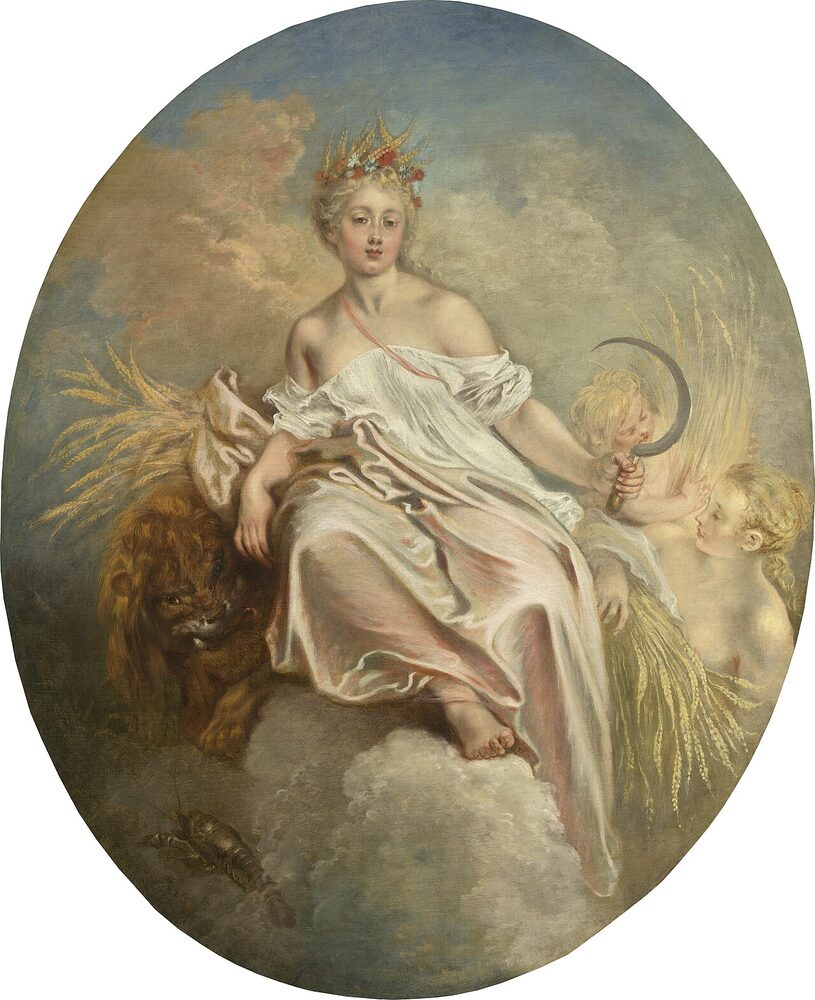
Demeter is the great goddess of the grain and the fertile earth — the power that makes the sown seed rise, ripens the corn in the ear, and gives mortals their daily bread. Of the Olympians she stands closest to the settled life of humankind: it was she, the Greeks believed, who first gave men the gift of agriculture and with it the laws and customs of ordered civilisation, so that she was worshipped as Thesmophoros, the bringer of the sacred order. Where her brother Zeus rules the bright heavens, Demeter's domain is the ploughed field, the threshing-floor, and the dark generative soil.
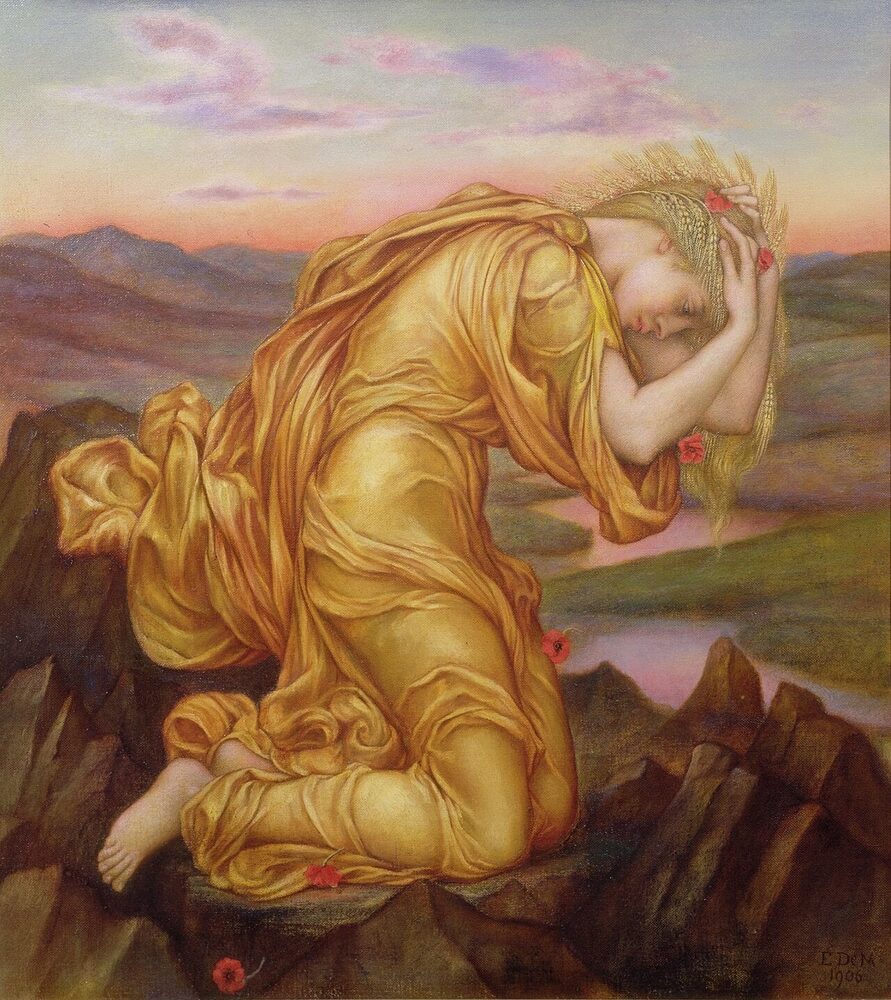
Yet the goddess of plenty is also the goddess of loss. Her defining story is the abduction of her daughter Persephone by Hades, lord of the dead — a grief so total that Demeter withdrew all growth from the earth and brought the world to the edge of famine. From the bargain that restored her daughter for part of each year came the turning of the seasons: the barren cold of Persephone's descent, the green return of her homecoming. In Demeter the Greeks read the whole cycle of the corn — buried like the dead, mourned, and raised again.
Because she knew death and return in her own child, Demeter became the mistress of the Mysteries. At Eleusis she founded the most sacred rites of the Greek world, which for a thousand years promised their initiates a happier lot beyond the grave. She is thus at once the homely goddess of bread and the keeper of the deepest hope — the mother whose sorrow and reunion stood as a promise that death is not the end.
Mythology
The abduction of Persephone and the origin of the seasons
The central myth of Demeter is told in full in the Homeric Hymn to Demeter (Hymn 2). Persephone, her daughter by Zeus, was gathering flowers with the daughters of Ocean upon the soft meadow of the plain of Nysa when she reached for a wondrous narcissus that Earth had grown as a snare, at Zeus's will and to please Hades. As she grasped it the ground gaped open and Hades, lord of the dead, burst forth in his golden chariot and seized her, carrying her down to his kingdom — all with the secret consent of Zeus, her own father (Hymn 2.1–39). Her cry rang out, but only Hecate and Helios the Sun had marked what befell.
For nine days Demeter roamed the earth with blazing torches in her hands, searching, tasting neither ambrosia nor the sweet draught of nectar, nor bathing, in her grief (Hymn 2.40–50). On the tenth Hecate and then Helios told her the truth — that Hades had taken Persephone with Zeus's leave. In wrath and sorrow she withdrew from Olympus and from the company of the gods, and turned her power against the earth: she made it a most dreadful year, so that the seed lay hidden in the ground and gave no shoot, and famine threatened to destroy the whole race of men and to rob the gods of their sacrifices (Hymn 2.305–313). At last Zeus relented and sent Hermes down to bring Persephone back. But Hades, before releasing her, gave her the seed of a pomegranate to eat; and because she had tasted the food of the dead, she was bound to return to him for a portion of each year — a third part below with Hades, and two parts above with her mother and the gods (Hymn 2.393–403, 445–447). So the seasons were born: when Persephone descends, Demeter mourns and the earth lies barren in winter; when she returns, the goddess rejoices and the world breaks into the green of spring. (A later Sicilian tradition set the abduction not at Nysa but in the flowery meadows of Enna in the heart of Sicily — the version favoured by Diodorus, Cicero, and Ovid — but the older Homeric Hymn leads with Nysa.)
Eleusis and the founding of the Mysteries
In her wandering, disguised as an aged woman past childbearing, Demeter came to Eleusis and sat grieving by the Maiden Well. There the daughters of King Keleos found her and brought her to the palace of their mother, Queen Metaneira, who took the stranger in and gave her the infant prince Demophoon to nurse (Hymn 2.90–168). The goddess, minded to make the child deathless, anointed him with ambrosia by day and by night laid him secretly in the heart of the fire like a brand, burning away his mortality. He grew like a god — until Metaneira spied on the rite and shrieked in terror to see her son in the flames. The spell was broken; Demeter snatched the child from the fire, rebuked the folly of mortals, and cast off her disguise, revealing herself in her true beauty and radiance (Hymn 2.231–280). She commanded the people of Eleusis to build her a great temple and altar beneath the town, and there, once Persephone was restored to her, she taught her rites and Mysteries — holy things that may not be spoken, for deep awe checks the tongue — and blessed is the mortal who has seen them (Hymn 2.270–274, 480–482).
The mission of Triptolemus
Among the lords of Eleusis to whom Demeter taught her rites was Triptolemus, in the usual account the elder son of King Keleos and Metaneira and brother of the infant Demophoon. To him above all the goddess entrusted her greatest boon to mortals — the knowledge of agriculture itself. In the Homeric Hymn he is named among the Eleusinian princes to whom Demeter revealed the conduct of her holy Mysteries (Hymn 2.153, 474–476); but it was in later tradition, gathered by Apollodorus and dramatised in Sophocles' lost tragedy Triptolemus, that his mission took its famous form. Demeter gave him seed-corn and a wondrous chariot drawn by winged serpents, and borne through the sky he crossed the whole inhabited earth, scattering the grain and teaching humankind to plough, to sow, and to reap (Apollodorus 1.5.2). Where Demeter's own story tells how the gift of the corn was won, Triptolemus is the hero who carries it out to all the world — the first sower and the founder of the settled, bread-eating life. It is this moment that is shown on the great fifth-century Eleusinian relief, where Demeter places the ears of wheat into the boy's hand as Persephone lays hers upon his head in blessing.
The dark goddess of Arcadia
A darker strand of the myth was told in the highlands of Arcadia. There it was said that while Demeter wandered grieving for Persephone, Poseidon pursued her with desire. To escape him she turned herself into a mare and mingled with the grazing horses of the region; but the god saw through the disguise, took the form of a stallion, and forced her. From this violent union the goddess bore a daughter — whose true name might not be uttered to the uninitiated, and who was known only as Despoina, "the Mistress" — and the swift immortal horse Areion. In her rage and defilement Demeter withdrew into a cave, and the earth again went unfruitful. At Thelpusa she was worshipped in this angry aspect as Demeter Erinys, "the Fury"; at Phigalia she was honoured as Demeter Melaina, "the Black," her cult image mare-headed and robed in dark, dwelling in a mountain cave (Pausanias 8.25.4–7 and 8.42.1–4). This grim Arcadian tale preserves an ancient face of the goddess — the corn-mother as a chthonic power of the black earth, whose grief can starve the world.
Worship — Ancient
Cult centres
The heart of Demeter's worship was Eleusis, some twenty kilometres west of Athens, where her great sanctuary and its initiation-hall, the Telesterion, drew worshippers from across the Greek world for well over a thousand years. Here were celebrated the Eleusinian Mysteries, the most prestigious of all Greek rites. Beyond Eleusis, Demeter Thesmophoros had Thesmophorion shrines in cities throughout the Greek world, from Attica to the colonies, wherever married women gathered for her autumn festival. In the mountains of Arcadia she kept her most archaic and shadowy cults — as Demeter Erinys at Thelpusa and as the mare-headed Demeter Melaina in the cave at Phigalia, described by Pausanias in his travels (8.25, 8.42). Herodotus records that the Thesmophoria itself was believed to have been brought to Greece from Egypt by the daughters of Danaus and preserved above all by the Arcadians (Herodotus 2.171).
Rites of the Mysteries
The Greater Mysteries were held each year in the month of Boedromion. Candidates for initiation (mystai) first bathed themselves and a young pig in the sea for purification, then joined the vast procession that walked the Sacred Way from Athens to Eleusis by torchlight, bearing the sacred objects and crying the name of Iacchos. Within the Telesterion, over one or more nights, the initiates experienced the secret rites — traditionally summed up as things said, things shown, and things done (legomena, deiknymena, dromena) — which culminated in a revelation that promised a blessed portion in the afterlife. What exactly was seen and done was guarded by an absolute vow of silence, and it is a mark of ancient piety that the secret was, in essentials, never betrayed.
Rites of the harvest and the Thesmophoria
Alongside the Mysteries stood the ordinary rites of the farming year. At the Thesmophoria, celebrated in Pyanepsion, married women alone withdrew for three days to honour Demeter and Persephone with fasting, mourning, and secret fertility rites: piglets thrown earlier into underground pits were retrieved once rotted and laid on the altars, then mixed with the seed-grain to make the fields fruitful (the festival at Ephesus is attested by Herodotus 6.16; the piglet-and-megara detail is described by the scholiast on Lucian, Dialogues of the Courtesans 2.1). At the Thalysia, farmers brought Demeter the first-fruits of the reaping in thanks; at the Haloa near the winter solstice her worshippers feasted about the threshing-floor. Her everyday offerings were fitting to a corn-goddess: barley and wheat cakes, honey, the first sheaf of the harvest, libations of wine, and the sacrifice of the pig, the animal most sacred to her.
Worship — Modern
Honouring Demeter today
A modern devotee within the reviving Hellenic tradition can honour Demeter as the gentle giver of bread and the mother who knows both grief and joy. A simple home shrine — a clean shelf bearing sheaves of wheat or barley, a few poppy heads, a bowl of grain, and a candle or small lamp for her torches — gives the goddess a place in the household. She is especially close at the table: to remember, before a meal, that the bread came from her earth is itself an act of devotion. Approach her with clean hands and a settled mind, and address her as Mother, giver of the grain and keeper of the Mysteries.
Offerings
Demeter's offerings are those of the field and the kitchen, and contemporary practice keeps them bloodless. Offer bread — a loaf you have baked, or the first slice of it — together with barley, wheat, or a bowl of cooked grain; honey; fruit, and above all the pomegranate that marks her daughter's story; olive oil; and libations of wine, or of pure water or milk. First-fruits are the most fitting gift of all: the earliest tomato of the garden, the first bread of new flour, a share of the harvest set aside for her. Present the offering with words of thanks and afterward pour it out or return it to the earth, so that it is truly given.
Prayer and epithets
Call on Demeter by the name that suits your need. Invoke her as Demeter Sito, she of the grain, in thanks for food and a full table; as Demeter Chloe, of the green shoot, at the turn of spring and for new beginnings and growth; as Karpophoros, the fruit-bearer, for the ripening of any work you have sown. Honour her as Thesmophoros, the law-bringer, as the giver of the settled and civilised life. And in grief, or when seeking hope in the face of death, turn to Demeter Eleusinia, mistress of the Mysteries, the mother who lost her daughter to the dark and won her back to the light — whose story is itself the promise that what is buried may rise again.
Epithets & Cult Titles
- Thesmophoros — Law-bringer, bringer of the sacred order — she who gave mortals the settled laws of agriculture and civilised life; honoured in the women's festival of the Thesmophoria
- Sito — Of the grain — Demeter as the giver of corn and daily bread
- Chloe — Of the green shoot — the goddess of the first tender blade rising in spring
- Karpophoros — Fruit-bearing — she who brings the crops to ripeness
- Eleusinia — Of Eleusis — Demeter of her great sanctuary and its Mysteries
- Anesidora — Sender-up of gifts — she who sends the good things of life up from the earth
- Melaina — The Black — her dark, grieving, wrathful aspect worshipped in the cave at Phigalia in Arcadia
- Erinys — The Fury — the avenging goddess of Thelpusa in Arcadia, angered by Poseidon's violence
Sources & Variants
- Homeric Hymn 2 to Demeter (the abduction of Persephone, the wandering and search 1–50; Eleusis, Metaneira and Demophoon 90–280; the famine 305–313; the pomegranate and the division of the year 393–403, 445–447; the founding of the Mysteries 270–274, 480–482)
- Hesiod, Theogony 453–467 (birth of Demeter and the swallowing by Cronus); 912–914 (Persephone born to Zeus and Demeter, carried off by Hades)
- Pausanias, Description of Greece 8.25.4–7 (Demeter Erinys at Thelpusa, the mare and Poseidon, Areion and the daughter); 8.42.1–4 (Demeter Melaina in the cave at Phigalia)
- Herodotus, Histories 2.171 (the Thesmophoria brought from Egypt by the daughters of Danaus, kept by the Arcadians); 6.16 (the Ephesian women celebrating the Thesmophoria)
- Apollodorus, Bibliotheca 1.5.1–3 (the rape of Persephone, Demeter at Eleusis and Demophon, the pomegranate seed; 1.5.2 Triptolemus given the winged-serpent chariot and seed-corn to sow the whole inhabited earth)
- Sophocles, Triptolemus (lost tragedy), and the Great Eleusinian Relief (ca. 440–430 BCE, National Archaeological Museum, Athens) — the mission of Triptolemus to carry agriculture across the earth
Gallery