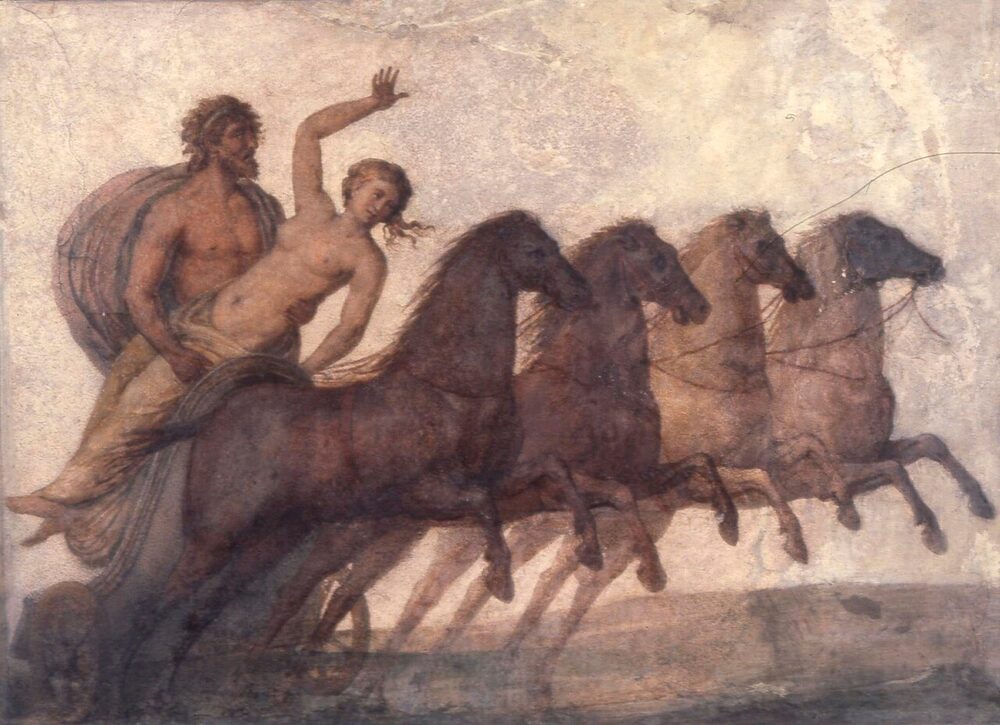
Hades
First Appearance
Hades first appears among the six children whom Rhea bore to the Titan Cronus — Hestia, Demeter, Hera, Hades, Poseidon and Zeus. Warned that his own child would overthrow him, Cronus swallowed each of them as it was born; so Hades, like his brothers and sisters, began his existence entombed within his father, and was disgorged full-grown only when Zeus at last forced Cronus to give them up.
— Hesiod, Theogony 453–467
Who They Are
Hades (HAY-deez) is the eldest brother who rules the world of the dead — and the god whose very name the Greeks preferred not to say. Fearing that to speak "Hades" aloud was to draw his attention, they called him instead Plouton, "the Wealthy One": the giver of the metals and gems buried in the ground, and of the grain that sprouts up out of the same dark earth into which the dead are laid. This is the frame in which the Greeks themselves approached him — not first as a demon of death, but as the sombre lord of everything the soil holds and hides, riches and corpses alike. His Roman name, Pluto, carries the same idea of wealth.
Only behind that gentler mask stands the grim king we more often picture: the "receiver of many" (Polydegmon), host to every mortal who ever lived, from whose realm almost no one returns. He is not evil — the Greeks did not imagine him as a devil, and he keeps his bargains and his boundaries with severe honesty — but he is inexorable. Homer calls him "the most hateful of gods to mortals," not because he is cruel but because he cannot be moved: he takes no bribes, hears few prayers, and lets no one go once they are his. He wears the Cyclopes' helm that makes its bearer invisible, an emblem of a god who is himself unseen, ruling a country no living eye surveys.
Yet his kingdom is not his alone. Beside him reigns Persephone, whose story on this page is told as an arc — carried off as an unwilling bride, she becomes over time the true and dreaded Queen of the Dead, who judges, commands the powers of the deep, and grants or refuses the petitions of those bold enough to descend. Around the pair lie the shadowed rivers, the ferryman and his fee, and the great hound at the gate; and behind them, always, the strange doubleness of a god who is at once the end of every life and the buried source of the wealth that sustains it.
Mythology
The division of the cosmos
When Zeus and his siblings had overthrown Cronus and defeated the Titans, the three brothers divided the universe between them by lot. Homer gives Poseidon the telling of it (Iliad 15.187–193): "when the lots were shaken I drew the grey sea to dwell in forever; Hades drew the misty darkness, and Zeus the wide sky; but the earth and high Olympus remain common to all three." So the underworld fell to Hades not as a punishment or a defeat but as his rightful portion, sovereign and equal in dignity to sky and sea — which is why Homer can name him "the Zeus below" (Zeus Katachthonios, Iliad 9.457). From the Cyclopes, who at the same war forged Zeus's thunderbolt and Poseidon's trident, Hades received the kunee, the cap or helm of darkness (Aïdos kyneē) that turns its wearer invisible — the "cap of Hades," made and given to him by the Cyclopes alongside his brothers' weapons (Apollodorus 1.2.1). It is a fitting emblem for the Unseen One, and it passes from hand to hand across the myths: on the battlefield of Troy Athena dons "the cap of Hades" so that not even the war-god Ares can see her (Iliad 5.844–845), and the nymphs lend it to Perseus for his hunt of the Gorgon (Apollodorus 2.4.2). That the god's own helmet is invisibility itself says everything about him — he is the lord no living eye beholds.
The abduction of Persephone — captive bride to reigning Queen
(A content note: this is the abduction myth, told here without dwelling on its violence.) The fullest telling is the Homeric Hymn to Demeter (Hymn 2). Persephone, daughter of Zeus and Demeter, was gathering flowers when she reached for a wondrous narcissus that Earth had grown as a snare; the ground yawned open and Hades, with Zeus's secret consent, carried her down to his realm to be his bride (so too Apollodorus 1.5.1). Demeter's grief blighted the earth until Zeus was forced to relent — but Hades had given Persephone a pomegranate seed to eat, and because she had tasted the food of the dead she was bound to him: she must spend a third of every year below with her husband, and two-thirds above with her mother. So the seasons were explained, and the underworld gained a queen.
But the Greek imagination did not leave her a victim. Across the wider tradition Persephone rises from stolen girl to genuine sovereign — the arc from captive to Queen. Already in Homer she is "dread Persephone" who, alongside Hades, carries out the curses mortals lay upon the dead (Iliad 9.457, 9.569). In cult and later myth she is the one who commands the powers of the deep and decides who may pass: it is Persephone, as much as Hades, whom Orpheus must move with his song; and in some tellings it is she who grants Heracles leave to take the hound, and she who each year presides over the mysteries of return. The maiden carried off against her will becomes the throned and unbending mistress of the shades — the true Queen of the Underworld the Greeks came to fear and revere.
The geography of the dead — rivers, ferryman, and the hound at the gate
The realm itself is bounded and guarded. Five rivers thread it: Styx, the water of hatred by which even the gods swear their unbreakable oaths; Acheron, the river of woe; Cocytus, the river of wailing and lament; Phlegethon (Pyriphlegethon), the river of fire; and Lethe, the water of forgetting whose draught erases the memory of the living world (the first four already named in Homer, Odyssey 10.513; Lethe chiefly in later sources). At the water's edge waits Charon, the grim ferryman, who will carry a soul across only if the fare is paid — and so the Greeks buried their dead with a small coin, an obol, placed in or beneath the tongue; the unburied and the penniless were left to wander the near shore. On the far side crouches Cerberus, the three-headed hound (with a serpent's tail and snakes upon his back, as Apollodorus 2.5.12 describes him), who fawns on all who enter and tears apart any shade who tries to leave.
Those who cheated death — Sisyphus and Asclepius
Hades' one absolute law is that his subjects stay his, and the myths dwell on the few who broke it. Sisyphus, cleverest of mortals, twice escaped: he chained up Death himself (Thanatos) so that for a time no one on earth could die, and later tricked Persephone into letting him return to the upper world — for which, once retaken, he was set to his endless stone. Asclepius, son of Apollo, grew so skilled in medicine that he began raising the dead outright, emptying the underworld of its due; at Hades' complaint that his kingdom was being robbed, Zeus struck the healer down with a thunderbolt (Apollodorus 3.10.3–4). The lesson of both is the same: the boundary Hades keeps is the one boundary the cosmos will not finally allow to be crossed.
Intruders and petitioners — Orpheus, Theseus, and Pirithous
A very few living mortals came down and stood before the thrones. Orpheus descended for his lost wife Eurydice, and with his lyre and voice did what no force could — he moved the unmovable, drawing tears from the shades and softening even Hades and Persephone, who granted that Eurydice might follow him back on one condition: he must not look behind until both had reached the light. At the very threshold, doubting, he turned — and she slipped back into the dark forever (the tender, tragic version is Roman, told by Virgil, Georgics 4.453–527, and Ovid, Metamorphoses 10.1–85). Others came with force and fared worse: Theseus and Pirithous descended meaning to carry off Persephone herself as a bride for Pirithous. Hades received them with false courtesy, seating them on the Chair of Forgetfulness, where they grew fast to the stone and lost all memory. When Heracles came for his twelfth labour to fetch Cerberus — which Hades permitted him to take, provided he mastered the beast bare-handed (Apollodorus 2.5.12) — he was able to wrench Theseus free, but the earth quaked when he pulled at Pirithous, and that bolder trespasser was left below forever.
Worship — Ancient
A god almost without temples
Hades is the great exception among the major Greek gods: he was worshipped almost nowhere. Where every city had its temples of Zeus, Athena or Apollo, shrines to Hades were vanishingly rare, and Pausanias singles out the reason as remarkable — the Eleans, he says, are the only Greeks he knows to honour Hades with a temple and precinct at all, opened just one day a year and entered by none but the priest (Description of Greece 6.25.2). The cause was the same name-dread that produced his euphemisms: men did not wish to build houses for death or to call its lord by name. When they did approach him it was often under the softened figure of Plouton, the wealth-giver — as at the Ploutonion at Eleusis, where he was received beside Demeter and Persephone in the Mysteries as a power of hope rather than horror.
Chthonic rites
What worship he did receive followed the aversive pattern of the chthonic (underworld) powers, sharply distinct from Olympian sacrifice. Where the sky-gods were given light-coloured victims on raised altars with the worshipper's face turned up and hands raised, Hades and the powers below received black victims — a black ram or ewe — slaughtered over a low pit or trench so the blood ran down into the earth, at night, with the sacrificer's face turned away and the whole offering burnt entire and given wholly to the god, never shared in a feast. Libations were poured directly into the ground: honey, milk, water, sometimes wine. To make contact with the dead themselves, Greeks might visit an oracle of the dead, a nekromanteion — the most famous stood on the river Acheron in Epirus, near where Acheron and Cocytus meet, where petitioners sought to summon and question the shades in the domain of Hades and Persephone.
Dread Persephone — the more feared of the pair
It is one of the quiet surprises of Greek religion that, of the two who ruled below, it was often Persephone rather than Hades whom the living more actively dreaded and invoked. Where Hades was so shunned that men would scarcely speak his name, Homer names his queen without flinching and with a fixed epithet of terror — epainē Persephoneia, "dread Persephone" — and it is she, at least as much as her husband, who is called upon to fulfil the curses mortals lay upon one another (Iliad 9.457, 9.569). Her name recurs among the powers of the deep summoned on the lead curse-tablets (defixiones) by which Greeks consigned their enemies to the underworld: to bind a foe, one wrote his name and gave it over to the chthonic queen. Hades kept his terrible silence and his few and shunned shrines; Persephone, throned beside him, was the more present and more dreadful figure in the imagination of the living — the sovereign who was actually addressed, feared, and asked to act.
Worship — Modern
Honouring Hades today
Modern Hellenic practice approaches Hades with reverence and without fear, and — importantly — without any literal blood sacrifice; the aversive rites of antiquity are studied, not re-enacted. Many devotees prefer his kindlier names, addressing him as Plouton, the giver of the earth's wealth, or invoking him and Persephone together as the royal couple of the underworld. A simple household shrine might hold a dark cloth, a sprig of cypress or a few grains, a pomegranate, and an unlit or steadily burning lamp. Because he is a god of the earth, his rites are naturally quieter and more inward than those of the bright Olympians — fitting for the lord of endings, memory, and the dead we carry with us.
Offerings and prayer
In place of the old black victims, a modern offering is a libation poured onto the earth — water, milk, honey, or wine — set down and left to the god rather than consumed. Cypress, narcissus, pomegranate, barley, and incense are all fitting gifts, as is a candle lit in memory of the dead. Address him with respect and calm rather than pleading, for he was always the god who could not be flattered. Call on Plouton in gratitude for the sustenance and wealth that come up out of the ground; on Eubouleus, "of good counsel," when seeking wisdom or peace with what cannot be changed; and remember Persephone beside him as Queen, honouring the two together. Prayers for the dead — a name spoken, a libation poured, a light kindled — are perhaps the most natural devotion of all to the Host of Many, into whose keeping every life at last is given.
Epithets & Cult Titles
- Plouton (Πλούτων) — The Wealthy One, the Rich — giver of the buried metals and the grain that rises from below; the favourable name Greeks used in place of his dreaded true one
- Aïdoneus (Ἀϊδωνεύς) — The Unseen — a lengthened, epic form of the name Hades itself, the lord no living eye beholds
- Chthonios (Χθόνιος) — Of the earth, the one beneath the ground — marking him among the powers of the deep as against the bright Olympians
- Polydegmon / Polydektes (Πολυδέγμων / Πολυδέκτης) — Receiver of Many, Host of Many — the king to whose halls every mortal at last comes as a guest
- Klymenos (Κλύμενος) — The Renowned, the Notorious — a euphemism that names his fame without naming him, used in cult at Hermione
- Eubouleus (Εὐβουλεύς) — Of Good Counsel — a gentling, Eleusinian title that flatters the dread god with wisdom and goodwill
- Zeus Katachthonios (Ζεὺς Καταχθόνιος) — The Zeus Below, the subterranean Zeus — Homer's phrase (Iliad 9.457) casting Hades as sovereign of the dead as Zeus is of the sky
Sources & Variants
- Hesiod, Theogony 453–467 (birth and swallowing by Cronus), 617–735 (Titanomachy and the division that follows)
- Homer, Iliad 15.187–193 (division of the cosmos by lot); 9.457, 9.569 (Zeus Katachthonios; Hades and dread Persephone fulfil mortal curses)
- Homer, Odyssey 10.508–515; 11 (the rivers of the underworld and the summoning of the dead)
- Homeric Hymn 2 (to Demeter), esp. 1–89, 334–433 (the abduction of Persephone, the pomegranate seed, and the division of her year)
- Homer, Iliad 5.844–845 (Athena wears the cap of Hades so that Ares cannot see her)
- Apollodorus, Bibliotheca 1.2.1 (the Cyclopes make and give Hades the cap of invisibility); 1.5.1 (abduction of Persephone); 2.4.2 (the nymphs lend Perseus the cap of Hades); 2.5.12 (Cerberus, and Theseus and Pirithous in the underworld); 3.10.3–4 (Asclepius struck down for raising the dead)
- Pausanias, Description of Greece 6.25.2 (the temple of Hades at Elis, opened once a year and entered only by the priest)
- Virgil, Georgics 4.453–527, and Ovid, Metamorphoses 10.1–85 (the Roman telling of Orpheus and Eurydice)
Gallery