Cronus
First Appearance
Cronus first appears as the last-born of the twelve Titans, the children of Gaia (Earth) and Uranus (Heaven): "and last of all she bore Cronus of the crooked schemes, most terrible of her children, and he hated his lusty sire." From his first mention Hesiod fixes both facts that will define him — his cunning (ankylomētēs) and his enmity toward his father.
— Hesiod, Theogony 132–138
Who They Are
Cronus (KROH-nus; Greek Κρόνος, Kronos) is the youngest of the first Titans, the son who overthrew his father Uranus and ruled the cosmos as king of the gods in the long age before Zeus. He is one of the twelve Titans born to Gaia (Earth) and Uranus (Heaven), and with his sister-consort Rhea he fathered the first Olympians — Hestia, Demeter, Hera, Hades, Poseidon, and Zeus. He stands at the hinge of the divine succession: the son who unseated one sky-father, and the father who was in turn unseated by his own son.
The Greeks held two irreconcilable pictures of him, and this page deliberately holds both without resolving them. In Hesiod's Theogony he is a figure of dread — "crooked-counselled" Cronus, who mutilated his own father and then, to escape the same fate, swallowed his children one by one as they were born. Yet in Hesiod's Works and Days the reign of Cronus is remembered as the lost Golden Age: the time when the first race of mortals lived like gods, without labour, grief, or old age, and the earth gave its fruit unbidden. The devouring tyrant and the blessed king are the same god, and the tradition never reconciled them.
His chief emblem is the sickle (harpē), the curved harvest-blade with which he cut down Uranus — a weapon that would echo down through Greek myth and, by way of his likeness to the grain and harvest, feed his eventual fusion with the Roman Saturn, god of sowing. His name was also drawn, in later philosophy, into a famous confusion with Chronos, "Time" — a conflation flagged below as an allegory, not an etymology.
Mythology
Content note: this figure's central myths involve the mutilation of a parent and a father who devours his own newborn children. The account below is frank but not graphic.
The castration of Uranus
Uranus, the first sky-king, hated the children Gaia bore him and, as each came forth, pressed them back and hid them away in the depths of the Earth, so that Gaia groaned within, crowded and constrained. In her pain she fashioned a great sickle of grey adamant (harpē) and called on her children to punish their father's cruelty. Fear seized them all, and none would answer — none but Cronus. Alone of the Titans he dared. "I will do it," he said, "and I care nothing for our father of evil name." Gaia hid him in ambush and set the toothed sickle in his hand. When Uranus came with the night and lay upon the Earth in desire, Cronus reached out from his hiding place, seized his father, and with the sickle cut away his genitals, casting them behind him into the sea. From the drops of blood that fell upon the Earth sprang the Furies (Erinyes), the Giants, and the ash-tree nymphs; from the severed flesh, carried on the foam of the sea, was born Aphrodite. (Told from Uranus's side on his own page; here it is Cronus's deed, and it is the founding act of his reign.)
So Cronus took the sovereignty of heaven — but the dying Uranus named the Titans (Titēnes) in bitter prophecy, "the straining ones," warning that vengeance would come for the deed.
The swallowing of his children
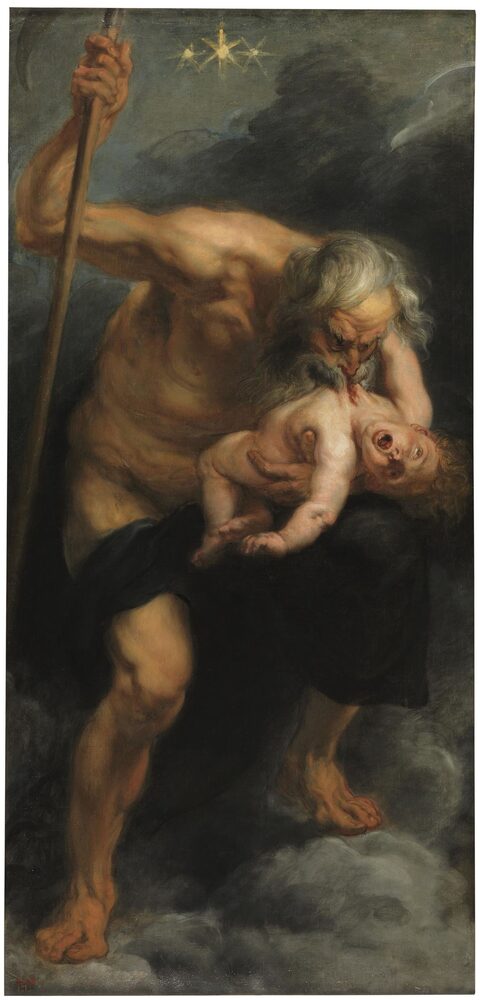
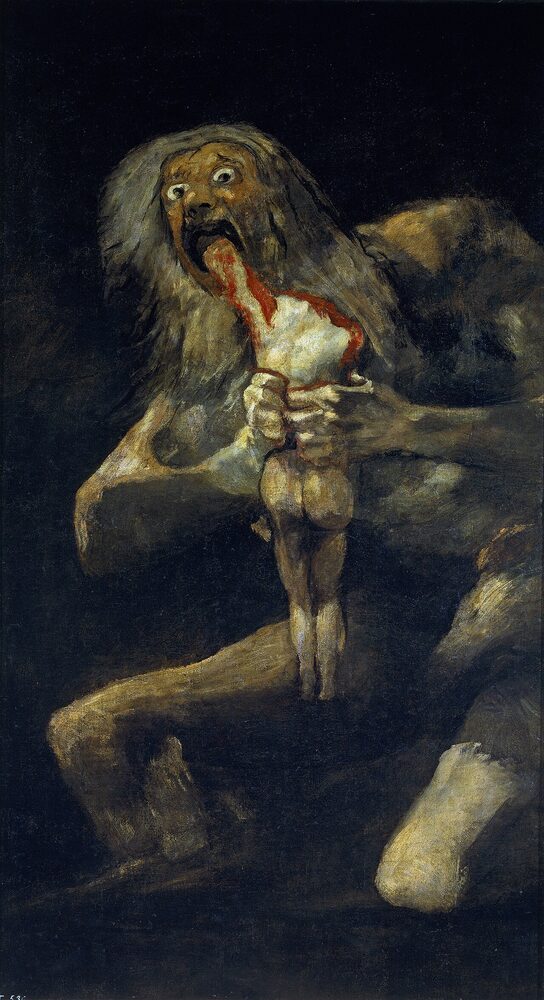
Cronus took his sister Rhea to wife, and she bore him glorious children — Hestia, Demeter, Hera, Hades, and Poseidon — and last of all Zeus. But Cronus swallowed each one as it came from its mother's womb, the moment it reached her knees. He did this because he had learned from Gaia and starry Uranus that he was destined to be overthrown by his own child — that as he had overpowered his father, so a son of his would overpower him in turn. Wakeful and unsleeping in his fear, he watched for each birth and swallowed his children alive, and grief beyond forgetting seized Rhea.
When she was heavy with Zeus, the last, Rhea begged Gaia and Uranus to help her contrive a plan to save him and to make Cronus pay for the children he had devoured. They sent her to Crete. There, in a deep cave beneath the earth, she bore Zeus in secret, and Gaia took the child to rear. To Cronus, Rhea gave in his stead a great stone wrapped in swaddling-clothes. He seized it in his hands and swallowed it down, never suspecting that in place of the stone his own unconquered son had been left alive, the son who would soon overthrow him.
Grown to strength, Zeus forced his father to disgorge his children. By the cunning of Gaia (and, in some tellings, an emetic drug), Cronus vomited up first the stone he had swallowed last, and then the five children, alive and whole. Zeus set the stone at holy Pytho (Delphi) beneath the glens of Parnassus, a sign and a marvel for mortal men — the Omphalos that pilgrims saw for centuries after. The disgorged children became the first Olympians, and with them Zeus made war on Cronus and the Titans.
The paradox: tyrant and Golden King
Here the tradition splits and will not be mended. The Theogony's Cronus is the paranoid devourer above. But Hesiod's Works and Days (109–126) tells of the Golden Age, the first and best of the ages of mortals, "when Cronus was king in heaven." Then men lived like gods, with hearts free of sorrow, far from toil and grief; wretched old age did not touch them; they took their joy in feasting, and the fertile earth bore its fruit abundantly of its own accord, while they lived in ease and peace. When that race was covered by the earth, they became pure spirits (daimones), guardians of mortal men.
The Greeks did not choose between these Cronuses. The same god is the harvest-king of a lost paradise and the child-swallowing tyrant of the succession myth — plenty and dread in one figure. The tension is left to stand.
The Titanomachy and his fate
For ten years Zeus and the Olympians warred against Cronus and the Titans, the gods entrenched on Olympus and the Titans on Othrys. Zeus freed the Cyclopes, who forged him the thunderbolt, and the three Hundred-Handers, whose hurled boulders overwhelmed the older gods. The Titans were beaten.
In Hesiod, Cronus's fate is Tartarus (Theogony 617–735): bound with the other defeated Titans and cast down into the misty gloom of the pit, as far beneath the earth as heaven is above it, behind bronze gates, with the Hundred-Handers set as their guards. This is the primary account, and this page leads with it.
But an alternative tradition softens the ending. In it Cronus is at length released and reconciled, sent to reign in peace over the Isles of the Blessed at the ends of the earth, where the heroes dwell in a renewed golden age (a strand rooted in Hesiod's Works and Days 168–173, where the fourth race of heroes is settled untouched by sorrow at the ends of the earth; a disputed appended line, Works and Days 173a, adds that Cronus himself reigns over them — the golden king restored — and the idea is developed more securely by Pindar and later writers). In the Roman form of this tradition, the deposed Cronus, as Saturn, fled westward to Italy and there ruled Latium in a golden age of his own, teaching men agriculture — the reason the Romans held their Saturnalia in his honour, that midwinter festival of feasting and reversal (see Festivals).
The afterlife of the sickle
The curved blade Cronus wielded — the harpē — did not vanish with him. The same distinctive weapon recurs in the hand of Perseus when he beheads Medusa, and its shape lived on in the sickle of the grain-harvest. This harvest association, more than any true etymology, drew Cronus toward his identification with Saturn, the Roman god of sowing and the harvest, so that the god of the succession myth became, in Italy, a benign old king of the plough.
A note on Kronos and Chronos ("Time")
Because their names sound alike, Cronus (Kronos) was identified in later thought with Chronos, "Time" — but this is a philosophical allegory, not a genuine etymology. Kronos and Chronos are different words, and the ancient scholars who equated them were reading meaning into a resemblance of sound. The identification took hold among the Orphics and especially the Stoics, who allegorised the myths of the gods into truths about the cosmos: the god who devoured his own children became an image of Time, which brings all things to birth and consumes them again — "Time devours all." The child-swallowing myth made the reading irresistible, and through it Cronus/Saturn became, and remains, an emblem of devouring Time. But the Golden Thread flags it clearly: this is a later interpretation laid over the god, not the origin of his name.
Worship — Ancient
A god more of story than of altar
Cronus had comparatively little living cult in the Greek world; he belonged more to the poets' account of the world's beginnings than to the daily religion of the cities. Where he was honoured, it was above all as a god of the harvest and of the vanished age of ease that his reign recalled. Pausanias records the Hill of Cronus (Kronion) at Olympia, where the keepers called the "Basilai" offered sacrifice to him at the spring equinox.
The Kronia
His principal Athenian festival was the Kronia, held at the height of summer as the grain was gathered in. Its character was that of a harvest-home and, strikingly, of social reversal: the ordinary hierarchy was set aside, and masters and slaves ate together at the same table as equals. In this the festival re-enacted, for a day, the classless ease of the Golden Age when Cronus was king — the same impulse that the Romans would carry to its fullest in the Saturnalia (see Festivals). Offerings fitting a harvest-god were given: honey-cakes, the first-fruits of the grain, and libations.
Worship — Modern
Honouring Cronus today
Cronus is a god approached with care and clear sight, for his myth holds real darkness. A modern devotee honours him best not as a monster but as what the tradition also made him: the king of the harvest and of the lost Golden Age, the god of the turning of the seasons and of time's great cycles of ripening and reaping. A simple shrine — a sheaf of wheat or a few ears of grain, a sickle or a curved blade in image, and a lamp — gives him a fitting place. He is a god of the old order, of endings that clear the ground for what follows, and reverence toward him is reverence toward time itself and the harvests it brings and takes.
Offerings
As a harvest-god, Cronus is most naturally given the first-fruits of the grain — bread, barley, a sheaf or a few ears of wheat — together with honey-cakes and a libation of wine poured onto the earth. The high summer, at the gathering-in of the harvest, and the turning of the year are especially apt times to remember him. Present the offering with thanks for what has ripened and been reaped, and set it aside afterward so that it is truly the god's.
Reflection & reverence
Where the myths of Zeus invite celebration, the myths of Cronus invite reflection — on time, on succession, on the passing of one order and the coming of the next, on plenty and its loss. Devotees may keep the Kronia in high summer as a harvest-thanksgiving, or mark the midwinter turn with a quiet observance of Saturn's season. Honour him as Ankylomētēs with clear eyes — the cunning old king — and as the lord of the Golden Age with longing for the ease the world once knew; hold, as the Greeks did, both faces at once.
Epithets & Cult Titles
- Ankylomētēs (Ἀγκυλομήτης) — Crooked-counselled, of crooked schemes — Hesiod's standing epithet for Cronus, marking his cunning and his twisting purpose
- King of the Titans — Youngest and mightiest of the first Titans, who ruled the cosmos in the age before the Olympians
- Lord of the Golden Age — In Works & Days, the blessed king under whom the first, golden race of mortals lived like gods, free of toil and sorrow
Sources & Variants
- Hesiod, Theogony 132–138 (birth of Cronus), 154–182 (the castration of Uranus), 453–506 (the swallowing of the children and the stone), 617–735 (the Titanomachy and Tartarus)
- Hesiod, Works and Days 109–126 (the Golden Age under Cronus); 168–173 (the heroes at the ends of the earth), with the disputed appended line 173a making Cronus reign over them
- Apollodorus, Bibliotheca 1.1–2 (the succession of Uranus, Cronus, and Zeus; the disgorging of the children)
- Pausanias, Description of Greece 6.20.1 (the Hill of Cronus and his cult at Olympia); 8.36.2–3 (Rhea and the stone)
- Pindar, Olympian 2.68–77 (Cronus reconciled, king over the Isles of the Blessed)
- On the later Kronos = Chronos ('Time') allegory: the Orphic theogonies and Stoic allegorists (e.g. Cicero, De Natura Deorum 2.64) — a philosophical identification, not an etymology
Gallery