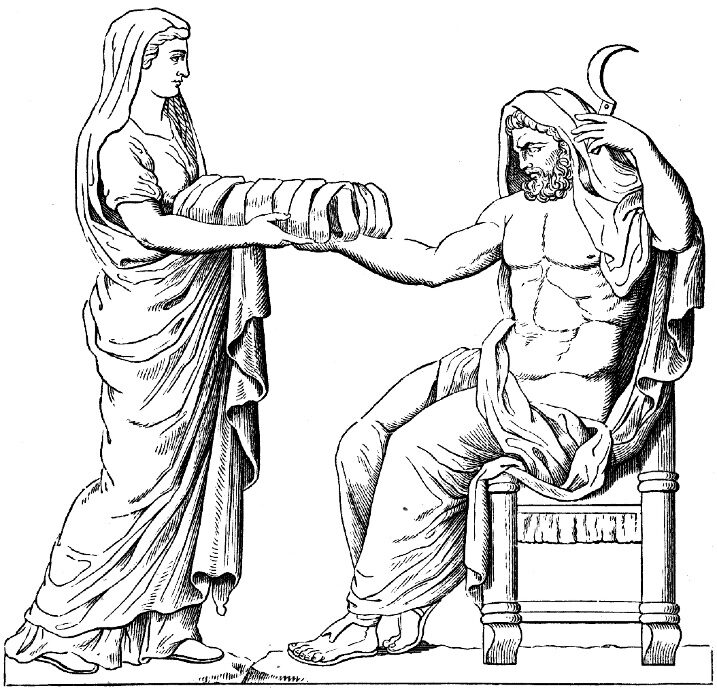
Rhea
First Appearance
Rhea first appears as a daughter of Earth (Gaia) and Sky (Uranus) who, subdued in love by her brother Cronus, bore the splendid children Hestia, Demeter and Hera, strong Hades, Poseidon the earth-shaker, and wise Zeus. But Cronus, warned that he was fated to be overcome by his own child, swallowed each of them as it came from the holy womb — and so began the grief that would move Rhea to save her youngest and undo her husband.
— Hesiod, Theogony 453–467
Who They Are
Rhea (REE-uh; Greek Ῥέα) is the Titaness of motherhood and generation, daughter of Gaia (Earth) and Uranus (Sky), and the mother of the first generation of Olympian gods. Wife and sister of the Titan Cronus, she bore him six children — Hestia, Demeter, Hera, Hades, Poseidon and Zeus — and it is through her that the ruling gods of Greek myth come into being. If Gaia is the deep body of the earth itself, Rhea is the maternal power a step nearer to the human: the goddess who suffers as a mother, schemes to protect her child, and stands at the hinge between the age of the Titans and the age of Olympus.
Her defining story is one of grief turned to cunning. Cronus, fearing a prophecy that one of his own children would overthrow him as he had overthrown his father, swallowed each newborn whole. Rhea, unable to bear it, saved her sixth child by hiding the infant Zeus in a cave on Crete and giving Cronus a swaddled stone to swallow in his place. That single act of maternal defiance sets in motion the fall of the Titans and the rise of the Olympian order — so that Rhea, though she never rules, is the mother of the world that does.
The Greeks came to identify Rhea closely with the Anatolian mountain-goddess Cybele, the "Great Mother" attended by lions and worshipped with drums, cymbals and ecstatic dancing. This syncretism — a later overlay, not her original nature — gave the archaic Titaness a vivid cult life across the Greek and Roman worlds, where she was honoured as Mētēr Theōn, the Mother of the Gods, and (at Rome) as the Magna Mater.
Mythology
The swallowing of the children
Rhea's marriage to Cronus began in sorrow. Cronus had learned from Gaia and Uranus that he was destined to be overthrown by one of his own sons, just as he had castrated and supplanted his own father Uranus. To cheat the prophecy, he swallowed each child the moment Rhea bore it — Hestia first, then Demeter and Hera, then Hades and Poseidon — each vanishing whole into their father's belly, alive but imprisoned. Rhea's grief was measureless, and when she found herself pregnant a sixth time she resolved that this child, at least, Cronus would not have (Hesiod, Theogony 453–468).
The rescue of the infant Zeus
Heavy with her last child, Rhea turned to her parents, Gaia and Uranus, and begged them for a plan to save the baby and make Cronus pay for the children he had swallowed. They told her what was fated and sent her to Crete. There, in secret, Rhea bore Zeus in the dead of night and gave the newborn into the keeping of Gaia (in other tellings, of nymphs), to be hidden away and raised far from his father's reach. In the child's place she took a great stone, wrapped it in swaddling-clothes as though it were a baby, and carried it to Cronus. Suspecting nothing, he seized the stone and swallowed it down — never guessing that his conqueror lived, safe and growing in his island hiding-place (Hesiod, Theogony 468–491; Apollodorus 1.1.5–1.1.7). That swaddled stone would later be set up at Delphi, where Pausanias reports it was still shown and anointed in his own day.
Mount Ida, the Dictaean cave, and the Kouretes
The tradition places Zeus's secret nursing in the mountains of Crete. The most common accounts name Mount Ida, though a widespread variant sets it in the Dictaean cave on Mount Dicte in the island's east; ancient authors differ, and both mountains claimed the honour (Apollodorus 1.1.6–7; Diodorus Siculus 5.70). To guard the infant, Rhea set over him the Kouretes (Curetes), armed youths — daimonic attendants of the Great Mother — who danced around the cradle in their war-gear, clashing their spears against their shields so that the din of bronze on bronze would drown out the baby's crying and Cronus, listening from afar, would never hear his son. The she-goat Amalthea suckled the child, and bees are said to have fed him honey. The Kouretes' armed dance became the mythic origin of the ecstatic, clashing music that always attended Rhea's later worship.
Freeing the swallowed children
Rhea's rescue of Zeus was only the beginning of her design; the plan reached its end when the grown Zeus returned to force his father to give up the children he had swallowed. By cunning — in Apollodorus's account, through a drug prepared by the Titaness Metis, an emetic that Cronus was made to take — Cronus vomited up all he had swallowed: first the stone, and then, alive and full-grown, Hestia, Demeter, Hera, Hades and Poseidon (Apollodorus 1.2.1). The disgorged brothers and sisters, freed by the mother who had schemed for years to save them, joined Zeus in the ten-year war against the Titans, at the end of which Cronus and his kin were cast down into Tartarus and the reign of the Olympians — Rhea's own children — began.
Rhea and the birth of Persephone's world
In the aftermath, Rhea remains a figure of maternal continuity between the generations. In the Homeric Hymn to Demeter it is Rhea whom Zeus sends down as messenger and reconciler to the grieving Demeter — her own daughter — to bring her back to Olympus and settle the terms of Persephone's return from the underworld. Even in the Olympian age, the mother of the gods keeps her ancient role: the one who mediates, consoles, and holds the divine family together.
Worship — Ancient
Rhea and the Great Mother
In her oldest Greek form Rhea had only a modest independent cult; she was honoured chiefly as Mētēr Theōn, "Mother of the Gods," the Titaness who bore the Olympians. Her worship gained enormous vividness, however, through her assimilation to Cybele, the Great Mother of Phrygia and the Anatolian highlands. This was a syncretism — a later Greek identification of two originally distinct goddesses, not Rhea's primal nature — but it became so complete that Greek writers used "Rhea" and "Cybele" almost interchangeably. Strabo (Geography 10.3) discusses this fusion at length, connecting Rhea's Cretan Kouretes with the Phrygian Korybantes and the ecstatic mountain rites of Cybele, and treating the clashing armed dance as the common thread that bound the two traditions together. From Cybele, Rhea took her lions, her chariot, her mural crown, and above all her tympana (hand-drums) and cymbals — the loud, ecstatic music that echoed the Kouretes' shields.
Cult centres and rites
As the Great Mother, Rhea-Cybele was worshipped across the Greek world and especially in Asia Minor, with mountain sanctuaries on Ida in the Troad and Ida in Crete, and a great cult centre at Pessinus in Phrygia. Her rites were unlike the sober offerings of the Olympians: torch-lit night processions in the mountains, the roar of drums and cymbals, ecstatic dancing, and the frenzied devotion of her attendant Korybantes. At Athens she had a temple, the Mētrōon in the Agora, which doubled as the city's public record-office — the archives of the state kept under the Mother's protection. Diodorus Siculus (Book 5) preserves a full Cretan account of her, and Euripides evokes her ecstatic mountain worship in the choruses of the Bacchae and Helen.
Rome and the Magna Mater
At Rome, Rhea-Cybele became the Magna Mater, the "Great Mother." In 204 BCE, on the counsel of the Sibylline Books during the war with Hannibal, the Romans fetched her sacred black stone from Pessinus to Rome and installed her on the Palatine, where her temple stood and her festival, the Megalesia, was celebrated each April with games and processions. Her eunuch priests, the Galli, served her with the same wild music and self-mortification that marked her eastern worship, so that the archaic Titaness-mother of Greek myth lived on at the heart of the Roman state.
Worship — Modern
Honouring Rhea today
A modern devotee approaches Rhea as the Mother of the Gods — the goddess of motherhood, of generation, and of the fierce protective love that will risk everything for a child. A simple home shrine suits her: a clean shelf bearing an image of a seated goddess, a lion, or a hand-drum, with a lamp or candle and perhaps a sprig of oak or pine. Because her worship was always bound up with music, some devotees mark her rites with the beat of a drum. Approach her with warmth and respect, as one turns to a mother.
Offerings
Fitting offerings echo her nurturing and fruitful character: milk and honey, first-fruits and grain, cakes, olive oil, and incense poured out or set aside for the goddess. A libation of milk or honeyed water is especially apt to the Mother who fed the infant Zeus. Present the offering with a few words of thanks, and afterward give it wholly to her — pour it onto the earth or set it apart — so that what was offered is truly hers.
Prayer & devotion
Call on Rhea as Mētēr Theōn, Mother of the Gods, in matters of motherhood, childbirth, family, and the protection of children — remembering the mother who hid her child from a devouring father and never gave up on those she had lost. In her syncretic form as Cybele, the Great Mother, she is invoked with drum and cymbal as a goddess of wild places, of the fertile and untamed earth, and of ecstatic release. Honour her, above all, as the source of the Olympian order — the mother without whose courage and cunning the gods themselves would never have come to reign.
Epithets & Cult Titles
- Mētēr Theōn (Μήτηρ Θεῶν) — Mother of the Gods — the Titaness who bore the first Olympians
- Megalē Mētēr — The Great Mother — her title once she was assimilated to the Anatolian Cybele (Latin Magna Mater)
- Rhea Kybelē — Rhea Cybele — the syncretic name under which Greeks worshipped her as the ecstatic mountain-mother
Sources & Variants
- Hesiod, Theogony 453–491 (the swallowing of the children, the rescue of Zeus, and the swaddled stone)
- Apollodorus, Bibliotheca 1.1.5–1.1.7 (Rhea, Cronus, and the birth of Zeus on Crete); 1.2.1 (Cronus made to disgorge the children by Metis's drug)
- Diodorus Siculus, Library of History 5.65–5.70 (Cretan account of Rhea, the Kouretes, and Zeus's upbringing)
- Strabo, Geography 10.3 (Kouretes, Korybantes, and the syncretism of Rhea with Cybele)
- Homeric Hymn 14 to the Mother of the Gods; Homeric Hymn 2 to Demeter 441–469 (Rhea as reconciler)
- Pausanias, Description of Greece 10.24.6 (the swaddled stone shown at Delphi)
Gallery