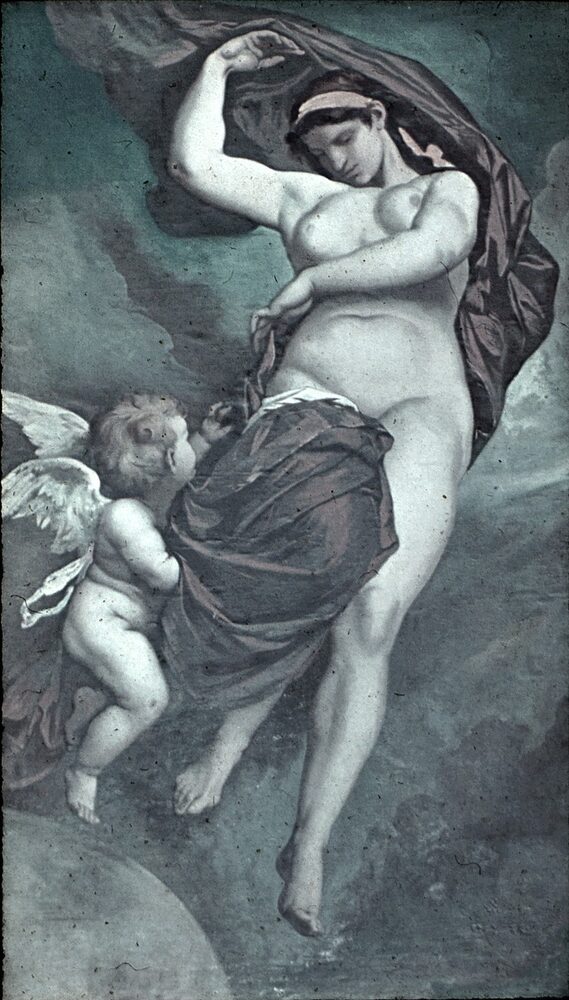
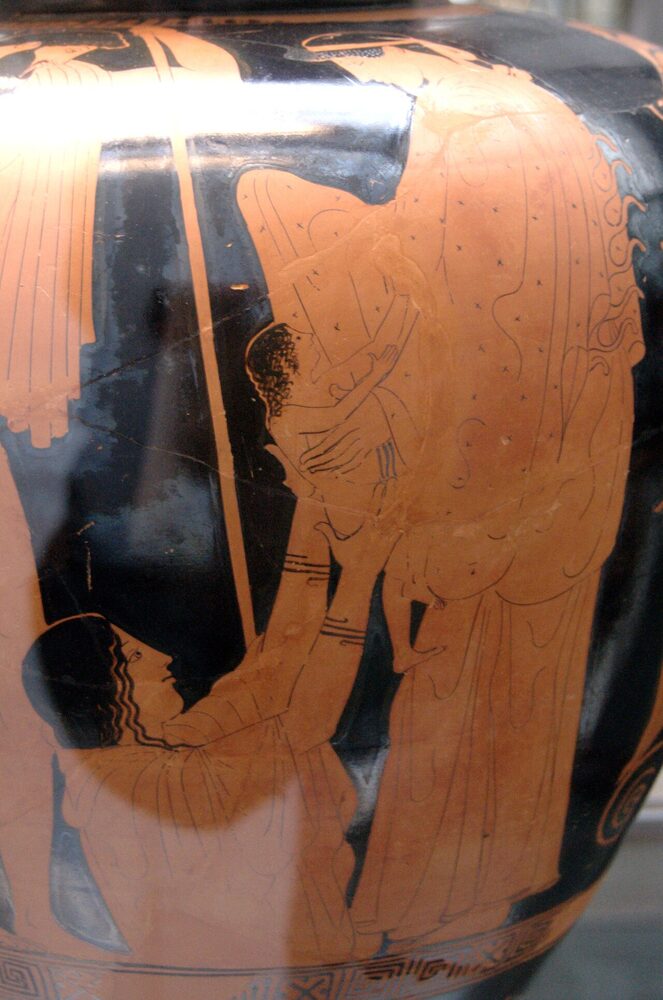
Gaia
First Appearance
Gaia appears at the very beginning of the cosmos. First of all, Hesiod says, Chaos came into being; and then broad-breasted Gaia, the ever-sure foundation of all the immortals who hold the peaks of snowy Olympus. She arises not as anyone's child but as one of the first powers of existence, the solid ground beneath everything that will come after — and from herself, without any mate, she brings forth starry Uranus (the Sky) to cover her on every side, and the Mountains and the barren deep of Pontus (the Sea).
— Hesiod, Theogony 116–125
Who They Are
Gaia (GY-uh or GAY-uh) is the primordial Earth — one of the first beings to emerge in the Greek account of how the world came to be, and the deep foundation on which all later creation rests. She is not merely a goddess of the earth but the earth itself made conscious and generative: broad-breasted, ever-sure, the ground that holds up gods and mortals alike and receives them again in death. Her Greek name is simply gaia or gē, "earth," and the sciences we call geo-graphy and geo-logy still carry her name.
In Hesiod's Theogony she comes into being just after Chaos, before there is sky, sea, or ordered world, and she begins to fill the emptiness by giving birth. Alone, without any father, she bears Uranus the starry Sky to be her equal and her covering, then the Mountains and the sea called Pontus. Uniting afterward with Uranus she becomes the great ancestress of the divine world — mother of the twelve Titans, of the three thunder-forging Cyclopes, and of the three hundred-handed giants — and through her further unions the grandmother of nearly every god who follows.
But Gaia is far more than a fertile mother. She is the oldest wisdom in the cosmos and its deepest will. She knows what is destined before anyone else, and again and again she sets that knowledge in motion — arming her son Cronus against his tyrant father, and later guiding her granddaughter Rhea to save the infant Zeus from the same tyranny in turn. She is the prophetic voice that first spoke at Delphi, ages before Apollo; she is the earth that can no longer bear a cruelty and rises to end it. To the Greeks she was ancient, patient, and not to be crossed: the ground that gives all gifts, keeps all oaths sworn upon her, and outlasts every king who thinks himself her master.
Mythology
The prime mover of the succession myth
More than any other figure, Gaia is the intelligence that drives the great generational turnover of divine kings — the pattern by which one ruler of the cosmos is overthrown by his own child, again and again, until the order finally settles. She is the Earth's deep, prophetic will, and twice she is the hidden hand behind the fall of a tyrant. What follows below is her central myth, told in full.
The imprisonment of her children
Content note: this myth involves violence against family, including a son's mutilation of his father.
Gaia's first husband was her own son Uranus, the Sky, whom she had brought forth to cover her. Together they conceived the eldest generation of gods: the twelve Titans, the three Cyclopes ("Round-eyes") who would one day forge the thunderbolt, and the three Hundred-Handers, the Hecatoncheires — Cottus, Briareus, and Gyges — vast beings each with a hundred arms and fifty heads. But Uranus hated his own offspring. As each was born, Hesiod says, he hid them away in the depths of Gaia — pressing them back into the earth, into her own body, so that they never came up into the light. Gaia, crushed and groaning within, was strained to bursting by the children imprisoned in her.
The grey sickle and the ambush
Aching under this cruelty, Gaia devised a plan. From within herself she created a new grey element — adamant, a stone hard as flint — and shaped from it a great jagged sickle. Then she gathered her children and appealed to them, telling them their father had begun the outrage and asking who among them would help her punish him. Fear seized them all, and no one dared to speak — all but one. Cronus, the youngest and boldest of the Titans, took courage and answered his mother that he would do the deed, for he too despised their brutal father. Gaia rejoiced. She hid him in ambush and put the sickle of grey flint into his hand and told him her whole design.
That night Uranus came, bringing on the darkness and stretching himself over Gaia in desire. From his hiding place Cronus reached out with his left hand, took the great sickle in his right, and struck — cutting away his father's genitals and flinging them behind him into the sea. The drops of blood that fell upon Gaia she received into herself, and in time bore from them the avenging Erinyes (the Furies), the armored Giants, and the ash-tree nymphs called the Meliae. From the severed flesh cast upon the waves rose Aphrodite. So the reign of the first sky-king was broken, exactly as the Earth had willed it — and Uranus, in his agony, named his rebel children Titans, "the Strainers," and foretold that vengeance would come upon them in their turn.
The second overthrow: Cronus and the saving of Zeus
Gaia's prophecy did not spare the son who had served her. Cronus took the kingship but ruled as fearfully as his father, for Gaia and Uranus together had warned him of a fixed destiny: that he too was fated to be overcome by his own child. To escape it, Cronus swallowed each baby that his wife Rhea bore — Hestia, Demeter, Hera, Hades, Poseidon — as soon as it was born. Rhea, grieving without end, turned to her parents Gaia and Uranus for counsel, and they told her how to save her youngest and repay the crimes of Cronus. When Zeus was due, they sent Rhea to Crete, and Gaia herself received the newborn from her daughter and hid him away in a deep cave in the earth to raise him in secret. To Cronus, Rhea gave a great stone wrapped in swaddling-clothes, which he swallowed whole, never suspecting that his conqueror had escaped.
Freeing the Cyclopes and the Hundred-Handers
When Zeus was grown and warred against the Titans, it was again the Earth's ancient counsel that turned the tide. Gaia prophesied that Zeus would win victory only with the help of the very beings the older kings had kept imprisoned. On her advice Zeus went down and freed the three Cyclopes, who in gratitude forged for him the thunder and the lightning-bolt, and released the three Hundred-Handers from their bonds beneath the earth, whose hurled boulders overwhelmed the Titans. So the Titans were cast down into Tartarus, and Zeus won the kingship — because Gaia, having raised up two kings and pulled down two, had chosen him.
Typhon, the Earth's last challenger
Yet Gaia was not simply the friend of the Olympians. When the Titans lay defeated and Zeus reigned supreme, Hesiod tells that Gaia, uniting with Tartarus, brought forth her last and most terrible child: Typhon (also Typhoeus), a monster of colossal size with a hundred serpent-heads flickering fire and voicing every dreadful sound. Had he prevailed, he would have ruled over gods and men. But Zeus met thunder with thunder, blasting Typhon with an unceasing storm of bolts until the earth itself melted, and hurled him down into Tartarus. Later poets made Typhon expressly the Earth's revenge for her defeated children the Titans and Giants — the sign that Gaia, mother of all, could still rise against even the king she had helped to crown.
The Giants and the Gigantomachy
In the tradition that grows after Hesiod, the Giants (the Gigantes) — born, as told above, from the blood of the castrated Uranus that fell on Gaia — become another of the Earth's broods raised against the gods. In this later myth Gaia, angered at the imprisonment of her Titan sons, rouses the Giants to storm Olympus, and the gods can defeat them only with the help of a mortal, Heracles. Gaia even seeks a magic herb to make her Giants invulnerable, but Zeus forestalls her. The Gigantomachy became one of the great subjects of Greek art, a mirror of the older Titan-war and one more chapter in the long struggle between the primal Earth and the ordered heaven.
The first oracle at Delphi
Long before Delphi belonged to Apollo, it belonged to Gaia. In the oldest tradition the Earth herself was the first prophetic power to speak there — the prophetic voice rising from a cleft in the ground — and she guarded the sanctuary through a line of successors. Aeschylus, in the opening lines of the Eumenides, has the Pythia name the succession: first Gaia held the oracle, then her daughter Themis, then the Titan Phoebe, who gave it as a birth-gift to Apollo. Guarding the place was Gaia's own child, the great earth-serpent Python, born of the mud (in some tellings the very slime the flood left behind). When Apollo came to claim the shrine he slew Python, and only then did the oracle pass fully into his keeping — an act for which, some said, he had to be purified, since he had killed a child of the Earth. Pausanias too preserves the memory that Gē was the first to hold the oracle at Delphi. In her, prophecy is not a bright Olympian gift but something older and chthonic: the deep knowledge of the ground itself, which was speaking truth before the gods of the sky were born.
Worship — Ancient
The Earth as an object of cult
Worship of Gaia (Gē) is among the oldest and most widespread in Greece, though it was rarely grand or centralized in the way of the Olympians — fitting for a power so ancient and diffuse. She was honoured across the Greek world under simple, functional titles: Gē Kourotrophos, "Earth the nurse of children," who had a precinct on the Athenian Acropolis; Gē Karpophoros, "fruit-bearing Earth," to whom farmers looked for the harvest; and Gē Themis or Gē the oath-keeper. Because oaths were sworn by touching or invoking the earth beneath the swearer's feet, Gaia was called to witness treaties and solemn promises alongside the sky and the sun — the ground that hears every vow and does not forget. Homer shows the practice at its most solemn: in the great battlefield oaths of the Iliad, Earth (Gē) stands among the sworn witnesses beside Zeus, the Sun, and the Rivers (Homer, Iliad 3.276–280; 19.258–260), and the most binding oath even of the gods themselves was sworn by Earth, the wide Heaven above, and the down-flowing water of the Styx (Iliad 15.36–38).
Rites and offerings
As a chthonic power — a deity of the earth and the underworld rather than the bright heavens — Gaia received rites suited to that older stratum of worship. Where Olympian gods were given the burnt thighbones and the worshippers kept the meat, chthonic offerings were often holocausts: the victim (frequently black, and often a pregnant animal, sacred to the fertile earth) burnt whole and given entirely to the goddess, its blood poured down into the ground rather than sprinkled on a raised altar. Bloodless offerings suited her too — libations of honey, milk, and water poured into the earth, and the season's first-fruits and grain returned to the soil that gave them. Her altars, where they existed, were low or were pits (bothroi) dug into the ground, so that the offering sank toward the goddess below rather than rising as smoke to the sky.
Delphi, Olympia, and the memory of the first prophetess
At the great sanctuaries Gaia's cult survived chiefly as memory and precedence. At Delphi, as we have seen, she was remembered as the oracle's first owner, and Pausanias (10.5) records the local traditions of that primeval age of Gē-worship there. At Olympia, Pausanias reports an ancient altar and a sanctuary of Gē with an oracle of the Earth in the earliest times, later overshadowed by Zeus. Everywhere the pattern is the same: Gaia is the deity who was there first, whose worship the younger gods inherit and overlay but never quite erase — because she is the ground on which all their temples stand.
Worship — Modern
Honouring Gaia today
For a modern devotee, Gaia is perhaps the most immediately present of all the gods, because her body is the earth underfoot — no image is truly needed, only attention. A simple practice is to keep a bowl of soil, a stone, or a growing plant as her token, and to honour her outdoors where possible, with bare feet on the ground. Because she is a chthonic power, the traditional gesture toward her is not the raised hands of the sky-gods but a downward one: kneeling, touching the earth, or pouring an offering directly onto the soil rather than onto a high altar.
Offerings
Gaia's most fitting offerings are those that return to the earth what the earth has given. Pour a libation of honey, milk, or water onto the ground (wine too, if wished), and lay down grain, fruit, flowers, or the first portion of a harvest or a meal — set out on the soil or, in the old manner, into a small pit or at the foot of a tree, so that the gift is truly given back to her and not taken up again. Composting a portion, or planting something in her honour, is a very natural modern form of the ancient first-fruits. Keep the rite quiet and sincere; hers is not a religion of spectacle.
Prayer and invocation
Call on Gaia by the aspect you need. Invoke Gē Mētēr, Mother Earth, in simple reverence and gratitude for the food and ground that sustain you. Turn to Gē Kourotrophos, nurse of the young, for the flourishing of children and growing things. Swear or seal a serious promise with the Earth as witness, as the ancients did, mindful that she keeps every oath sworn upon her. And in seasons of planting and harvest, thank Gē Karpophoros, the fruit-bearer, whose patient generosity underlies every other gift the gods can give.
Epithets & Cult Titles
- Gē Mētēr (Γῆ Μήτηρ) — Mother Earth — the oldest and simplest of her titles, the soil that bears and receives all life
- Pandora (Πανδώρα) — All-giving — she who yields every gift of the fertile ground
- Anēsidōra (Ἀνησιδώρα) — Sender-up of gifts — the earth from whose depths the harvest and the dead alike rise
- Kourotrophos — Nurse of the young — protector and nourisher of children, a title shared with several goddesses
- Themis-bearer / Prōtomantis — First prophetess — the primeval owner of the oracle at Delphi before Apollo (Aeschylus, Eumenides 1–8)
- Eurusternos (Εὐρύστερνος) — Broad-breasted, wide-bosomed — Hesiod's image of the earth as the sure foundation of all things (Theogony 117)
Sources & Variants
- Hesiod, Theogony 116–210 (Gaia's emergence; the birth of the Titans, Cyclopes, and Hundred-Handers; the grey sickle and the castration of Uranus)
- Hesiod, Theogony 233–239 (Gaia's children by Pontus — Nereus, Thaumas, Phorcys, Ceto, Eurybia)
- Hesiod, Theogony 453–506 (the saving of the infant Zeus; the counsel of Gaia and Uranus) and 617–735 (the freeing of the Hundred-Handers and the Titanomachy)
- Hesiod, Theogony 820–880 (Typhon, born of Gaia and Tartarus)
- Apollodorus, Bibliotheca 1.1–1.6 (Uranus, the succession, the Titanomachy, and the war of the Giants)
- Aeschylus, Eumenides 1–8 (the succession of the Delphic oracle: Gaia, Themis, Phoebe, Apollo)
- Homer, Iliad 3.276–280; 15.36–38; 19.258–260 (Earth invoked as a sworn witness to oaths, including the gods' own binding oath)
- Pausanias, Description of Greece 10.5 (Gē as the first holder of the oracle at Delphi); 5.14 (altar of Gē at Olympia)
- Homeric Hymn 30 to Gaia, Mother of All
Gallery