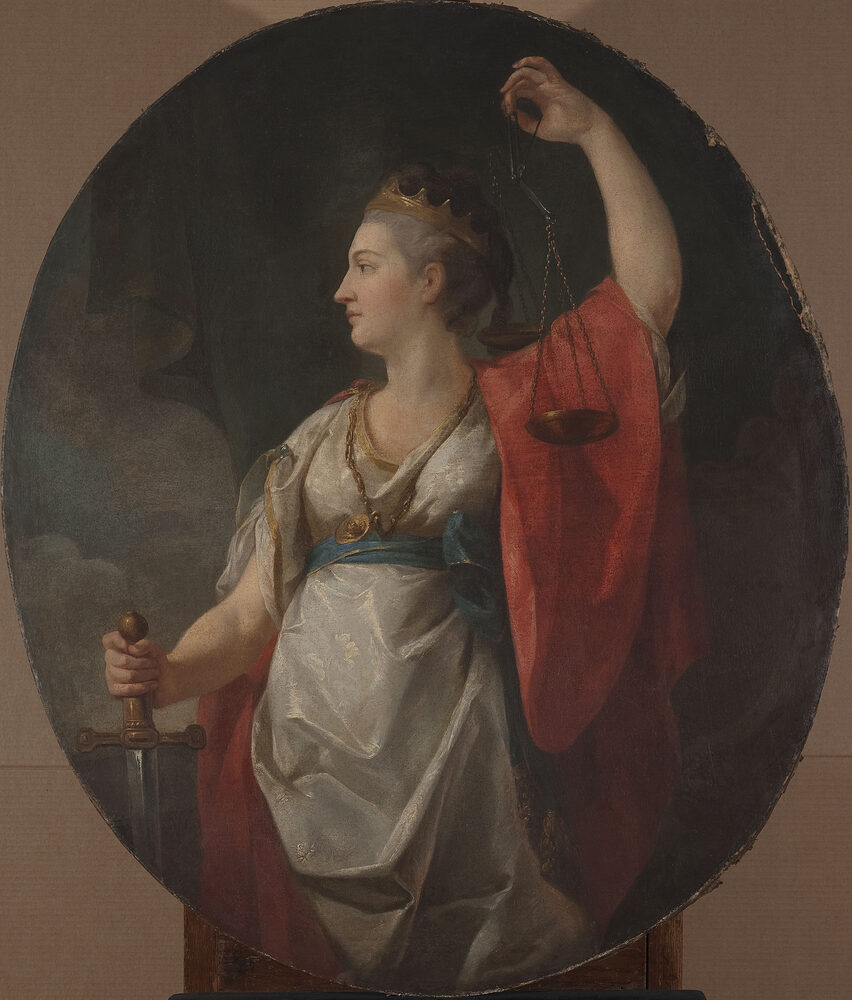
Themis
First Appearance
Themis first appears in the catalogue of the Titans, among the children whom Gaia (Earth) bore to Uranus (Heaven): "Theia and Rhea and Themis and Mnemosyne and gold-crowned Phoebe and lovely Tethys." She is thus one of the elder generation of gods, a daughter of Earth and Sky and sister to Cronus, born before the reign of the Olympians she would later counsel.
— Hesiod, Theogony 135
Who They Are
Themis (THEM-iss) is the Titaness of divine law and right order — the goddess who is themis itself made a person. In Greek, themis is not law in the sense of written statute but the older and deeper thing beneath it: divinely sanctioned custom, the fixed and proper way of what ought to be done among gods and men. It is themis that a suppliant be received, that a guest be honoured, that an oath be kept, that the assembly be rightly convened. The goddess embodies this settled rightness, and she is carefully distinguished from her neighbours in meaning — from nomos, the man-made statute enacted by a city, and from dike, justice as the particular verdict or judgement rendered in a case. Where dike decides the single dispute, Themis is the standing order of propriety within which any judgement is even possible.
Daughter of Gaia and Uranus, Earth and Sky, she belongs to the first divine generation, sister to Cronus and Oceanus and Rhea. Yet unlike most of the Titans she is not overthrown or bound in Tartarus after the great war; instead she passes into the new order as one of its foundations. Hesiod names her the second wife of Zeus, and from that union she bears the powers that hold the world together in time: the Horae, the Seasons and goddesses of ordered life, and the Moirai, the Fates who apportion each mortal's destiny. Themis is the mother, in a real sense, of order itself — of the turning year and of the measured span of every human life.
She is also a great prophetic power, older than Apollo's oracle at Delphi and its keeper before him. The Greeks pictured her enthroned at Zeus's side as his most trusted counsellor, the goddess of good counsel and of the assembly, who calls the gods together and sends them away again. To speak of Themis is to speak of the invisible framework of rightness on which both cosmos and community rest.
Mythology
Themis and the earth-oracle at Delphi
Before Apollo held the oracle at Delphi it belonged to the elder goddesses, and Themis was among its first keepers. Aeschylus opens the Eumenides (lines 1–8) with the Pythian priestess recounting the peaceful succession of the shrine: first Gaia (Earth), the primordial prophet; then her daughter Themis, who received the oracular seat from her mother; then the Titaness Phoebe, who held it next; and last Phoebe gave it as a birth-gift to Apollo, who bears her name as Phoibos. In this telling the passage of the oracle from Themis to Apollo is a gift and an inheritance, not a conquest — the god of prophecy receives his voice from the older goddess of right order. Themis is thus a foundational prophetic power, and elsewhere Aeschylus goes so far as to identify her with Gaia herself: in Prometheus Bound (line 18, and 209–213) the bound Titan calls his mother "Themis and Gaia, one form of many names," the earth-goddess whose foreknowledge he shares.
The oracle after the flood: Deucalion and Pyrrha
Themis's prophetic office is remembered too in the tale of the great flood. When Zeus sent the deluge to drown a corrupt race of men, only the righteous Deucalion and his wife Pyrrha survived, their vessel coming to rest on the slopes of Parnassus — the mountain of the oracle that was Themis's own to keep before Apollo. In the fullest surviving telling, that of the Roman poet Ovid (Metamorphoses 1.367–415, and so a later account), the two survivors climb to the shrine where in that age Themis gave her prophecies and beg to learn how the emptied world might be repeopled. The goddess answers in the veiled manner of oracles: they are to go forth with covered heads and loosened robes and "cast behind you the bones of your great mother." Pyrrha shrinks from the seeming impiety — until Deucalion reads the riddle: their great mother is the Earth, and her bones are the stones of the ground. Casting stones behind them as they walk, they watch each soften and take human shape, and so the race of mortals is born anew from the rock. The older Greek tradition (Pindar, Olympian 9.43–53, and later Apollodorus, Bibliotheca 1.7.2) likewise has the pair remake mankind from stones cast on Parnassus, though it is Ovid who names Themis as the oracular voice that guides them — fitting for the elder keeper of that same prophetic seat.
The counsel she gives Prometheus
It is from Themis that Prometheus draws his famous foresight. In Prometheus Bound he explains that his mother — Themis, whom he equates with Gaia — had foretold to him how the war between the Titans and the Olympians would be decided: not by brute strength but by cunning and guile. Because he alone heeded her prophecy and gave his counsel to Zeus, Prometheus survived the fall of the Titans. The knowledge that lets Prometheus defy Zeus, and the secret he guards — the identity of the union that would one day threaten Zeus's throne — descends from Themis, the goddess who sees what is fated. Through her, prophecy and right order are bound together: what is themis and what is destined are, in the end, the same fabric.
Her children by Zeus: the Horae and the Moirai
Hesiod (Theogony 901–906) gives Themis her central place in the divine order as the second consort of Zeus and the mother of two great broods. First she bears the Horae (Ὧραι), the "Seasons" or "Hours" — Eunomia (Good Order, or Lawful Governance), Dike (Justice), and Eirene (Peace) — who, in Hesiod's words, "watch over the works of mortal men," turning the seasons of the year and keeping the ordered life of cities. Their very names spell out their mother's domain made manifest in the human world: good law, right judgement, and the peace that follows from them. Then Themis bears the Moirai (Μοῖραι), the three Fates — Clotho ("the Spinner," who spins the thread of life), Lachesis ("the Apportioner," who measures it out), and Atropos ("the Unturnable," who cuts it) — to whom, Hesiod says, "Zeus gave the greatest honour," for they give mortals at their birth both good and evil to have. That the goddess of right order should be mother to both the seasons and the Fates is deeply fitting: through her daughters, Themis governs order in space and society and order in time and destiny alike.
The prophecy of Thetis's son
Themis's foreknowledge shapes the greatest turn in the affairs of gods and heroes. Pindar tells the tale in the eighth Isthmian Ode: Zeus and Poseidon both desired the sea-nymph Thetis and contended for her hand — until "Themis of good counsel" rose in the assembly of the gods and revealed the fate that hung over the marriage. It was destined, she declared, that Thetis would bear a son mightier than his father, one whose hand would loose a weapon more terrible than the thunderbolt. Were Thetis to wed Zeus or any god, that son would overthrow the ruler of heaven as Zeus had overthrown Cronus before him. Heeding her wisdom, the gods renounced their suit and gave Thetis instead to a mortal, Peleus, king of Phthia — so that her destined greater-than-his-father son would be a hero and not a god. That son was Achilles, the mightiest of the Greeks at Troy, mortal because a goddess's prophecy had bent the whole design of things to keep Zeus's throne secure. (In the version dramatised in Prometheus Bound, it is Prometheus who holds this same secret — fittingly, since his foresight is Themis's gift.)
The goddess of good counsel and the assembly
In Homer, Themis is the presiding spirit of the divine gathering. In the Iliad (20.4–6), when Zeus bids the goddess Themis summon the gods to council, it is she who calls them from every quarter to the assembly on Olympus; and in the Odyssey she is named as the one "who breaks up and gathers the assemblies of men." She is enthroned beside Zeus as his confidante — an image owed to Pindar and to general iconography rather than to any one episode — and in the Homeric Hymn to Apollo (3.123–125) she gives the newborn Apollo his first nectar and ambrosia on Delos; and it is Themis who, in the Iliad (15.87–95), receives Hera when she returns storming to Olympus and steadies the assembly with a cup and a word. From this role comes her cult title Themis Agoraia, "of the assembly": the goddess who ensures that when gods or citizens gather to deliberate, the gathering itself is rightly ordered. She is, throughout, less a goddess of dramatic myth than the quiet keeping-power at the centre of every rightful gathering and every sound decision — the good counsel at the king's right hand.
Worship — Ancient
Cult and sanctuaries
Themis was worshipped across Greece more as a venerable, foundational power than as the centre of a great popular cult. Her most famous association was with Delphi, where the tradition of her early tenure of the oracle kept her memory alive in the sanctuary of Apollo; Pausanias (Book 10) records the succession of the shrine's early holders and the honour paid to the elder goddesses. In Attica she held a notable seat at Rhamnous, where she shared a precinct with Nemesis — the pairing of Right Order with Due Retribution was a natural one — and a temple and a seated statue of Themis stood there, one dedicated in the early fourth century BCE and still surviving. She was honoured too at Athens, on the slopes of the Acropolis and in association with the law-courts, and at Olympia an altar stood in her name. In Thessaly the title Ichnaia, "of Ichnae," preserved one of her oldest local cults.
Rites and character of her worship
As a goddess of order rather than of a single dramatic domain, Themis received the ordinary honours of the Olympian cult — libations of wine, offerings of barley cakes and first-fruits, and incense — rather than any distinctive or sensational rite. She was frequently invoked alongside other gods rather than alone: with Zeus, whose counsellor she was, in matters of justice and oaths; with Nemesis in matters of retribution; and in the swearing of solemn oaths, where the fixed rightness she embodied gave weight to a binding promise. Her presence in a sanctuary marked it as a place of settled order and sound judgement. In art she came to be shown holding scales — later the emblem of her Roman counterpart Justitia — and sometimes a sceptre, and her prophetic aspect was recalled by the oracular tripod on which she was depicted seated as the Pythia of old.
Worship — Modern
Honouring Themis today
A modern devotee can honour Themis as the goddess of right order, sound judgement, and the keeping of what is proper. A simple shrine — a clean shelf or corner — with a small pair of scales, a sprig of laurel, and a candle gives her a fitting place; the scales recall her domain of measured rightness, and the laurel her ancient tie to the Delphic oracle. Because Themis presides over deliberation and good counsel, her worship suits any moment of weighing a decision, seeking clarity, or committing to act rightly. Approach her calmly and with a settled mind, addressing her as the goddess of divine law and right custom, and ask not for a particular outcome but for the discernment to see what is themis — what is truly proper — and the steadiness to hold to it.
Offerings
Where the ancients poured libations and burnt incense, a household devotee today can offer a libation of wine (or of spring water or milk), a little barley or a barley cake, honey, and incense such as frankincense. First-fruits — a portion of a harvest, a first serving of a meal, or a small share of good fortune set aside — are especially apt for a goddess of right custom and due proportion. Present the offering with a few honest words of thanks, and pour out or set aside what is given so that it is truly hers.
Prayer & occasions
Call on Themis Agoraia, goddess of the assembly and of good counsel, before any meeting, deliberation, or decision that must be made rightly, that the gathering be well-ordered and the choice sound. Invoke her when swearing or sealing an oath, as the fixed rightness that makes a promise binding. Turn to her when seeking to act in accord with what is proper rather than merely what is permitted — the distinction between themis and mere nomos lies at the heart of her worship. And in remembrance of her prophetic office, honour her as the elder keeper of the Delphic voice, the goddess whose foreknowledge is one with the settled order of what ought to be.
Epithets & Cult Titles
- Agoraia (Ἀγοραία) — Of the assembly — goddess who convenes and dissolves the gathering of gods and citizens, and presides over its right conduct
- Themis — Right custom personified — the divinely established order of what is proper, as distinct from human statute
- Euboulos / Euboulia — Of good counsel — the wise adviser who sits beside Zeus and guides his judgements
- Ichnaia (Ἰχναία) — The Tracker, of Ichnae in Thessaly — a cult title marking one of her oldest seats of worship
Sources & Variants
- Hesiod, Theogony 135 (Themis among the Titan children of Gaia and Uranus); 901–906 (Themis as second wife of Zeus, mother of the Horae — Eunomia, Dike, Eirene — and the Moirai — Clotho, Lachesis, Atropos)
- Aeschylus, Eumenides 1–8 (the Delphic succession: Gaia → Themis → Phoebe → Apollo); Prometheus Bound 18 and 209–213 (Themis identified with Gaia; she gives Prometheus his foreknowledge)
- Pindar, Isthmian 8 (Themis of good counsel reveals the prophecy that Thetis would bear a son mightier than his father; her marriage to the mortal Peleus)
- Homer, Iliad 15.87–95 (Themis receives Hera on Olympus); 20.4–6 (Themis summons the gods to assembly at Zeus's command); Odyssey 2.68–69 (Themis who gathers and dissolves the assemblies of men)
- Homeric Hymn 3 to Apollo (Themis feeds nectar and ambrosia to the newborn Apollo)
- Ovid, Metamorphoses 1.367–415 (later Roman telling: Deucalion and Pyrrha consult the oracle of Themis after the flood and repeople the earth from stones); cf. the earlier Greek tradition in Pindar, Olympian 9.43–53 and Apollodorus, Bibliotheca 1.7.2 (the couple remake mankind from stones on Parnassus)
- Pausanias, Description of Greece 10.5.5–6 (the early oracle at Delphi); 1.33 and 7.5 (cult of Themis, including Rhamnous with Nemesis)
Gallery