Uranus
First Appearance
Uranus first appears not as a child of any parent but as the first offspring of Earth herself: "Gaia bore first, equal to herself, starry Uranus, that he might cover her about on every side, and be an ever-sure dwelling-place for the blessed gods." He is Heaven brought forth by Earth to match her measure — her equal, her covering, and soon her mate.
— Hesiod, Theogony 126–128
Who They Are
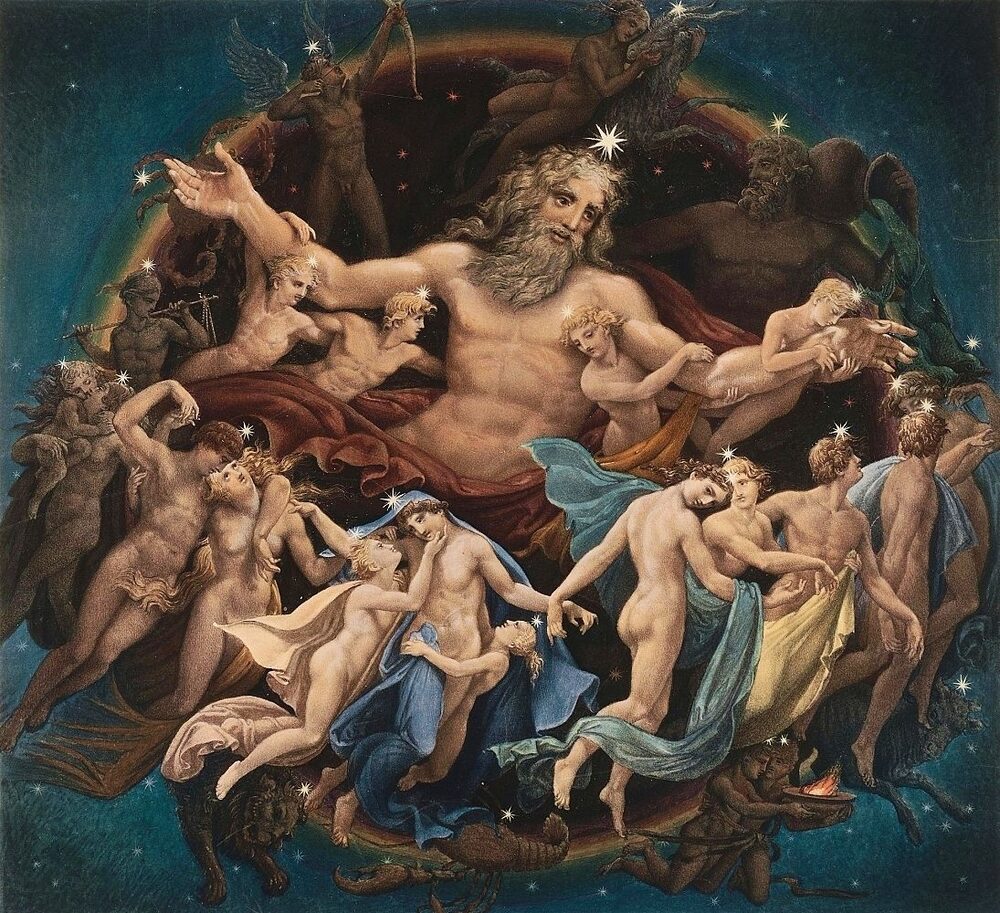
Uranus (YOOR-uh-nus / yoo-RAY-nus) is the primordial Sky — at once a person and the physical heaven itself. In the oldest Greek account, Hesiod's Theogony, he is not born of gods but produced by Gaia, the Earth, "equal to herself," to arch over her on every side. He is therefore both a divine being with will and voice and the literal firmament: the starry dome that covers the world. To speak of Uranus is to speak of the sky you can see, personified and made a father.
As Earth's covering and her first consort, he lies over her and fathers upon her the first great families of the cosmos: the twelve Titanes (Titans), the three thunder-forging Cyclopes, and the three hundred-armed Hekatoncheires (Hundred-Handers). In this generative role Uranus is the raw seed of nearly everything that follows — the Olympians themselves descend from him through his son Cronus. Yet he is no benevolent creator. He is an oppressive, inert presence, so hostile to his own children that he refuses to let them be born into the light, and his story is one of cruelty answered by cruelty.
It is essential not to confuse Uranus with the later sky-kings, above all Zeus (see his page). Uranus is the sky of the first generation — physical, undifferentiated, generative, and finally passive. He does not reign as a storm-king or a lord of justice; he simply is the heaven, and his rule is little more than his crushing weight upon the earth. Once maimed and overthrown, he withdraws to the heights and takes almost no further part in myth, remembered chiefly through a curse and a prophecy. The bright, thundering, law-giving sky-father is his distant descendant, not himself.
Mythology
Content note: this section describes family violence, including the mutilation of a parent, as the ancient sources tell it.
Earth and Heaven, and the children shut in the dark
Gaia bore Uranus to be her equal and her covering, and then lay with him. Their union produced the first generation of gods: the twelve Titanes — Oceanus, Coeus, Crius, Hyperion, Iapetus, Theia, Rhea, Themis, Mnemosyne, Phoebe, Tethys, and youngest of all Cronus — followed by the three Cyclopes, Brontes, Steropes and Arges, "Thunderer," "Lightning" and "Bright," each with a single round eye in his brow; and finally the three Hekatoncheires or Hundred-Handers, Cottus, Briareus and Gyges, monstrous beings with a hundred arms and fifty heads apiece. In these last, the strongest of his children, Uranus took no pride but only loathing.
Hesiod tells that Uranus hated his offspring from the first. As each was born he would not let it come up into the light but hid it away in the body of Gaia — pressing his children back into the depths of the Earth, their own mother's womb, so that they could not be born. Gaia, stretched and groaning with the brood crammed inside her, was wracked with pain and rage.
The sickle, the ambush, and the castration
Gaia devised a remedy. From within herself she brought forth grey adamant and fashioned a great jagged sickle (the harpē), and she laid her plan before her imprisoned children, calling on them to punish their father's wickedness. Fear gripped them all — all but the youngest, Cronus, who alone answered that he would do the deed.
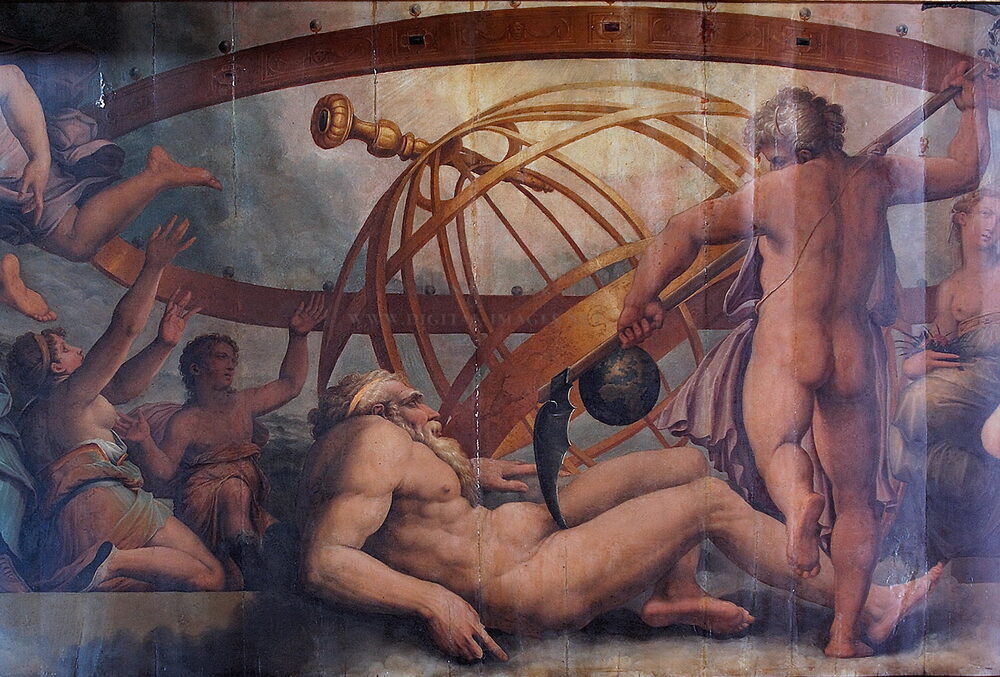
Gaia hid Cronus in ambush and placed the sickle in his hand. When Uranus came at nightfall, longing for love, and lay stretched over Earth on every side, Cronus reached out from his hiding-place, seized his father's genitals, and with the jagged sickle cut them away, flinging the severed parts behind him into the sea. So Sky was maimed and torn from Earth, and the endless embrace that had crushed the children was broken — Heaven drew back and away, and has kept his distance from Earth ever since.
Born of the blood and the severed flesh
From the violence sprang new life. As the drops of blood from the wound fell upon Gaia, the Earth received them and in due season brought forth three fearsome kindreds:
- the Erinyes (the Furies), the avenging spirits who pursue oath-breakers and above all those who shed the blood of their own kin;
- the Gigantes (the Giants), a race of mighty warriors gleaming in armour, who would one day rise against the Olympian gods;
- and the Meliae, the nymphs of the ash trees, from whom (in one tradition) the hard early race of men was descended.
The severed genitals themselves fell into the open sea and were carried long over the waves, and a white foam (aphros) gathered around the immortal flesh. Within it grew a maiden, who was borne first to Cythera and then to Cyprus, and stepped ashore a goddess: Aphrodite, the foam-born, whose beauty and desire entered the world out of Uranus's own body. (See her page for the full account of her birth and worship.) That Aphrodite is the daughter of Uranus's severed flesh is Hesiod's version; other traditions make her instead a daughter of Zeus and Dione.
The curse and the naming of the Titans
As his sons drew back from the deed, the maimed Uranus reproached them and foretold a reckoning. Hesiod says it was Uranus who gave them their name: he called them Titanes, "the Straining Ones" or "Overreachers" (from titainontas, "straining"), because in their presumption they had stretched out their hands to a monstrous deed for which vengeance (tisis) would surely come. In that word both the name and the curse were bound together: those who overreach against their father will themselves be paid in kind.
The prophecy took hold of the whole succession. Just as Uranus was overthrown by his son, so it was fated — and Uranus and Gaia together later warned him of it — that Cronus in his turn would be brought down by a child of his own. That is why Cronus swallowed his children as they were born; and it is Zeus, escaping that fate, who at last breaks the chain of usurpation. Uranus's maiming is thus the first act in the long story of divine succession that ends only with the secure kingship of Zeus.
After the fall: the remote sky
Once cut away from Earth, Uranus effectively leaves the stage. He does not fight in the Titanomachy, holds no throne, and receives no cult of consequence. He endures as the physical heaven overhead and as an occasional voice of prophecy paired with Gaia, but he is a spent and remote power — the oppressive first Sky, overthrown, drawn back to his height, and thereafter almost wholly passive. What was raw and generative in the first age has passed to his descendants.
Worship — Ancient
A god almost without cult
Uranus is a striking case of a great mythological figure who received virtually no worship. Unlike the Olympians, he had no temples, no festivals, no priesthoods, and no regular sacrifices of his own anywhere in the Greek world. He belongs to the cosmological imagination — the poets' account of how the world came to be — far more than to the practice of religion. When the Greeks looked up, the sky was simply there; they did not, as a rule, bring it offerings.
Where he does appear
Uranus's real home is in poetry and philosophy. Hesiod's Theogony gives him his defining role as the first Sky and the father castrated by his son. He is invoked, together with Gaia, in the great oaths and cosmogonies as one of the primordial powers by whom the order of the world was fixed, and he appears in the genealogies that later mythographers such as Apollodorus set in order. Among the philosophers and in the Orphic tradition his name (ouranos) becomes the ordinary word for "the heavens," and speculation about the physical sky and about Uranus the god run together — a fitting fate for a figure who was never fully separable from the firmament he personified.
Worship — Modern
Honouring Uranus today
Because Uranus had almost no ancient cult, a modern devotee has little traditional ritual to draw on and much room for simple, sincere practice. He is best approached not as a personal patron in the manner of an Olympian but as a cosmic presence — the Sky itself, the eldest father of the gods, the vast covering over the world. Honour is most naturally given outdoors and by night: standing beneath the open, star-filled heaven, hands raised (the Hellenic posture toward the sky-gods), and acknowledging Uranus as the starry firmament from which the whole divine order descends.
Offerings
A libation is the fitting gift — clean water, wine, or a little milk or honey, poured out under the open sky with a few words of recognition. Frankincense or another fragrant incense, its smoke rising toward the heavens, suits a god who is the height above us. A sprig of ash, the tree of the Meliae born from his blood, may be set on a small shrine. Keep the rite plain and reverent: with Uranus the point is less to petition than to acknowledge the sky overhead as an ancient and generative power.
Reverence and reflection
Uranus rewards contemplation more than petition. Under the night sky one may reflect on the beginnings of things, on the succession of the generations, and on his hard lesson — that the overreaching hand invites its own reckoning. Those drawn to the primordial powers may honour Uranus alongside Gaia, his Earth and mate, greeting Heaven and Earth together as the first parents of the cosmos, exactly as the old oaths did.
Epithets & Cult Titles
- Asteroeis (Ἀστερόεις) — Starry — Hesiod's standing epithet for the night sky spangled with stars
- Ouranos Eurys (οὐρανὸς εὐρύς) — Wide Heaven — Homer's standing phrase for the broad sky
- Akmonides (Ἀκμονίδης) — Son of Akmon — an archaic patronymic of the sky-father, Akmon being an old name for the heaven (Alcman and the scholia)
Sources & Variants
- Hesiod, Theogony 126–128 (Gaia bears starry Uranus, equal to herself), 132–153 (the Titans, Cyclopes and Hundred-Handers), 154–182 (Uranus hides his children in Earth; Gaia forges the sickle; Cronus's ambush and the castration), 183–200 (the blood-born Erinyes, Giants and Meliae; the foam-born Aphrodite), 207–210 (Uranus names the Titans and foretells vengeance)
- Hesiod, Theogony 463–465 (Uranus and Gaia warn Cronus he is fated to be overthrown by his own son)
- Apollodorus, Bibliotheca 1.1.1–1.1.5 (Uranus, first ruler of the universe; his children shut in Tartarus; Gaia's sickle and the castration by Cronus; birth of the Erinyes)
- Homer, Iliad 5.370–417 (Aphrodite as daughter of Zeus and Dione — the alternative to Hesiod's foam-birth)
Gallery