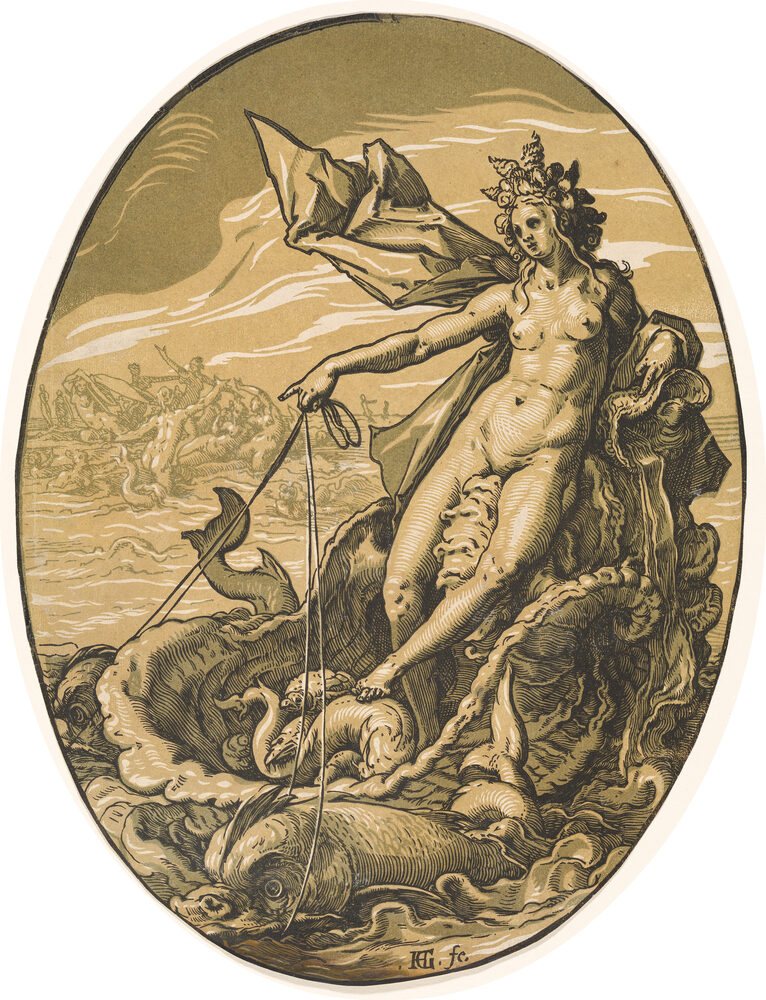
Tethys
First Appearance
Tethys first appears in the great catalogue of the children of Uranus (Heaven) and Gaia (Earth), named last of the female Titans (just before Cronus): "and she bore Tethys." She stands from the outset as one of the twelve elder Titans, the generation that ruled the cosmos before Zeus, and is soon after joined to her brother Oceanus as the mother of the world's waters.
— Hesiod, Theogony 133–136
Who They Are
Tethys (TEE-thiss / TETH-iss; Greek Τηθύς) is the Titaness of the nurturing fresh waters — wife of Oceanus, the encircling world-river, and with him the co-equal source of all the moving water of the earth. Where Oceanus is the great stream that girdles the world, Tethys is the fertile, mothering principle that feeds it: the springs and wellheads, the streams and groundwater that rise from beneath the earth to swell the rivers and nourish the living land. She is not a minor consort standing at Oceanus's side, but the mother from whose body the waters flow — together they engender the three thousand rivers and the three thousand Oceanid nymphs who water the whole world.
She belongs to the eldest divine generation, one of the twelve Titans born to Uranus (Heaven) and Gaia (Earth). Her name the Greeks felt as a word of kinship and fostering — hearing in it τήθη (tēthē, "grandmother") and τηθίς (tēthis, "aunt") — fitting for the elder nurse of the waters and the ancestress of a numberless watery brood. Homer twice calls her simply "mother Tethys," pairing her with Oceanus as the origin of the gods.
A word of caution against a very common confusion: Tethys the Titaness is not Thetis the Nereid. Tethys (Τηθύς) is the ancient wife of Oceanus and grandmother of the sea; Thetis (Θέτις) is a young sea-nymph, one of the fifty daughters of Nereus, and the mother of Achilles. The names sound alike and both belong to the sea, but they are entirely different figures separated by generations — Thetis is, through the Oceanid line, effectively Tethys's descendant.
Mythology
The mother of the waters
Hesiod tells that Tethys, joined in love to Oceanus, bore the Rivers of the whole earth — he names Nile, Alpheus, Eridanos, Strymon, Meander, Ister and many more — "three thousand" swift-flowing streams, "and hard it is for a mortal man to tell the names of all." To these she added a matching company of daughters, the three thousand Oceanids, "who are dispersed far and wide, and in every place alike serve the earth and the deep waters." From this single union flows, quite literally, all the fresh water of the world: the rivers that cut the valleys, the springs that rise in the hills, and the nymphs who preside over every fountain, brook and mere. Among her named daughters stand figures of the first rank — Styx, eldest of the Oceanids, by whose waters the gods swear their unbreakable oath; Metis, the embodiment of cunning wisdom whom Zeus would swallow; Clymene, mother of Prometheus and Atlas in some accounts; and Dione. The rest — Doris, Electra, Eurynome, Callirhoe, Perseis and thousands more — the poets leave to prose and to the imagination.
Tethys is thus best understood not as the ocean's queen-consort merely, but as its generative mother: Oceanus is the water's encircling flow, Tethys the fertile source that keeps it moving, the nursing element that feeds spring, cloud and river in the endless circulation of the waters.
Oceanus and Tethys, origin of the gods
Homer preserves what may be an older and grander conception of the pair. In the Iliad (14.201, repeated at 14.302), Hera names "Oceanus, origin (genesis) of the gods, and mother Tethys" as the primal couple from whom the divine race sprang, and speaks of going to the ends of the earth to visit them and reconcile their long quarrel. Some ancient readers took this to preserve a cosmogony in which the watery pair were among the first parents of the gods, a Greek echo of the Near-Eastern idea of the world born from the mingling of waters. Plato himself, in the Timaeus (40e), lists Oceanus and Tethys as children of Ge (Earth) and Ouranos (Heaven) and as the parents of Cronus and Rhea; while it is Homer's line, taken up in Plato's Cratylus (402b) and Theaetetus (152e), that was read as making water the first principle of all things. Whether Homer means a genealogy older than Hesiod's or simply honours the couple as the source of the sea's own vast progeny, the passage fixes Tethys firmly beside Oceanus as a first principle of the cosmos, not an afterthought to it.
Apart from the war of the Titans
When Zeus rose against Cronus and heaven was torn by the ten-year Titanomachy, Oceanus and Tethys took no part on either side. The encircling world-river and its nurturing mother stood aloof from the battle that consumed the other Titans — a neutrality that spared them the losers' fate and let them keep their ancient honours undisturbed under the new order of Zeus. Homer preserves a memory of exactly this. In the Iliad (14.200–210) Hera recalls that when Zeus "thrust Cronus down to dwell beneath the earth and the barren sea," her mother Rhea gave her into the keeping of Oceanus and Tethys, "who lovingly nursed and cherished me in their halls." The queen of the gods was thus raised in the house of the water-Titans through the very years of the war — a detail that at once marks the pair as standing apart from the strife and casts Tethys again in her defining role as nurse and fosterer: here she rears not rivers and nymphs but a goddess of the coming Olympian age, the child of the enemy generation entrusted to her care.
The estrangement of Oceanus and Tethys, and the Bear that never bathes
A late and specifically Roman myth — told by Ovid in the Metamorphoses (2.508–530) and again in the Fasti — makes Tethys and Oceanus the guardians of a boundary in the sky. When Callisto, the nymph loved by Jupiter and hated by Juno, was set among the stars as Ursa Major, the Great Bear (and her son Arcas as the neighbouring constellation), Juno's jealousy was not appeased by seeing her rival glorified in heaven. So the goddess descended to the ancient waters and begged her foster-parents Tethys and Oceanus a single favour: that they never receive the Bear into their waters, never let her sink beneath the horizon to bathe in the world-encircling stream as the other stars do. The elder couple granted it. This, the Roman poets explain, is why the Great Bear alone wheels forever about the pole and never sets — barred by Tethys and Oceanus from the rest and refreshment of the western sea. The tale is Ovidian and Roman, a poetic star-story rather than an old Greek cult-myth, but it is the most memorable single scene in which Tethys acts, and it turns on precisely her power over the receiving waters at the edge of the world.
Worship — Ancient
A genealogical rather than a cultic goddess
Tethys had almost no active cult in the Greek world. Like several of the eldest Titans, she was honoured in poetry and cosmology far more than at any altar: she is a figure of the genealogists and theologians, invoked to explain the origin of the waters rather than approached with regular sacrifice. There were no temples of Tethys, no festival in her name, and no priesthood — a silence that itself tells us how the Greeks understood her, as a primeval source belonging to the world's foundations rather than to the ordinary traffic of prayer and offering.
Where she was named and pictured
Where Tethys does appear is in the great cosmological texts and in art. Hesiod's Theogony (337–370) gives the fullest ancient account of her, cataloguing the rivers and Oceanids she bore. Homer's Iliad (14.201–210, 14.301–306) preserves her as the primal "mother," and later thinkers from Plato onward returned to that passage when they treated the waters as the origin of things. In the Roman period she becomes a favourite of the mosaic-makers: the great bath and dining-room floors of Antioch and North Africa show Tethys rising from the sea as a stately matron, sea-green or wave-crowned, often with small wings at her temples and a rudder or a ketos (sea-monster) beside her, sometimes paired with the bearded Oceanus — an image of the fertile, life-giving waters fitting for a room of fountains and baths.
Worship — Modern
Honouring Tethys today
A modern devotee who feels drawn to Tethys honours her most fittingly at water. Because the ancients left her almost no ritual of their own, her worship today is best kept simple and elemental, drawn from her nature as the mother of springs and rivers. A shrine near a source of fresh water — even a bowl of clean spring water kept on a shelf, or a bottle drawn from a stream or well — gives her a place. She is the nurturing, encircling elder of the waters; approach her with the quiet gratitude one owes to the source that sustains all life.
Offerings
Offer Tethys what belongs to her element. A libation of fresh spring water poured onto the earth or into a bowl set aside for her is the most fitting of all — water given back to the mother of waters. Milk and honey, both anciently poured to the elder and chthonic powers, suit her nurturing character; so does a little clean rainwater gathered for the purpose. Present the offering at a spring, river, or well if you can, with a few words naming her as the mother of the three thousand rivers and the three thousand Oceanids, and afterward pour it out so that it is truly hers.
Prayer & reflection
Turn to Tethys in reverence for fresh water and its endless renewal — at a spring, when rain breaks a drought, or in simple thanks for the water that sustains a household. Honour her together with Oceanus, her consort and co-source, as the paired origin of all the moving waters; remember her too as the ancestress of the Oceanids and the river-gods, so that every fountain and stream may be felt as a child of hers. In an age mindful of water's scarcity and worth, a devotion to Tethys naturally carries a care for living rivers and clean springs as a form of reverence to the goddess who mothers them.
Epithets & Cult Titles
- Titēnis (Τιτηνίς) — The Titaness — her standing designation as one of the twelve elder children of Uranus and Gaia
- Mother Tethys (μήτηρ Τηθύς) — Homer's phrase (Iliad 14.201, 14.302), naming her with Oceanus as the parent-source from whom the gods themselves are sprung
Sources & Variants
- Hesiod, Theogony 133–136 (birth among the Titans), 337–370 (the Rivers and the Oceanids born of Tethys and Oceanus)
- Homer, Iliad 14.200–210 and 14.301–306 (Oceanus 'origin of the gods' and 'mother Tethys'; Hera fostered in their halls during the overthrow of Cronus, marking their neutrality in the Titanomachy; their estrangement)
- Plato, Timaeus 40e (Oceanus and Tethys named as children of Earth and Heaven and parents of the gods, after Homer)
- Ovid, Metamorphoses 2.508–530 and Fasti 2.153–192 (Juno's plea to Tethys and Oceanus; why the Bear, Ursa Major, never sets — flagged Roman/Ovidian)
- Apollodorus, Bibliotheca 1.1.3 (Tethys among the Titans); Hesiod, Theogony 346–366 (the Oceanid catalogue, including Dione at 353)
Gallery