Tychē
First Appearance
Tyche enters Greek poetry not as a great power but as one name among many. In Hesiod's Theogony she is listed among the three thousand slim-ankled daughters of Oceanus and Tethys — "and Tyche" set in the long roll of the Oceanid nymphs (360), a minor sea-child with no story of her own. The Homeric Hymn to Demeter (420) names her again in the same company: Tyche is one of the Ocean's daughters gathering flowers in the meadow with Persephone on the day Hades carried the girl away. In these oldest appearances she is a small, abstract water-nymph, a personification of "chance" barely distinguished from her sisters — nothing yet of the crowned goddess who would one day stand over whole cities.
— Hesiod, Theogony 360; Homeric Hymn to Demeter (2) 420
Who They Are
Tyche (TY-kee) is the goddess of fortune, chance, and luck — the unseen power that decides how things fall out, the lot a person or a city draws from the turning of events. Her name is simply the Greek word tychē, "that which happens," and she is that word made divine: the giver of unearned prosperity and the author of sudden ruin, the force the Greeks felt behind every stroke of good or ill luck that no wisdom could foresee and no virtue could command.
She is really two figures wearing one name, and the larger of them comes late. In her first and classical form she is a minor goddess — one of the many Oceanid daughters of the sea, named in a list by Hesiod and in the Homeric Hymn to Demeter, barely more than a personified abstraction, the small spirit of "chance." But in the Hellenistic age — the centuries after Alexander, when old certainties fell away and men felt their lives turned by forces far beyond their control — Tyche swelled into one of the most powerful and most worshipped deities of the Greek world. In that anxious, cosmopolitan age she became the great protectress of cities, each town honouring its own Tyche as the guardian of its destiny, and she took on the image that would define her for all time to come: a majestic enthroned goddess wearing a mural crown — a diadem shaped like a city's walls and towers — holding a horn of plenty and steering the world with a rudder.
Her attributes together tell the whole of what the Greeks believed about fortune. She holds the rudder (pēdalion), for she steers the affairs of the world; she stands on or holds a ball or sphere, for fortune is unstable and rolls where it will; she turns a wheel, the ever-circling rise and fall of estates; and she pours out the cornucopia, the horn of plenty, for she is the source of sudden wealth. She is blind, or blindfold, in the moral sense the Greeks increasingly gave her — she gives without desert and takes without warning — and that is exactly why so great an age built her so many temples: not because she was just, but because she was everywhere, and could not be ignored.
Mythology
The crowned goddess of the Hellenistic age
Tyche's greatness belongs above all to the Hellenistic period — the three centuries between Alexander the Great and the coming of Rome — when she rose from a minor nymph to one of the most widely worshipped powers in the Greek world. It was an age of new cities and shifting kingdoms, of fortunes made and lost overnight, of ordinary people who felt their lives steered by vast events they could neither see nor master; and in such an age the goddess of chance came naturally to the fore. The Greeks of this period spoke of Tyche constantly, as the power behind every unlooked-for turn of events, and they raised her temples (a Tycheion stood in city after city) as they had once raised them to the old Olympians. The historian Polybius, writing in the second century BC, could hardly tell the story of his turbulent world without invoking her — now praising, now blaming, the Tyche who overturned kings and raised up nations. She had become the presiding deity of an uncertain age.
The Tyche of a city: fortune made civic
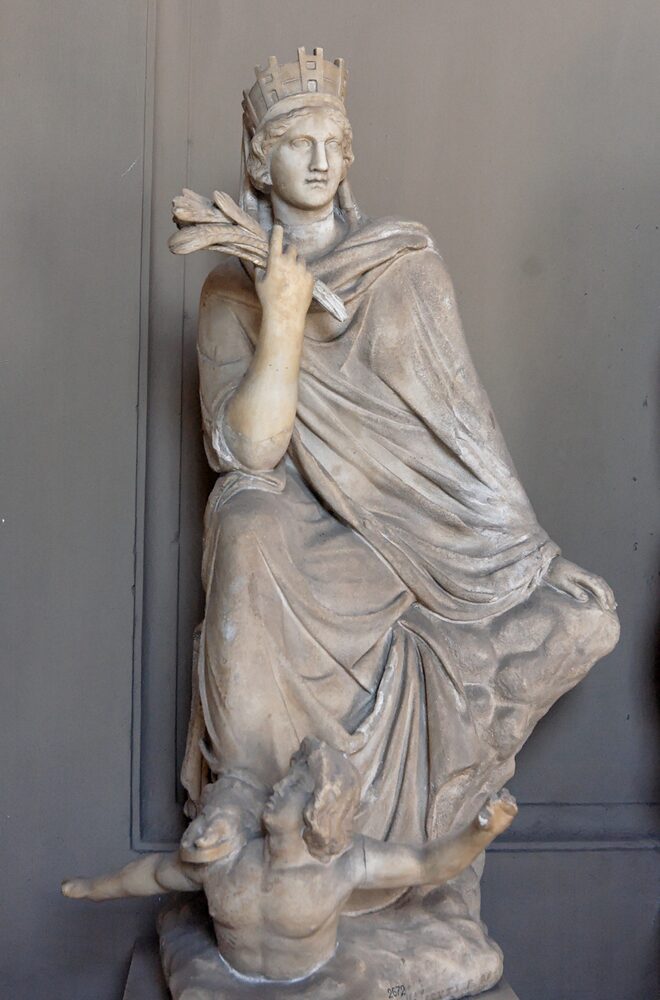
The most characteristic form the goddess took in this age was the Tyche of a particular city — each town's own guardian Fortune, the personified destiny and prosperity of that one place. Antioch had its Tyche, and so did Alexandria, and Smyrna, and a hundred lesser towns; a city's Tyche was its luck and its life made into a goddess, honoured as its protectress and shown on its coins. Her mark in art is the mural crown (the Latin term is corona muralis) — a diadem fashioned in the shape of city walls and towers, so that the goddess seems to wear the very fortifications of the town upon her head. To see a crowned female figure with battlements for a diadem on a Greek coin or statue is almost always to be looking at the Tyche of that city, holding its fate in her keeping. In this civic form Tyche is not blind caprice but a cherished guardian, the Fortune a people hoped would stand by their walls.
The Tyche of Antioch: Eutychides' famous statue
The single most celebrated image of the goddess — the one that fixed her type for the whole ancient world — was the Tyche of Antioch, made around 300 BC by the sculptor Eutychides of Sikyon, a pupil of the great Lysippos, when Seleucus I founded his new capital of Antioch on the river Orontes. Eutychides showed the goddess seated on a rock (the mountain Silpios, above the city), one foot resting easily upon the shoulder of a young man swimming at her feet — the personified river Orontes, surging up out of the water beneath her. She wears the mural crown of the city's walls, is draped in a flowing robe, and in some versions holds a sheaf of grain, the token of the land's abundance. The composition was so admired that it was copied endlessly — on coins, in small bronzes, in marble reductions (a well-known small copy survives in the Vatican) — and it became the model for the civic Tyche of city after city across the Greek and later the Roman world. In Eutychides' goddess the whole idea of the city-Fortune found its perfect and lasting shape: the land, the river, and the walls all gathered into one serene enthroned figure.
Rudder, wheel, ball, and horn: the image of chance
Beyond the civic crown, Tyche is known by a cluster of attributes that between them spell out the Greek understanding of fortune. She holds the rudder (Greek pēdalion), the steering-oar of a ship, because she guides and directs the course of human affairs as a helmsman steers a vessel — fortune as the hidden hand on the tiller of the world. She is shown with a ball or sphere (sphaira), sometimes standing upon it, because fortune is round and rolling and never still: it can tip in any direction at any moment. She turns a wheel, the ancestor of the medieval "wheel of fortune," the endless revolution by which those who are high are brought low and the low are lifted up. And she carries the cornucopia (the keras Amaltheias, the horn of plenty), overflowing with grain and fruit, because she is the giver of wealth and increase. Rudder and wheel and ball and horn — direction, instability, reversal, and bounty — are fortune's four faces, and the goddess holds them all.
The earlier strand: the Oceanid daughter of the sea
Behind the crowned goddess of the cities lies an older and humbler Tyche, and it is where her name first appears. In the oldest poetry she is simply one of the Oceanids — a daughter of the Titan Oceanus, the world-encircling river, and his sister-wife Tethys — named in Hesiod's long catalogue of their three thousand daughters (Theogony 360) and again in the Homeric Hymn to Demeter (420), where she is one of the Ocean's girls gathering flowers in the meadow with Persephone on the fatal day that Hades rose up and carried the maiden off to the underworld. In this earliest form Tyche has no myth of her own; she is a slender water-nymph, a personification of "chance" scarcely distinguished from her many sisters. The lyric poet Pindar (early fifth century BC) gives her the first real lift toward greatness: he opens his twelfth Olympian ode by invoking "Saviour Fortune, daughter of Zeus the Deliverer" (Sōteira Tycha) and praying her to guard the city of Himera — already the city-saving, destiny-steering goddess in germ, and already, significantly, called a daughter not of Ocean but of Zeus, as befits a power grown great. The road from Hesiod's list-nymph to Eutychides' enthroned protectress runs straight through Pindar's prayer.
Worship — Ancient
The great goddess of an uncertain age
Few deities rose so far so fast as Tyche. In the classical period she was a minor figure, but from the Hellenistic age onward she became one of the most widely worshipped divinities in the Greek world — a goddess with real temples, priesthoods, festivals, and civic honours, precisely because the age that made her great was an age that felt itself at the mercy of chance. Where the old Olympians governed fixed spheres — sea, sky, war, love — Tyche governed the one thing every person and every city feared most: the unforeseeable. Her cult answered a real and widespread anxiety, and it spread accordingly, until by the Roman period hardly a city of any size was without its shrine to its own Fortune.
Agathē Tychē and the formula of good luck
At the everyday level Tyche was honoured as Agathē Tychē, "Good Fortune," often paired with the Agathos Daimon ("Good Spirit") as a benign power invoked for the success of any undertaking. Her name opens a vast number of Greek inscriptions and public decrees in the formula "Agathēi Tychēi" — "with Good Fortune" — a standing prayer, set at the head of the document, that the business there resolved might turn out well. In this guise she was less a remote goddess than a daily companion to Greek civic and private life, invoked at the start of ventures the way one might touch wood: an acknowledgement that no plan, however wise, succeeds without fortune's consent.
Cult images and the witness of Pausanias
The traveller Pausanias, who in the second century AD toured the shrines of Greece and described what he saw, is our best witness to Tyche's cult images. He records (Pausanias 4.30.3–6) that the poet-sculptor Bupalus made an early statue of Tyche for the people of Smyrna, showing her with the polos (a tall cylindrical crown) on her head and the horn of Amaltheia — the cornucopia — in her hand, and he notes that Pindar too had sung of her as one of the Fates and mightier than her sisters. He describes a famous group at Thebes in which Tyche carries the infant Ploutos (Wealth) in her arms (Pausanias 9.16.1–2), a tender image of Fortune as the nurse of riches, and he mentions a Tyche made by Praxiteles for the Megarians. These scattered notices show the goddess honoured across the Greek mainland with real cult statues, each emphasising one face of her: the crown of her civic power, the horn of her bounty, the child of wealth she brings to birth.
Worship — Modern
Fortune's wheel, turning still
No single ancient image has had a longer afterlife than Tyche's wheel. Through the Roman Fortuna it passed into the Middle Ages as the great Rota Fortunae, the Wheel of Fortune — the turning wheel to which kings and beggars alike are bound, lifted to the top and cast down again — a figure that fills medieval manuscripts, Boethius's Consolation of Philosophy, the poetry of Dante and Chaucer, and the Tarot. The phrase "wheel of fortune," the idea of fortune as a fickle lady who raises and ruins at whim, and the very notion of "fortune" itself all descend in an unbroken line from the Greek goddess of chance; she is woven so deep into the language that we invoke her every time we speak of good or bad luck.
A patron of chance, change, and the city
Among modern Hellenic polytheists (Hellenists) who honour the old gods, Tyche is a natural patron for all that lies beyond our control — the unlooked-for opportunity, the sudden reversal, the venture whose outcome cannot be known. She is approached much as the ancients approached her: invoked as Agathē Tychē, Good Fortune, at the start of a new undertaking, a move, a journey, or a risk, with the old prayer that things may turn out well. In her civic aspect she sits well as a guardian of one's own city or community, the Fortune of a place and its people; and her cluster of attributes makes her an apt figure for meditation on change itself — the rudder reminding us that fortune steers, the ball that it rolls, the wheel that it turns, and the horn that it gives as freely as it takes.
The wisdom in her blindness
Part of Tyche's enduring hold is that she was never pretended to be just. The Greeks knew she gave without desert and struck without warning, and in honouring her they were really making peace with a hard truth the ancient world faced as squarely as our own: that much of a life's shape is dealt, not earned. To reckon with Tyche is to hold two things at once — to work and plan as though outcome depended on us, and to bow, when the wheel turns, to the part that never did. In that double wisdom, the goddess of a two-thousand-year-old anxious age still speaks very directly to ours.
Epithets & Cult Titles
- Sōteira (Σώτειρα) — Saviour, Deliverer — the city-saving Fortune who guards a town and keeps it from ruin; Pindar opens his twelfth Olympian ode by calling on 'Saviour Fortune' (Sōteira Tycha) to watch over the city of Himera (Olympian 12.1–2)
- Agathē Tychē (Ἀγαθὴ Τύχη) — Good Fortune — the benevolent face of the goddess, often paired with the Agathos Daimon ('Good Spirit'); countless Greek inscriptions and decrees open with the formula 'Agathēi Tychēi' ('with Good Fortune'), a prayer that the business begun may turn out well
- Poliouchos (Πολιοῦχος) — City-holding, city-guarding — the title under which each Hellenistic city honoured its own particular Fortune, the Tyche who wore that town's walls as her crown and held its destiny in her keeping
- Automatia (Αὐτοματία) — The self-acting, the spontaneous — Fortune as the power that works of its own accord, without visible cause; the general Timoleon, who felt himself carried by her through all his victories, raised a shrine to Tyche Automatia in his house (Plutarch, Timoleon 36)
Sources & Variants
- Hesiod, Theogony 360 (Tyche named among the Oceanid daughters of Oceanus and Tethys)
- Homeric Hymn to Demeter (2) 417–424 (Tyche among the Ocean's daughters gathering flowers with Persephone at her abduction)
- Pindar, Olympian 12.1–2 (invocation of 'Saviour Fortune' — Sōteira Tycha, daughter of Zeus the Deliverer — to guard the city of Himera; Pindar reckons her among the Fates and mightier than they)
- Pausanias, Description of Greece 4.30.3–6 (Bupalus's statue of Tyche at Smyrna with polos and the horn of Amaltheia; the Homeric and Pindaric testimonies to the goddess)
- Pausanias, Description of Greece 9.16.1–2 (the Tyche of Thebes carrying the infant Ploutos/Wealth) and 1.43.6 (Praxiteles' Tyche for the Megarians)
- Polybius, Histories, passim (Tyche as the presiding power of the Hellenistic age, overturning and raising up kingdoms)
- Plutarch, Life of Timoleon 36 (Timoleon's shrine to Tyche Automatia, 'self-acting Fortune')
- On Eutychides of Sikyon's Tyche of Antioch (c. 300 BC): the enthroned goddess with mural crown and the river-god Orontes at her feet, known through ancient copies and coins — the type that fixed the image of the civic Tyche
- Fortuna, the Roman goddess with whom Tyche was identified — source of the medieval Wheel of Fortune and the modern word 'fortune' — Roman
Gallery