Potamoi / the River-gods
First Appearance
The Potamoi first appear as a family in Hesiod's Theogony (337–370), where Tethys bears to Oceanus "the swirling rivers" — and Hesiod then recites a great roll-call of them by name: Nile and Alpheus and deep-eddying Eridanus, Strymon and Maeander and the fair-flowing Ister, Phasis and Rhesus and silver- whirling Achelous, Nessus, Rhodius, Haliacmon, Heptaporus, Granicus, Aesepus and holy Simoeis, Peneus and Hermus, Caïcus, great Sangarius, Ladon, Parthenius, Euenus, Ardescus, and divine Scamander — and these, the poet says, are only some, for "there are three thousand" of them, and no mortal man could tell all their names. From the first the rivers are named gods, sons of Ocean and the sea-mother, as many as the flowing waters of the world.
— Hesiod, Theogony 337–370 (the birth of the rivers from Oceanus and Tethys, with a long roll-call of their names)
Who They Are
The Potamoi (poh-tuh-MOY; singular Potamos, poh-tuh-MOSS), in Greek the Ποταμοί, "the Rivers," are the river-gods of Greek myth — and the simplest way to understand them is that a river was not, to a Greek, a thing but a person: every flowing stream in the land was a living god, with a name, a shape, a father and a mother, and often descendants of his own among the people who lived along his banks. They are place-gods: not one deity of rivers-in-general but hundreds of separate gods, one for each actual river — Achelous of the great river in the west, Scamander of the plain of Troy, Alpheus of Olympia, Inachus of Argos, Asopus of Boeotia, and a thousand more. Hesiod says there are three thousand of them, and that no one could tell all their names.
They are all brothers, and their parents are the two eldest waters of the world: Oceanus, the vast fresh-water stream that the early Greeks believed encircled the whole earth, and his sister-wife Tethys, the mother of waters. From that primal pair came the rivers as sons and the Oceanids, the three thousand water-nymphs, as daughters — so that every spring, stream, and river in Greece was reckoned a child of Ocean. This makes the Potamoi cousins of the whole watery world and, through their parents, close kin to the oldest gods of all.
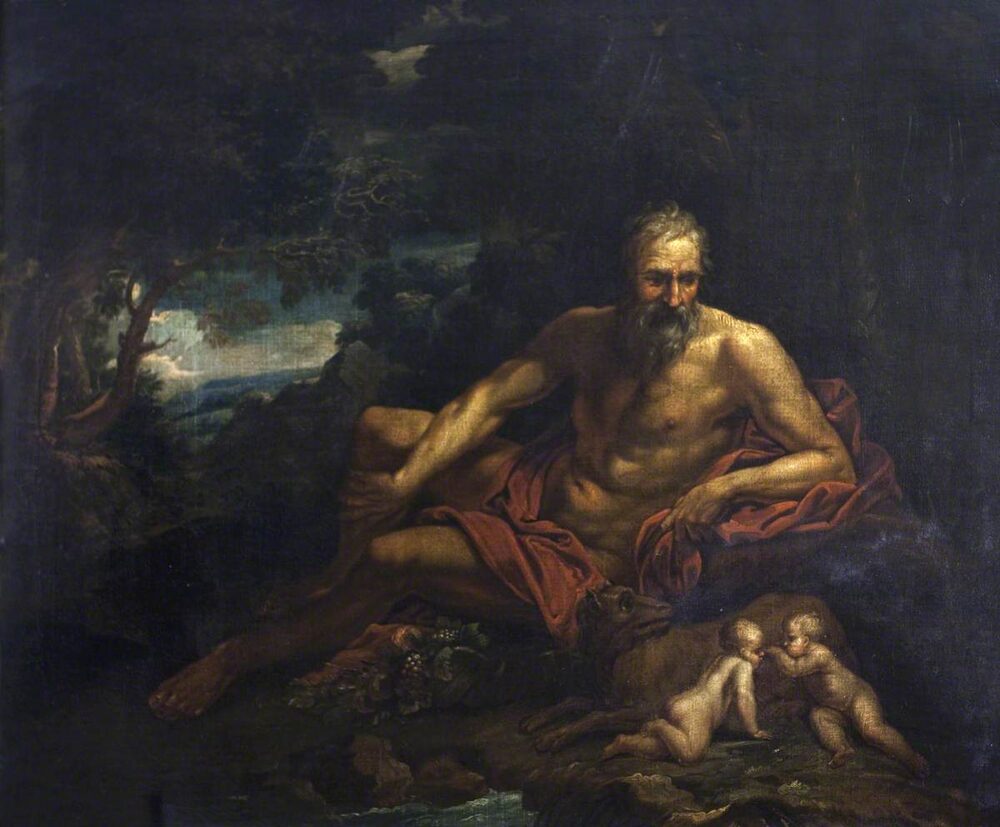
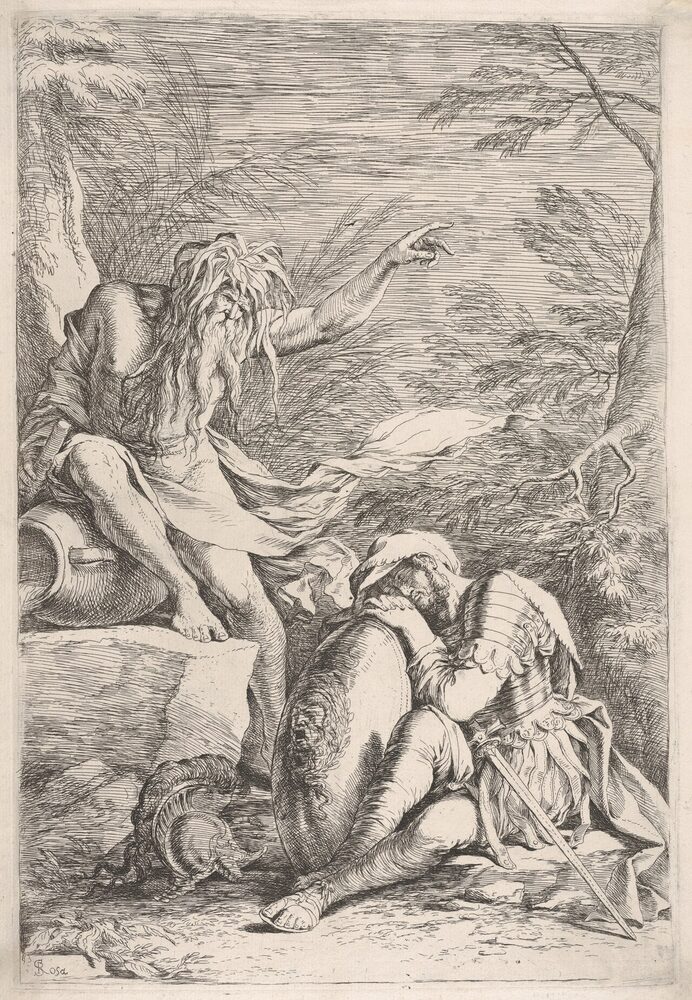
Two things mark a river-god wherever he appears. The first is his shape: he is most often drawn as a powerful bull, or as a bearded man with a bull's horns springing from his brow — the horns standing for the roaring, wilful, unstoppable force of a river in flood, which the Greeks likened to a charging bull. He may also appear as a great reclining man leaning on an urn from which water endlessly pours, crowned with reeds, or as a water-serpent coiling through his own stream. The second is his fatherhood: the Potamoi are above all the ancestors of peoples. Their daughters are the fresh-water nymphs, and their descendants are the founding kings and heroes of cities — so that to trace a Greek city's royal line back far enough was very often to arrive at the local river-god, the first father of the land. This page holds the whole family in view: the shape, the worship, and the two great stories in which a river-god steps out of his banks and into the foreground of myth — Achelous wrestling Heracles, and Scamander rising against Achilles.
Mythology
The three thousand sons of Ocean
The rivers are born near the beginning of the world. In Hesiod's Theogony (337–370), the Titaness Tethys bears to her brother-husband Oceanus — the great fresh-water river the early Greeks imagined flowing in a circle around the rim of the flat earth — a vast brood of children: the rivers as sons and the Oceanids (water-nymphs) as daughters. Hesiod names some twenty-five of the rivers in a rolling catalogue — Nile, Alpheus, Eridanus, Strymon, Maeander, Ister (the Danube), Phasis, Achelous, Simoeis, Scamander, and more — and then throws up his hands: there are three thousand rivers and as many nymph-daughters, "and no mortal could tell all their names, but each is known to those who dwell around it." That last phrase is the key to the whole class of gods. A river-god is a local god, known and worshipped by the people who live along his water; there is no single "god of rivers" over them all, but a separate divine person for every stream, each the child of Ocean and Tethys and each the god of one real place on the map.
The shape of a river-god — the bull and the horn
The Potamoi have a characteristic form, and it is one of the most vivid images in Greek religion. A river-god is drawn as a bull, or as a man with the horns and ears of a bull set in a broad bearded face — and the reason is the behaviour of a real river. A quiet stream in summer is one thing; the same river in the winter flood is a bellowing, charging, irresistible force that tears away banks and drowns the fields, and to the Greek eye that was the rage of a great bull. So the coins of river-cities across the Greek world stamp their local Potamos as a bull, or a man-faced bull, or a horned swimmer; poets call the rivers "bull-formed" (tauromorphos) and "bull-faced." The horn is the concentrated emblem of the river's power — which is exactly why the greatest single thing to come out of a river-god in all of myth is a horn, broken from the brow of Achelous, as the next story tells. A river-god may also appear more gently: as a great reclining old man leaning on a tilted urn from which his waters pour without end, his hair and beard streaming like water, a crown of reeds on his head and a water-serpent at his side. Horned bull or reclining river-father, the image always says the same thing — this water is alive, and it is a god.
Achelous wrestling Heracles — the greatest river-god
The fullest story of any river-god is the wrestling-match of Achelous (ak-eh-LOH-us), god of the largest river in Greece and reckoned the eldest and greatest of all the Potamoi — so great that his name could be used to mean fresh water itself. The tale is told most fully by Ovid (Metamorphoses 8.547–9.100), and it turns on a contest for a bride. Both Achelous and the hero Heracles sought the hand of Deianeira, the beautiful daughter of King Oeneus of Calydon. Deianeira dreaded the river-god as a suitor — for a god who could not hold one shape was a fearful husband — and when Heracles came to contend for her, the two settled the matter as the Greeks settled everything, by a wrestling-match, with the girl as the prize.
Achelous fought as a river-god fights: by changing his shape. First he wrestled Heracles as a man, and was thrown. Then he turned himself into a writhing serpent and coiled to strike — but Heracles laughed, saying he had strangled far worse serpents in his cradle, and gripped him fast. Then Achelous took his truest and most terrible form and became a great bull, lowering his horns and charging. Heracles met the bull head-on, seized it by the horns, wrestled it down, and set his whole weight against the neck until — with a wrench — he snapped off one of the horns, breaking the river-god's power and winning the match and the bride. Beaten and ashamed, hiding his broken brow under a wreath of reeds, Achelous gave up Deianeira to Heracles.
And the broken horn did not go to waste, for out of it came one of the loveliest objects in all mythology. In the common telling, the water-nymphs (the Naiads) took the horn that Heracles had torn away, filled it with fruits and flowers, and made it the Cornucopia (in Greek the keras Amaltheias, the "horn of plenty") — the ever-full horn overflowing with the harvest of the earth, which became the enduring symbol of abundance. (A second, older tradition ties the horn of plenty instead to the goat Amaltheia who nursed the infant Zeus; the two stories were told side by side. Ovid's version, giving the horn to Achelous, is the one usually pictured.) So the emblem of a river-god's strength, broken off in defeat, became the world's image of plenty — a fitting turn, since it is the rivers that make the fields bear.
Scamander rising against Achilles — the river that fought a hero
If the wrestling of Achelous shows a river-god at his most fabulous, the rage of Scamander shows one at his most awesome and most frightening — a whole river rising in fury against a man. The scene is one of the strangest and grandest in Homer's Iliad (Book 21), and it is the only time in the poem that a hero fights not another warrior but a god of the landscape itself. Scamander (also called Xanthus, "the yellow river," by the gods) is the great river of the Trojan plain, and in his water Achilles does a terrible thing. Mad with grief and fury after the death of Patroclus, Achilles drives the routed Trojans into Scamander's stream and butchers them there, choking the beautiful current with corpses and turning the water red, until the river itself can bear no more.
Scamander speaks to Achilles out of his own depths, a god rising in his waters, and begs him to stop — to do his killing on the plain and not clog and defile the stream. Achilles will not stop. Then the river-god's patience breaks, and he rises against the hero in flood: Scamander gathers all his waters into a towering, roaring wave and comes down on Achilles to drown him, sweeping away the corpses and pursuing the man across the plain, the flood curling and crashing at his back however fast he runs. For a moment the greatest of the Greek heroes is helpless — not against a spear but against water, the living river bent on pulling him under, and Achilles cries out in fear that he will die an inglorious death, drowned like a swineherd-boy swept away in a winter torrent rather than falling in battle. Scamander even calls on his fellow-river Simoeis to join him, and the two waters together nearly overwhelm the hero.
What saves Achilles is fire against water. The goddess Hera, watching her favourite hero about to drown, sends her son Hephaestus, the god of fire and the forge, to fight the river. Hephaestus looses a supernatural blaze across the plain — burning the corpses, then the trees and the very banks, then setting the water itself alight until Scamander boils and steams and cries out in agony, scalded in his own bed. The river-god yields, swearing to Hera that he will never again defend the Trojans, and his flood sinks back into its channel. It is one of the boldest strokes in all of Homer: a duel between the river and the fire, the two raw elements, with the hero's life the stake — and a reminder that a Potamos, for all that he is usually a local, kindly god, is an elemental power that even a hero cannot fight alone.
Fathers of nymphs, fathers of cities
For all their occasional terror, the deepest role of the Potamoi in Greek myth is quiet and genealogical: they are the fathers of the land's people. A river-god's daughters are the fresh-water nymphs — the Naiads of his springs and pools — and through those daughters, and through his own unions with mortal and divine women, a river-god becomes the first ancestor of the families who live along his banks. Time and again, when a Greek city traced its royal line back to its beginning, it arrived at the local river-god as the founding father.
The pattern is everywhere. Inachus, the chief river of the Argive plain, was reckoned the first king and ancestor of Argos — the father of Io (the maiden whom Zeus loved and Hera turned to a heifer) and the head of the whole Argive royal house, so that the Argives were, in a real sense, the children of their river. Asopus, a river-god of Boeotia and the Peloponnese, was the father of a great tribe of daughters — among them Aegina (carried off by Zeus, and mother of the line of Aeacus, grandfather of Achilles himself), Thebe (who gave her name to the city of Thebes), and Salamis and Corcyra and others, each daughter becoming the nymph-namesake of an island or a city. Peneus, the river of the vale of Tempe in Thessaly, was the father of Daphne, the nymph who fled Apollo and became the laurel, and of Cyrene and others. Achelous himself was called the father of the Sirens, and of many nymphs and springs.
This is the truest picture of what a river-god was to the Greeks: not a distant Olympian but the intimate, present, first father of a particular place — the water that had always been there, that watered the fields and gave the people drink, that had (they believed) literally raised the local children with its moisture, and from whom the oldest families of the city were descended. A Potamos is the god of a river, and the river is the life and the ancestry of the land it runs through.
Worship — Ancient
The nearest gods of all
Of all the divine powers a Greek acknowledged, the river-god was in one sense the nearest — not a far Olympian on a mountain-top but the very water at the edge of the village, present, audible, and daily. Every river had its cult, small or great, and the worship of the Potamoi was among the oldest and most universal strands of Greek religion, because every community lived beside water and owed its life to it. Homer already treats river-worship as immemorial custom: the rivers are gods to be prayed to, sworn by, and given their due, and to defile or dishonour a river is a real impiety.
The hair-offering — a river raised you
The most characteristic rite of river-cult was the offering of hair. Greek boys let their hair grow long through boyhood and, on the threshold of manhood, ceremonially cut it and dedicated it to the local river-god, in thanks for having been reared — for the river, with its water, was believed to have nourished and raised the children of its valley. Homer gives the classic instance: old Peleus had vowed the hair of his son Achilles to the river Spercheus of his homeland, promising sacrifices too, if the boy came safe home from Troy — a vow left unpaid, which Achilles cuts his hair to acknowledge at the funeral of Patroclus (Iliad 23.140–151). Pausanias, centuries later, still records the same rite performed for the river Cephisus and others. To shear one's first beard or boyhood locks for the river was to repay the water that had made you.
Bulls in the water, and libations at the bank
Because the river-god wore the shape of a bull, the bull was his fitting sacrifice — and river-sacrifice could be dramatic. Achilles, taunting Scamander, throws in the river's face the long Trojan custom of sacrificing bulls to him and casting living horses into his eddies (Iliad 21.130–132), a vivid glimpse of a real practice: animals given to the river by being drowned in it, offered to the water directly. Gentler and more everyday were the libations poured at the bank and the small gifts thrown into the stream — cakes, first-fruits, coins — and the rule, insisted on by Hesiod (Works and Days 737–741), that a traveller must never cross a river's flowing water without first washing his hands and praying, for to wade a stream unwashed and with unclean hands was to earn the anger of the god. Whole cities put their river-god on their coins, stamped as a bull or a horned man-headed bull or a reclining river-father, a public declaration of the god who watered and defended them.
Achelous, the water in every oath
The greatest of the river-cults was that of Achelous, whose worship spread far beyond his own river in the west. So thoroughly was Achelous identified with fresh water itself that, an ancient authority tells us, the Greeks used his name to mean water everywhere: to pour "Achelous" in libation was to pour water, and oracles (including, it was said, the oracle at Dodona) instructed worshippers to sacrifice to Achelous by name. He appears with Heracles and in countless dedications, and his bull-image is among the commonest of all river-god types. In him the local god of one river became, in cult and in speech, the god of running water as such — the nearest the diffuse worship of the Potamoi ever came to a single, Panhellenic river-god.
Worship — Modern
Honouring the nearest gods
In modern Hellenic practice, the Potamoi hold a special and beloved place precisely because they are the most local and most present of the gods — a devotee need not imagine a distant Olympus but can honour a river-god at any actual river, stream, or spring. Where the great gods are approached in the mind, a Potamos can be greeted at the water's edge, and this makes river-worship one of the most naturally revived of ancient rites. To pause at a flowing stream, to speak a word of respect and gratitude to its god, and to keep its water clean and undefiled is to do very much what the ancients did.
Offerings at the water
The traditional gifts are simple and unchanged: a libation poured into or beside the flowing water — of wine, or fittingly of clean water itself, given back to the river; a few flowers, a cake, or first-fruits set on the current; a candle lit at the bank. Following the old rule of Hesiod, many who honour the river-gods will not cross or enter a stream without a moment's washing of the hands and a quiet prayer, treating the water as the living god it was always held to be. Because the ancient rite of the hair-offering marked a river-god as the one who nurtures and raises the people of his valley, acts of care for a local river — keeping it clean, protecting its life, honouring it as an ancestor of the place — sit naturally as a modern devotion, one where reverence and the plain good of the land run together.
The reclining river-god, still among us
Beyond formal worship, the Potamoi survive vividly in art and image. The ancient type of the river-god — the great reclining bearded man leaning on an overflowing urn, crowned with reeds — became one of the most enduring figures in Western art: it is the model for countless Renaissance and Baroque fountains, where a personified river reclines with his water-jar (the four rivers of Bernini's fountain in Rome are direct descendants of the Greek Potamos), and for the personified rivers — Father Thames, Old Man River, and their kind — that still stand for the great streams of the world. Every fountain-figure of a reclining river-father with his urn, every city that speaks of its river as a living presence, and every quiet act of honouring water at its source keeps alive the oldest and nearest of the Greek gods: the three thousand sons of Ocean, one for every flowing stream, the bull-horned, reed-crowned fathers of the land.
Epithets & Cult Titles
- ταυρόμορφος / ταυρωπός (tauromorphos / taurōpos) — "bull-formed," "bull-faced" — The standard shape of a river-god: a bull, or a man with a bull's horns and a bull's brow. The roaring, wilful, unstoppable rush of a river in flood was seen as the strength of a charging bull, and so the Potamoi are shown as bulls or bull-horned men on coins and in poetry across the Greek world
- κερασφόρος (kerasphoros) — "horn-bearing" — A descriptive title for the horned river-god. The horn is the emblem of a river's force — and it is the horn broken from the river-god Achelous that became the Cornucopia, the horn of plenty, the single most famous object to come from a river-god's brow
- Ἀχελῷος (Achelous) — The greatest of the Potamoi, god of the largest river in Greece, so revered that his name could stand for river-water itself: to swear "by Achelous" or to pour "Achelous" in libation was to mean fresh water everywhere. The individual river-names — Achelous, Scamander, Alpheus, Inachus, Asopus — are each the proper name of a single Potamos
- εὐρυρέων / βαθυδίνης (euryreōn / bathydinēs) — "wide-flowing," "deep-eddying" — Homeric formula-epithets for the great rivers, marking the breadth of their waters and the deep whirling pools of the current; the kind of standing title attached to a named river-god in epic
Sources & Variants
- Hesiod, Theogony 337–370 (the birth of the rivers and the Oceanid nymphs from Oceanus and Tethys; the roll-call of some twenty-five named rivers; the 'three thousand' rivers, each known to those who dwell around it)
- Hesiod, Works and Days 737–741 (never cross a flowing river without first washing the hands and praying, lest the god be angered)
- Homer, Iliad 21.1–384 (Scamander/Xanthus rises in flood against Achilles for choking his stream with corpses, nearly drowns him, calls on Simoeis, and is driven back by the fire of Hephaestus)
- Homer, Iliad 21.130–132 (the Trojan custom of sacrificing bulls to Scamander and casting living horses into his eddies)
- Homer, Iliad 23.140–151 (Peleus' vow of Achilles' hair to the river Spercheus; the hair-offering to a river-god)
- Ovid, Metamorphoses 8.547–9.100 (Achelous the shape-shifting river-god wrestles Heracles for Deianeira, turns to serpent and bull, and loses his horn, which becomes the Cornucopia) — Roman retelling of the fullest surviving version
- Apollodorus, Bibliotheca 2.7.5 (Heracles wrestles the river-god Achelous for Deianeira and breaks off his horn)
- Apollodorus, Bibliotheca 2.1.1–3 (Inachus, river-god and first king and ancestor of Argos, father of Io); 3.12.6 (Asopus and his daughters, including Aegina and Thebe)
- Pausanias, Description of Greece (river-cults and the hair-offering to rivers such as the Cephisus; local river-gods on coins and in myth throughout the Greek lands)
- Callimachus and the scholia, on Achelous whose name stands for fresh water everywhere, and the instruction to sacrifice to him by name (as at Dodona)
Gallery