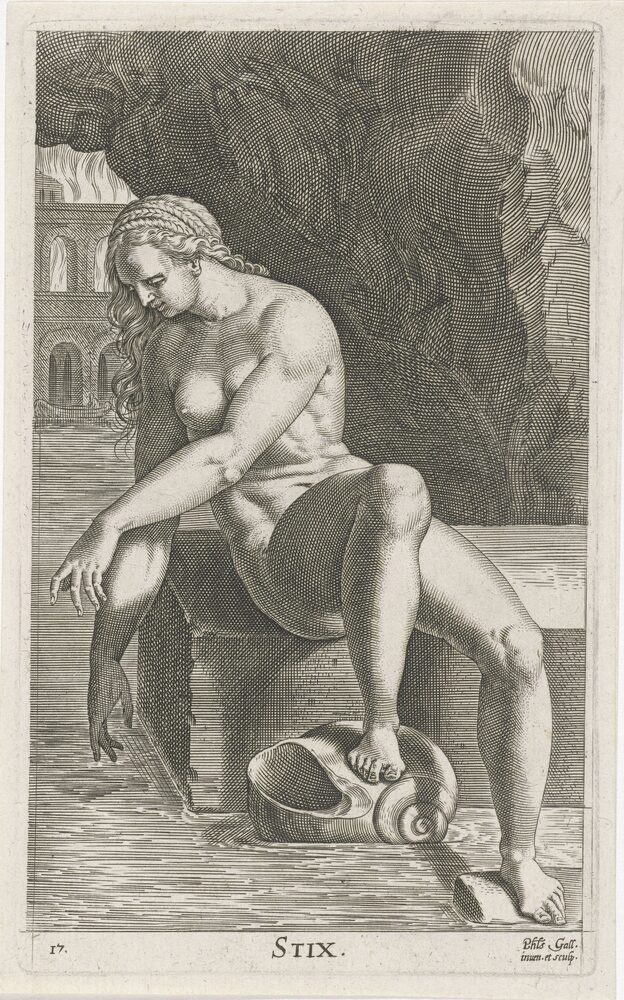
Styx
First Appearance
Styx first appears in Hesiod's catalogue of the daughters of Oceanus and Tethys, where she is named as the most honoured of them all. She comes fully into the story at the outbreak of the war against the Titans: on the counsel of her father Oceanus she was the very first of the immortals to climb to Olympus and stand with Zeus, bringing her four children — Zelus, Nike, Kratos and Bia — to fight at his side. For this Zeus honoured her above all the gods and made her water the great oath of heaven.
— Hesiod, Theogony 361 & 383–403
Who They Are
Styx (STIX) is the eldest of the Oceanids — the senior daughter of the Titan Oceanus and his sister-wife Tethys — and at the same time the dark, ice-cold river that winds through the underworld and the goddess who embodies it. Her Greek name comes from the verb στυγεῖν, "to hate, to shudder at," so that she is quite literally "the Abhorred," the water of dread by whose black stream the shades of the dead are bounded off from the living world. Yet for all the horror attached to her river, Styx is honoured among the gods as no other minor divinity is, and the reason is loyalty.
When Zeus rose against the Titans, it was Styx who came first. On the advice of her father Oceanus she was the earliest of all the immortals to ascend to Olympus and declare for the young sky-god, and she did not come empty-handed: she brought her four children — Nike (Victory), Kratos (Strength), Bia (Force) and Zelus (Rivalry) — to stand and fight for him. In gratitude Zeus raised her above every other power. He set her children forever beside his throne, and he made the water of Styx the most binding witness in the cosmos: the oath sworn upon her can never be broken without terrible cost, even by a god.
So Styx holds two faces that the Greeks never felt to be in conflict. She is the shuddering river of the dead, the boundary of the underworld that even the Olympians name with awe — and she is the faithful ally, the personified reward of standing on the right side at the founding of the world. To swear "by the water of Styx" was to call as witness the goddess who had proved, once and for all, that loyalty is the thing the king of heaven honours most.
Mythology
First to Olympus — the loyal ally of the Titanomachy
Hesiod tells that when Zeus summoned the gods to Olympus to make war on the Titans, promising that whoever fought at his side would keep their rights and honours, Styx was the first to answer. On the counsel of her father Oceanus she climbed to Olympus before any other immortal and pledged herself to Zeus, and she brought with her the four children she had borne to the Titan Pallas: Zelus (Zeal, Rivalry), Nike (Victory), Kratos (Strength, Power) and Bia (Force). These were no ordinary allies but the very powers by which a king rules, and Hesiod says they have no house and no path apart from Zeus, but dwell forever where he dwells and go wherever the god leads them.
Because she came first, and because she came with such gifts, Zeus honoured Styx above all the other gods. He gave her surpassing rewards: he made her the great oath of the deathless ones, and decreed that her children should live beside him for all time. In this way the loyalty of a single Oceanid was written permanently into the order of heaven — Victory, Strength, Force and Zeal standing always at the throne, and their mother's cold water made the one witness that even gods must fear. (Hesiod, Theogony 383–403; Apollodorus 1.2.2–5.)
The oath by the water of Styx
Of all Zeus's gifts to her, the greatest was this: that the water of Styx became the most solemn and most dreaded oath an immortal can swear. When strife breaks out among the gods on Olympus and the truth of a matter is in doubt, Zeus sends Iris, the rainbow messenger, down the long road to the underworld to fetch the sacred water in a golden jug — the far-famed cold stream that trickles down from a high and beetling rock, a branch broken off from the great river Oceanus that flows through the dark night under the earth. The god who would swear pours out a libation of this water and speaks the oath upon it.
The penalty for perjury is terrible even for a deathless being. Hesiod says that any god who pours that water and then swears falsely lies for one full year breathless and voiceless, stretched out in a deathlike coma upon a spread bed, tasting neither nectar nor ambrosia, cut off from speech and spirit. And when the long year of sickness is spent, a second and harsher trial follows: for nine more years he is banished from the councils and the feasts of the eternal gods, kept apart from their company; only in the tenth year is he received back among them. So the oath of Styx binds even the immortals, and no god who has once shuddered at her water lightly forswears it. (Hesiod, Theogony 775–806.)
The dread river of the underworld
Styx is not only the goddess who witnesses oaths but the river itself, winding icy and black through the realm of the dead. Homer names her as the water by which the gods swear their most binding vows — Hera, wishing to reassure Zeus, swears "by the down-flowing water of Styx, which is the greatest and most dread oath for the blessed gods" (Iliad 15.37–38), and on the island of Ogygia the nymph Calypso is made to swear the same great oath by the Styx before Odysseus will trust her (Odyssey 5.185). In the geography of the underworld her stream is one of the rivers that ring the house of Hades, its water so cold and so charged with dread that the very gods invoke it with awe. The Greeks imagined it as a place set utterly apart — imperishable, everflowing, and abhorred — the fitting boundary between the world of the living and the silent country of the dead.
Worship — Ancient
The Styx of Arcadia
Uniquely among the rivers of the dead, the Styx was believed to have a real earthly source, and it drew genuine cult and dread. High in the mountains of northern Arcadia, near the ancient town of Nonacris above Pheneus, a thin thread of dark water fell from a tall cliff — the modern Mavroneri, the "Black Water." Pausanias describes it at length (Description of Greece 8.17.6–18.6): the water, he reports, was held to be deadly poison to man and beast, and so corrosive that it broke through every vessel of glass, crystal, stone, pottery, horn or bone, and dissolved even iron and bronze — only the hoof of a horse was said to contain it. Herodotus records that the Arcadians of Nonacris swore their most solemn oaths by this water (Histories 6.74), tying the local spring directly to the great oath of Hesiod's gods.
A witness, not a temple-cult
Styx had no great temple, no festival calendar, and no procession of the kind that Zeus or Athena commanded. Her worship was of a different order: she was invoked, not feasted. Where Zeus was the guardian of oaths, Styx was the substance of the ultimate oath itself — the thing sworn by. In myth the gods pour libations of her water; on earth her Arcadian spring received the awe due to something sacred and dangerous rather than the shared sacrifices of an Olympian altar. To reverence Styx in the ancient world was, above all, to keep faith with what one had sworn, knowing that her cold water forgets nothing.
Worship — Modern
Honouring Styx today
Styx is not a goddess of the household hearth or the harvest but of the sworn word and of steadfast loyalty, and a modern devotee honours her best in that spirit. A simple shrine — a dark bowl of clean, cold water set on a quiet shelf, perhaps with a small dish or ewer beside it to recall the golden jug of the oath — is enough to give her a place. Approach her not for favours but for constancy: when you make a serious promise, a resolution, or a vow of loyalty, you may speak it over her water and let her stand as its witness, mindful that the point of her cult is that an oath once given is not lightly taken back.
Offerings
Because Styx is herself water, the natural offering is water: pour a libation of cold, clean spring water fully onto the earth or into a bowl set apart for her, giving it wholly and taking nothing back. Keep her offerings pure and unmixed rather than rich — she is honoured by plainness and by truth, not by abundance. A few sincere words naming what you swear or what loyalty you mean to keep are more fitting than any elaborate rite.
Reverence & the oath
Call on Styx as Horkos Megas, the Great Oath, when you would bind yourself to a promise you truly intend to keep, and as Presbytate, the Eldest, in acknowledgement of her age and her place of honour among the powers of the world. Above all, honour her by the one virtue her whole myth exists to reward: loyalty freely given at cost. She was first to Olympus when it counted, and Zeus set her above every other god for it. To keep faith — with a person, a cause, or a word once given — is the truest reverence her worshipper can offer.
Epithets & Cult Titles
- Presbytate (Πρεσβυτάτη) — The Eldest — senior of the three thousand daughters of Oceanus and Tethys
- Aphthitos (ἄφθιτος) — The Imperishable, the deathless — Hesiod's word for the everflowing water that cannot pass away
- Horkos Megas (Ὅρκος Μέγας) — The Great Oath — the sacred witness by whom the gods themselves swear and dare not lie
- Katastyx — The Utterly-Abhorred — the dread cold water that gods and mortals alike shrink from
Sources & Variants
- Hesiod, Theogony 361 (Styx among the Oceanids); 383–403 (first to Olympus, her four children, Zeus's honour and the making of the great oath); 775–806 (the golden jug, Iris, and the penalty for a god who swears falsely)
- Homer, Iliad 15.37–38 (Hera swears by the down-flowing Styx, the greatest oath of the gods); Odyssey 5.185 (Calypso's oath by the water of Styx)
- Apollodorus, Bibliotheca 1.2.2–1.2.5 (Styx daughter of Ocean; her alliance with Zeus with Nike, Kratos, Zelus and Bia; Zeus's decree that the gods swear by her)
- Herodotus, Histories 6.74 (the Arcadians of Nonacris swear by the water of the Styx)
- Pausanias, Description of Greece 8.17.6–18.6 (the Styx spring of Nonacris in Arcadia and its deadly, vessel-dissolving water)
Gallery