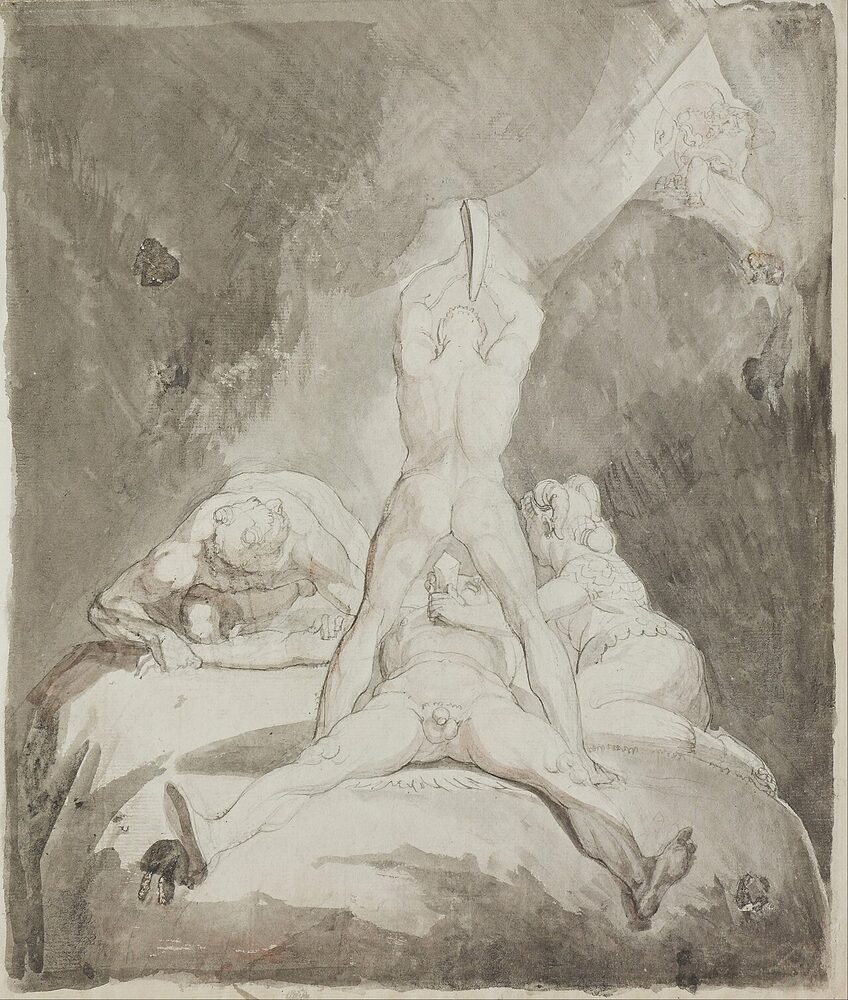
Kratos, Bia, Zēlos (with their sister Nikē)
First Appearance
The four appear together at their birth in Hesiod's Theogony (383–403): "Styx, daughter of Ocean, joined with Pallas and bore in his halls Zelus (Emulation) and fair-ankled Nike (Victory); and she brought forth Kratos (Power) and Bia (Force), surpassing children. These have no house apart from Zeus, no dwelling and no path except where the god leads them, but they dwell forever beside deep-thundering Zeus." Hesiod then tells why: when Zeus summoned the gods to Olympus to fight the Titans and promised that whoever stood with him would keep his honours, Styx came first of all the immortals, bringing her children at her father Ocean's counsel — and for that Zeus honoured her, making her the great oath of the gods, and gave her children an everlasting place at his side.
— Hesiod, Theogony 383–403
Who They Are
Kratos, Bia, and Zelus (KRAT-oss, BEE-ah, ZEE-luss) — Strength, Force, and Zeal — are three of the four children of the Oceanid Styx and the Titan Pallas, and with their sister Nike ("Victory," who has her own page in the Golden Thread) they form one of the most telling small families in all of Greek myth. They are not gods of rivers or harvests or arts, but of pure abstractions: the powers by which Zeus rules the cosmos. Kratos is power and mastery; Bia is force and violence, might laid upon the unwilling; Zelus is zeal, rivalry, the eager striving to equal and surpass; Nike is victory, the crown of every contest. Set side by side they read almost as a single idea unfolded — the strength to rule, the force to compel, the zeal to strive, and the victory that seals it all.
Their importance lies not in deeds of their own but in where they stand. Hesiod tells (Theogony 383–403) that these four alone, of all the gods, have no house and no road apart from Zeus: they dwell forever beside his throne, going only where he leads. They are his honour guard and the living emblems of his sovereignty, the proof written at his side that power, force, zeal, and victory are his to give. The Greeks understood this as the deep meaning of the Titanomachy's settlement: when the new king of heaven took his throne, Strength and Force took their places beside it and never left.
Of the three, Kratos and Bia have the most vivid single appearance in Greek literature. In the opening scene of Aeschylus's tragedy Prometheus Bound, it is Kratos and Bia who drag the rebel Titan Prometheus to a desolate crag at the edge of the world and stand over the smith-god Hephaestus as he rivets the chains — the cold, unfeeling agents of Zeus's will, strength and force made visible in the service of a new and harsh regime. There the abstractions become characters, and we see exactly what it means to be the enforcers of the throne.
Mythology
The children of Styx and Pallas
Kratos, Bia, Zelus, and Nike were born to Styx — eldest and most honoured of the daughters of Ocean (Oceanus), the goddess of the dread underworld river by whose water the gods swear their unbreakable oaths — and to the Titan Pallas, a son of the Titan Crius. In Hesiod's Theogony (383–385) Styx "joined in love with Pallas and bore Zelus and fair-ankled Nike in his halls, and she bore Kratos and Bia, surpassing children." Their names tell their natures without disguise: Kratos is kratos (κράτος), power and mastery; Bia is bia (βία), force and violence; Zelus is zēlos (ζῆλος), zeal, rivalry, the ardour to emulate; and Nike is nikē (νίκη), victory. They are the family of the qualities that win and hold dominion — a household of pure power.
First to Olympus: the reward of Styx
The decisive moment of their story is not their birth but their mother's choice. Hesiod (Theogony 389–403) tells that when Zeus called the gods up to Olympus to make war on the Titans, he proclaimed that whoever fought at his side and had held no honour under the old king Cronus would be raised to honour under the new. Styx was the very first of the immortals to come, bringing her four children with her, on the wise counsel of her father Ocean. Zeus never forgot it. He honoured Styx above all by making her the great oath of the gods — so that to this day an immortal who swears falsely by the water of Styx lies breathless and voiceless for a year and is cut off from the councils of heaven. And to her children he gave an honour just as lasting: a place beside his own throne forever. Thus the four spirits of power came to stand at the side of the king of the gods not by nature only but as the earned reward of being first and faithful in the war that made him king.
The throne-sharers of Zeus
From that settlement comes the image that defines them. Hesiod says of the four (Theogony 386–388) that "they have no house apart from Zeus, nor any dwelling nor path except where the god leads them, but they dwell forever beside deep-thundering Zeus." They are paredroi — "throne-sharers," those who sit or stand beside the seat of the ruler — and they are inseparable from him. The meaning the Greeks read in this was plain and profound: strength, force, zeal, and victory are not independent gods wandering the world, but attributes of sovereignty itself, always at the side of the one who rules. Where Zeus is, there they are; what Zeus wills, they carry out. They are less persons than the personified powers of kingship, the honour guard of heaven's throne.
Kratos and Bia bind Prometheus
The three brothers and their sister rarely act in myth — their role is to stand, not to do — but there is one great exception, and it is unforgettable. The tragedy Prometheus Bound (ascribed to Aeschylus) opens at the ends of the earth, a trackless Scythian waste, where the Titan Prometheus is to be punished for stealing fire and giving it to mortals against Zeus's will. The first figures on stage are Kratos and Bia, who have dragged the prisoner there, together with the reluctant smith-god Hephaestus, whose task is to chain Prometheus to the rock. (Aeschylus, Prometheus Bound 1–87.)
Kratos does all the speaking; Bia stands beside him in utter silence, a mute and menacing presence through the whole scene. It is Kratos who names the place and the sentence, who harries the unwilling Hephaestus to get on with the riveting, who mocks Prometheus's cleverness and tells him bluntly that his wisdom could not save him from "Forethought" of his own fate. "This is the wages of your man-loving ways," he sneers; drive the wedge through his chest, strike the fetters hard. Hephaestus pities the Titan and loathes the work — "I have not the heart," he says, "to bind a kindred god by force to this storm-beaten gorge" — but Kratos is pitiless: the command of Zeus is young and new and heavy, and none is truly free but Zeus. In this single scene the two abstractions become living characters, and the Greeks' idea of them is laid bare: Strength and Force are the cold enforcers of a ruler's will, deaf to pity, present at every act of compulsion done in the name of the throne. Through them the audience is made to feel the hardness of the new regime of Zeus, and to begin — against the enforcers' own contempt — to pity the bound rebel they serve against.
Zelus, zeal and rivalry
Of the four, Zelus has the quietest afterlife in story, but his nature is subtle and worth marking. Zēlos is the eager rivalry that strives to match or outdo another — the spur that drives a competitor, the ardent emulation that can be noble (the honest wish to equal the good) or can curdle into envy and jealousy (which the Greeks also called zēlos, and from which the English word "zeal," and by another road "jealous," descend). He is the fitting brother of Victory: for where there is a contest to be won, there first must be the zeal that enters it. Together Zelus and Nike are the beginning and the end of every striving — the drive that competes and the crown that rewards.
Nike, their sister
The fourth of the children, Nike — "Victory" — grew far beyond her brothers in worship and renown, and in the Golden Thread she has a page of her own. Where Kratos, Bia, and Zelus remained chiefly abstractions at the throne, Nike became a beloved and widely worshipped goddess, the winged bringer of victory in war and in the games, crowned with laurel, carved in gold and ivory, and set on the hand of Athena herself. It is worth seeing the family whole, for it shows how the Greeks thought: the same parents, Styx and Pallas, gave the world both the unseen enforcers of power and the radiant goddess of triumph — strength, force, and zeal on the one hand, and on the other the victory they all serve.
Worship — Ancient
Powers of the throne, not gods of the temple
Kratos, Bia, and Zelus had, for the most part, no temples, no priests, and no festivals of their own. They were understood as powers belonging to Zeus rather than as independent deities to be petitioned, and the Greeks worshipped them, when at all, only within the worship of the sovereignty they embodied. This is itself the point Hesiod makes: having "no house apart from Zeus," they could hardly have houses — shrines — of their own. Their honour was to stand at his, and to be named among the forces by which the cosmos is ruled.
The oath by Styx
If the children had little cult, their mother had the greatest honour imaginable, and theirs is bound up with hers. Because Styx came first to Zeus's side in the Titan war — bringing these very children — Zeus made her water the oath that binds even the gods (Hesiod, Theogony 775–806). The most solemn vow an immortal can swear is "by the water of Styx," and to break it is to lie as if dead for a year and be exiled from the feasts and councils of the gods for nine more. Every time that oath was named, the honour of Styx and her children — the household that stood first with Zeus — was called to mind. The power that guards the word of the gods flows from the same source as the powers that guard his throne.
Glimpsed in the poets and the philosophers
Where the three do appear, it is in poetry and reflection rather than ritual. Aeschylus gave Kratos and Bia their one great scene in the Prometheus Bound, and later writers and allegorists took them, with Zelus, as moral and political emblems — the attendants that any power must command, the strength, force, and zeal without which no rule stands. In this way the three lived less on altars than in the Greek imagination of what sovereignty is made of.
Worship — Modern
The powers behind the throne
For a modern reader or devotee, Kratos, Bia, and Zelus are best approached not as gods to be prayed to in isolation but as a meditation on the nature of power — on what it means that the Greeks set Strength, Force, and Zeal at the right hand of their highest god and kept them there forever. To honour them is to reckon honestly with the forces that stand behind every throne: the strength that enables rule, the force that can compel, the zeal that strives and competes. They sit well as figures of contemplation for anyone thinking about ambition, authority, competition, and the uses and dangers of power — including the warning written into the Prometheus Bound, where strength and force, severed from mercy, become something terrible.
Kratos in the modern imagination
Of the three, Kratos has found an unexpected second life: his name — the Greek word for "power" — survives inside dozens of English words (demo-cracy, auto-cracy, every "-cracy" is a rule, a kratos), and in our own age the name "Kratos" has become widely known as the protagonist of a celebrated series of video games loosely drawn from Greek myth. That modern hero is an invention and should not be confused with the ancient figure, who was not a warrior at all but the personified power of Zeus; still, the fame of the name has brought many readers back to Hesiod and Aeschylus to meet the original — the spirit of strength who stands, silent and tireless, beside the throne of the king of the gods.
Striving and victory, together
Zelus, least known of the four, offers the gentlest point of reflection. As the god of zeal and honest emulation — the drive to match and better the good we admire — he is a fitting patron of any wholehearted striving, and the natural companion of his sister Nike, Victory. To hold the two together is to remember an old truth the family teaches: that victory is the child of zeal, that no crown is won without the ardour that enters the contest, and that strength and force, rightly ordered, serve the striving rather than crush it.
Epithets & Cult Titles
- Κράτος (Kratos) — "Strength, Power" — The eldest-named of the four in Hesiod: kratos is the Greek word for power, might, mastery, the strength by which one rules or prevails. He is Zeus's strength made into a god, and in Aeschylus's Prometheus Bound he is the hard-tongued enforcer who drives the binding of Prometheus
- Βία (Bia) — "Force, Violence" — Force, violent might, compulsion — strength not merely possessed but used, the power that seizes and constrains. In the Prometheus Bound Bia stands beside her brother at the binding but speaks not a word, a mute and terrible presence; the Greeks debated whether to picture Bia as female (as the noun's gender suggests) or male
- Ζῆλος (Zelus) — "Zeal, Rivalry, Emulation" — Zeal, ardour, the eager rivalry that strives to equal or surpass another — the drive to emulate, from which comes both honourable ambition and envious jealousy. He is the spur of competition itself, fittingly a brother to Victory
- πάρεδροι Διός (paredroi Dios) — "the throne-sharers of Zeus" — Not a proper name but their defining station: the four who sit or stand beside (para-) the seat (hedra) of Zeus. Hesiod says they have no house and no path apart from the god, but dwell forever where he leads — the living signs that strength, force, zeal, and victory belong to the king of the gods
Sources & Variants
- Hesiod, Theogony 383–403 (Styx bears Zelus, Nike, Kratos, and Bia to Pallas; they have no house apart from Zeus and dwell forever beside his throne)
- Hesiod, Theogony 389–403 (Styx comes first of the immortals to Zeus in the Titan war, bringing her children; Zeus honours her and gives her children an everlasting place at his side)
- Hesiod, Theogony 775–806 (Styx made the great oath of the gods; the penalty for the god who forswears her water)
- Aeschylus, Prometheus Bound 1–87 (Kratos and Bia drag Prometheus to the Scythian crag and oversee his binding by Hephaestus; Kratos speaks as the pitiless enforcer of Zeus's will, Bia stands silent)
- Apollodorus, Bibliotheca 1.2.2–1.2.4 (Styx and her children Nike, Kratos, Bia, and Zelus allied with Zeus against the Titans and given honour)
Gallery