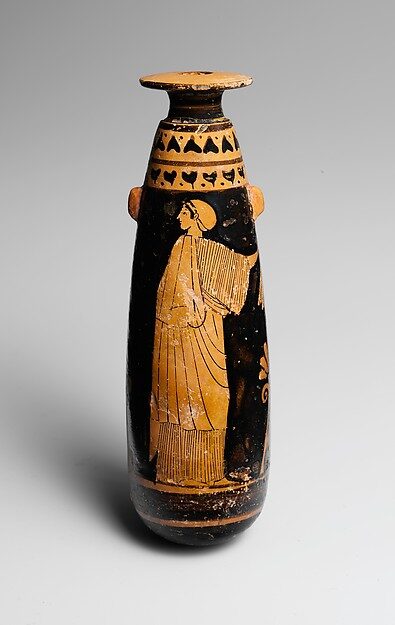
Nikē
First Appearance
Nike first appears in Hesiod's Theogony (383–388) not as a warrior but as a member of a family. Styx, daughter of Ocean, bore to Pallas four children: Zelus (Rivalry), Nike (Victory), Kratos (Strength), and Bia (Force). Hesiod says that these four have no house and no path apart from Zeus, no seat and no way except where the god leads them, but dwell forever beside him — because their mother Styx brought them to stand first with Zeus in his war against the Titans, and he honoured her for it. So from her earliest appearance Nike is defined by where she stands: always at the side of Zeus.
— Hesiod, Theogony 383–388
Who They Are
Nike (NY-kee) is the winged goddess of victory — the swift, bright figure who flies down out of the sky to crown the winner, whether the winner is an army on the battlefield, a runner at the games, or a chariot first across the line. Her name is simply the Greek word for "victory," nike, and that is exactly what she is: the moment of winning itself, made into a goddess and given wings. Wherever a contest was decided in the Greek world — in war, in the great athletic festivals, in the theatre, in any struggle with a winner and a loser — Nike was understood to be present, the divine presence of triumph.
She is one of the great personifications, a member of the class of Greek divinities who are an abstract idea walking and breathing: Victory in person, as her siblings are Strength, Force, and Rivalry in person. But unlike many personifications, who stay pale and literary, Nike became one of the most beloved and most often depicted figures in all of Greek art. Sculptors and vase-painters loved her — the rush of her descent, the sweep of her great wings, the fluttering of her robe pressed back against her body by the wind of her own flight. The most famous statue to survive from the whole ancient world, the Winged Victory of Samothrace now in the Louvre, is an image of Nike alighting on the prow of a ship, and she stands, wings still spread, as the single most recognisable Greek goddess in the modern eye.
Two companionships define her. She is first of all the constant attendant of Zeus, king of the gods, at whose side she has stood since the war against the Titans and in whose hand or in whose temple she is so often shown — a small winged figure standing on the outstretched palm of the great god, the victory he grants held out for all to see. And she is fused, more closely than with any other deity, with Athena: at Athens the two became a single goddess, Athena Nike, "Athena-as-Victory," worshipped together in a small and beautiful temple on the edge of the Acropolis. To understand Nike is to understand a Greek habit of mind — that the abstract things a people most desire, victory above all, are not cold ideas but living powers, to be honoured, thanked, and (if you are wise) kept from ever flying away.
Mythology
A goddess born of Styx and a Titan
Nike belongs to the second generation of divine powers, the children of the Titans, and her parentage places her exactly. Her father is Pallas, one of the Titans (a son of the Titan Crius — not to be confused with the several other figures who bear that common name), and her mother is Styx, the eldest daughter of Ocean and the goddess of the great river of the underworld by whose black water the gods swear their most binding oaths. From this union came four children who would always be named together: Zelus (Rivalry, or Zeal — the eager desire to win), Nike (Victory), Kratos (Strength, the power that holds and rules), and Bia (Force, raw violent might). The four are a family of the hard powers that decide a contest — the wanting of it, the winning of it, the strength to hold it, and the force to seize it — and in Greek imagination they move together.
Styx, the war against the Titans, and the place at Zeus's side
The defining moment of Nike's story is not her own doing but her mother's, and it fixes her place in the cosmos forever. When Zeus and the younger gods rose against the Titans in the great war for the mastery of heaven — the Titanomachy, told more fully on Styx's own page — Zeus made a proclamation to all the divine powers: whoever would fight on his side against the Titans should keep their honours, and whoever had held no rank under the old order should be raised to one. Styx, on the counsel of her father Ocean, was the very first to answer. She came to Olympus bringing her four children with her — Nike, Kratos, Bia, and Zelus — and set them at Zeus's side to fight for him.
Zeus never forgot it. He made Styx herself the great oath of the gods, the unbreakable witness by whom the immortals swear; and he kept her children beside him always as the reward for their mother's loyalty. This is why Hesiod says that Nike and her siblings have no home and no road apart from Zeus, no seat and no path except where he leads: they dwell forever with the king of the gods. And so Nike is ever at Zeus's side — the victory that the ruler of the world keeps always in his gift and always within reach. In art this is shown with wonderful literalness: Zeus, and Athena too, are again and again depicted holding a small winged Nike out on the palm of one hand, the goddess of Victory standing on the hand of the power that dispenses it.
Victory in person, and why she has wings
Nike is a personification — an abstract thing, victory, made into a divine person — and the Greeks gave her wings to say something true about what victory is. Victory is swift: it arrives suddenly, it comes down from above like a decision from heaven, and it is gone as quickly, ready to fly to the next contest and the next winner. The winged goddess sweeping down to lay a wreath on the victor's head is the perfect image of a triumph that alights for a moment and could as easily lift away. This double truth — that victory descends as a gift but never stays of its own accord — is the key to her most famous cult, at Athens, where the city took the drastic step of making its Victory wingless precisely so that she could never leave (see the worship section below).
Nike and Athena: the two made one
No two Greek deities are more closely fused than Nike and Athena. Athena is the goddess of war waged with wisdom and skill — and the natural end of such war is victory, so Victory becomes almost an aspect of Athena herself. At Athens the two were worshipped as a single goddess, Athena Nike, "Athena Victory," and the great cult-statue of Athena Parthenos inside the Parthenon held a full-sized figure of Nike in her outstretched right hand. Where Nike stands with Zeus as the victory the king of the gods bestows, she stands with Athena as the victory that wisdom and disciplined courage win. The two companionships are the two halves of her nature: victory as a gift from on high, and victory as the earned reward of skill.
A goddess of few stories and endless images
It is worth being honest about what kind of goddess Nike is. She has almost no myths of her own — no love affairs, no quarrels, no adventures, no children of note. She does not act; she attends. This is the ordinary condition of the personifications, who are less characters in stories than presences invoked at the right moment. But what Nike lacks in narrative she more than makes up in presence: she is everywhere in Greek and Roman art, on coins and vases and temple-fronts and battlefield monuments, forever descending, forever crowning, forever pouring the libation of thanks. She is the goddess you meet not in a tale but at the instant of winning — and for the Greeks, who prized the contest above almost everything, that made her one of the most present divinities of all.
Worship — Ancient
The Victory who guards the Acropolis
Nike's greatest cult was at Athens, and it is one of the most revealing in all of Greek religion. On the south-west edge of the Acropolis, on the bastion beside the great gateway, the Athenians built a small and exquisite temple to Athena Nike — Athena-as-Victory — completed in the later fifth century BC, its cult served by a priestess appointed by the city and its sacrifices regulated by public decree. Here the two goddesses were worshipped as one: the war-goddess of the city in her aspect as the giver of triumph.
Nike Apteros — the wingless Victory
The most famous thing about this cult is the paradox at its heart. The ancient cult-image of the goddess in this shrine was made without wings — Nike Apteros, "Wingless Victory." The traveller Pausanias, who saw it, records the Athenians' own explanation: they had made their Victory wingless so that she would never fly away from Athens but remain with the city forever. It is one of the most touching ideas in Greek religion — a people so anxious to keep victory that they clipped the wings of the goddess herself, holding fast to the triumph they feared to lose. The ordinary Nike of art is winged, swift, always about to depart; the Nike of Athens was deliberately made unable to leave.
Victory in the hand of the gods
Beyond her own shrine, Nike was present wherever the greater gods dispensed triumph. The colossal statue of Athena Parthenos in the Parthenon held a life-sized Nike in her right hand; the equally colossal Zeus at Olympia, one of the Seven Wonders, likewise held a figure of Nike on his outstretched palm — the king of the gods offering Victory to the world. At Olympia and the other great games, Nike was the goddess who crowned the winners, and her image presided over the contests; a celebrated statue of Nike by the sculptor Paeonios stood at Olympia, shown alighting from the air. Everywhere, the pattern was the same: Victory shown in the gift of a greater power, or descending under her own wings to the winner.
The offerings of the victorious
Because Nike was the presence of winning itself, her worship was above all the worship of the victorious. A general who won a battle, a city that won a war, an athlete who won his event, a chorus that won the prize in the theatre — all gave thanks to Victory. The natural offerings were the spoils and arms of the defeated enemy, dedicated in gratitude; statues and images of Nike set up to commemorate a triumph (the Nike of Paeonios and the Winged Victory of Samothrace were both such victory-monuments); and the wreaths, palms, and fillets of the games, which were themselves her emblems. To win was, in a sense, to have been visited by the goddess, and the honours paid to her were the winner's thanks for the visit.
Worship — Modern
Honouring Victory today
A personification like Nike is honoured today in a particular key: not as a great story-telling deity petitioned for the ordering of the world, but as the living presence of a single clear thing — victory, success, the crowning of effort. A modern devotee drawn to her might turn to her at the threshold of any contest or hard endeavour, any moment where there is a struggle to be won: an examination, a competition, a court case, a race, a piece of work brought at last to a finish. She is the goddess of the winning of it, and hers is the presence to invoke when the outcome hangs in the balance and again when the effort has come home.
Offerings and remembrance
Fitting gifts follow her ancient emblems. A wreath of laurel or a single palm branch set on a small altar recalls the crown and the palm she carried to every winner; a libation of wine poured out in thanks after a success given wholly to her honours her as the victorious of old did, with gratitude for a triumph received. A lit candle and a few words of thanks at the finish of a long undertaking, or an image of the winged goddess descending, keep her presence near. Because her Athenian cult was, above all, about keeping victory rather than merely winning it, a quiet remembrance in the season of success — a refusal to take a triumph for granted — sits especially well as a tribute to the goddess whose wings the ancients clipped so that she would never leave.
The most familiar goddess in the modern eye
More than through any formal cult, Nike lives on today as perhaps the single most seen figure of Greek religion, though most who see her do not know her name. The Winged Victory of Samothrace, wings spread on her ship's prow, is one of the most famous statues in the world, the crown of the Louvre. Her winged, wreath-bearing form is the direct ancestor of the "victory" and "angel" figures on countless war memorials, medals, and trophies down to the present day; the laurel wreath she carried is still the universal sign of the champion. And her very name, Nike, meaning simply "victory," has become one of the best-known words on earth as the name of a sportswear brand whose "swoosh" is meant to evoke the sweep of her wing — so that the ancient goddess of winning still presides, unrecognised, over the games and the winners of the modern world.
Epithets & Cult Titles
- Apteros (Ἄπτερος) — Wingless — the title of the Nike worshipped on the Athenian Acropolis, whose famous statue was made without wings so that Victory could never fly away from the city (see the worship section below)
- Pteroessa (Πτερόεσσα) — Winged — the ordinary form of Nike in art, the swift goddess who flies down to crown the winner; wings are her single most recognisable mark
- Athena Nike (Ἀθηνᾶ Νίκη) — Athena-as-Victory — the title under which the two goddesses are fused into one, worshipped together in the small temple on the Acropolis; Victory understood as an aspect of the war-goddess Athena
- Chrysopteros (Χρυσόπτερος) — Golden-winged — a poetic epithet for Nike's shining wings as she descends, the gold of the wreath she carries answered by the gold of her feathers
Sources & Variants
- Hesiod, Theogony 383–388 (Styx bears Zelus, Nike, Kratos, and Bia to Pallas; they dwell forever beside Zeus)
- Hesiod, Theogony 389–403 (Styx first to Olympus with her children in the war against the Titans; Zeus's reward and honour to her)
- Homeric Hymn 8, to Ares 4 (Ares called 'victory-bearing,' nikēphoros — the language of Victory in cult); and the wide use of Nikēphoros as a divine epithet
- Pausanias, Description of Greece 1.22.4 and 3.15.7 (the wingless Nike / Athena Nike at Athens, made without wings so that Victory would never leave the city)
- Pausanias, Description of Greece 5.11.1–2 (the Nike held in the hand of the Zeus at Olympia) and 5.26.1 (the Nike of Paeonios at Olympia)
- Pausanias, Description of Greece 1.24.7 (the Nike in the hand of Athena Parthenos in the Parthenon)
- Bacchylides and Pindar, victory odes (epinikia) passim (Nike invoked as the goddess of triumph in the games)
- Inscriptiones Graecae I³ 35 and 36 (the Athenian decrees establishing the priestess and temple of Athena Nike) — historical cult evidence
- Note on late/derivative material: the identification with the Roman Victoria, and much of the imperial imagery of Victory, is Roman rather than Greek and is flagged as such
Gallery