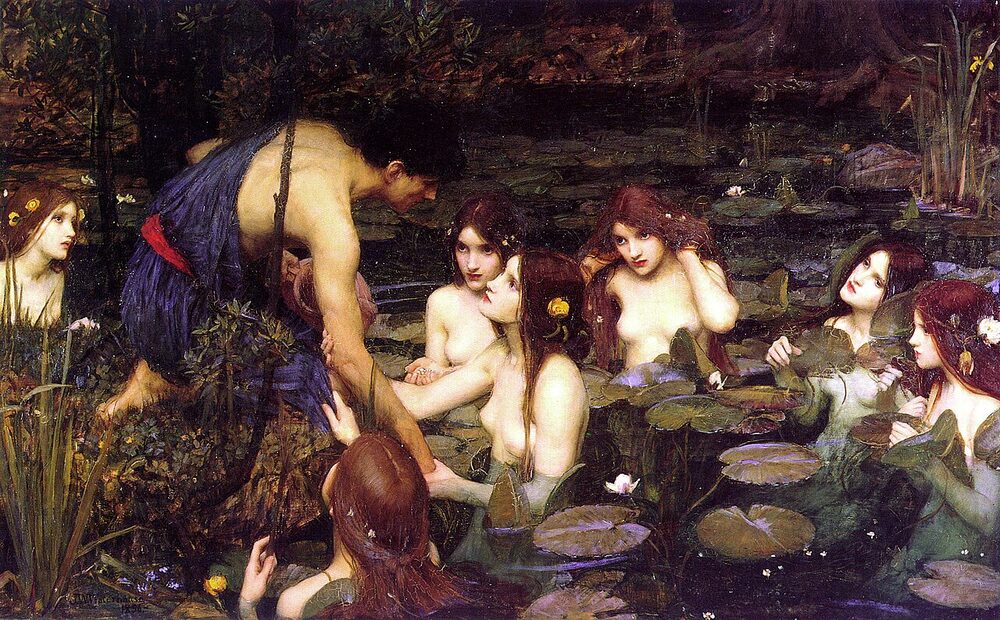
Nymphai / Nymphs
First Appearance
The nymphs are present in Greek poetry from its very beginning. Homer's Iliad (20.8–9) gathers them to the assembly of the gods — "none of the rivers was absent, save Ocean, nor any of the nymphs who haunt the lovely groves, the springs of rivers, and the grassy meadows" — while the Odyssey (13.103–112) describes the cave of the nymphs on Ithaca, with its stone bowls and jars where bees store honey and the Naiads weave sea-purple cloth. Hesiod's Theogony sorts them into their great families: the Meliae, the ash-tree nymphs, spring from the blood of the wounded Uranus fallen on the Earth (187–198); the fifty Nereids are born to Nereus and Doris (240–264); and the three thousand Oceanids to Oceanus and Tethys (346–366), "who are dispersed abroad and haunt the earth and the depths of the waters, everywhere alike."
— Homer, Iliad 20.8–9 and Odyssey 13.103–112; Hesiod, Theogony 130–139, 187–198, 240–264, 346–366
Who They Are
The nymphs (NIMFS; Greek Νύμφαι, Nymphai; singular nymphē) are the many goddesses of the living world — the divine young women who are the springs, the rivers, the trees, the mountains, and the sea, each one the indwelling life of a particular place. The Greek word nymphē means simply "a young woman" or "a bride," a girl at the age of marriage, and that is exactly how the nymphs were imagined: beautiful maidens, forever young, who danced in the meadows and by the water and who were the companions and lovers of gods and the mothers of heroes. But a nymph is never merely a pretty spirit. She is a goddess, and more than that she is a place made divine — this spring, this oak, this hillside — so that to speak of a nymph is to speak of the sacred life of one particular spot of earth.
This is the single most important thing to understand about them: the nymphs are place-bound. Where the great Olympians rule whole domains from the sky, each nymph belongs to one thing and one place. A Naiad is her spring; a Dryad is her wood; a Hamadryad is one single tree, so wholly that when the tree is cut down she dies with it. The nymphs are the Greek way of feeling that the natural world is alive and inhabited — that a wood or a well or a mountain is not empty matter but the body of a goddess, who can be pleased or offended, who watches those who come to her, and who must be honoured. It is the oldest and warmest form of Greek religion, the worship not of the distant gods of Olympus but of the divine presence in the water one drinks and the tree one sits beneath.
There are a great many kinds, and the Greeks sorted them chiefly by where they lived: the Naiads of fresh water, the Dryads and Hamadryads of the trees, the Oreads of the mountains, the Nereids of the salt sea, and the vast family of the Oceanids, the three thousand daughters of the encircling Ocean. They are goddesses, divine and immensely long-lived — the poets say a nymph outlives ten phoenixes — yet they are not quite the deathless immortals the Olympians are, and some, most poignantly the Hamadryads, can truly die. Their ancestry runs back to the very sources of water and earth: to Oceanus and Tethys, to old Nereus of the sea, to the river-gods, and to the body of the Earth herself. This page holds them all together — first what a nymph is, and then, one by one, the great kinds.
Mythology
What a nymph is — a goddess of one place
Before the kinds, the thing itself. A nymph is a female divinity of the natural world, imagined always as a beautiful young woman and always tied to a particular feature of the landscape — a spring, a river, a tree, a grove, a mountain, a cave, a meadow, a stretch of sea. She is not a symbol of the place; in the oldest way of feeling, she is the place, its life made conscious and personal. When a Greek looked at a clear spring bubbling from the rock, he did not see water only; he saw the home, or the very body, of a Naiad, and he behaved accordingly — drawing her water with a word of thanks, pouring a little back, keeping her pool clean, never fouling it. To insult a nymph's spring or fell her tree was not vandalism but sacrilege, an offence against a goddess who was watching.
This is why the nymphs matter out of all proportion to their individual fame. They are the Greek sense that the world is full of gods — that no wild place is empty. They are also the point where religion touches daily life most closely: a farmer, a shepherd, a woman fetching water met the nymphs far more often than she met Zeus. And they were dangerous as well as kindly. To come upon a nymph unawares, or to be loved by one, could overturn a mortal life: the word nympholēptos, "nymph-seized," named a person caught up and possessed by the nymphs — sometimes driven mad, sometimes granted prophecy and poetry, always marked out and no longer wholly his own.
Are the nymphs goddesses — and can they die?
The nymphs are goddesses, and the Greeks treated them as such: they receive worship, they are called theai (goddesses), they consort with the Olympians as near-equals, and they live across spans of time no mortal could imagine. And yet they occupy a subtle middle place between the deathless gods and mortal creatures — a question the ancients themselves found interesting. The Homeric Hymn to Aphrodite (lines 256–272) gives the fullest answer: the mountain-nymphs, it says, are "neither mortal nor immortal." They live very long — long enough to be counted among the gods — and they eat the divine food and dance with the immortals; but they are not eternal as Zeus is eternal. For most nymphs this simply means an almost unimaginable length of life; the poet Ausonius later reckoned a nymph's span at ten times the life of a phoenix, itself many human lifetimes.
But for one kind the boundary is sharp and tragic, and it is the clearest proof that a nymph can die: the Hamadryads, the tree-nymphs bound each to a single tree, live only as long as their tree lives, and when it is cut or withers, the nymph within it perishes too. The same Homeric Hymn says it plainly of the mountain tree-nymphs: when the fated day of their death is near, first the beautiful trees wither, the bark falls away, the branches drop — and "at that hour the soul of the nymph leaves the light of the sun." So the nymphs are goddesses who can grieve, and love, and — some of them — die: divine, but woven into the mortal life of the living world in a way the Olympians never are.
Naiads — the nymphs of fresh water
The Naiads (Ναϊάδες, Naiades, "the flowing ones," from naein, "to flow") are the nymphs of all fresh water: of springs and fountains, of rivers and streams, of wells, brooks, and marshes. They are perhaps the most beloved and the most everyday of all the nymphs, because fresh water is life, and every spring and well had its Naiad. She is her water: where the spring flows clear and sweet, the Naiad is present and pleased; if a spring failed or dried, the Greeks might say the Naiad had departed or died. Their fathers are most often the river-gods (themselves sons of Oceanus) or Oceanus himself, so that a Naiad of a particular river is commonly the daughter of that river's own god.
The Naiads were held to have real power over their waters, and those waters had power in turn: many springs sacred to the Naiads were believed to heal, to grant fertility, or to inspire — the very word for a poet's inspiration by a spring goes back to them. Their water was used to bathe brides before marriage and to purify. But they could be jealous and dangerous too: the beautiful boy Hylas, companion of Heracles on the voyage of the Argo, went to fill his pitcher at a woodland spring and was pulled down into the water by the Naiads who loved him and never seen again — a story every Greek knew, and a warning that the tender maidens of the water could take as well as give. Naiads were also mothers on a grand scale: countless local heroes and kings were said to be the sons of a river-god and a Naiad of the land.
Dryads and Hamadryads — the nymphs of the trees
The Dryads (Δρυάδες, Dryades, from drys, "oak," and by extension any tree) are the nymphs of trees and woodland — the life of the forest imagined as a company of maidens who dance in the glades and haunt the groves. A Dryad in the broader sense is a woodland nymph, free to move through her wood and to outlive any single tree. But within them is a closer and stranger kind, and here lies one of the most touching ideas in all Greek myth: the Hamadryad (Ἁμαδρυάς, Hamadryas, "together-with-the-tree").
A Hamadryad is bound to one single tree, and lives and dies with it. She is born when the tree sprouts and she perishes when it falls; her life is the tree's life exactly. To fell such a tree was therefore to commit murder, and the myths punish it savagely. The most famous is the tale of Erysichthon, a Thessalian who scorned the gods and took an axe to a great oak in a grove sacred to Demeter — an oak that was the home of a Hamadryad. As he struck, the tree bled, and the dying nymph cried out from within it and warned him that punishment would come. Demeter answered her nymph's death by cursing Erysichthon with a hunger that could never be filled: he ate everything he had, sold his own daughter for food, and at the last devoured his own body. Conversely, those who loved and protected the trees were rewarded — the pious Rhoecus propped up a falling oak and its grateful Hamadryad offered him her love. The Hamadryads are the sharpest expression of the whole nymph-idea: the goddess is the place so completely that to destroy the place is to kill the goddess.
Oreads — the nymphs of the mountains
The Oreads (Ὀρειάδες, Oreiades, from oros, "mountain") are the nymphs of the mountains, the hills, the high rocky places, and the grottoes and caves within them. They belong to the wild uplands rather than the tended valley, and they are above all the companions of Artemis, who ranges the mountains with her band of nymphs hunting and dancing — an Oread is often imagined running at the huntress-goddess's side. Because caves are their haunts, the Oreads shade into the nymphs of grottoes, and many of the sacred nymph-caves of Greece were theirs.
The best-known Oread is Echo, a mountain-nymph of Mount Cithaeron and Helicon, whose story explains a natural wonder. In the tale Ovid tells most fully, Echo helped Zeus in his love-affairs by distracting his wife Hera with endless chatter; when Hera discovered the trick, she punished Echo by taking away her power of speech, leaving her only able to repeat the last words spoken to her. Then Echo fell hopelessly in love with the beautiful youth Narcissus, who spurned her; wasting away in grief, she dwindled until nothing was left of her but her voice, which still answers, in the mountains and hollow places, whoever calls — the echo we still hear. The Oreads are thus the voice and the wildness of the high places, the goddesses one meets on the lonely heights where Artemis hunts.
Nereids — the fifty daughters of the salt sea
The Nereids (Νηρηΐδες, Nērēides) are the nymphs of the Mediterranean sea, the fifty beautiful daughters of the old, kindly sea-god Nereus (the "Old Man of the Sea") and the Oceanid Doris. Where the Naiads are fresh water, the Nereids are the salt water, and unlike the wilder, storm-tossed powers of the deep they are gentle and benign — the calm, friendly, life-giving face of the sea, who help sailors and rise from the waves to dance. Hesiod names all fifty in the Theogony, and several are great figures in their own right.
Chief among them is Thetis, the silver-footed sea-goddess whom Zeus himself desired, but who was married to the mortal Peleus when it was foretold that her son would be greater than his father — and that son was Achilles, the greatest of the Greeks at Troy, whom Thetis loved and mourned and tried in vain to save. Another is Amphitrite, who became the wife of Poseidon and the queen of the sea. A third, Galatea, is the sea-nymph wooed by the lovesick Cyclops Polyphemus. The Nereids were widely worshipped by sailors and coastal peoples, who prayed to them for safe voyages, and it was the Nereids whom Queen Cassiopeia offended when she boasted her daughter Andromeda was fairer than they — an insult that brought the sea-monster down on her land. The Nereids show the nymph-idea extended to the whole sea: the water alive, and on the whole kindly, peopled by fifty divine sisters.
Oceanids — the three thousand daughters of Ocean
The Oceanids (Ὠκεανίδες, Ōkeanides) are the eldest and the most numerous of all the nymphs: the three thousand daughters of the Titan Oceanus — the vast river the Greeks believed encircled the whole flat earth — and his sister-wife Tethys. Hesiod names some forty of them and then throws up his hands: they are three thousand, he says, "dispersed abroad" over all the earth and the depths of the waters, and "no one could tell all their names." Their three thousand brothers are the river-gods; between them, the sons and daughters of Oceanus and Tethys, they are all the waters of the world.
Because they are so many and so old, the Oceanids overlap with every other kind and stand behind them all: many Naiads are Oceanids or their descendants, and the mother of the Nereids, Doris, is herself an Oceanid. Several are among the greatest of goddesses in their own right — Styx, the eldest, is the dread river of the underworld by whom the gods swear their unbreakable oaths; Metis ("Wisdom"), Zeus's first consort, was an Oceanid, swallowed by Zeus so that Athena was born from his head; Doris, Electra, Clymene, Perseis, and Dione are Oceanids who became mothers of gods and heroes; and it is a chorus of pitying Oceanids who come to comfort the chained Titan in Aeschylus's Prometheus Bound. The Oceanids are the nymph-idea taken to its origin: the whole of the world's water understood as an immense family of goddesses, springing from the encircling Ocean that is the source of every spring, river, and sea.
The tracing of their divine ancestry
Set side by side, the kinds of nymph reveal a single great family tree of water and earth. At its head stands Oceanus, the world-encircling river, and his wife Tethys: from them come the three thousand Oceanids and the three thousand river-gods. From the river-gods in turn come most of the Naiads, each the daughter of the stream she inhabits. From old Nereus (himself a son of Pontus, the Sea, and the Earth) and the Oceanid Doris come the fifty Nereids of the salt sea. The Dryads, Hamadryads, and Oreads — the nymphs of tree and mountain — are more often simply daughters of the Earth (Gaia) herself, or of particular gods and rivers of their region, born from the land they belong to. And oldest of a special kind are the Meliae, the ash-tree nymphs, who in Hesiod spring directly from the blood of the wounded Uranus (Sky) falling upon the Earth — nymphs born, quite literally, where heaven's blood met the ground. So however local a single nymph may be — one well, one oak, one hill — her lineage runs back to the primeval sources of the living world: to Ocean, to the Sea, to the Rivers, and to the Earth.
Worship — Ancient
The nearest gods — worship at spring and cave
Of all the divine beings of Greece, the nymphs were among the most constantly and intimately worshipped, precisely because they were the nearest to hand. One did not need a great temple or a priesthood to honour a nymph; her shrine was her spring or her cave, and her rites were simple, local, and woven into daily life. Wherever water rose from the ground or a cave opened in a hillside, there was likely a place of the nymphs. Worshippers brought modest offerings — milk, olive oil, and honey poured out at the water's edge or the cave-mouth, together with cakes, fruit, garlands of wildflowers, and small terracotta figurines and carved reliefs left as votives. The characteristic offering was liquid and gentle, fitting goddesses of flowing water: no great blood-sacrifice, but the pouring of milk and honey and the drawing of the sacred water itself.
The sacred caves — the nymphaea
The most distinctive centres of nymph-worship were the caves sacred to the nymphs, called nymphaea, found all over the Greek world and often shared with the goat-god Pan and with Hermes and the rustic powers. The Corycian Cave, high on Mount Parnassus above Delphi, sacred to the Corycian nymphs, was among the most renowned: excavation has found its floor rich with thousands of votive offerings left over centuries. In Attica, the cave of the nymphs at Vari on the slopes of Hymettus preserves a moving record of personal devotion — inscriptions and rough sculptures carved into the living rock by a man named Archedemos of Thera, who describes himself as nympholēptos, "seized by the nymphs," and who laid out the cave as a garden and shrine at their bidding. These caves show nymph-worship at its most heartfelt: an individual, often humble, drawn into the service of the goddesses of a particular sacred place.
Nymphs of marriage, childbirth, and the nurture of the young
Because nymphē means "bride," the nymphs were bound up with marriage and the passage of a girl into womanhood. Brides bathed before their weddings in water carried from a sacred spring — the loutrophoria, the ritual fetching of nuptial water — and offerings were made to the local nymphs at weddings. The nymphs were also kourotrophoi, "nurturers of the young": guardians of children and of the fertility that brings them. In myth they are the great nurses — the infant Zeus was hidden and reared by nymphs in the Cretan cave; the baby Dionysus was given to the nymphs of Nysa to raise; Aristaeus, and many another god and hero, were nursed by nymphs. To pray to the nymphs was to pray over the whole cycle of a life at its tenderest points: marriage, birth, and the raising of children.
Everywhere, and for everyone
The worship of the nymphs was not confined to any one city or shrine; it was Panhellenic in the truest sense — present everywhere, because water and trees and mountains are everywhere. Shepherds and herdsmen honoured the nymphs of their pastures and springs; travellers gave thanks at a roadside fountain; whole communities kept festivals at their local sacred spring. This universality made the nymphs, along with Pan and Hermes, the gods of ordinary rural piety, the divine presences a Greek met and honoured every day of a working life, far more often than the great gods of the city temples. Theirs was the religion of the countryside and the water-source, humble, constant, and very old.
Worship — Modern
The living world, still inhabited
For many modern Hellenic polytheists and for those drawn to the older, nature-centred strands of Greek religion, the nymphs are among the most naturally revived of all the ancient divinities — because the impulse behind them is so immediate. To feel that a spring, a great old tree, a mountain, or the sea is alive and worthy of reverence needs no elaborate theology; it is one of the most direct forms of religious feeling there is. A modern devotee honours the nymphs much as the ancients did: with simple offerings of water, milk, honey, and oil poured out at a spring or the foot of a tree, with a few words of greeting and thanks to the presence of a place, and with the care that treats a well or a wood as sacred ground rather than a resource to be used up.
Nymphs and the ethic of place
The nymph-idea carries an ethic that speaks strongly to the present: that particular places are alive, and that to foul a spring, poison a river, or fell an ancient tree is not a neutral act but an offence against a goddess. The myths of the punished tree-cutter and the polluted spring read easily now as parables of care for the natural world, and many who honour the nymphs today do so as an expression of reverence for the specific, local, living landscape — this river, this grove, this shore — rather than for nature in the abstract. In honouring the Naiad of a nearby spring or the Dryad of an old tree, the modern worshipper keeps the oldest Greek insight: that the world is full of gods, and that they live in the places we can walk to.
The word that stayed behind
Even where the worship has faded, the nymphs are everywhere in the language and imagination of the West. The word "nymph" itself lives on for a beautiful young woman and for the immature form of an insect (a usage from natural history); "Naiad" and "Dryad" and "Nereid" are common poetic words for the spirits of water, tree, and sea; a grand fountain or bathing-hall is still called a nymphaeum after the ancient nymph-caves. In art and poetry the nymphs never left — from Renaissance paintings of Diana and her nymphs at the bath, to the Pre-Raphaelite Hylas drawn down by the Naiads, to a thousand garden fountains carved as maidens pouring water. And in the everyday world, wherever someone stops at a mountain spring to drink and feels, for a moment, that the place is somehow alive and watching, the nymphs are quietly still worshipped, in the oldest way of all.
Epithets & Cult Titles
- Ναϊάδες (Naiades) — "the flowing ones" — The Naiads, nymphs of fresh water, from naein (νάειν), "to flow": the maidens of springs, rivers, wells, and fountains. The class-name doubles as a title — to call a nymph a Naiad is to name both her kind and her home, the running water she is.
- Δρυάδες (Dryades) — "the oak / tree maidens" — The Dryads, nymphs of trees and woodland, from drys (δρῦς), "oak" (and by extension any tree): the spirits of the forest. The Hamadryad (Ἁμαδρυάς, "together-with-the-tree") is the closest-bound of these, born and dying with her own single tree.
- Ὀρειάδες (Oreiades) — "the mountain maidens" — The Oreads, nymphs of mountains, hills, and grottoes, from oros (ὄρος), "mountain": the maidens of the high places and the caves within them, companions of Artemis on the heights.
- Νηρηΐδες (Nērēides) — "the daughters of Nereus" — The Nereids, the fifty nymphs of the salt sea, daughters of the old sea-god Nereus and the Oceanid Doris: the gentle powers of the Mediterranean, among them Thetis, mother of Achilles, and Amphitrite, queen of the sea.
- Ὠκεανίδες (Ōkeanides) — "the daughters of Oceanus" — The Oceanids, the three thousand daughters of the Titan Oceanus and his sister Tethys: nymphs of the great encircling river Ocean and of all the waters that flow from it, so numerous that Hesiod says no one could name them all.
Sources & Variants
- Homer, Iliad 20.4–9 (the nymphs of groves, river-springs, and meadows summoned to the assembly of the gods); 6.21–22, 14.444, 20.384 (Naiad-nymphs as mothers of Trojan warriors by river-gods)
- Homer, Odyssey 13.102–112 (the cave of the nymphs on Ithaca, with its stone jars, looms, and bees); 6.123–124 (Nausicaa and the nymphs); 12.318 (the nymphs' meadow)
- Hesiod, Theogony 129–130, 187–198 (the Meliae, the ash-tree nymphs, born from the blood of Uranus falling on Gaia); 240–264 (the fifty Nereids, daughters of Nereus and Doris, all named); 337–370 (Oceanus and Tethys; the river-gods and the three thousand Oceanid nymphs, 'no one could tell all their names')
- Homeric Hymn to Aphrodite (5) 256–272 (the mountain-nymphs 'neither mortal nor immortal,' who nurse Aeneas; the tree-nymphs whose life ends when their tree withers and dies)
- Homeric Hymn 19 to Pan (Pan and the mountain-nymphs dancing by the springs); Homeric Hymn 26 to Dionysus (the nymphs of Nysa who reared the infant Dionysus)
- Apollonius of Rhodes, Argonautica 1.1207–1272 (Hylas drawn down into the spring by the amorous Naiad; the loss of Hylas and Heracles' grief)
- Callimachus, Hymn to Delos (4) and Hymn to Artemis (3) (nymphs as companions of Artemis; local nymphs of springs and islands)
- Callimachus, Hymn to Demeter (6) 24–117 (Erysichthon fells the sacred grove and its tree-nymph, and is cursed by Demeter with unquenchable hunger)
- Ovid, Metamorphoses 1.689–712 (Pan and Syrinx); 3.339–510 (Echo, the mountain-nymph, and Narcissus); 8.738–878 (Erysichthon and the Hamadryad of Demeter's oak) — Roman retellings
- Aeschylus, Prometheus Bound 128–283 (the chorus of Oceanid nymphs who pity and counsel the chained Prometheus)
- Pausanias, Description of Greece, various (the Corycian Cave of the nymphs on Parnassus, 10.32.2–7; sacred springs and their Naiads throughout Greece)
- Inscriptions of the Vari Cave, Attica (the dedications of Archedemos of Thera, the nympholēptos, 'seized by the nymphs')
Gallery