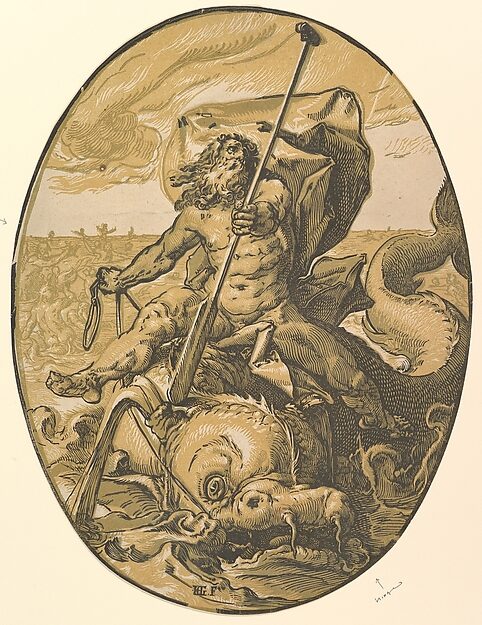
Oceanus
First Appearance
Oceanus first appears in the earliest catalogue of the Titans, named as the eldest of the twelve children whom Gaia (Earth) bore to Uranus (Heaven): "She bore deep-swirling Oceanus" heads the list, before Coeus, Crius, Hyperion, Iapetus, and the rest. From the very first he is the senior of his generation — the firstborn Titan and the great water that would encircle all the works of his younger kin.
— Hesiod, Theogony 133
Who They Are
Oceanus (oh-SEE-uh-nus / oh-kee-AH-nos) is the eldest of the Titans and the divine embodiment of the great River that the Greeks imagined flowing in an unbroken circle around the rim of the flat earth. He is not the sea as a sailor knows it, but the primordial fresh-water stream at the edge of the world — a boundless current with neither source nor mouth, curving back upon itself, from which every other water is born. Rivers, springs, wells, and even the salt seas draw their flow from him; and at the world's western edge the sun, moon, and stars sink into his waters to be carried round in the dark and rise again in the east.
It is worth setting him apart from the other waters of Greek myth. Oceanus is the encircling fresh-water river; Pontus, the barren Sea, is the salt deep within the earth's ring; and Poseidon, a god of the younger Olympian order, is the ruler and shaker of the Mediterranean that mortals actually sail. Oceanus belongs to the oldest layer of the cosmos — a Titan of the first generation, older than the sea-gods and older than the Olympians who came to govern the visible world.
With his sister and consort Tethys he is the great progenitor of waters: from their union came the three thousand river-gods and the three thousand Oceanid nymphs, so that nearly every stream and spring in the Greek world could trace its lineage to the pair at the edge of creation. Yet for all his seniority and vast fatherhood, Oceanus is a curiously peaceable figure. He held aloof from his brothers' war against heaven, and where the other Titans are remembered for revolt and defeat, he is remembered as the calm, deep-flowing boundary of all things.
Mythology
The eldest Titan and the world-encircling stream
In Hesiod's Theogony (133), Oceanus is the firstborn of the Titans, "deep-swirling Oceanus," eldest of the twelve children of Earth and Heaven. The Greeks pictured the inhabited world as a broad disk, and Oceanus as the mighty river running round its outermost edge — a stream so wide and deep that it had no far bank, curving endlessly back into itself. All fresh waters were understood to issue from him: "from whom all rivers flow, and every sea, and all springs and deep wells," as Homer has it (Iliad 21.195–197). At the horizon his waters meet the sky, and it is into Oceanus that the heavenly bodies descend at their setting and out of which they climb at dawn, so that he governs the great daily circuit of sun, moon, and stars.
The vast progeny of Oceanus and Tethys
Oceanus took his sister Tethys to wife, and from them sprang the waters of the world in almost countless number. Hesiod (Theogony 337–370) tells of the Potamoi, the river-gods — he names some two dozen, among them the Nile, the Alpheus, the Achelous, the Scamander, and the Ister (Danube) — and then declares that in all there are three thousand of them. Equal to these are the daughters, the Oceanids: three thousand slender-ankled nymphs of the waters, "scattered far and wide" over the earth, who with the rivers watch over the young. Hesiod names a long roll of them and then confesses that no mortal could tell them all — only those who dwell near each knows her name.
Among these daughters are figures of the first importance. Styx, eldest of the Oceanids, became the dread river of the underworld and the very oath of the gods, honoured by Zeus above all her sisters for her early aid against the Titans (Hesiod, Theogony 361, 383–403, 775–806). Metis, "Wisdom," was Zeus's first consort and the mother of Athena. Clymene bore Prometheus and Atlas to Iapetus, and Dione is named in some traditions as mother of Aphrodite (Homer, Iliad 5.370–371; Apollodorus 1.3.1). Others famous in myth — though without pages of their own here — include Doris, wife of Nereus and mother of the Nereids; Eurynome, mother of the Graces; Electra, wife of Thaumas; and Callirhoe; while among the rivers the Nile and the great Achelous, eldest and mightiest of streams, stand out. Through this immense family Oceanus and Tethys are the ancestors of nearly all the waters and water-spirits of the Greek world.
Neutral in the war of heaven
When Cronus led the Titans in revolt — first against their father Uranus, and later in the ten-year Titanomachy against Zeus and the Olympians — Oceanus did not join them. Alone among the great Titans he held aloof from the war, keeping to his encircling stream while his brothers fought and fell. Because of this neutrality he escaped the fate of the defeated Titans, who were chained and cast down into Tartarus; Oceanus kept his ancient place at the edge of the world. This aloofness gave him, in later poetry, the character of a wise and cautious elder rather than a rebel.
Aeschylus: the conciliatory elder
That temper is drawn most fully in Aeschylus's tragedy Prometheus Bound. There Oceanus comes riding a winged creature to the crag where the rebel Titan Prometheus has been chained by Zeus, and he comes not to defy the new king but to counsel submission. He urges Prometheus to bend, to soften his proud words, to "know thyself" and adapt to the changed order of things, and he offers to go and plead with Zeus on his behalf. Prometheus, unbending, warns him off lest he draw Zeus's anger upon himself, and Oceanus — timid, prudent, and above all a survivor — withdraws. He is portrayed as the elder statesman of the old gods: kindly, self-preserving, and reconciled to the world's new masters.
Variant: Oceanus as the origin of the gods
Hesiod makes Oceanus a child of Earth and Heaven, one Titan among the twelve. But Homer preserves a strikingly different and older-sounding tradition. In the Iliad, Oceanus and Tethys are named not as descendants but as the source of everything: "Oceanus, the origin of the gods, and mother Tethys" (Iliad 14.201, repeated at 14.246), from whom the gods themselves are sprung. In this rival cosmogony the world begins not from Hesiod's Chaos but from the primal waters — a divine pair of world-parents whose union generated the family of gods. Ancient readers already noticed the clash, and later thinkers (Plato among them, and Aristotle reporting the tradition) treated the Homeric line as evidence of an archaic belief that water was the first principle of all things. It stands as one of the clearest surviving traces of a water-cosmogony beneath the more familiar Hesiodic scheme.
Worship — Ancient
A cosmic power rather than a cult-god
Oceanus belonged to the vast, remote furniture of the cosmos more than to the everyday religion of the city, and he received little in the way of temple, festival, or organised cult of his own. He was a power invoked and imagined rather than housed and fed — the world's boundary, named in poetry and cosmology far more often than approached at an altar. Where he was honoured, it was chiefly through the waters that were his children: to pour a libation into a river or spring, or to reverence a local Potamos, was in a sense to reverence Oceanus, the father from whom all such waters flowed.
Oath and libation
His eldest daughter Styx carried the one truly awful sanction of his line — the oath of the gods, sworn by her underworld water, which not even Zeus would break (Hesiod, Theogony 775–806). In the ordinary piety of mortals, the waters of Oceanus's family were the natural recipients of libation: the Greeks poured offerings to rivers before crossing them, dedicated locks of hair to a local stream at coming of age, and named Oceanus and the Oceanids in the great genealogies recited by the poets. In art he was shown as a mighty bearded man, often with the horns of a bull or the tail of a serpentine fish, sometimes bearing a cornucopia or a serpent — the emblem of the ever-circling, life-giving stream.
Worship — Modern
Honouring Oceanus today
A modern devotee who wishes to honour Oceanus honours him best at the water's edge. Because he is the source of every river, spring, and sea, any moving fresh water — a stream, a well, the rain, even water drawn and held in a clean bowl — can serve as his shrine. Approach with a moment of stillness and acknowledge him as the eldest Titan, the great River that encircles the world and gives rise to all waters. A simple image or word — a spiral or circle for the back-flowing stream — may mark a small home shrine to him.
Offerings
The fitting offering to Oceanus is water itself, and libation is his natural rite. Pour clean fresh water, or a little wine or honey, into a river, a spring, or the sea, with a few words naming him and his consort Tethys and giving thanks for the waters that sustain all life. Where the ancients honoured the local river-god as his child, a modern devotee may honour whatever stream or shore is near, and through it the father of all waters.
Prayer & remembrance
Call on Oceanus in gratitude for water and for the turning of the days — for it is into his stream that the sun and stars were said to descend and from it to rise. Remember him too as the peaceable elder who kept apart from strife: a god to invoke for calm, for endurance, and for the wisdom that adapts and survives. Honour his daughter Styx when a promise must be made truly binding, and the Oceanids and river-gods, his children, at every spring and stream.
Epithets & Cult Titles
- Ἀψόρροος (Apsorrhoos) — Back-flowing — the stream that circles round upon itself, having no beginning and no end
- Ὠκεανός βαθυρρείτης (Bathyrrheites) — Deep-flowing — Homer's epithet for the vast, deep current at the world's rim
- Ἀκαλαρρείτης (Akalarrheites) — Softly-flowing, gently-streaming — the calm, unhurried river of Homer's similes
- Γένεσις πάντεσσι (Genesis pantessi) — Origin of all things — the Homeric title naming him the source from which everything is born
Sources & Variants
- Hesiod, Theogony 133 (eldest of the Titans), 337–370 (the rivers and Oceanids, the three thousand of each), 361 and 775–806 (Styx, the oath of the gods)
- Homer, Iliad 14.201 and 14.246 (Oceanus, origin of the gods, and mother Tethys — variant cosmogony); 21.195–197 (all rivers, seas, springs, and wells flow from Oceanus)
- Aeschylus, Prometheus Bound 284–396 (Oceanus's visit and cautious counsel to Prometheus)
- Apollodorus, Bibliotheca 1.1–1.2 (Oceanus among the Titans; children of Oceanus and Tethys; Dione)
- Plato, Cratylus 402b and Theaetetus 152e (the Homeric line read as making water the origin of all things)
Gallery