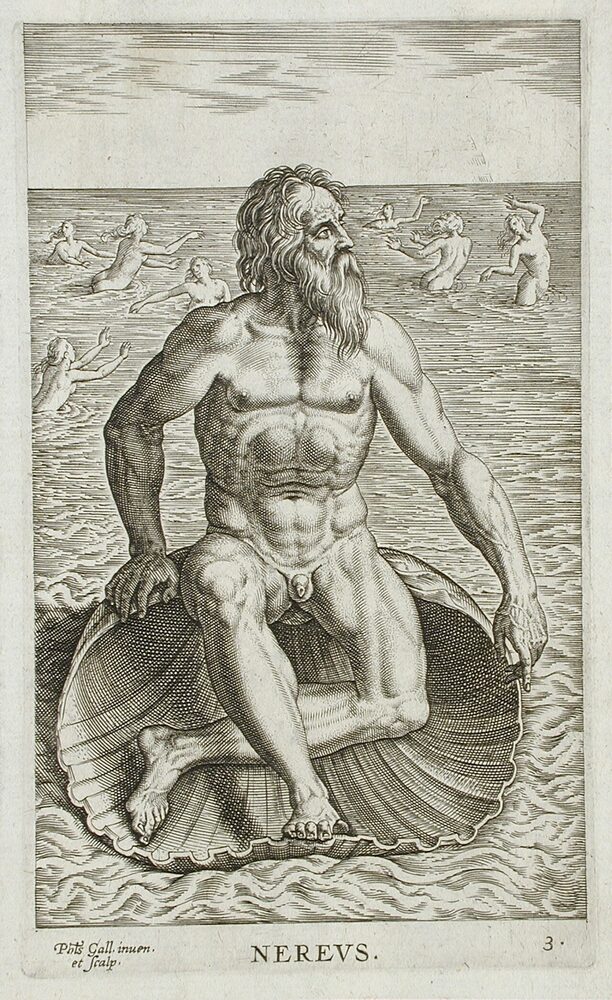
Nereus
First Appearance
Nereus enters Greek poetry in Hesiod's Theogony (233–236) as the eldest child that Pontus (the Sea) fathered upon Gaia (the Earth): "Pontus begot Nereus, the eldest of his children, truthful and no liar; and men call him the Old Man, because he is unerring and kindly, and does not forget the laws of righteousness, but knows just and gentle counsels." A few lines later (240–264) Hesiod turns to his children and pours out the long, ringing catalogue of the fifty Nereids, the sea-nymph daughters that Nereus fathered on Doris, the Ocean's daughter — naming them one after another, each name a quality of the sea, from calm Galene to swift-running Kymatolege who stills the waves.
— Hesiod, Theogony 233–236 and 240–264
Who They Are
Nereus (NEER-yoos) is the kindly old god of the sea — the truthful "Old Man of the Sea," gentle and just, gifted with true prophecy, and father of the fifty sea-nymphs called the Nereids. He belongs to the very first generation of divine beings born after the Titans and before the Olympians: the eldest child of Pontus (the Sea itself) and Gaia (the Earth), he is the sea made into a person, but a person of a particular and beloved kind. Where his father Pontus is the bare salt water and Poseidon, who came later, is the sea in its storming, quaking power, Nereus is the sea's older, calmer soul — the deep in its wisdom rather than its wrath.
What the Greeks loved about Nereus, and told first about him, was his honesty. Hesiod, listing his qualities before anything else, calls him apseudēs kai alēthēs — "unlying and true" — a god who does not deceive, who keeps just and gentle thoughts, and who "does not forget the laws of what is right." This made him something rare among the old sea-powers: not a monster to be feared but an elder to be trusted, a grey-bearded god of true counsel. Because he knows all that is, he is also a prophet, and like the other shifting sea-gods he can change his shape at will — flowing from form to form like water itself when someone tries to hold him. The most famous story of Nereus is exactly that: the hero Heracles seizing him and hanging on through fire and flood and beast until the old god yields up the truth.
But Nereus is remembered above all as a father. By the gentle Oceanid Doris he had fifty daughters, the Nereids — the lovely sea-nymphs whose names are the moods and gifts of the sea, and who move through Greek myth as a shimmering chorus: among them Thetis, mother of Achilles; Amphitrite, who became queen of the sea as Poseidon's wife; and Galatea, the white sea-nymph loved by the giant Cyclops. To meet Nereus in the old poems is almost always to meet him surrounded by these daughters, the loveliest company in the sea, and to feel the sea itself as a household — old, wise, and kindly at its head.
Mythology
The eldest child of the Sea
Nereus stands near the very root of the divine family tree. When Gaia, the Earth, had brought forth Pontus — the Sea — "without sweet union of love," as Hesiod says, she then lay with her own son the Sea, and their firstborn was Nereus. This makes him a primordial being, older than the Olympians, older even than most of the Titans' children: the sea given a face and a heart at the world's beginning. And yet, strikingly, the first sea-god is not terrible. Hesiod introduces him not with power but with character: he is "the eldest of his sons, truthful and no liar," and men call him the Old Man — ho gerōn — because from his first moment he is unerring, kindly, mindful of justice, "and knows righteous and gentle counsels." In a genealogy full of monsters and grim powers, Nereus is the note of gentleness at the head of the sea's line.
The Old Man of the Sea
Homer gives him his lasting title: the Halios Gerōn, the "Old Man of the Sea." In the Iliad it is to this ancient father that the grieving Thetis goes, and it is from his silvery caves beneath the water that she and her sisters rise. The Greeks in fact spoke of several "old men of the sea" — Nereus, Proteus, Phorcys, Glaucus — all sharing the same character: aged, sea-dwelling, wise, prophetic, and able to slip from shape to shape. Nereus is the eldest and gentlest of them, the pattern of the type. He lives in the depths of the Aegean, in a hollow cave beneath the waves, and there he keeps his household of daughters. He does not rule the sea as a king rules — that role passes to Poseidon among the younger gods — but he abides in it as its oldest inhabitant and its truest voice, the sea's memory and conscience.
The unlying prophet
Because Nereus "knows all things," he is a seer, and his prophecy has the same quality as his character: it is always true. This is why heroes and gods come to him for knowledge no one else will give straight. But a truth-telling sea-god is a hard thing to catch. Like Proteus (the "Old Man" of Egypt, whose name has given us the word protean, ever-changing) and like the river-god Achelous, Nereus can change his shape to escape a questioner — turning into running water, into leaping fire, into a wild beast, into a tree or a serpent, anything to wriggle free of the grip that would force him to speak. The rule the old stories teach is always the same: to win the truth from a shifting sea-god, you must lay hold of him and simply not let go, holding on through every terrifying transformation until, exhausted and defeated, he returns to his own shape and answers true. It is a striking Greek image — that the truth is real and knowable, but must be wrestled for and held onto through everything that would frighten you into letting it slip away.
Heracles wrestles the truth from Nereus
The most famous telling of this is the wrestling-match with Heracles. In the course of his labours, Heracles was sent to fetch the golden apples from the Garden of the Hesperides, at the far western edge of the world — but no one could tell him the way there, for it was a secret guarded at the ends of the earth. Only Nereus knew the road. So Heracles, on the counsel (in some tellings) of the nymphs of the river, went and found the Old Man of the Sea asleep, and seized him fast. At once Nereus began to change: he became fire, blazing in the hero's arms; he became rushing water that would pour away between his fingers; he became a lion, a serpent, every shifting and frightening form the sea could offer. But Heracles, whose whole strength was his refusal to let go, held on and would not loosen his grip through any of it, and squeezed the old god tight until at last, worn out and unable to escape, Nereus gave in — resumed his own aged shape, and told Heracles truly the way to the Garden of the Hesperides and how the golden apples might be won. It is a scene the vase-painters loved: the straining hero locked around the fish-tailed old man, with flames or a serpent bursting from the god's body as he tries in vain to slip free. (This is the best-known version; some poets gave the same role to other sea-gods, but the wrestling of the shape-shifting Old Man for the truth is above all Nereus's story.)
Doris and the fifty daughters
For all his prophecy, Nereus is remembered most as a father. He took as his wife Doris, one of the three thousand daughters of Ocean (Okeanos) and Tethys — a gentle Oceanid whose name itself suggests the sea's bounty — and by her he had, the poets say, fifty daughters: the Nereids, the sea-nymphs of the Aegean. Hesiod names them all in a long, musical roll-call in the Theogony (240–264), and the list is really a poem about the sea itself, for nearly every Nereid's name is one of the sea's own qualities or gifts — its calm, its swell, its shelter, its speed, its shining. There is Galene ("calm-of-the-sea") and Kymothoe ("wave-swift"), Kymatolege ("wave-stiller"), Pontoporeia ("sea-crossing," a helper of ships), Halie ("of the salt"), Nemertes ("the unerring," who has, Hesiod says, "the mind of her deathless father"), and dozens more. Together the Nereids move through Greek myth as a shimmering chorus — dancing on the calm water, rising from the waves to help sailors, mourning at funerals of heroes — the loveliness and the many moods of the sea made into fifty gentle sisters.
The famous Nereids
Three of Nereus's daughters outgrew the chorus and won famous stories of their own. Thetis, the silver-footed, was so beautiful that both Zeus and Poseidon desired her — until it was prophesied that she would bear a son greater than his father, whereupon the gods hastily married her to a mortal, Peleus; her son was Achilles, the greatest of the warriors at Troy, and it is Thetis who, in the Iliad, rises from Nereus's sea-caves with her sisters to grieve for her doomed child. Amphitrite became the queen of the sea: Poseidon loved her, and when she fled his suit and hid in the deep, a dolphin found her and won her over, and she came to reign at the sea-god's side as his wife (her son by Poseidon was Triton, the merman herald of the waves). And Galatea — "milk-white" — was the sea-nymph loved by the one-eyed giant Polyphemus the Cyclops, whose clumsy, hopeless wooing of her, and her own love for the shepherd Acis, became one of the most retold of all the sea-nymph tales. So from the household of the gentle Old Man came the mother of Achilles, the queen of the whole sea, and the beloved of the Cyclops — three of the most memorable women in all of Greek story.
The gentle god eclipsed by Poseidon
As the younger Olympian gods rose, Nereus, like the other primordial powers, stepped back into the deep of the sea and the deep of the past. Poseidon, of the next generation, became the sea's ruler and its storm-bringing king, and it was Poseidon's name the sailors chiefly feared and prayed to. But Nereus was never forgotten or dethroned; he simply remained what he had always been — the sea's ancient, kindly elder, dwelling below the reach of the storms, the keeper of true counsel, and the father of its loveliest daughters. The Greeks kept a clear feeling for the difference between them: Poseidon was the sea's power, Nereus its wisdom; Poseidon its rage, Nereus its peace. And in the oldest layer of all, before either of them, Nereus was simply the first face the sea ever wore.
Worship — Ancient
A god more of poetry than of temples
Nereus, like most of the primordial and elemental sea-powers, was honoured more in story, prayer, and art than in great civic temples. He had no major state cult with grand festivals of the kind given to the Olympians; there is little evidence of large sanctuaries dedicated to Nereus by name. This is typical of the "old" nature-gods — Pontus, Oceanus, the Nereids as a group — who were felt to be everywhere in their element rather than housed in one shrine, and who were reached by the seaside, at the water's edge, rather than at an inland altar. To honour Nereus was, in the main, to honour and address the sea itself in its gentler, deeper aspect.
The prayers of seafarers
Where Nereus was truly worshipped was on the water and along the shore, by the people whose lives depended on the sea's mood: fishermen and sailors. To the Old Man of the Sea and to his daughters the Nereids, seafarers prayed for calm water and safe passage, and poured libations into the waves — wine, honey, sometimes a portion of the catch given back to the deep — before or during a voyage. The Nereids especially were felt as present and helpful powers, rescuers of the shipwrecked and calmers of the swell, and Nereus stood behind them as their father and the source of the sea's kindliness. A prayer to the calm of the sea was, in effect, a prayer to Nereus's own gentle nature.
The Nereids in cult and place
His daughters received more direct local honour than Nereus himself. There is record of altars and precincts of the Nereids at various coastal spots in the Greek world — Pausanias, travelling Greece, notes places where the sea-nymphs were honoured — and the Nereids appear constantly in seaside dedications and in the imagery of harbours and ships. Because Nereus was inseparable from this beloved chorus of daughters, his cult, such as it was, lived largely through theirs: to reverence the Nereids was to reverence their father the Old Man. In the visual arts he was a familiar figure from early times, shown as a dignified fish-tailed elder — most memorably in the great scenes of Heracles wrestling him, painted on vases and carved in relief, where the ancient audience would have read at once both the god's shifting power and his final, truthful yielding.
An elder honoured through his element
In the broadest sense, then, Nereus was worshipped every time the sea's calm was thanked, every time a sailor poured wine to the deep and asked for a gentle crossing, and every time the Nereids were invoked. He was a god felt more than housed — approached not through a temple door but at the shoreline, in the presence of the water that was his very body and his daughters' home.
Worship — Modern
The gentle elder of the sea
For modern Hellenic polytheists — those who seek to revive the worship of the Greek gods today — Nereus offers a distinctive and gentle presence: not the storming power of Poseidon but the calm, wise, truthful old soul of the sea. A devotee drawn to Nereus tends to be drawn to what the ancients loved in him — his honesty, his kindness, his just and gentle counsel, and his deep, patient wisdom — and to honour him as a patron of truth-telling, of calm in trouble, of the sea's peace, and of the wisdom that comes with age. He is a fitting god for anyone who lives by or loves the sea, and for anyone who values truth spoken plainly and gently.
Offerings at the water's edge
Following the ancient shape of his honours, worship of Nereus is naturally done at the shore, or facing the sea, rather than at an indoor altar. The simplest and most traditional offering is a libation poured into the water — wine, or honey, or fresh water — given wholly to the sea and not taken back, with a prayer for calm passage, for truth, or for the safety of those at sea. Some who honour him also honour the Nereids alongside him, his fifty daughters, as the living presences of the sea's kindliness; a candle lit for a safe voyage, a few words of thanks for a calm day on the water, or a small gift returned to the waves all sit well within his worship. Because his defining virtue is truthfulness, a devotee may also honour him simply by keeping to the truth and speaking it gently — living out the very quality the Old Man is loved for.
Nereus in the modern imagination
Beyond formal devotion, Nereus survives quietly wherever the sea is imagined as a wise old grey-beard rather than an angry king — the "Old Man of the Sea" of countless later poems, paintings, and stories, the gentle father of the mermaid-like sea-nymphs. The Nereids in particular have never really left the Western imagination; they stand behind the whole long tradition of mermaids and sea-maidens in art and story, and through them their father the Old Man endures. And in the night sky and the naming of things marine — from the moon of Neptune named Nereid to the scientific name of the sea-going ragworms (Nereis) — his name is still given to the creatures and places of the deep, keeping the memory of the sea's oldest and kindest god alive.
Epithets & Cult Titles
- Halios Gerōn (Ἅλιος Γέρων) — The Old Man of the Sea — Homer's own name for him, marking him as the ancient, kindly grey-beard of the salt water, the sea's own gentle elder
- Apseudēs (Ἀψευδής) — The unlying one — the truthful, the god who cannot and will not deceive; Hesiod names this as the very first thing about him, that he never speaks a false word
- Nēmertēs' father / the truthful of heart — 'He who does not forget what is right' — Hesiod says Nereus is gentle and kindly, keeps just thoughts, and forgets not the laws of righteousness; his daughter Nemertes ('the unerring, the true') carries his own nature in her name
- Prophet of the deep (mantis) — A seer-god who knows all things that are, gifted with true prophecy like the other 'old men of the sea' (Proteus, Phorcys, Glaucus); it is for this knowledge that Heracles must wrestle him
Sources & Variants
- Hesiod, Theogony 233–236 (Nereus the eldest child of Pontus and Gaia, truthful and unlying, called the Old Man because he is unerring, kindly, and mindful of righteousness)
- Hesiod, Theogony 240–264 (the catalogue of the fifty Nereids, daughters of Nereus and the Oceanid Doris, their names the qualities of the sea)
- Homer, Iliad 1.357–361, 18.35–64 (Thetis and her sisters rising from the sea-caves of their father the Old Man of the Sea to grieve)
- Homer, Iliad 18.140–141 and Odyssey (Nereus as the 'Old Man of the Sea,' Halios Gerōn; the type shared with Proteus at Odyssey 4.351–570)
- Apollodorus, Bibliotheca 2.5.11 (Heracles seizes the shape-shifting Nereus and holds him until he tells the way to the apples of the Hesperides)
- Pherecydes (early source, via later authors, for Heracles wrestling Nereus for the road to the Hesperides)
- Pindar, Pythian 3.92 and elsewhere (Nereus and the Nereids; Thetis among the daughters of the Old Man)
- Ovid, Metamorphoses 13.738–897 (Galatea, the Nereid loved by the Cyclops Polyphemus) — Roman retelling
- Pausanias, Description of Greece (local honours and precincts of the Nereids in the Greek coastal world)
- Homeric Hymns and later lyric (Amphitrite, daughter of Nereus, as the wife of Poseidon and queen of the sea)
Gallery