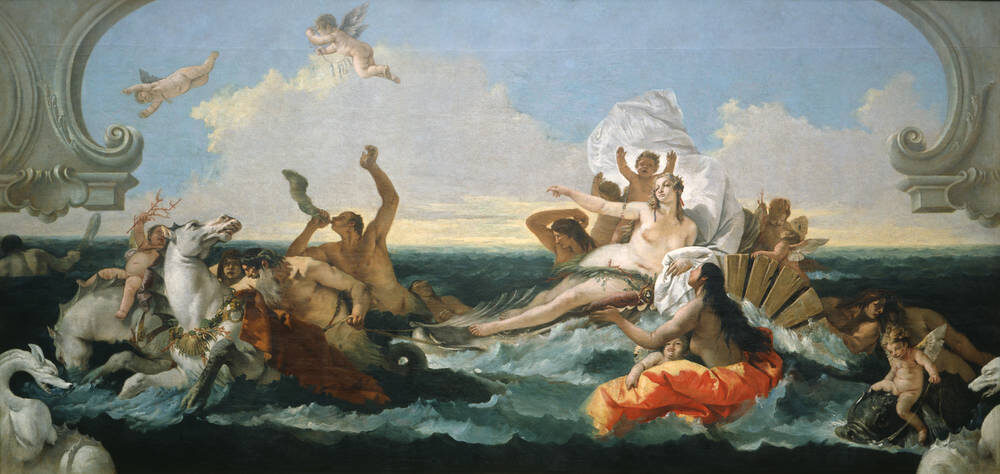
Amphitrite
First Appearance
Amphitrite first appears in Hesiod's Theogony twice over in the catalogue of the fifty Nereids (243, 254), named among the daughters of the sea-elder Nereus and Doris as one of the lovely immortal maidens of the deep. Later in the same poem (930–933) Hesiod names her again in her greater role: the wife of Poseidon the earth-shaker, and by him the mother of "great, wide-ruling Triton," who dwells with his mother and his kingly father in their golden house beneath the sea. Homer, who never tells the story of her marriage, already uses her name as a word for the sea itself — Odysseus sails and suffers upon the swell "of Amphitrite," her groaning, fish-filled water.
— Hesiod, Theogony 243 and 254; then 930–933; Homer, Odyssey 3.91, 5.422, 12.60
Who They Are
Amphitrite (am-fih-TRY-tee) is the Queen of the Sea — the wife of Poseidon and, in her own right, one of the fifty Nereids, the lovely sea-nymphs who are the daughters of the gentle sea-elder Nereus. She is the female counterpart to her husband's stormy kingship: where Poseidon is the sea's violence, its earthquakes and its wrecking waves, Amphitrite is more often the sea itself in its wholeness and its calm, the salt water that encircles the whole earth. So closely was she identified with the deep that the oldest Greek poems simply use her name to mean the sea: when Homer's sailors labour on the heaving swell, they labour on the water "of Amphitrite."
Her story is, above all, the story of how a sea-nymph became a queen. She begins as one maiden among her forty-nine sisters, dancing in the depths; she ends enthroned beside the lord of the ocean, sharing his three-pronged sceptre and his golden hall. And the way she made that journey — fleeing the god's wooing to the very ends of the sea, and being brought home not by force but by the gentle persuasion of a dolphin — is one of the tenderest of all the sea-myths, and the reason a dolphin still swims among the stars.
As queen she is the mother of Triton, the trumpeter of the deep with his twisted conch-shell horn, and the matriarch of a whole watery household. The Romans called her Salacia and set her beside their own Neptune, but she is Greek to the core: the crowned and dark-eyed lady of the sea, rising from the waves in a chariot drawn by sea-creatures, the net in her hand and the crab's claws curving up from her brow like a crown.
Mythology
A Nereid in her own right
Before she was ever a queen, Amphitrite was a Nereid — one of the fifty daughters of Nereus, the kindly and truthful "Old Man of the Sea," and of Doris, herself a daughter of Ocean. Hesiod lists all fifty of these sea-nymphs by name in the Theogony, and Amphitrite stands among them twice, a sister to Thetis (the future mother of Achilles), to Galatea, to Panopeia and Amphinome and all the rest — the shining, gentle spirits of the calm and generous sea, who dance in their father's halls and rise to the surface to help sailors in distress. It matters to remember this, because Amphitrite is not merely "Poseidon's wife" in the way a mortal queen is defined by her husband: she is a sea-goddess in her own blood and birth, a daughter of the deep long before the deep's king ever noticed her. Her sisterhood with the Nereids is never lost — in art she is often shown among them, and the whole company of sea-nymphs is, in a sense, her royal court.
The flight and the dolphin
The story of her marriage is the loveliest thing told of her. Poseidon, lord of the sea, saw Amphitrite dancing with her sister Nereids — on the island of Naxos, some say, among the other daughters of Nereus — and desired her for his wife. But Amphitrite did not want him. Unwilling to give up her maidenhood and her freedom, she fled from his wooing, and she fled as far as it was possible to flee: to the very edges of the world, to the stream of Ocean that rings the earth, and (the poets say) to Atlas himself, the Titan who holds up the sky at the western bourne of all things, hiding herself away at the ends of the sea where she thought the god would never find her.
Poseidon could not find her, and would not force her. Instead he sent out searchers to seek her through all the waters — and the one who found her, and who won her, was a dolphin (Delphinus). The dolphin sought her out in her hiding-place, and by its gentle persuasion — its coaxing, its soft speech, the trust that the friendly creature inspired — it changed her mind and reconciled her to the god, and it brought her back through the sea to Poseidon to be his bride. So she came to her marriage not dragged and unwilling, but persuaded and consenting, led home by the kindest of the sea's creatures.
Poseidon was so grateful to the dolphin for this gentlest of services that he honoured it forever: he set its image among the stars, as the little constellation Delphinus, the Dolphin, which still swims in the northern sky. It is one of the rare Greek star-myths that turns not on death or punishment but on a good deed rewarded — the messenger of a happy marriage, fixed in heaven so that no one would forget the night it talked a goddess into love.
Queen of the Sea, and the mother of Triton
Once married, Amphitrite became the Queen of the Sea, enthroned beside Poseidon in the golden palace that Hesiod places in the depths, sharing his rule over all the salt water of the world. She is his consort as Hera is Zeus's and Persephone is Hades's — the female sovereign of one of the three great realms into which the brothers divided the cosmos. In the art of the Greeks she rides beside him in a chariot drawn through the waves by hippocamps (the fish-tailed horses of the sea) or by dolphins and Tritons, crowned and robed, the whole procession of sea-creatures attending their king and queen.
Their son is Triton, the merman-herald of the deep — a god from the waist up and a great fish or serpent below, who carries a twisted conch-shell for a trumpet. When Triton blows his shell he can rouse the waves to fury or lull them flat again, and it is his horn that Poseidon uses to sound the retreat of the flood-waters. Hesiod calls him "great and wide-ruling," and says he dwells in the golden house of the deep with his dear mother and his kingly father. Later poets give Amphitrite other sea-children besides — among them the seal-herding sea-nymph Rhode (Rhodos), and (in some tellings) the fearsome dog-monster of the deep — but Triton is her true and famous son, and through him she is the matriarch of the merfolk.
The queen and her rivals
Because she was the sea's queen, Amphitrite was also, in a few myths, the sea's jealous wife — and here she shows the harder edge that the calm water can turn. When Poseidon loved the beautiful mortal-turned-nymph Scylla, it was Amphitrite (in one version of the tale, though Circe takes the role in another) who could not bear the rival: she is said to have poured magic herbs into the pool where Scylla bathed, and so transformed the lovely girl into the six-headed, barking horror of the strait that would one day devour Odysseus's men. It is a small myth and a variant one — many tellers give the deed to Circe instead — but it is worth knowing, because it shows that the Greeks imagined Amphitrite as a real queen with a queen's pride, not merely a decorative figure at Poseidon's side. Homer, for his part, keeps her mostly as the sea itself: it is "Amphitrite" who breeds and hides the sea-monsters, "Amphitrite" whose fish-thronged, groaning water Odysseus must cross.
Worship — Ancient
Worshipped beside Poseidon
Amphitrite had almost no separate cult of her own; she was honoured, as a queen is honoured, beside her king. Wherever Poseidon was worshipped along the coasts and islands of the Greek world, Amphitrite belonged to the sacred space as his consort — named in his prayers, present in his sanctuaries, her image standing at his side. This is the ordinary pattern for the great divine wives whose husbands overshadow them in cult: like Persephone beside Hades in the underworld, Amphitrite was a real and named power of the sea, invoked and depicted, but she did not draw the crowds of pilgrims or the festival calendars that the Olympians did in their own right.
In temple and image
Where she does appear, she appears in splendour. Pausanias, the traveller who catalogued the shrines of Greece in the second century AD, saw her figure on the great cult-statue of Poseidon at the Isthmian sanctuary near Corinth (2.1.7–8): Amphitrite and Poseidon together, with the sea-child Palaimon riding a dolphin, and around them a chariot and Nereids, the whole marine court worked in gold and ivory. She was a favourite subject for the decoration of temples, fountains, and above all mosaic floors, where the "Triumph of Poseidon and Amphitrite" — the divine pair riding the waves in their sea-drawn chariot amid a swirl of Tritons and Nereids — became one of the best-loved images of the ancient marine world, carried on into Roman art across the Mediterranean.
The prayers of seafarers
For those who lived by the sea, Amphitrite was a real presence to be reckoned with before a voyage. As the very body of the salt water — the water a ship must cross — she received a share of the sailor's piety: libations poured over the ship's rail into the waves, prayers for calm water and safe passage, the small gifts of gratitude offered when a crossing ended well. To pray to Poseidon for the sea's mercy was, in effect, to pray to Amphitrite too, for she was the sea whose goodwill they needed.
Worship — Modern
The lady of the sea today
For modern Hellenic polytheists and for those drawn to the powers of the sea, Amphitrite has found a devotion warmer and more personal than her quiet ancient cult ever was. She is honoured as the Queen of the Sea in her own right — the crowned sea-goddess of stillness and depth and the encircling salt water — and often as a patroness of the ocean's beauty and mystery, of the creatures of the deep, and of those who love or work upon the water. Where an ancient worshipper met her chiefly as Poseidon's consort, many today address her directly, as a sovereign power with her own presence and her own gifts.
Offerings and practice
Her worship naturally faces the water. A devotee might bring offerings to the sea itself — a libation of wine or honey poured onto the waves, a wreath of flowers cast upon the water, salt or shells set on an altar, a candle lit for calm and safe passage. Sea-glass, pearls, coral, and the images of her creatures — the dolphin above all, but also seals and fish — sit fittingly on a shrine to her, as do the emblems of her queenship, the net and the crab-claw crown. Those who cannot reach the sea keep a bowl of salt water in her honour. Because her own myth turns on gentleness — on being won not by force but by kindness and persuasion — devotion to her is often coloured by that same note of tenderness and consent.
In sky and story
She endures, too, in the place the myth set her keepsake: the little constellation Delphinus, the Dolphin, still swims in the northern summer sky, a compact diamond of stars carrying forever the memory of the creature that talked a fleeing goddess into love and marriage. To find the Dolphin overhead is to remember Amphitrite's story — the Nereid who fled to the ends of the sea and was brought home to be its queen. And she lives in art as she always has: the radiant "Triumph of Amphitrite," the sea-queen riding the waves beside her king, remains one of the enduring images of the ocean's majesty, reworked from ancient mosaic to Renaissance canvas to the present day.
Epithets & Cult Titles
- Queen of the Sea (Βασίλεια τῆς Θαλάσσης) — Ruler of the salt water beside Poseidon — the descriptive title that best captures her role, the female sovereign of the deep who shares her husband's dominion over the whole sea
- Halosydne (Ἁλοσύδνη) — Sea-nourished, or sea-born — a genuine Homeric epithet (Odyssey 4.404) used of the creatures 'of Halosydne', that is, of Amphitrite, the sea that feeds all the fish and seals of the deep
- Kyanopis (Κυανῶπις) — Dark-eyed, or blue-glancing — a poetic epithet describing her as the sea itself is described, with the deep blue-black colour (kyanos) of the open water
Sources & Variants
- Hesiod, Theogony 243, 254 (Amphitrite named among the fifty Nereids, daughters of Nereus and Doris)
- Hesiod, Theogony 930–933 (Amphitrite the wife of Poseidon and mother of great, wide-ruling Triton, in the golden house of the deep)
- Homer, Odyssey 3.91, 5.422, 12.60, 12.97 (Amphitrite's name used for the sea itself — its swell, its groaning water, and the sea-monsters she breeds and hides)
- Homer, Odyssey 4.404 (the seals of Halosydne, 'the sea-nourished,' an epithet of Amphitrite)
- Apollodorus, Bibliotheca 1.4.5–6 and 1.2.7 (Amphitrite as Nereid; the marriage to Poseidon; Triton among their offspring)
- Oppian, Halieutica 1.38 and Eratosthenes/Hyginus on Delphinus (the dolphin that found the fleeing Amphitrite and reconciled her to Poseidon, set among the stars as the constellation Delphinus) — the flight-and-dolphin tradition; late/Hellenistic material
- Hyginus, Astronomica 2.17 and De Astronomia (Poseidon's dolphin and the origin of the constellation Delphinus) — Roman, late
- Pausanias, Description of Greece 2.1.7–8 (Amphitrite beside Poseidon on the cult-statue at the Isthmian sanctuary near Corinth)
- Ovid, Metamorphoses 1.13–14 (Amphitrite as a name for the sea encircling the earth) — Roman
- Servius on Virgil and the Scylla variant (Amphitrite, jealous of Poseidon's love for Scylla, poisons her bathing-pool and transforms her into the monster) — late, and a minor variant; Circe takes this role in the better-known version
Gallery