Poseidon
First Appearance
Poseidon first appears among the six children of the Titans Cronus and Rhea — Hestia, Demeter, Hera, Hades, and "the loud-crashing Earth-Shaker" Poseidon, with Zeus the youngest. Warned that he was fated to be overthrown by his own child, Cronus swallowed each one as it came from the womb to his mother's knees. So Poseidon, like his elder siblings, was devoured at birth and imprisoned within his father, to be disgorged only years later when Zeus compelled Cronus to bring the swallowed children back into the light.
— Hesiod, Theogony 453–491
Who They Are
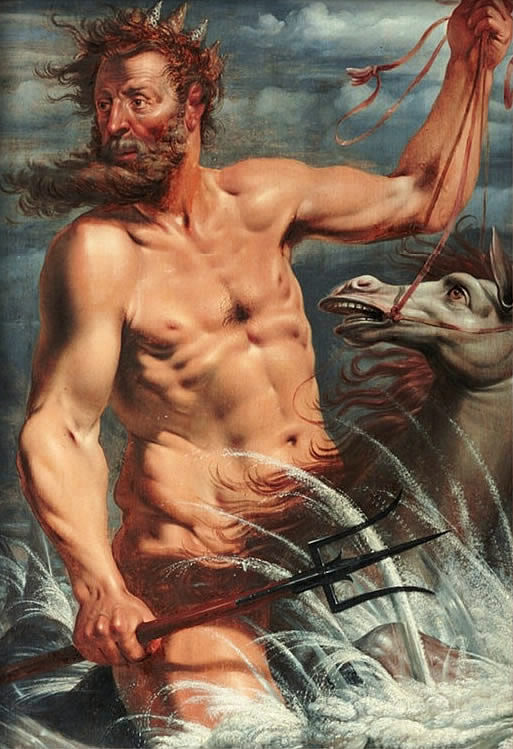
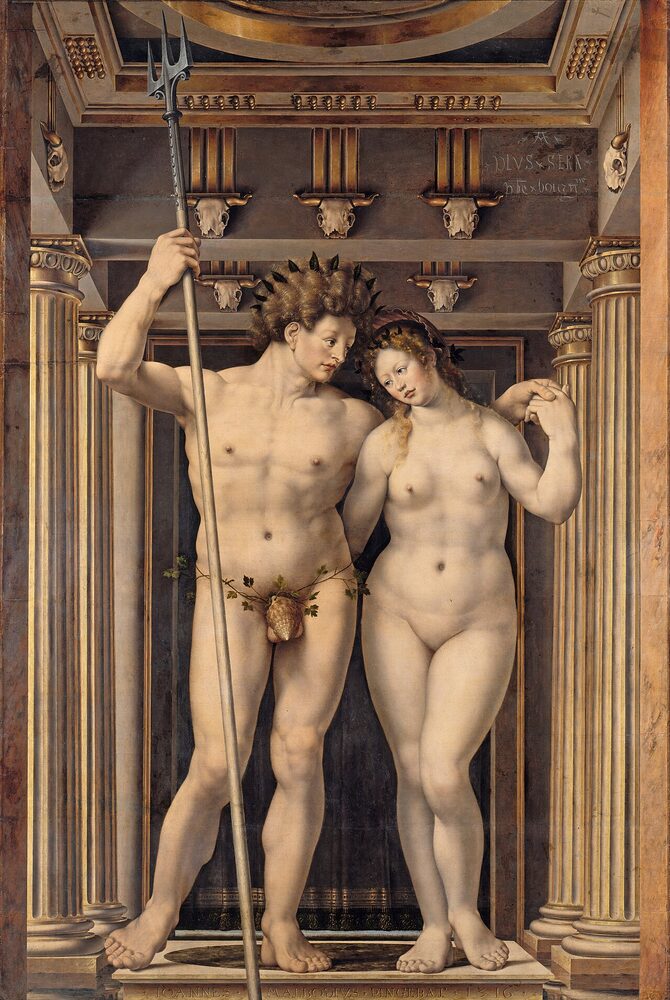
Poseidon is the Greek god of the sea, of earthquakes, and of horses — the second of the three sons of Cronus and Rhea, and after Zeus the most powerful of the Olympians. When the Titans fell and the cosmos was divided, the grey salt sea became his portion, and he took up the trident, the three-pronged spear with which he stirs the waters, splits the rock, and shakes the very ground. Homer names him again and again the "Earth-shaker," Enosichthon, for the Greeks felt the earthquake and the storm-driven wave as the direct stroke of his anger.
Yet he is far more than a storm at sea. He is Poseidon Hippios, lord of horses, who brought the first horse into the world and whose galloping herds the Greeks saw in the white manes of the breaking surf. He is Gaieochos, the earth-embracer, whose waters clasp and uphold the land, and Asphaleios, the Securer, prayed to for firm ground beneath a city's feet. Sailors poured libations to him before a voyage; horsemen honoured him at the racecourse; and whole cities set his great temples on their headlands, at Sounion and the Isthmus and Cape Tainaron.
In myth his character is proud, restless, and easily wronged. He contended with the other gods for the patronage of the greatest cities — losing Athens to Athena, Argos to Hera, the Isthmus shared with the Sun — and answered each defeat with flood or drought. His loves were many and his offspring wild: the sea-god Triton, the winged horse Pegasus and the warrior Chrysaor, the savage Cyclops Polyphemus, and among mortals the hero Theseus. Blind Polyphemus's curse turned his wrath upon Odysseus and drove that hero across the sea for ten long years.
Mythology
The division of the cosmos
After the ten-year war against the Titans was won and the defeated gods were bound in Tartarus, the three sons of Cronus divided the world between them. In the Iliad, Poseidon himself tells how it was done: the three brothers born of Rhea and Cronus — Zeus, Poseidon, and Hades — shook the lots, and each drew his domain. To Poseidon fell the grey sea to dwell in forever, to Hades the misty dark of the underworld, and to Zeus the wide sky among the clouds and bright air; but the earth and high Olympus were left common to all three. On the strength of this, Poseidon insists he is no subject of Zeus but his equal in honour, for all that Zeus is the elder-born (Iliad 15.187–193).
Birth and the Arcadian variant
Like his elder brothers and sisters, Poseidon was swallowed at birth by his father Cronus, who feared a prophecy that his own child would overthrow him (Hesiod, Theogony 453–467). He remained imprisoned within Cronus until Zeus, grown to strength, forced the Titan to disgorge the swallowed children full-grown. This is the version that leads. The Arcadians, however, told a local variant that made Poseidon's escape a twin of Zeus's own: Rhea, when she had borne Poseidon, hid the infant among a flock of lambs at a spring near Mantinea and told Cronus she had given birth to a foal, giving him a young horse to swallow in the child's place — just as she would later give him a stone wrapped in swaddling-clothes in place of Zeus (Pausanias 8.8.2). The spring there was called Arne, "the Lamb."
The contest for Athens
The most famous of Poseidon's myths is his contest with Athena for the patronage of Athens. Each god offered the city a gift. Poseidon struck the rock of the Acropolis with his trident and brought forth a spring of sea-water — the "Erechthean sea," a well of salt water whose token, along with the mark of the trident, was still shown in Herodotus's day and later within the Erechtheion (Herodotus 8.55). Athena, appearing after him, planted the first olive tree and called King Cecrops to witness her claim. The gods (or in another telling Cecrops and the citizens) judged Athena's gift the greater, and she won the city and gave it her name (Apollodorus, Bibliotheca 3.14.1). Poseidon in his anger flooded the Thriasian plain of Attica, and was only checked from further destruction.
This was not his only such quarrel. At Corinth he disputed the land with Helios the Sun; the Hundred-Hander Briareus arbitrated and gave the heights of Acrocorinth to Helios but the Isthmus and its shores to Poseidon, whose great sanctuary stood there ever after (Pausanias 2.1.6). At Argos he contended with Hera; the river-gods Inachus, Cephisus, and Asterion judged the land to be Hera's, and Poseidon in spite dried up their streams, so that to this day, Pausanias says, the Argive rivers run only after rain (Pausanias 2.15.5). At Troezen the outcome was gentler: his dispute with Athena was settled by Zeus, who bade the two gods hold the land in common, and the Troezenians honoured both together ever after — Athena Polias and Poseidon Basileus, "the King" (Pausanias 2.30.6). Even Delphi was reckoned Poseidon's in the oldest days, when he shared the great oracle with Earth herself; in time he gave up his portion to Apollo and took in exchange the island of Calauria off the Argolid coast, where his temple stood and the league of cities that met there kept his cult (Pausanias 2.33.2; 10.5.6). So the pattern ran through the myths of half the Greek world: again and again Poseidon laid claim to a city, and where the judgment went against him he answered with flood or drought, the salt sea and the shaking earth made the instruments of his displeasure.
The horse and the wooing of Amphitrite
Poseidon Hippios was honoured as the god who first brought the horse into the world, and the Greeks saw his creatures in the surf's white manes and in the earthquake's shudder alike. When he sought the sea-nymph Amphitrite, one of the daughters of Nereus, to be his queen, she fled from him to the farthest edge of the world, to Atlas by the stream of Ocean. Poseidon sent searchers after her, and a dolphin found her and won her over with persuading words, bringing her back to be his bride. In gratitude the god set the image of the dolphin among the stars as the constellation Delphinus (Eratosthenes, Catasterismi; Hyginus, Astronomica 2.17).
Medusa, Pegasus, and Chrysaor
In the oldest telling, Hesiod says that "the Dark-haired One" — Poseidon — lay with the Gorgon Medusa in a soft meadow among spring flowers. Later, when the hero Perseus cut off her head, there sprang forth from her the winged horse Pegasus, so named because he was born near the springs (pegae) of Ocean, and the warrior Chrysaor of the golden blade (Hesiod, Theogony 278–283). This meadow union is the Greek version and the one that leads. The far better-known account that makes the encounter a rape in Athena's temple, for which Athena punished Medusa by turning her hair to snakes, is a Roman elaboration told by Ovid (Metamorphoses 4.790–803) and is not found in the Greek sources.
The wrath against Odysseus
Poseidon's fiercest surviving anger in myth falls upon Odysseus. On his voyage home from Troy the hero was trapped in the cave of the Cyclops Polyphemus, a savage one-eyed son of Poseidon, and escaped only by blinding the monster. Boasting his true name as he sailed away, Odysseus gave Polyphemus the means to curse him: the Cyclops prayed to his father Poseidon that Odysseus never reach home, or come late and broken, having lost all his companions, in a stranger's ship (Odyssey 9.526–536). Poseidon heard, and from the poem's opening lines it is his standing wrath that harries Odysseus across the sea and delays his homecoming for years (Odyssey 1.19–21).
Worship — Ancient
Cult centres
Poseidon's sanctuaries were set, fittingly, where land met sea and where the ground itself was felt to move. Chief among them was Isthmia, on the narrow isthmus of Corinth, where his temple hosted the Panhellenic Isthmian Games every two years. On the headland of Cape Sounion at the southern tip of Attica rose the great white marble temple whose columns still stand above the sea, a landmark for every ship rounding into the Saronic Gulf. At Onchestos in Boeotia lay an ancient sanctuary and sacred grove already named in the Homeric Hymns, and at the tip of the Mani peninsula, at Cape Tainaron, stood a famous temple over a cave held to be an entrance to the underworld. The Ionian Greeks gathered at the Panionion on Mount Mycale to honour Poseidon Helikonios as the god of their league. And the Achaean city of Helike kept perhaps his most renowned local cult — until 373 BCE, when an earthquake and a great wave swallowed the city in a single winter night, a catastrophe the ancients read without hesitation as the Earth-shaker's wrath (Pausanias 7.24; Diodorus Siculus 15.48).
Rites
Poseidon received animal sacrifice like the other Olympians, and his special victim was the bull — dark bulls above all, whose bellowing the poets likened to the god's own roar; Homer describes just such a sacrifice of black bulls on the shore at Pylos (Odyssey 3.5–8). Horses too were sacred to him, and in some places, most famously in Argos, horses were cast into springs or the sea as offerings to Poseidon Hippios. Because he was the god of earthquakes, he was invoked as Asphaleios, "the Securer," to hold the ground firm; because he ruled the sea-lanes, sailors and colonists poured libations of wine to him before setting out, and gave thanks on safe arrival. His games at the Isthmus, with their crown of wild celery, were themselves a great act of worship, drawing competitors and pilgrims from across the Greek world.
Worship — Modern
Honouring Poseidon today
A modern devotee of Poseidon can honour him simply and sincerely, without any bloodshed. A small shrine — a shelf or table will serve — bearing an image of the trident, a horse or dolphin, a seashell, a dish of sea-water or sea-salt, and a lamp or candle gives the god a place in the home. He is well honoured near real water: at the shore, a harbour, a river, or a spring. Approach him with respect as the lord of the sea and the shaker of the earth, keeping in mind both his power and his pride, and address him aloud by name and epithet.
Offerings
Where the ancients gave the bull, a household devotee today most naturally offers libations and shared food. Pour a libation of wine — or of fresh water, or of sea-water returned to the sea — onto the earth, into flowing water, or into a bowl set aside for the god. Barley or a barley cake, olive oil, honey, and frankincense are all fitting, as is anything of the sea offered in gratitude. A traveller by ship, boat, or ferry may pour a small libation and ask for safe passage. Present the offering with a few words of praise, and afterward pour out or set aside what was given so that it is truly the god's.
Prayer & epithets
Call on Poseidon by the epithet that fits your need. Invoke Poseidon Asphaleios, the Securer, for steadfast ground and safety from what shakes a life or a house; Poseidon Pelagios, of the open sea, and the Earth-shaker Enosichthon for a safe voyage and calm waters when you travel by sea; Poseidon Hippios, of horses, for those who work with or love horses, or for strength and spirited endurance; and Poseidon Phytalmios, the Nurturing, in thanks for the waters that give life. Approach him honestly and do not boast before him, mindful of what pride cost Odysseus.
Epithets & Cult Titles
- Enosichthon / Ennosigaios — Earth-shaker — he who moves the ground, master of the earthquake (Homer's constant title for him)
- Gaieochos — Earth-holder, earth-embracer — the sea that clasps and upholds the land
- Hippios — Of horses — creator, giver, and tamer of the horse, patron of horsemanship
- Asphaleios — The Securer, the Steadfast — invoked to hold the ground firm and ward off earthquakes
- Pelagios — Of the open sea — lord of the deep salt water far from shore
- Phytalmios — The Nurturing, the Plant-nourisher — the moisture that quickens growth
- Prosclystios — Of the surging, He-who-dashes-against — the breaking wave hurled upon the coast
Sources & Variants
- Hesiod, Theogony 453–491 (birth and swallowing of the children of Cronus); 278–283 (Poseidon, Medusa, and the birth of Pegasus and Chrysaor)
- Homer, Iliad 15.187–193 (the three brothers' division of the cosmos by lot)
- Homer, Odyssey 1.19–21 (Poseidon's standing wrath); 9.526–536 (Polyphemus's curse); 3.5–8 (sacrifice of black bulls at Pylos)
- Homeric Hymn 22 to Poseidon (the Earth-shaker, mover of earth and sea, tamer of horses and saviour of ships)
- Apollodorus, Bibliotheca 3.14.1 (the contest with Athena for Athens)
- Herodotus, Histories 8.55 (the salt sea and olive of the Acropolis)
- Pausanias, Description of Greece 8.8.2 (Arcadian birth variant with the foal); 2.1.6 (Corinth contest with Helios, judged by Briareus); 2.15.5 (Argos contest with Hera and the dried rivers); 2.30.6 (Troezen held in common by Poseidon and Athena); 2.33.2 and 10.5.6 (Poseidon's early share in Delphi, exchanged with Apollo for the island of Calauria); 7.24 (the destruction of Helike)
- Eratosthenes, Catasterismi, and Hyginus, Astronomica 2.17 (the dolphin, Amphitrite, and the constellation Delphinus)
- Ovid, Metamorphoses 4.790–803 (the later Roman version of the Medusa story, noted as non-Greek)
- Diodorus Siculus, Bibliotheca Historica 15.48 (the earthquake and flood of Helike in 373 BCE)
Gallery