Triton
First Appearance
Triton first appears in Hesiod's Theogony (930-933), where he is named as the child of Poseidon, lord of the sea, and Amphitrite: a "mighty" and "wide-ruling" god who dwells in the golden depths with his father and his queenly mother, keeping his home in the deep sea beside them. From this single early notice grows the whole later picture of the merman-herald — half man and half fish, the trumpeter of his father's waters.
— Hesiod, Theogony 930-933
Who They Are
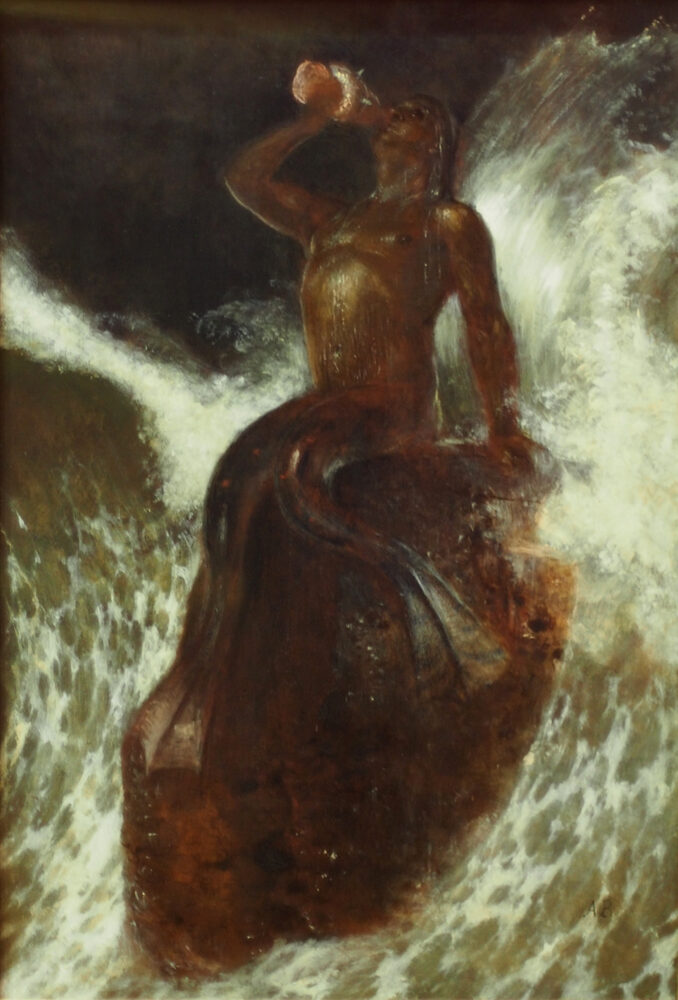
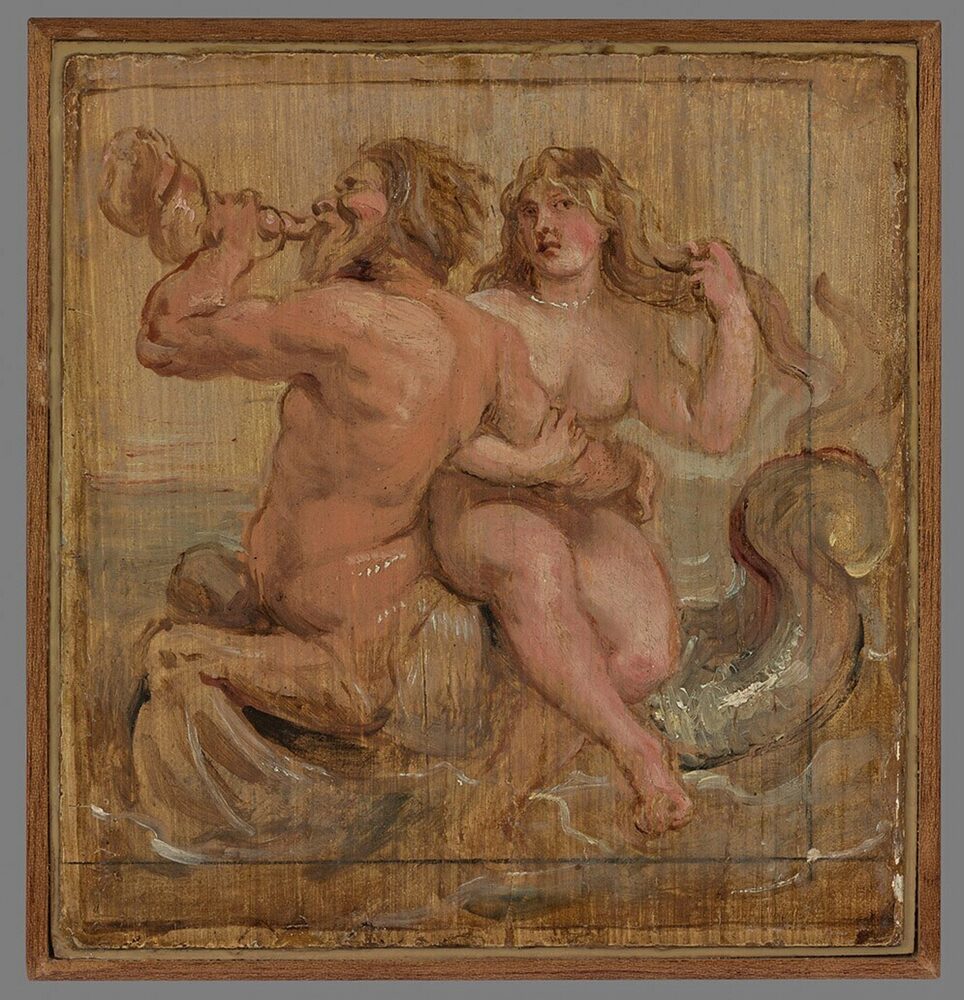
Triton (TRY-tun) is the herald of the sea — the son of the sea-king Poseidon and his queen Amphitrite, and the merman-god who dwells with them in the golden palace beneath the waves. He is pictured, from very early on, as a creature of two natures: a man above and a great scaled fish-tail below, riding the swell with a trident in his hand and a spiralling seashell at his lips. That shell is his instrument and his emblem. Triton is above all the one who blows the conch, the crier and messenger of the deep, whose horn-note carries his father's commands out across the water.
What makes him worth knowing is a single vivid power: the calming and rousing of the sea by sound. When the twisted shell (the Greeks called it a kochlos) swells to a full blast, the waves rise; when its note softens and falls away, the water lies down flat and quiet again. So Triton is the god you meet at the exact edge where the sea turns from wild to gentle — the divine sound that stills a storm. He works this at Poseidon's word, the obedient herald of the sea-king's court rather than a ruler in his own right, and that is his particular character: not the master of the ocean but its trumpeter and go-between.
He is also the ancestor, in a sense, of a whole crowd of lesser sea-beings. In the earliest telling there is only one Triton, this named son of Poseidon. But over the centuries the poets and artists multiplied him: "tritons," in the plural, became a whole class of fish-tailed sea-spirits — mermen who ride beside Poseidon's chariot and blow their shells in his train. That later development is important to keep straight. The god of this page is the one herald, the single named Triton; the swarming tritons of later art are his offspring in the imagination of the Greeks, drawn out of his one figure.
Mythology
The herald in his father's house
The oldest picture of Triton is the simplest. Hesiod's Theogony (930-933) names him just after listing the marriage of Poseidon and Amphitrite: their son is Triton, "mighty" and "wide-ruling," who keeps his home in the deep with his father and his lady mother, in the golden palace beneath the sea. There is no adventure here yet, only a place and a family — the sea-king, his queen, and their son dwelling together in the depths. Everything the later Greeks made of Triton grows out of this small seed: the son of the sea-lord's own house, and therefore the natural herald and mouthpiece of that house.
From this beginning the artists gave him his body. Triton is imagined as a merman — a man from the waist up, with a long, scaled, fish's tail below (sometimes doubled, or ending in fins), and often with other marks of the sea about him: a skin roughened like a shell, small fins at his brow, the look of something grown in salt water. He rides the waves rather than walks the land, and where he goes the lesser creatures of the sea go with him.
The conch and the calming of the waves
Triton's defining possession is his trumpet, and it is not made of metal but of shell. He carries a great twisted sea-shell — a spiralling conch, the kind the Greeks called a kochlos — bored through at the tip so that he can blow it like a horn. This is the instrument on which his whole character turns.
The clearest description of how it works comes from the Roman poet Ovid, and because it is Roman and late it should be flagged as such rather than taken for old Greek belief — but it captures the Greek image exactly. In Ovid's telling of the great Flood (Metamorphoses 1.330-342), when the waters are at last to go down, Poseidon's Roman counterpart calls up Triton rising above the deep, his shoulders thick with sea-shells, and bids him blow his sounding conch to call the waters home. Triton takes up the hollow shell that widens in a spiral from its tip, sets it to his lips, and sounds the retreat — and the note is heard by every sea and river under both the rising and the setting sun, and hearing it, the waters draw back and sink into their beds. Here the conch is a signal-trumpet that commands the sea to obey: swelled to a blast it rouses the flood, sounded soft it calls the waters down to calm.
That is the heart of Triton. Whether raising the waves or laying them to rest, he does it by sound, and he does it at the command of the sea-king. He is the herald who turns his father's will into a note the whole ocean can hear — the divine trumpeter at the seam between storm and stillness.
Triton and the Argonauts in Libya
Triton's one real adventure in Greek story is a rescue, and a gentle one. In Apollonius of Rhodes' Argonautica (Book 4, roughly lines 1550-1620), Jason and the Argonauts, homeward bound with the Golden Fleece, are driven off course and cast up on the coast of Libya. A great storm-surge lifts their ship, the Argo, and carries it far inland, and there it grounds — stranded in the shallow, weed-choked waters of Lake Tritonis, a briny lagoon with no clear way back out to the open sea. The heroes carry the ship on their shoulders across the burning sand and set it down in the lake, but they cannot find the channel out, and they are trapped.
Their escape comes as a gift. In gratitude for an offering — a great tripod that the seer Orpheus counsels them to dedicate to the gods of the land — the god of the lake himself appears to them. It is Triton, who comes (at first in the guise of a young man, then showing his true shape) and takes up a clod of earth as a token of friendship, giving it to the Argonaut Euphemus. Then, most helpfully of all, he shows them the hidden outlet of the lake and guides the Argo down the channel and back out to the open sea — swimming ahead of the ship, or in some tellings taking hold of her keel and drawing her through the water himself, until the heroes are once more on the broad deep and free to sail home. It is Triton at his most characteristic: not a monster to be fought, but a helper of sailors, the sea-god who knows the way through the water and brings the lost ship safely out.
This Libyan setting is also why the Greeks tied his very name to that place. Because his story lived at Lake Tritonis, and because his mother is sometimes herself called Tritonis, the name "Triton" was read as meaning something like "the one of that water" — the god belonging to the lake and the sea around it.
From one Triton to many tritons
There is one more thing that has to be said plainly, because it is the single easiest point to muddle. In the beginning there is one Triton — this named son of Poseidon and Amphitrite, the single herald of the sea. But as the centuries passed, the poets and the vase-painters and the mosaic-makers began to imagine many of him.
By the later Greek and Roman periods, "tritons" (in the plural, and with a small letter) had become a whole class of sea-spirits — a crowd of fish-tailed mermen, drawn out of the one god's image, who swim in the train of Poseidon, ride beside his chariot over the waves, blow their conches in his procession, and sport through the sea with the Nereids (the sea-nymphs). Some later writers even split Triton in two along the line of sex, imagining female counterparts, the "tritonides." These swarming tritons of the sea's retinue are a real and lovely part of ancient art — you meet them everywhere on mosaics and reliefs of the sea — but they are a later development, generalised out of the single figure of Hesiod's one god. The Triton of this page is the original: the one herald, the named son of the sea-king, from whom all the others were imagined.
Worship — Ancient
A god more of story than of altar
Triton was, for most Greeks, a figure of poetry and art more than the centre of a great public cult. He has no major festival of his own and no famous temple to rival those of the Olympians; his home is the imagination of the sea rather than a single civic shrine. But he was not without honour, and the places where he was worshipped fit his character exactly — they cluster where fresh water meets the sea, and along the coasts where sailors and fishermen needed the good will of the deep.
Boeotia and the Libyan lake
The traveller Pausanias, writing his guide to Greece (9.20-21), records a cult of Triton in Boeotia, at the town of Tanagra, and repeats the local stories told of him there — tales of a Triton who troubled the coast and the cattle and the fisherfolk until he was overcome, and whose great preserved image the townspeople could still show. Whatever we make of the folk-tale, the point for worship is that Tanagra kept Triton as a real presence of its own shore. Far to the south, the Greeks tied him most of all to Lake Tritonis in Libya, the briny lagoon of the Argonauts' story, which was regarded as his special water and the source of his name — and which the Greeks also linked to the birth of Athena, sometimes called Tritogeneia, "Triton-born," for it.
The manner of his honours
Where Triton was honoured, it was in the way proper to a sea-god of the lesser sort: with the offerings that coastal people give to the powers of the water on whom their safety and their livelihood depend. Libations of wine poured out into the sea (given wholly to the water and not taken back), the first of a catch returned to the deep, and prayers for calm water and safe passage are the natural gifts to a god whose whole nature is the stilling and the rousing of the waves. As the herald and son of Poseidon, Triton shared in the wider reverence given to the sea-king's household, and to pray to him was, in effect, to appeal to the deep through its own trumpeter and messenger.
Worship — Modern
Honouring the herald of the sea
In modern Hellenic practice — the living revival of the old Greek religion — Triton is honoured as a sea-god of the gentler, helping kind: the herald and son of Poseidon, the trumpeter who calms the waves and guides the lost ship home. A devotee drawn to him might keep a small remembrance of the sea near at hand — a spiral conch or sea-shell, an image of the merman with his shell-horn and trident — and turn to him for the things his story is about: safe passage over water, calm after storm, and the finding of a way out of a place one has become stuck in. He is a fitting patron for sailors, swimmers, fishers, and travellers by sea, and for anyone praying for rough waters (of the literal or the figurative kind) to be stilled.
Offerings and remembrance
The most fitting offering follows the ancient shape and the god's own element: a libation of wine or fresh water poured into the sea — or, away from the coast, into a bowl of salt water set aside for him — given wholly and not taken back. A conch or shell laid on a household shrine, a candle lit with a prayer for calm and safe passage, or simply the sounding of a shell-horn by the water are all natural ways to honour the trumpeter of the deep. Because his kindest deed was to guide the stranded Argo back to the open sea, prayers to Triton often ask, in the same spirit, for help in getting free of a difficulty and finding the channel back to clear water.
Legacy in name and image
Beyond formal devotion, Triton lives on wherever the sea is pictured. His name and figure fill the fountains and gardens of Europe — the muscular merman with his twisted shell, water spouting from the conch, is one of the most familiar of all sea-images, from Bernini's famous Triton Fountain in Rome onward. Science borrowed his name too: the large spiral sea-snails called tritons or "triton's trumpets" are named for the shell he blows, and the great moon of the planet Neptune — Neptune being Poseidon's Roman name — is called Triton after him, so that the sea-king's herald now circles the sea-king's world in the sky. And in the word itself lingers the memory of the many: any fish-tailed merman of art or story is, in the end, a triton, drawn from the one god who first sounded the conch.
Epithets & Cult Titles
- Kēryx halós (κῆρυξ ἁλός) — Herald of the sea — Triton is the crier and messenger of the deep, who carries and announces the will of his father Poseidon across the waves
- The conch-blower — A descriptive title for his defining act — he sounds the great twisted seashell (the kochlos) as a trumpet, its note swelling to rouse the waves or dying away to still them at Poseidon's command
- Trumpeter of the deep (kochlos-bearer) — Bearer of the spiralling shell-horn — the shell itself became his emblem, so closely bound to him that a spiral sea-snail still carries the name Triton in the study of shells
- Herald of Poseidon's palace — The son who dwells with his parents in the golden home beneath the sea (Hesiod, Theogony 930-933), Triton stands as the household herald of the sea-king's court
Sources & Variants
- Hesiod, Theogony 930-933 (Triton, mighty son of Poseidon and Amphitrite, dwelling in the golden depths with his parents)
- Apollonius of Rhodes, Argonautica 4.1550-1620 (Triton, god of Lake Tritonis in Libya, appears to the stranded Argonauts, gives Euphemus the clod of earth, and guides the Argo out to the open sea)
- Pausanias, Description of Greece 9.20-21 (the cult and local legends of Triton at Tanagra in Boeotia)
- Ovid, Metamorphoses 1.330-342 (Triton sounds his conch to call the waters of the Flood back to their beds) — Roman retelling, flagged as late
- Pindar, Pythian 4.19-56 (the god of Lake Tritonis and the token of the clod of earth in the Argonaut tradition)
- Herodotus 4.178-180 (Lake Tritonis in Libya and its associations)
- Later Greek and Roman art and poetry (mosaics, reliefs, and the poets) for the development of the plural 'tritons' as a class of fish-tailed sea-spirits in Poseidon's train
Gallery