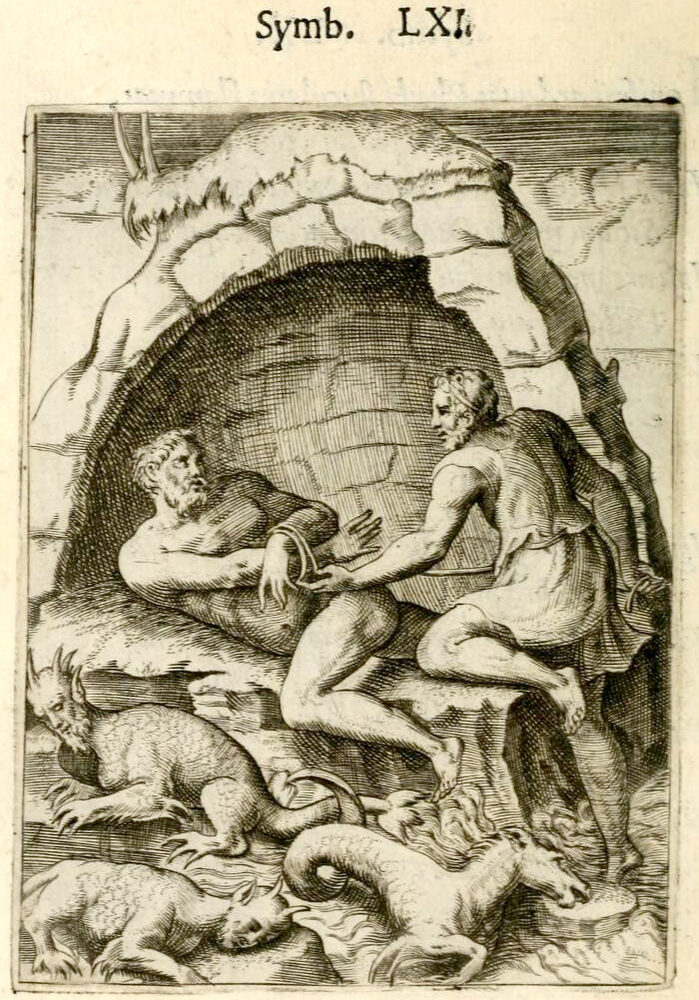
Proteus
First Appearance
Proteus first appears in Homer's Odyssey, in the tale Menelaus tells to Telemachus of his own long road home. Becalmed and starving on the island of Pharos off the coast of Egypt, Menelaus is helped by Eidothea, a sea-nymph and Proteus's own daughter, who reveals that her father — "the Old Man of the Sea," the deathless Egyptian Proteus who knows the depths of every sea and serves Poseidon — comes up at noon to sleep among his seals, and that if Menelaus can seize and hold him through all his changing shapes, the god will be forced to tell him the way home and the fates of the other returning heroes.
— Homer, Odyssey 4.351–570
Who They Are
Proteus (PROH-tee-us) is the prophetic Old Man of the Sea — an ancient, deathless spirit of the deep who knows all things, past and present and to come, but will tell them to no one unless he is caught and held fast against his will. He belongs to a small family of grey sea-elders in Greek myth, the halioi gerontes ("old men of the sea"), among them Nereus and Phorcys: primeval, gentle, truthful powers of the water, older and stranger than the bright Olympians, who carry the sea's own knowledge in them. Proteus is the herdsman of that world's flocks — he drives up the seals of the sea-god Poseidon to bask on the shore in the heat of the day, counts them like a shepherd counting sheep, and lies down to sleep among them.
What makes Proteus unforgettable, and what has carried his name into English, is the way he keeps his knowledge hidden: he changes shape. Take hold of him to force an answer and he becomes a lion, a serpent, a leopard, a great boar; he turns to running water in your hands, then to a tall tree; he becomes anything and everything rather than speak. Only a questioner who holds on through every terrifying form — who does not let go and does not flinch — wins the moment when the god, worn out and seeing his tricks are useless, gives up, returns to his own shape, and answers truly. From this comes the English word protean: endlessly changeable, able to take any form, versatile past pinning down.
His parentage was never fixed — some called him a son of Poseidon, some a son of Oceanus, the world-encircling river — and the Greeks were content to leave it so, for he is less a figure of family and dynasty than an elemental presence, the sea's memory given a face. To meet Proteus in a story is to meet the truth itself as the old Greeks imagined it: real, and knowable, and yours only if you are strong and patient enough to hold the slippery thing still until it stops fighting and speaks.
Mythology
Menelaus stranded on Pharos
The great story of Proteus is told in the fourth book of Homer's Odyssey, and it is told by Menelaus himself, king of Sparta, to young Telemachus, who has come seeking word of his lost father Odysseus. On his own way home from Troy, Menelaus recounts, the gods had held him fast on the island of Pharos, a low island lying off the mouths of the Nile in Egypt, "as far from the shore as a hollow ship can sail in a whole day with a good wind behind her." For twenty days no wind blew that would carry his ships to sea; the sailors' food ran out and their strength with it, and they wandered the beach fishing with bent hooks against starvation, and Menelaus could not understand which of the gods he had offended or how to make it right.
Eidothea and the counsel to seize her father
Pity for him moved a goddess of the place — Eidothea, a daughter of "mighty Proteus, the Old Man of the Sea." She found Menelaus wandering apart from his men and told him plainly that he was trapped by his own ignorance, and that there was one who could set him free. Her father Proteus, she said — the deathless Egyptian, servant of Poseidon, who knows the depths of all the seas — comes up out of the water at midday, when the sun is at its height, and lies down to sleep in the shelter of the rocks with his flocks of seals about him. If Menelaus and three chosen companions could ambush the god and lay hold of him, and hold on no matter what, Proteus would be forced to tell him the road home and the fates of the men he had left behind. But, she warned, the old god would not go quietly: caught, he would turn himself into every creature that moves on the earth, and into water, and into blazing fire, to shake them off — and they must grip him all the harder and not let go until he wearied and became again the shape in which they had first seen him sleeping. Only then should they release him and ask their questions.
The ambush among the seals
Eidothea herself prepared the trap. At dawn she rose from the swell of the sea carrying the skins of four seals, freshly flayed, and scooped out four hollows in the sand of the beach for Menelaus and his three companions to lie in. She laid them down in the pits and covered each man with a sealskin for a disguise, so that they might pass, in the god's own flock, for seals. The ambush was very nearly unbearable: the stench of the sea-fed seals was deadly — "a most cruel ambush would this have been, for the deadly reek of the sea-born seals distressed us sorely," Menelaus remembers — and the goddess pitied them and set sweet-smelling ambrosia under each man's nose to overpower the smell. All the long morning they waited among the real seals, holding their nerve. At last, in the noonday heat, the seals came trooping up out of the grey water and lay down in their rows along the shore, and at midday the old god himself came up after them, and went along his fat flock counting them over, and told the four disguised men in among the number, never suspecting the ambush; and then he too lay down to sleep.
Holding fast through every shape
With a shout the men rushed him and flung their arms around him — and Proteus did not forget his cunning arts. First he became a great bearded lion, and then a serpent, and then a leopard, and then a huge boar; he turned to flowing water, and then to a high tree in leaf. But the men held on, gripping him without flinching through every change, and would not let go. At last the old god wearied of it, and, beaten, spoke and asked Menelaus which of the gods had taught him this ambush and what it was he wanted. Then, and only then, released, Proteus told the truth, as sea-gods must once they are pinned: that Menelaus had failed to make the proper offerings to Zeus and the other gods before sailing, and must return to the Nile and there sacrifice to appease them before the winds would carry him home. And he answered the harder questions too — the fates of the Achaean captains coming back from Troy: how Aias the Locrian had drowned, how Menelaus's own brother Agamemnon had been murdered on his return, and how Odysseus was still alive but held captive and weeping on the island of the nymph Calypso, with no ship and no way to leave. Then the Old Man of the Sea went back down into the swell of the water, and Menelaus did as he was told, and came home at last.
The prophet who must be forced to speak
The scene became the very type of a certain kind of Greek encounter with the divine: knowledge is really there to be had — the god does not lie and does not withhold out of malice — but it must be taken, wrestled from a power that will do everything to slip away. Proteus's shape-shifting is not random mischief; it is the natural defence of a truth that does not want to be handled, and the story teaches that only a firm and patient grip, one that endures through fear and disgust and every trick, is rewarded with a straight answer. The same motif attaches to other old sea-powers — Nereus is wrestled by Heracles for the way to the Garden of the Hesperides, and Thetis changes shape to escape the grasp of her mortal suitor Peleus — but it is Proteus above all whose name the Greeks and we after them attached to the idea of a thing that will be anything to avoid being caught.
The other Proteus — a king of Egypt
Beside the Homeric sea-god there runs a quite separate tradition, and it is worth keeping the two apart. In it Proteus is not a shape-shifting spirit at all but a mortal king of Egypt, a just and pious ruler at Memphis. The historian Herodotus (2.112–120) reports the Egyptian priests' version of the Trojan story: that Paris, carrying off Helen, was blown to Egypt, and that King Proteus, appalled at the wrong done to a guest-friend's marriage, kept Helen safe and unharmed in Egypt for the whole length of the war and sent Paris away in disgrace — so that the Helen fought over at Troy was only a phantom, and the real woman was in Egypt all along. The tragedian Euripides built his play Helen on exactly this idea, setting it at the tomb of the good king Proteus in Egypt, where the true Helen has waited out the war in chastity. This righteous Egyptian monarch and Homer's slippery Old Man of the Sea share little but a name and the Egyptian setting, and the Greeks themselves seem to have felt them as two different figures; the sea-god is the older and the more famous, and it is he who gives us the word protean.
Worship — Ancient
A god of story more than of altars
Proteus is one of those Greek divine figures who lived vividly in poetry and story but left only a faint mark in organised cult. There is no great temple of Proteus, no Panhellenic festival, no priesthood that we know of — he belongs to the same dim, elemental class as the other "old men of the sea," Nereus and Phorcys, powers felt to be real and ancient but honoured, when they were honoured at all, at the general level of the sea's own divinity rather than with a public cult of their own. Where a sailor or a fisherman poured a libation to the powers of the deep before a voyage or after a catch, Proteus was among the grey elders such an offering reached, but the sources do not preserve a specific, named ritual addressed to him.
Pharos, Egypt, and the sea-god's home
What the ancients gave Proteus instead of temples was a place. Homer fixed his home firmly at the island of Pharos off the Egyptian coast — the same small island on which, centuries after Homer, the Ptolemies would raise the famous lighthouse, one of the Seven Wonders, so that the name Pharos passed into many languages as the ordinary word for a lighthouse (French phare, Italian faro). The Egyptian setting was part of Proteus from the beginning, and the later Greeks who visited Egypt — Herodotus among them — were shown local traditions there that they connected with the name, including the temple precinct at Memphis that Herodotus calls the sanctuary of "the foreign Aphrodite," which he associates with the story of Proteus and Helen.
The Egyptian king and his tomb
In the alternative, "historical" tradition — Herodotus and Euripides — Proteus the just king of Egypt was remembered with a tomb and a sacred precinct at Memphis, and it is at that tomb that Euripides sets the whole action of his Helen. This is memory and setting rather than living god-cult in the Greek sense, but it shows how the Greeks localised the name and gave it a resting-place in the Egyptian landscape they found so ancient and full of wonders. Between the two traditions, the ancient reality of Proteus was less a matter of sacrifice than of a name attached to a famous shore, and of a story told and retold about the truth that must be wrestled from the sea.
Worship — Modern
Honouring an old man of the sea
A modern devotee drawn to Proteus meets a god who was always more a presence than an institution, and can honour him in that spirit. Because he belongs to the sea and to its grey, truthful elders, the natural place to remember him is at the water's edge, and the natural offering is the oldest one given to the powers of the deep: a libation poured out to the sea — wine, or clean fresh water, given wholly to the waves and not taken back. A candle by the shore, a few words spoken to the Old Man of the Sea, or the simple act of watching the water at noon — the hour he came up among his seals — all sit well with the shape of his myth.
The god of change and of hard-won truth
More than through ritual, Proteus lives on as an idea, and it is a rich one to sit with. He is the patron, if he is patron of anything, of the truth that will not be had cheaply — the knowledge that changes shape and slips the grip, and yields only to the one who holds on through every frightening form until it tires and speaks straight. Those who work at difficult understanding — scholars, seekers, anyone wrestling a slippery problem toward a clear answer — can find in Proteus a fitting image: do not let go, do not flinch at the shapes it takes, hold fast until the thing turns back into itself and tells you what is true. He is also, quite simply, the god of change and adaptability, of the self that can become many things.
Protean — his word in the language
Proteus's deepest survival is in the English word he gave us. To call a thing protean is to say it is endlessly changeable, able to take any form, versatile beyond pinning down — a protean actor who disappears into every role, a protean talent, a protean disease that shows itself in a hundred different symptoms. Every time the word is used, the old sea-god changing under Menelaus's grip on the beach at Pharos is quietly remembered. Few minor gods of Greek myth have left so lasting a mark on the way we speak, and in that word Proteus keeps doing the one thing he was always known for: becoming something new.
Epithets & Cult Titles
- Halios Gerōn (ἅλιος γέρων) — The Old Man of the Sea — Homer's standing title for Proteus, the aged and knowing spirit of the deep; the same phrase is used of other primeval sea-gods such as Nereus and Phorcys
- Poimēn phōkaōn (ποιμὴν φωκάων) — Herdsman of the seals — Proteus as the shepherd who drives up Poseidon's flocks of seals from the water to sleep on the shore at noon
- Aigyptios (Αἰγύπτιος) — The Egyptian — Proteus as the sea-god who haunts the island of Pharos off the mouths of the Nile, and, in a separate tradition, a righteous king of Egypt
- Polytropos — Of many turns, of many shapes — a descriptive title (not a fixed cult-name) for the god who changes into every form to escape his questioners
Sources & Variants
- Homer, Odyssey 4.351–570 (the whole episode: Menelaus stranded on Pharos, Eidothea's counsel, the ambush among the seals, the shape-shifting, and the prophecy of the homecomings)
- Virgil, Georgics 4.387–529 (the Roman retelling: Aristaeus seizes and holds the shape-shifting Proteus to learn why his bees have died) — Latin source
- Ovid, Metamorphoses 8.730–737; 11.221–223 (Proteus named as the type of the shape-changer, and his prophecy to Peleus about Thetis) — Roman source
- Herodotus, Histories 2.112–120 (the separate tradition of Proteus as a just king of Egypt who sheltered the real Helen)
- Euripides, Helen (the play set at the tomb of King Proteus in Egypt, where the true Helen waits out the Trojan War)
- Apollodorus, Epitome 6.1 and Bibliotheca (Proteus and the Egyptian Helen tradition; the old men of the sea)
Gallery