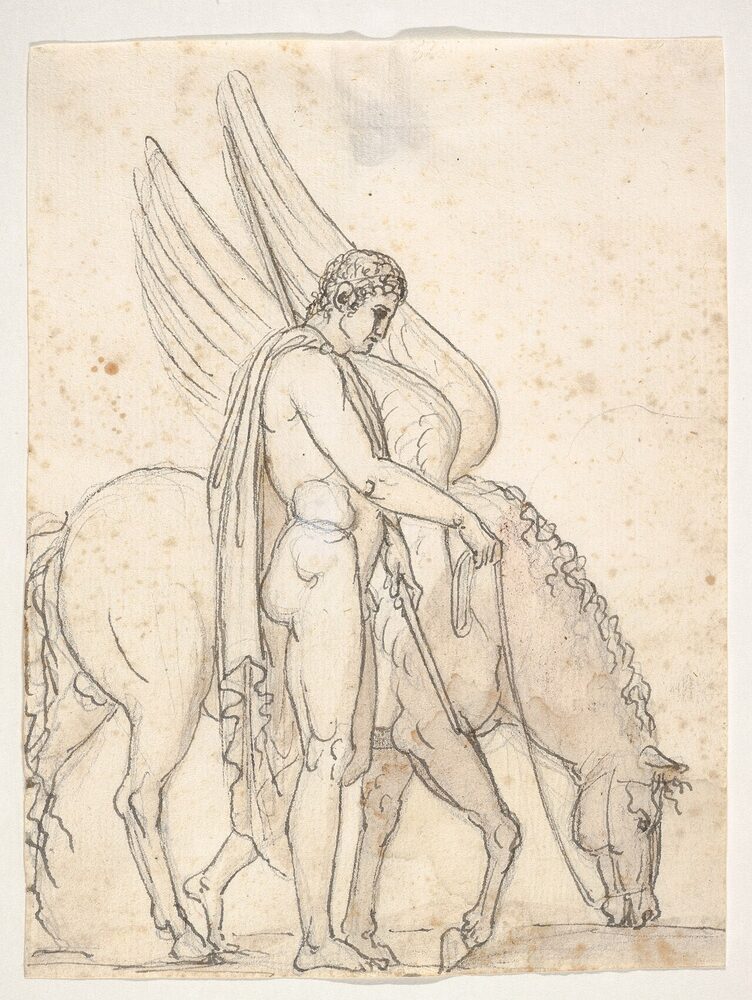
Bellerophon
First Appearance
Bellerophon first appears in the Iliad, when the Lycian Glaucus, meeting Diomedes on the battlefield, recites his own ancestry and tells the whole story of his grandfather: how Proetus's wife falsely accused the blameless Bellerophon, how he was sent to Lycia bearing a folded tablet of deadly signs, how he slew the Chimera and survived every ambush, and how at the last, hated by the gods, he wandered the Aleian plain alone, eating out his own heart.
— Homer, Iliad 6.152–211 (the exchange of Glaucus and Diomedes)
Who They Are
Bellerophon (buh-LAIR-uh-fon) is one of the oldest and most tragic of the Greek heroes — the rider of the winged horse Pegasus, the slayer of the Chimera, a man raised to the very edge of the divine and then broken for reaching past it. His story is already old in Homer, who tells it in full in the sixth book of the Iliad, and it carries within it the whole shape of Greek heroism: the god-touched exploit, the impossible task survived, and the ruin that comes when a mortal forgets that he is mortal.
By the standard tradition his true father was Poseidon, lord of horses and of the sea, though he was reared as the son of Glaucus, king of Corinth (Ephyre), and it is as a Corinthian prince that he begins his tale. His name was read by the Greeks themselves as "slayer of Belleros" — some killing, otherwise forgotten, that first drove him from his home. What follows is the pattern the later hero-myths would inherit: a false accusation, a treacherous errand, a string of deadly trials, and a triumph so complete that it tempted the hero to overreach.
For Bellerophon does not fail. He wins every contest set to kill him — the Chimera, the Solymi, the Amazons, the ambush of Lycia's best men — and is rewarded with a kingdom and a princess. His fall, when it comes, is not defeat but hubris: mounted on Pegasus, he tries to ride up to Olympus itself and take his place among the gods. For that presumption he is thrown down, crippled and shunned, to end his days wandering alone. He is the hero as warning — the measure of how far a mortal may climb, and of the exact height at which the gods strike him down.
Mythology
The false accusation and the deadly letter
Bellerophon began his exile in the house of Proetus, king of Tiryns (or of Argos), who received the young man as a guest and purified him of an earlier killing. But Proetus's wife — Homer calls her Anteia, the tragedians Sthenoboea — conceived a violent passion for the handsome stranger, and when he refused her she turned her desire to hatred. She went to her husband and accused Bellerophon of the very crime she had attempted, swearing that he had tried to force himself upon her and demanding his death. (Content note: the tale turns on a false accusation of attempted rape and a plot to murder an innocent guest.)
Proetus believed her, but he would not kill a man who had eaten at his table — to murder a guest was to break the sacred bond of hospitality that the gods themselves protect. So he chose a colder path. He sent Bellerophon away to Lycia, to the court of his father-in-law Iobates, and gave him a folded tablet to carry, scratched inside with "baneful signs" and instructions that the bearer be put to death. Bellerophon, not knowing he carried his own death warrant, delivered it faithfully — and from this moment comes the ancient phrase, the "Bellerophontic letter," the message whose carrier bears his own doom sealed in his hand.
The golden bridle and the taming of Pegasus
Before the tasks could be met, Bellerophon needed the winged horse. The tradition tells it so: the hero longed to master Pegasus, the immortal winged stallion, but the horse could not be caught by any ordinary means. Sleeping in the temple of Athena, Bellerophon received the goddess in a dream, and she set beside him a golden bridle — and when he woke, the bridle lay there in truth, no dream but a gift. With it he came to the spring of Peirene in Corinth, where Pegasus was drinking, and the golden bridle tamed the untamable horse at a touch. So mounted, on a steed born of the sea and the blood of Medusa, Bellerophon rose into the air, and the impossible errands of Lycia became possible. (Pegasus has his own tale and his own page; here he is the hero's mount and the instrument of his rise.)
The Chimera and the lead-tipped spear
Iobates, honouring his guest, feasted Bellerophon for nine days before he read the tablet — and then, bound like Proetus by the law of hospitality, he too would not kill the young man outright. Instead he set him a task no man was meant to survive: to slay the Chimera, the monster ravaging Lycia — a single creature part lion, part goat, part serpent, that breathed living fire. Flying above it on Pegasus, out of reach of its flame, Bellerophon still faced the problem of its breath, which no blade could pass. His answer was cunning as much as courage: he fixed a lump of lead to the point of his spear and drove it into the Chimera's jaws, and the monster's own fire melted the lead, which ran molten down its throat and choked and burned it from within. So the Chimera died by its own flame turned against it. (The Chimera has her own page, coming; here she is the first and greatest of Bellerophon's trials.)
The Solymi, the Amazons, and the ambush
The Chimera was only the first task. When Bellerophon returned alive, Iobates sent him against the Solymi, the fierce mountain people whom Homer calls the hardest fight Bellerophon ever fought, and he overcame them. Then against the Amazons, the warrior-women "who fight like men," and he defeated them too. At last Iobates gave up the pretence of tasks and laid a plain ambush: he set the best fighters of Lycia to wait for Bellerophon and kill him on his way home — and Bellerophon, Homer says, killed every one of them, so that not one came back.
Now the king understood. No man could survive so much unless the gods were with him, and Iobates saw at last that his guest was of divine descent. He abandoned the plot, showed Bellerophon the fatal tablet, and made peace: he gave him his daughter — later writers name her Philonoe — in marriage and half his kingdom besides, and Bellerophon became a prince of Lycia, honoured and prosperous, the father of children who would themselves be remembered (among them Hippolochus, father of that same Glaucus who tells the whole story at Troy).
The fall from Pegasus
Here the tale should end in triumph, and for the tragic hero that is exactly the danger. Grown great beyond any mortal — victor over monster and army and ambush, rider of the horse of the gods — Bellerophon could not keep to the measure of a man. In his pride he resolved to ride Pegasus up to Olympus itself, to take his seat among the immortals as though he had earned a place at their table. (Content note: the ending turns on downfall, disability, and a lonely, embittered death.)
Zeus would not suffer it. As Bellerophon climbed the sky, the king of the gods sent a single small thing against all his greatness — a gadfly, which stung Pegasus, and the startled horse reared and threw its rider. Bellerophon fell the whole height he had climbed, back to the earth. He did not die of it, and that was the cruelty: he was left crippled and (some say) blinded, broken in body and hated by the gods for his presumption. And so, in Homer's unforgettable words, "hated by all the gods, he wandered alone over the Aleian plain, eating out his own heart and shunning the paths of men" (Iliad 6.200–202). The hero who had flown higher than any mortal ended lower than most — landless, friendless, and abandoned by the very powers that had raised him, a living warning of the height at which the gods strike a mortal down.
Worship — Ancient
A hero, not a god
Bellerophon was honoured in the Greek manner not as a god but as a hero — one of the mighty mortal dead who were thought to retain power in and around the place tied to their story, and who received offerings at a tomb or precinct rather than at a temple altar. His worship belonged above all to Corinth, the city he came from: the Corinthians kept his memory as one of their own, and the winged horse Pegasus and the spring Peirene, where he had bridled him, were among the city's proudest emblems — Pegasus appears on Corinthian coinage for centuries. Pausanias, walking Corinth in the second century CE, records a precinct of Bellerophon in the grove called Craneion outside the city (Description of Greece 2.2.4).
Corinth and Lycia
His cult reached beyond Corinth to Lycia, the land he won and ruled, where his exploits were localised in the landscape — the fire-breathing Chimera itself was connected by ancient writers to the perpetual natural gas flames of Mount Chimaera near Phaselis, still burning today, so that the myth was rooted in a real and visible marvel of the region. Hero-cult of this kind typically involved offerings poured into the ground at the tomb, libations, and the keeping of the hero's story in local memory and civic pride; the hero was called on for protection and, in some places, for aid in trouble. Because Bellerophon's tale ends in disgrace, his was never a great Panhellenic cult like that of Heracles, but a more local and civic honouring, strongest where his deeds were felt to have happened.
Worship — Modern
Honouring Bellerophon today
Bellerophon is not a god to be worshipped but a hero to be remembered, and a modern devotee honours him best in the way the Greeks honoured their heroes — with respect for his memory and reflection on his story. Those drawn to him tend to be riders and horse-lovers (for he is the great horseman of myth), and those who value courage and cleverness together, for he beat the Chimera as much by wit as by valour. A simple remembrance — an image of the winged horse, a poured libation of wine, a reading of the sixth book of the Iliad — is a fitting way to keep his name.
Offerings and reflection
Where the ancients gave libations at a hero's tomb, a modern honourer may simply pour out a little wine or water to his memory and speak his name and his deeds. But Bellerophon's deepest gift to us is not an offering to receive; it is a lesson to hold. His life is the clearest of the Greek warnings against hubris — the pride that forgets the limit of a mortal life. He did everything right, won every trial, earned every reward, and was destroyed only when he tried to rise above his own humanity and sit among the gods. To remember Bellerophon is to remember both halves of him: the blameless hero who tamed the winged horse and slew the monster, and the broken man on the Aleian plain, eating out his heart — the height a mortal may reach, and the exact place where reaching further will throw him down.
Epithets & Cult Titles
- Bellerophontes (Βελλεροφόντης) — Slayer of Belleros — the older, fuller form of his name, carrying the sense of the killing from which his fame was said to spring, though who or what Belleros was is now beyond recovery
- The Blameless (amumon) — Descriptive, from Homer's amumon — the standard epic praise-word for a hero of flawless worth, used of Bellerophon in the Iliad before his fall
- Tamer of Pegasus — Descriptive — the rider who alone bridled and mastered the winged horse at the spring of Peirene, the deed by which he is best remembered
- Slayer of the Chimera — Descriptive — victor over the fire-breathing monster of Lycia, the first and greatest of the tasks set to destroy him
Sources & Variants
- Homer, Iliad 6.152–211 (the tale of Bellerophon told by Glaucus: the false accusation of Anteia, the folded tablet and its baneful signs, the Chimera, the Solymi, the Amazons, the ambush, the marriage and kingdom, and the final wandering on the Aleian plain)
- Hesiod, Theogony 319–325 (the Chimera and her nature) and Catalogue of Women fragments (Bellerophon and Pegasus)
- Pindar, Olympian 13.60–92 (the golden bridle given by Athena in a dream, the taming of Pegasus at Peirene, and the warning of Bellerophon's fall)
- Apollodorus, Bibliotheca 2.3.1–2 (the fullest connected narrative: Proetus, Sthenoboea, Iobates, Pegasus, the Chimera, the tasks, and the marriage to Philonoe)
- Pausanias, Description of Greece 2.2.4 (the precinct of Bellerophon at Corinth) and 2.4.1 (Peirene and Pegasus)
- Hyginus, Fabulae 57 (Sthenoboea) and 157 (the sons of Poseidon, naming Bellerophon)
Gallery