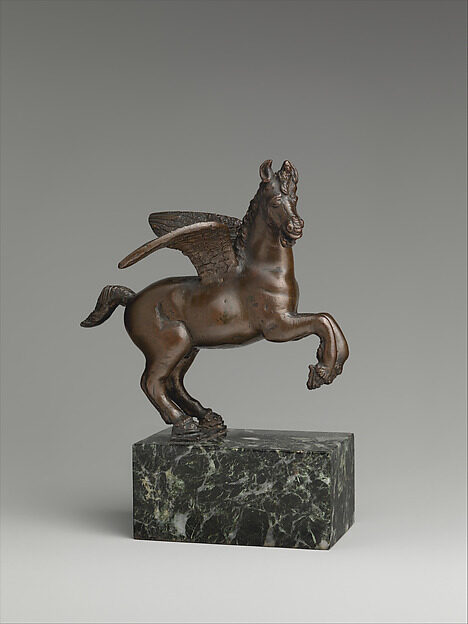
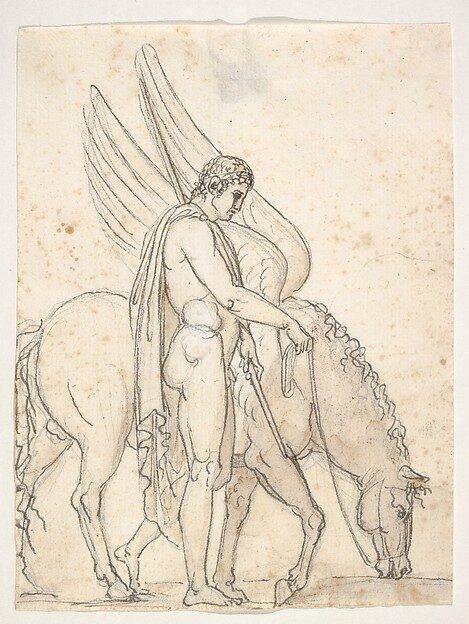
Pegasus
First Appearance
Pegasus first appears at the moment of his birth in Hesiod's Theogony (280–286): when Perseus struck the head from Medusa, the winged horse Pegasus and the warrior Chrysaor sprang together from her severed neck. Hesiod explains the name — Pegasus was so called because he was born beside the springs (pēgai) of Ocean — and tells how the horse at once left the earth, flew up to the deathless gods, and now lives in the house of Zeus, carrying the thunder and lightning of Zeus the counsellor.
— Hesiod, Theogony 280–286
Who They Are
Pegasus (PEG-uh-sus) is the winged horse of Greek myth — Πήγασος in Greek, the same Pegasus in Latin — and the most beloved of all its fabulous creatures, a snow-white stallion with the wings of a great bird who was born from the blood of a monster and ended his days in the stables of heaven. He belongs to no single hero's story but threads through several: he is born in Perseus's, he is tamed and ridden in Bellerophon's, and he comes to rest in Zeus's, carrying the god's thunderbolts through the sky. The Greeks never quite worshipped him — he is a creature, not a god — but they loved him, and made him an emblem of two things at once: the free power of flight, and the sudden welling-up of poetry, for it was his hoof that opened the fountain of the Muses.
His origin is one of the strangest and most vivid in all myth. When Perseus beheaded the Gorgon Medusa, who had lain with the sea-god Poseidon, the two children she had conceived by that union burst from her severed neck in the same instant: the winged horse Pegasus and his twin, the golden-sworded warrior Chrysaor. So Pegasus is a child of Poseidon — fitting for a god who was himself "the horse-god," Poseidon Hippios — and of Medusa, born at the very stroke of a hero's sword. From that violent instant he flies straight up out of the myth of his own birth and into the wider sky.
What makes Pegasus more than a marvel is what he came to mean. Where his hoof struck the ground on Mount Helicon, a spring broke open — Hippocrene, "the Horse's Spring" — whose waters the Muses loved, and from which, the poets said, inspiration itself could be drunk; so the winged horse became the horse of poetry, the mount that later ages would make a symbol of the soaring imagination. And he became a fixture of the night sky, set among the stars as the constellation Pegasus, one of the largest in the northern heavens. To follow him is to move from a monster's blood to the fountain of the Muses to the halls of Zeus — birth, flight, and a home among the immortals.
Mythology
Born from the Gorgon's neck
Pegasus's life begins with a death. The Gorgon Medusa — alone mortal among her three sisters — had once lain with the sea-god Poseidon, and was carrying his children when the hero Perseus came for her head. Guided by Athena to strike by Medusa's reflection and never her deadly face, Perseus cut the head clean from her neck; and in that same instant, from the severed neck, sprang the two children she had conceived: the winged horse Pegasus and his twin, the golden-sworded warrior Chrysaor ("he of the golden blade"). Hesiod tells it plainly in the Theogony (280–286): the two leapt out together at the stroke. Later poets embroidered the image — Ovid has Pegasus born from his mother's blood soaking into the earth — but the core is fixed from the earliest telling: Pegasus is a child of Poseidon and Medusa, born at the very edge of the world by the streams of Ocean, and born of violence.
Hesiod gives the horse his name in the same breath and sends him at once out of the story of his birth: Pegasus was so called (the poet says) because he was born beside the springs — pēgai — of Ocean, and having left the earth he flew up to the house of the deathless gods, where he dwells and carries the thunder and lightning of Zeus. So from his first appearance Pegasus is already the sky-horse of the king of the gods; the adventures with a mortal rider are a chapter the earlier poets fold in between his birth and that final home.
The golden bridle and Bellerophon
The great mortal chapter of Pegasus's story is not his own but that of the hero Bellerophon, whose full arc is told on his own page — here it belongs only insofar as it is the tale of how the untamable horse was, for a time, tamed. Pegasus could not be caught. He came down to drink at the spring Pirene on the heights of Corinth, and Bellerophon longed to master him, but no man could get near the wild winged thing or set a bridle on him. In Pindar's telling (Olympian 13), the hero, in despair, slept a night in the temple of Athena, and the goddess came to him in a dream and put into his hands a golden bridle, telling him to show it to Poseidon the Horse-Tamer and use it on the horse. Bellerophon woke to find the bridle real and lying beside him; with it he approached Pegasus at the spring, and the horse suffered himself to be bridled and mounted.
Mounted on Pegasus, Bellerophon became for a while the most fortunate of heroes. From the air, out of reach of its fire, he fought and killed the Chimera — the fire-breathing monster, part lion, part goat, part serpent, whose story is told on its own page — raining down his attack from above where no earthbound warrior could stand. On Pegasus's back he also overcame the Solymi and the warrior-women the Amazons, and every task his enemies set to destroy him he turned instead into a victory. The winged horse was the wellspring of all his glory; without Pegasus, Bellerophon was only a man, and with him he was very nearly more.
The fall of the rider and the flight of the horse
It was that "very nearly" that undid Bellerophon — and here the horse and rider part ways forever. Grown proud on his triumphs, Bellerophon presumed at last to ride Pegasus up to Olympus itself, to take a place among the gods as though he were one of them. The gods do not suffer a mortal to climb into heaven uninvited. As Bellerophon urged the horse up the sky, Zeus sent a tiny thing to end the great flight — in the later tradition a gadfly, which stung Pegasus so that the horse reared and threw his rider (the earliest sources give only the fall itself, not the insect). Bellerophon fell all the long way back to the earth; he survived the fall (in the grimmest versions lamed and blinded by it), and lived out his last days wandering alone and hated, "devouring his own heart," as Homer says, shunning the paths of men. Pindar (Isthmian 7) marks the moral cleanly: the horse flew on, but the man came down.
Pegasus himself suffered nothing. Freed of his rider, he flew on up the very road Bellerophon had been forbidden — on to Olympus and the halls of Zeus, the home Hesiod had given him from the start. So the same flight that destroyed the mortal completed the immortal: Bellerophon's presumption was his ruin, and Pegasus's ascent was his homecoming.
The horse of the Muses and the spring on Helicon
One of Pegasus's most enduring deeds has nothing to do with any hero. On Mount Helicon, the mountain of the Muses, the winged horse stamped his hoof upon the rock, and where the hoof struck, a spring of water gushed up. It was called Hippocrene (Ἱπποκρήνη), "the Horse's Spring," and its waters were sacred to the Muses; poets said that to drink of it was to drink inspiration itself. A second such fountain, Pirene at Corinth, was likewise tied to his hoof in some tellings. The story is told by Aratus and by the mythographer Hyginus, and Ovid gives it a charming frame: Athena, visiting the Muses on Helicon, is shown the new-made spring and told that the winged offspring of Medusa had opened it with his hoof. Through Hippocrene, Pegasus became forever the horse of poetry — the creature at whose touch the water of song breaks out of the bare rock — and it is chiefly this that carried his name down through the centuries as a symbol of the poetic imagination.
Among the stars, in the stable of Zeus
Pegasus's true and final home is the sky. Hesiod had said it first — that he dwells in the house of Zeus and carries the god's thunder and lightning — and later ages gave him a second sky-home beside it, setting him among the constellations as the great figure of Pegasus, the Horse, one of the largest in the northern heavens (Aratus describes it, and Hyginus collects the star-lore in his Astronomica). In the sky he is drawn, as such things often are, as only the forepart of a horse, wings spread, plunging headlong among the stars. So the creature born from a monster's blood at the edge of the world ends as a bearer of the king-god's fire and a shape written into the night: no longer any hero's mount, but Zeus's own sky-horse, stabled in heaven and shining in the constellations.
Worship — Ancient
A creature, not a god
Pegasus was never a god to be worshipped, and it would misrepresent the Greeks to invent a cult for him: he had no temple, no priesthood, no festival of his own, and no sacrifices were offered to him. He was a divine creature — a marvel that belonged to the stories of the gods and heroes rather than a power to be petitioned. What he had instead of cult was a rich public life as an emblem and an association, and it is there, honestly, that his place in ancient religion and civic life is found.
The badge of Corinth
Above all, Pegasus was the sign of Corinth, the city whose spring Pirene he had haunted and where Bellerophon had bridled him. From the sixth century BC onward the Corinthians stamped the winged horse on their silver coins — the famous staters known as "colts" (pōloi) — so widely and for so long that Pegasus became one of the most recognizable civic symbols in the Greek world, carried in trade across the Mediterranean and copied by Corinth's colonies. To see the winged horse on a coin was to know the money of Corinth. In this way Pegasus lived in the ancient world less as an object of prayer than as the proud badge of a great city.
The Muses' spring on Helicon
His other public tie was sacred rather than civic. Because his hoof had opened the fountain Hippocrene on Mount Helicon, Pegasus was bound to the cult of the Muses, whose sanctuary and grove lay on that mountain and whose festival, the Mouseia, was held there. Travellers were shown the spring as one of the sights of Helicon, and the poets who invoked the Muses' inspiration invoked, by extension, the water the winged horse had struck from the rock. So Pegasus stood at the edge of a genuine cult — not its object, but the mythical author of its holy spring, the horse whose hoof-print was the fountainhead of song.
Worship — Modern
Not a cult, but a living symbol
As in antiquity, Pegasus today is not the object of worship but one of the most alive of all the images the Greeks left us — and modern Hellenic practice, which honours the gods, would recognize him for what he is: a beloved divine creature, met in the stories and in the sky rather than at an altar. Where he is "kept" now is in art, language, and the imagination, and there he has never faded.
The horse of poetry and inspiration
Because his hoof opened the Muses' spring, Pegasus became, and remains, the emblem of poetry and inspiration itself — "to mount Pegasus" or "to ride Pegasus" is an old figure for taking flight into verse, and the winged horse has stood on the frontispieces of poetry books, the seals of literary academies, and the badges of the arts for centuries. The soaring, upward image of him — a creature that turns the heavy earthbound horse into a thing of the air — made him a natural symbol for creative flight, and he has been painted and sculpted from antiquity through the Renaissance (Rubens, Redon, and countless others) to the present.
In the sky and in the world's speech
Pegasus keeps his ancient home among the stars as the constellation Pegasus, one of the largest in the northern sky, still mapped today with the "Great Square of Pegasus" as one of the season's easiest star-patterns to find; a whole family of naming — from the first exoplanet ever found around a sun-like star (51 Pegasi b) to spacecraft and telescopes — draws on that constellation. And his name has become one of the most widely borrowed in all mythology: Pegasus brands airlines, corporations, sports teams, software, and machines the world over, almost always to summon the same two ideas the Greeks gave him — flight and inspiration. Few creatures of myth are so thoroughly woven into ordinary modern speech and imagery, and in that ubiquity the winged horse born from Medusa's blood still flies.
Epithets & Cult Titles
- Πήγασος / 'the winged horse' (ho ptēnos hippos) — The one defining image — a horse with the wings of a great bird, the only such creature in Greek myth to become a lasting emblem; the wings are his in art from the earliest vase-paintings onward
- born by the springs of Ocean (pēgai Ōkeanoio) — Hesiod's own explanation of the name: Pegasus was born at the streams of Ocean at the world's edge, and the poets tied Πήγασος to pēgē, 'spring' — making him at once the spring-born horse and the striker-open of springs wherever his hoof came down
- horse of the Muses (Mousaios hippos) — On Mount Helicon his hoof broke open the fountain Hippocrene ('the Horse's Spring'), whose waters the Muses loved and from which poets were said to drink their inspiration; so he became the horse of poetry itself
- bearer of Zeus's thunderbolt (brontēs kai steropēs phorēs) — Hesiod ends his birth-notice by saying Pegasus flew from the earth to the deathless gods and dwells in the house of Zeus, carrying the thunder and lightning of Zeus the counsellor — the sky-horse who bears the god's fire
Sources & Variants
- Hesiod, Theogony 280–286 (Pegasus and Chrysaor spring from Medusa's severed neck; the name from the springs of Ocean; Pegasus flies to the gods and carries Zeus's thunder and lightning)
- Hesiod, Theogony 325 (Pegasus and the Chimera in the monster-genealogy)
- Pindar, Olympian 13.63–92 (Bellerophon, the dream of Athena and the golden bridle, the taming of Pegasus at Pirene, and the killing of the Chimera)
- Pindar, Isthmian 7.44–47 (Bellerophon's fall and the moral of the presumptuous flight)
- Apollodorus, Bibliotheca 2.3.2 (Bellerophon, Pegasus, and the Chimera); 2.4.2 (Pegasus and Chrysaor born from Medusa)
- Ovid, Metamorphoses 4.785–786 (Pegasus born of Medusa's blood); 5.256–268 (Athena on Helicon and the making of Hippocrene by the winged horse's hoof); 6.119–120 (Poseidon and Medusa)
- Aratus, Phaenomena 205–224 (the constellation of the Horse, and the spring Hippocrene struck open on Helicon by his hoof)
- Hyginus, Astronomica 2.18 (the constellation Pegasus and the star-lore of the winged horse; Hippocrene)
- Homer, Iliad 6.155–202 (the tale of Bellerophon — told, notably, without naming Pegasus)
- Pausanias, Description of Greece 2.5.1 (Pirene at Corinth), 9.31.3 (Hippocrene, the horse's spring on Helicon)
Gallery