Medousa
First Appearance
Medusa first appears in Hesiod's Theogony as one of three Gorgon-sisters, the daughters of the sea-deities Phorcys and Ceto, who dwell beyond glorious Ocean at the edge of the world near the clear-voiced Hesperides. Hesiod names the three — Stheno, Euryale, and Medusa "who suffered a grievous fate" — and marks the crucial difference between them: Medusa alone was mortal, while her two sisters were deathless and ageless. He then tells the moment of her end and its strange fruit: when Perseus struck the head from her neck, out sprang great Chrysaor and the winged horse Pegasus, the two children she had conceived by Poseidon in a soft meadow among the spring flowers.
— Hesiod, Theogony 270–283
Who They Are
Medusa (meh-DOO-sah) is the most famous monster of Greek myth, and one of its most misunderstood. She is one of the three Gorgons — daughters of the ancient sea-powers Phorcys and Ceto — and in the oldest and clearest tradition she is a monster from birth: a creature of the world's western edge whose face was so terrible that any living thing that met her gaze was turned to stone. Her name, ironically, means "guardian" or "queen," from a root of protection and rule; and it is exactly as a guardian-face, the petrifying visage that wards off evil, that she outlived every god who was actually worshipped.
Two things must be held apart at the outset, because popular retellings blur them. First, Medusa is one of three sisters and the only mortal among them: her siblings Stheno ("the mighty") and Euryale ("the wide-roaming") were immortal and ageless, which is why the whole logic of the hero's quest turns on finding and killing the one Gorgon who could be killed. Second, the well-known story that Medusa was once a beautiful woman raped by Poseidon and punished by Athena with a face of snakes is not the ancient Greek account at all — it is a specifically Roman version, told centuries later by Ovid, and this page follows the older tradition first and flags the Ovidian variant clearly as the later development it is.
What made her unforgettable was not only how she died but what her death produced and left behind. From her severed neck sprang the winged horse Pegasus and the golden-sworded giant Chrysaor, the children fathered on her by Poseidon. Her head, cut off by Perseus (whose own page tells the hero's side of the deed in full), became the most powerful object in the mythic world — a weapon that turned enemies to stone even in death — and passed at last onto the aegis of Athena, so that the face which had petrified the living now guarded the breast of the goddess of war. From there it entered the visual language of the whole Greek world as the gorgoneion, stamped on shields, temples, armour, and coins to turn away harm. Medusa is thus a rare thing in myth: a monster whose face became a blessing.
Mythology
The daughters of Phorcys and Ceto
In the oldest genealogy, the one Hesiod gives in the Theogony (270–279), the Gorgons belong to the teeming brood of the primordial sea. Their parents are Phorcys and Ceto, a pair of ancient sea-deities whose children are the monstrous and uncanny powers of the deep — the Graeae, the Gorgons, the serpent Echidna, and the dragon that guards the golden apples. The three Gorgon-sisters live "beyond glorious Ocean, at the edge, toward night, where the clear-voiced Hesperides are" — at the very western rim of the world, in the borderland between the living lands and the dark. There is no suggestion in Hesiod of a woman transformed: the Gorgons are born what they are, daughters of sea-monsters, monstrous from the first. This is the tradition The Golden Thread follows as primary.
Their names are telling. Stheno (Σθεννώ) means "the strong" or "the mighty"; Euryale (Εὐρυάλη) means "the wide-roaming" or "of the broad salt sea"; and Medusa (Μέδουσα) means "the guardian" or "the queen." Of the three, Hesiod says, only Medusa "suffered a grievous fate," for she alone was mortal, while Stheno and Euryale were deathless and unageing. That single distinction is the hinge of her whole story: because two of the Gorgons could never die, the entire drama of the hero comes to rest on the one who could.
The face that turned the living to stone
Early poetry gives the Gorgon a face of pure horror, and later mythographers fill in the catalogue of terrors. In Apollodorus's summary (Bibliotheca 2.4.2) the Gorgons have heads "twined about with the scales of serpents," great tusks like a boar's, hands of bronze, and golden wings on which they fly; and whoever looked upon them was turned from a living thing to stone. Homer already knows the head as a thing of dread — the "Gorgo, grim of face" glares from the centre of Athena's aegis (Iliad 5.741) and from Agamemnon's shield (Iliad 11.36–37), and in the Odyssey (11.634) Odysseus flees the underworld in terror that Persephone will send up "the Gorgon's head" against him. The defining power is the gaze: not a weapon in the hand but the mere sight of the face, which fixes the beholder into stone. It is this that makes her unkillable by ordinary means and forces the strange, indirect method by which she is finally overcome.
Poseidon in the meadow
Even in the earliest telling, Medusa is not only a horror; she is also a mother-to-be. Hesiod says that Poseidon, "the dark-haired one, lord of the sea," lay with her "in a soft meadow among spring flowers" (Theogony 278–279). In the archaic account this union is not framed as a violation but simply stated — a sea-god coupling with a daughter of the sea — and its whole importance is what it sets up: Medusa is already pregnant by Poseidon at the moment of her death, so that when her head is struck off, the children conceived in that meadow are what come bursting out of the wound. Hold this thread; it pays off at the beheading.
The later Roman variant: Ovid's beautiful maiden
(Content note: the following variant centres on sexual assault; it is described plainly, not graphically.) The version most people know today is not the Greek one. Roughly seven centuries after Hesiod, the Roman poet Ovid (Metamorphoses 4.794–803) tells a wholly different origin: Medusa, he says, was once a mortal woman of surpassing beauty, most admired for her glorious hair. Neptune (Poseidon) raped her in the temple of Minerva (Athena); and the outraged goddess, unable or unwilling to punish the god, turned her wrath on the victim and transformed Medusa's beautiful hair into serpents. In this telling the petrifying monster is a made thing, a woman punished for a crime done against her — a tragic reversal that has proved enormously influential in later art, poetry, and modern feminist reading. But it should be understood for what it is: a later Roman variant, absent from Hesiod, Homer, Pindar, and the Greek mythographers, in which Medusa is born a monster to monstrous parents. The Golden Thread leads with the Greek tradition and flags Ovid's version as the later, Roman innovation it is.
The coming of Perseus and the beheading
The killing of Medusa is the central deed of the hero Perseus, and his page tells the quest in full — the boast to King Polydectes, the theft of the single eye from the grey Graeae, the gifts of the nymphs (the winged sandals, the cap of invisibility, the magic wallet or kibisis), the harpe-sword of Hermes, and the mirror-bright shield of Athena. From Medusa's own side, what matters is the ingenuity forced by her gaze. Because to look on her was death-in-stone, Perseus could not face her directly; guided by Athena and Hermes, he came upon the three Gorgons asleep at the world's edge and struck by her reflection, watching Medusa only in the polished bronze of Athena's shield and cutting with his face turned away — the goddess, some say, guiding his hand. With a single stroke of the curved harpe he severed the mortal Gorgon's head. Then, sweeping it into the wallet where its eyes could do no harm, he fled — for the two immortal sisters, Stheno and Euryale, woke and rose shrieking into the air after him, and only the cap of Hades, which hid even from a Gorgon's sight, let him escape. That shriek of the pursuing sisters had its own long afterlife (see below).
What sprang from the wound
Here the meadow pays off. At the very instant the head came away, out of Medusa's severed neck leapt the two children she had carried by Poseidon: the winged horse Pegasus and the giant Chrysaor, "he of the golden blade" (Hesiod, Theogony 280–283). (No separate pages exist for these two, so their births are told here in prose only.) Pegasus — whose name Hesiod links to the springs, the pēgai, of Ocean near which he was born — would fly up to the halls of Zeus to carry his thunder and lightning, and would later be tamed by the hero Bellerophon. Chrysaor, named for the golden sword he was born holding, would father the three-bodied giant Geryon whom Heracles fought. So from the body of the monster came a marvel and a warrior: even in death Medusa is generative, and the horror gives birth to the beautiful.
The blood that kills and the blood that heals
Medusa's power did not die with her. Her blood was double-natured, a perfect emblem of her whole ambiguous being. The mythographers report that Athena gathered the blood from her veins and gave it to the healer Asclepius: the blood drawn from the left side was a deadly poison, while the blood from the right could raise the very dead to life (Apollodorus 3.10.3; Euripides, Ion 999–1009). The same monster whose gaze brought death yielded a substance that could restore it — and in some accounts it was precisely for using it to resurrect the dead that Asclepius was struck down by Zeus's thunderbolt. Later legend added that the Libyan desert bred its serpents from drops of the Gorgon's blood that fell as Perseus flew over it, and that the red coral of the sea was born, in Ovid's telling, where he laid the fresh head down on the sea-weeds and its power turned the soft plants to stone (Metamorphoses 4.740–752).
The head after death: the gorgoneion and the aegis
The severed head kept its petrifying force, and in Perseus's hands it became a weapon: he used it to turn the sea-monster (or the tyrant Polydectes, or the rival Phineus) to stone, deeds told on his own page. When his quest was done, Perseus gave the head to Athena, who set it forever upon her aegis, the goatskin storm-shield at her breast — so that the face which had turned men to stone now went to war on the side of the goddess, terrifying her enemies. From that mythic origin came the real-world gorgoneion: the frontal Gorgon-face, tongue out and tusks bared, that the Greeks stamped on shields, breastplates, temple-roofs, and coins across the archaic and classical worlds to turn away evil. In this way the story closes on its central irony: the monster's face, the very thing that made her a horror, became the most widespread protective emblem in Greek art.
Worship — Ancient
Not a goddess but a guardian-face
Medusa had no cult. She was a monster, and monsters in Greek religion were not worshipped — no temple, priesthood, sacrifice, or festival was ever hers. What she had instead, and to a degree almost no true deity could match, was a face with a job to do. The severed Gorgon-visage, the gorgoneion (γοργόνειον, "the Gorgon-thing"), was one of the most important apotropaic emblems in the Greek world: an image set up not to be prayed to but to avert evil, frightening away harm, the evil eye, and hostile powers by its sheer ugliness. To understand Medusa's place in ancient religion is therefore to look not at altars but at doorways, shields, and rooftops — everywhere the Greeks wanted a guardian.
The gorgoneion in temple, armour, and coin
The apotropaic Gorgon-face is everywhere in archaic and classical Greece. The oldest surviving Greek stone pediment, on the Temple of Artemis at Corfu (Kerkyra), about 580 BCE, is dominated by an enormous running Gorgon flanked by panthers, with the tiny figures of Pegasus and Chrysaor at her sides — a monstrous guardian set over the god's house. Gorgon-faces were moulded onto the antefixes that capped temple roof-tiles, so that a ring of grimacing Gorgons warded the sacred building from its edges. Warriors bore the gorgoneion on the boss of the hoplite shield and on the breastplate — most famously on the aegis of Athena herself, whose statues (including Phidias's great Athena Parthenos) wore the Gorgon at the breast. Cities stamped the face on their coins (Neapolis in Macedonia, Parion, and others) as a civic guardian. In every case the logic is the same: the face that killed the living was set to guard the living, its terror turned outward against whatever might do harm.
The shriek, the flute, and the changing face
Medusa left her mark on ancient culture in subtler ways too. Pindar (Pythian 12) traces the origin of the aulos-tune called the "many-headed melody" to Athena, who invented it in imitation of the shrill wailing lament that poured from the immortal Gorgon Euryale as she mourned her slain sister Medusa — a myth of music born from monstrous grief. And over the centuries the very look of the gorgoneion softened: the grotesque, tongue-lolling, tusked mask of the archaic period gradually gave way, by the later classical age, to the beautiful Medusa — a serene, sorrowful woman's face with small wings and a knot of snakes in her hair, the type preserved in the Roman marble known as the Medusa Rondanini. The monster's face was slowly becoming a tragic one, a shift that Ovid's origin-story would complete in words.
Worship — Modern
The emblem that never died
No monster of antiquity has had a longer afterlife as a symbol than Medusa, and the ancient logic of the gorgoneion — a guardian-face that protects — survives in surprising places. The Gorgon head sits at the centre of the flag of Sicily, the Trinacria, where her serpent-wreathed face marks the meeting-point of the island's three legs. The luxury house Versace took the Medusa head as its logo, chosen (the designers said) because whoever fell under her gaze could not turn back — beauty and danger fused into a brand. Heraldry, tattoo art, coats of arms, and countless emblems still deploy the frontal Gorgon-face for exactly the reason the archaic Greeks did: it is arresting, and it wards.
Medusa in art
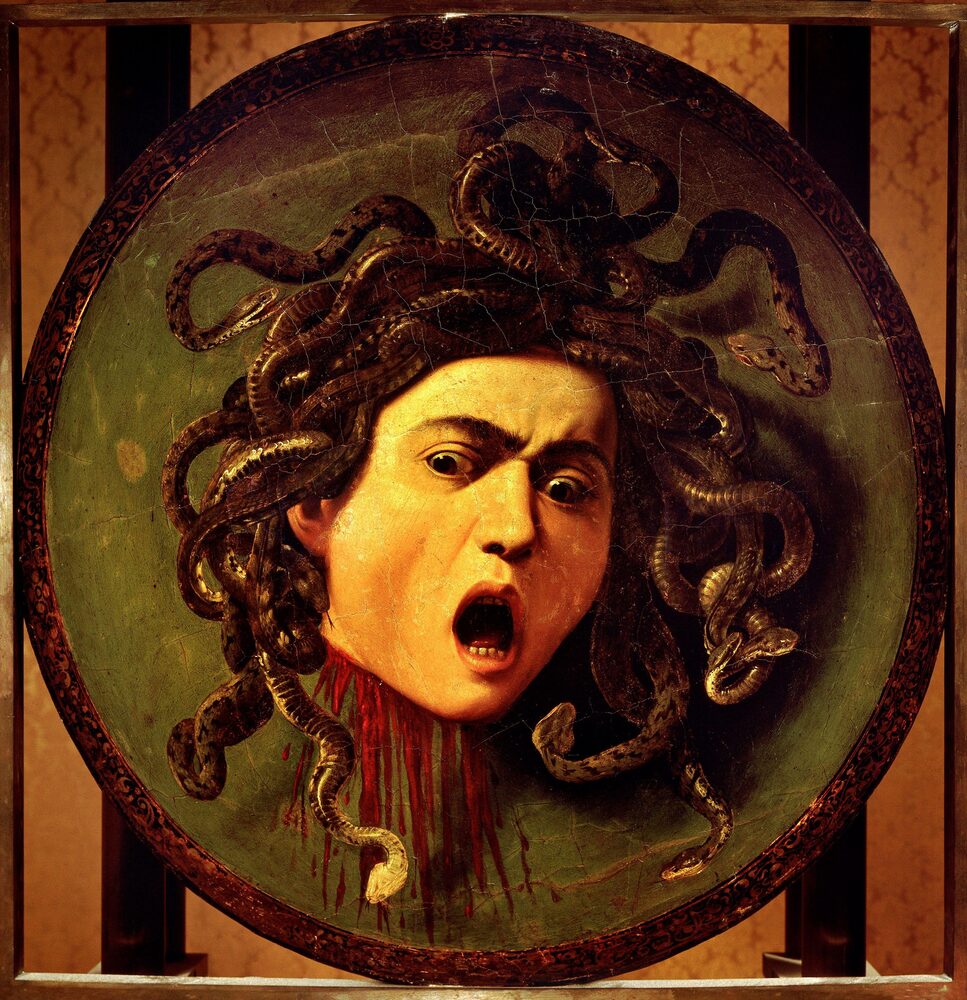
Medusa has been irresistible to artists precisely because she concentrates so much — beauty and horror, death and generation — into a single face. Benvenuto Cellini cast the great bronze Perseus with the Head of Medusa (1554) that still stands in the Loggia dei Lanzi in Florence. Caravaggio painted her severed, screaming head onto a ceremonial shield (c. 1597, now in the Uffizi), catching the instant of the killing stroke. Peter Paul Rubens, Arnold Böcklin, and Gian Lorenzo Bernini each gave her their own treatment, and the Medusa Rondanini type — the beautiful, sorrowing Gorgon — became the model for countless neoclassical cameos and reliefs. In every age she is a test-piece: to render Medusa is to render the impossible knot of the terrifying and the beautiful at once.
The monster reclaimed
In modern thought Medusa has been taken up and re-read, especially through the lens of Ovid's version, in which she is a victim punished for a wrong done to her. Sigmund Freud's brief essay Das Medusenhaupt ("Medusa's Head," 1922) read the snaky severed head as an image of male terror. Far more influential has been the feminist reclamation: Hélène Cixous's landmark essay The Laugh of the Medusa (1975) turned her from an object of dread into a figure of women's speech and power — "you only have to look at the Medusa straight on to see her. And she's not deadly. She's beautiful and she's laughing." In the same spirit, Luciano Garbati's sculpture Medusa with the Head of Perseus (2008), installed opposite a New York courthouse in 2020, was embraced as a #MeToo emblem — the wronged woman holding the head of her attacker, the ancient story of victim and monster deliberately turned inside out. Medusa today is thus honoured in a way no cult ever offered her: not feared as a monster, but read as a survivor, and set at the centre of arguments about beauty, rage, power, and who gets to tell whose story.
Epithets & Cult Titles
- Gorgṓ (Γοργώ) — The Grim One, the Terrible — from gorgos, 'fierce, grim, dreadful'; the singular name of the Gorgon, of which Medusa is the most famous of three sisters, and the root of the emblem called the gorgoneion
- euparēos (εὐπάρῃος) — 'Fair-cheeked' — the striking epithet Pindar gives her (Pythian 12.16), a hint even in early tradition of a beauty behind the horror, later seized upon by Ovid
- hē thnētē (ἡ θνητή) — 'the mortal one' — The descriptive title that sets her apart from her sisters Stheno and Euryale: alone of the three Gorgons Medusa was mortal, and so alone could be killed (Hesiod, Theogony 277–278)
- Gorgṓpis / the Gorgon-faced — A descriptive title drawn from her defining feature — the face (ōps) that turned the living to stone; the same element gives the apotropaic 'Gorgon-eyed' quality later fixed to Athena and to shields
Sources & Variants
- Hesiod, Theogony 270–283 (the three Gorgons as daughters of Phorcys and Ceto; Medusa alone mortal; her union with Poseidon; the birth of Pegasus and Chrysaor from her severed neck)
- Homer, Iliad 5.741 (the Gorgon-head on Athena's aegis) and 11.36–37 (on Agamemnon's shield); Odyssey 11.634 (the Gorgon-head as a terror of the underworld)
- Pindar, Pythian 12.6–24 (Perseus and the slaying; 'fair-cheeked Medusa'; the flute-tune born of the immortal Gorgons' lament)
- Apollodorus, Bibliotheca 2.4.2–3 (description of the Gorgons — serpent scales, boar's tusks, bronze hands, golden wings, the petrifying gaze; the beheading) and 3.10.3 (Athena's gift of Medusa's blood to Asclepius, the killing left and the raising right)
- Euripides, Ion 999–1009 (the two-natured blood of the Gorgon, one drop deadly, one drop healing)
- Ovid, Metamorphoses 4.740–803 (Roman variant — Medusa as a once-beautiful maiden, the assault by Neptune in Minerva's temple, her hair turned to snakes; the birth of coral) — later Roman retelling, flagged as such
- Pausanias, Description of Greece 2.21.5–6 (rationalised Argive traditions about Medusa) and 3.17.3
- Hélène Cixous, 'The Laugh of the Medusa' (Le Rire de la Méduse, 1975) — the central modern feminist reading — with Sigmund Freud, 'Medusa's Head' (1922), as the earlier psychoanalytic reception
Gallery