Scylla
First Appearance
Scylla and Charybdis first appear together in Homer's Odyssey, in the sailing-directions the witch Circe gives Odysseus before he leaves her island (12.73–126). She describes two rocks that guard a narrow strait: in the higher, sunless cliff lurks Scylla, a barking horror with twelve dangling feet, six long necks and six heads, each mouth triple-rowed with teeth, who leans from her cave to snatch dolphins, sea-dogs, and men from passing ships; beneath the lower rock, under a great wild fig tree, Charybdis three times a day sucks the black water down and three times belches it up, so that no ship caught in her gulp survives. Circe's grim counsel is to hug Scylla's cliff and lose six men rather than steer for Charybdis and lose them all — and at 12.234–259 Odysseus does exactly that, watching six of his crew torn shrieking from the deck, "the most pitiful thing," he says, that his eyes beheld in all his wanderings.
— Homer, Odyssey 12.73–126 (Circe's warning) and 12.234–259 (the passage of the strait)
Who They Are
Scylla (SIL-uh) and Charybdis (kuh-RIB-dis) are the twin terrors of a single narrow strait — the most famous "death on either hand" in all of Greek myth, a passage so deadly that to steer clear of one monster is to fall to the other. They are not gods to be worshipped but perils to be survived, and the Greeks placed them at the seam of the known world, in the churning water between Italy and Sicily where the currents run strange and hard. To pass between them is the sailor's nightmare made into geography: a beast on the cliff and a maw in the sea, and a channel too narrow to avoid both.
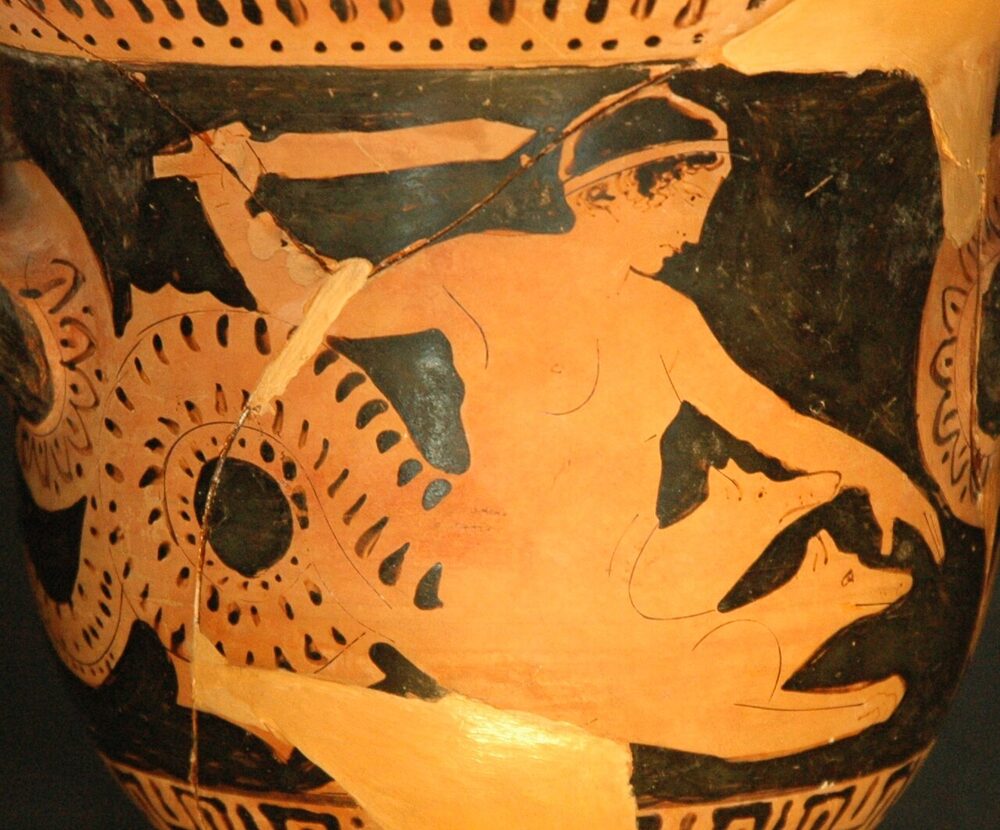
Scylla is the six-headed cliff-monster. Homer gives her twelve misshapen feet dangling from her lair, six impossibly long necks, and on each a head grinning with three tight rows of teeth; later art and poetry girdle her waist with a ring of baying dog-heads and end her body in serpent- or fish-tails, so that the whole creature is part maiden, part hound, part sea-snake. She lives high in a sunless cave in the rock, drawing back so far inside that no spear can reach her, and leans out to fish for prey — dolphins, sea-dogs, and above all the men of passing ships, six at a time, one snatched for each ravening head. Her voice, in a cruel joke Homer builds into her very name, is only the thin yelp of a new-born puppy.
Charybdis is her opposite in every sense: not a body but an appetite, a vast whirlpool beneath the facing rock who swallows the sea itself. Three times each day she gulps the black water down to the bare sand and three times spews it roaring back, and any hull caught over her when she draws breath is dragged to the bottom whole. Between the two — the monster you can lose a few men to and the abyss that takes everyone — lies the terrible arithmetic that gives their names their long afterlife: to be caught "between Scylla and Charybdis" is to be trapped between two dooms with no safe course between, the ancient sailor's version of "between a rock and a hard place."
Mythology
The strait and the two rocks
Everything about Scylla and Charybdis is a matter of place. Homer sets them at a strait so narrow that a man could shout across it (Odyssey 12.101), guarded by two crags. The taller rock rises sheer and smooth, its peak lost in dark cloud that never clears summer or winter, and no mortal could climb it "not if he had twenty hands and feet" (12.73–84); halfway up its face, turned toward the gloom of Erebus, opens the misty cave where Scylla lairs. The lower rock stands a bowshot off, and on it grows a great leafy wild fig tree; beneath that tree, Charybdis sucks the dark water down. The passage between is so tight that the two perils face each other across it, and a ship must run one gauntlet or the other — there is no clean middle way.
Later writers fixed this mythic strait to a real one: the Strait of Messina, the swift, treacherous channel between the toe of Italy (Calabria) and Sicily. Scylla was localised on the Italian side, at the promontory and town that still bears the name Scilla; Charybdis was placed opposite, in the whirling water off Cape Pelorus near Messina, where the meeting of two tides genuinely churns the sea into eddies. The monsters, in this reading, are the strait's real dangers — rock and current — given faces and hungers.
Scylla the monster
Homer's description (Odyssey 12.85–100) is precise and horrible. Scylla has twelve feet, all dangling and deformed, and six very long necks, and on each neck a ghastly head whose mouth holds three rows of crowded teeth, thick with black death. From the waist down she is sunk in the hollow of the cave; only the heads reach out into the open, fishing the rock-face below for dolphins and sea-dogs and whatever larger prey the loud-groaning sea may feed her. No sailors, Homer says, have ever passed her cliff unhurt: with each head she snatches one man from a dark-prowed ship. And in a stroke that has fascinated readers ever since, he tells us her voice is tiny — the yelp of a new-born puppy (skylax, σκύλαξ) — a small sound folded into her very name for so vast a horror.
Later tradition elaborated her form. Virgil (Aeneid 3.424–428) gives the fullest composite: a maiden's face and fair breast down to the waist, and below "a sea-beast's monstrous body, dolphins' tails joined to a belly of wolves." From this comes her enduring image in art — a beautiful woman above, a girdle of savage dog-heads baying around her middle, and a coiling fish- or serpent-tail below. Whether the dogs are literal heads sprouting from her waist or the "wolves' bellies" Virgil describes, the picture is the same: a creature stitched together from woman, hound, and sea-snake, whose upper beauty makes the lower monstrousness worse.
Charybdis the whirlpool
Charybdis is barely a body at all. Homer (Odyssey 12.101–107) makes her pure motion: three times a day she draws the sea down into herself and three times hurls it back up, and when she swallows, the water boils and roars and the rock bellows around her, and the sea-floor shows black with sand at the bottom of the funnel. Pale terror seizes any crew that sees it. Where Scylla takes a fixed toll — six men, no more — Charybdis is all-or-nothing: escape her breath and you pass free; be over her when she gulps and the whole ship goes down. She is the abyss to Scylla's teeth.
Her origin is told only in later, scholiastic tradition (a note on Homer, and Servius on the Aeneid): Charybdis was once a daughter of Poseidon and Gaia, a creature of monstrous greed who stole the cattle of Heracles (the herds he had driven from Geryon) and devoured them, until Zeus struck her with a thunderbolt and cast her into the sea, where her endless hunger became the whirlpool that swallows and vomits the tide forever. Because she has no shrine, no worshippers, and — in the older sources — no parents named at all, the Golden Thread keeps her wholly here in the prose beside Scylla, rather than in the family-tree of the gods.
The debated birth of Scylla
(Content note: her parentage is one of the most tangled in myth; the sources flatly disagree.) Homer names only her mother, Crataeis (Κράταιις, "the mighty one"), and Circe urges Odysseus to pray to Crataeis for mercy that Scylla strike but once (Odyssey 12.124–126); no father is given. Apollonius of Rhodes (Argonautica 4.828–829) makes her the child of Phorcys — the old sea-god of the deep's dangers — and of "night-wandering Hecate, whom men call Crataeis," identifying the shadowy mother with the goddess of witchcraft. Other traditions call her a daughter of Phorcys and Ceto, the sea's mother of monsters; Hyginus (Fabulae, Preface and 151) instead files her among the fearsome brood of Typhon and Echidna, alongside Cerberus, the Chimaera, and the Hydra; still others make her a daughter of Triton or of the river Crataeis. Because the sources cannot be reconciled, the tree here uses only the well-attested father Phorcys, and leaves the rest of the quarrel to this paragraph. What the traditions share is a sense that she is born of the sea's oldest and darkest powers.
The famous origin: Glaucus, Circe, and the poisoned pool
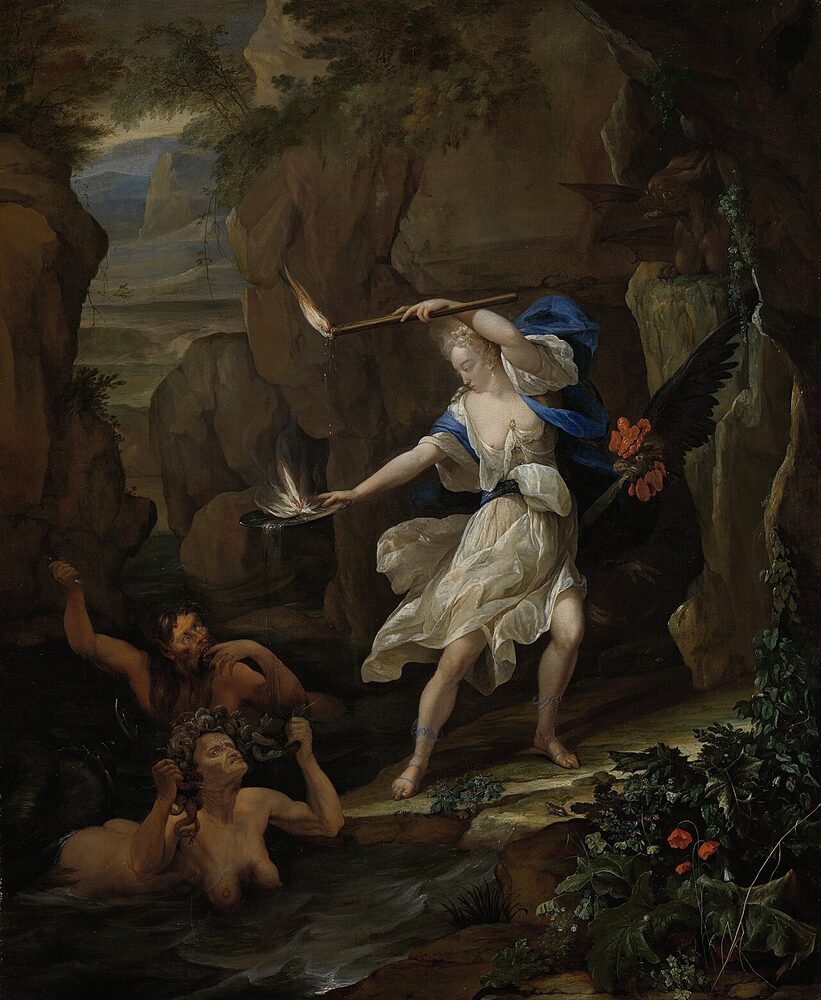
The most beloved story of how Scylla became a monster is late — Roman, from Ovid (Metamorphoses 13.730–14.74) — and should be read as the poet's brilliant elaboration rather than early myth. In it, Scylla begins as a beautiful nymph who plays along the Sicilian shore and scorns every suitor. The sea-god Glaucus — himself once a mortal fisherman transformed into a green merman — falls hopelessly in love with her, and when she flees him, he goes to the witch Circe to beg for a charm to win her. But Circe conceives a violent passion for Glaucus, and when he refuses her, declaring he will love Scylla though the sea run dry, the spurned enchantress turns her fury on the innocent girl. She poisons the still pool where Scylla loves to bathe, steeping it with the juices of dreadful roots and chanting a dark spell three times nine times over. When Scylla wades in waist-deep, the water around her hips erupts into a ring of snarling, yelping dogs; she flinches and flees, not knowing at first that the baying hounds are now part of her own body, sprung where her thighs and feet had been. So the lovely nymph is fixed forever as the barking horror of the rock — Circe's jealousy made flesh — while Glaucus weeps and turns from the witch who used her herbs so cruelly.
Odysseus and the forced choice
The most famous passage of the strait is Odysseus' — his story is told on his own page. Warned by Circe, he faces the arithmetic she set him: better to lose six men to Scylla than the whole ship to Charybdis. Steering close under Scylla's cliff to keep clear of the deadly whirlpool, he watches in helpless horror as the six heads dart down and each snatches a comrade from the deck; the men are hauled up screaming, calling his name, reaching for him, and are eaten in the mouth of the cave — "the most pitiful sight," he says, of all his wanderings (Odyssey 12.234–259). He keeps his ship, at the price of six lives, exactly as Circe foretold.
His second passage is worse. After his surviving crew slaughter the cattle of the Sun and Zeus wrecks the ship, Odysseus is carried back alone toward the strait — and this time straight over Charybdis, just as she gulps the sea down. His makeshift raft is swallowed whole, but he leaps and clings to the wild fig tree overhanging the whirlpool, hanging on "like a bat" through the long hours until, at evening, Charybdis belches up the timbers again; he drops onto the floating keel and paddles clear with his hands (Odyssey 12.426–446). He alone, of all who ever met Charybdis, is spat back out alive.
The Argonauts, guided by Thetis
Jason's ship the Argo had to run the same gauntlet, and the story of its passage is a study in contrast (Apollonius, Argonautica 4.786–832, 4.921–967). Where Odysseus lost six men, the Argonauts lost none — because they had divine help. Hera, who favoured Jason, asked the sea-goddess Thetis to shepherd the ship through, and Thetis and her sister Nereids darted through the water like a line of dolphins, passing the Argo from hand to hand and steering it safe between Scylla's cliff and Charybdis' gulf and past the clashing Wandering Rocks beyond. The two passages, side by side, became a favourite ancient lesson: the same deadly strait costs a wandering man six of his crew and costs the god-guarded hero nothing — for against Scylla and Charybdis, Homer's Circe says plainly, there is no fighting; the only safety is speed and the favour of the gods.
Worship — Ancient
Not a goddess but a danger
Scylla and Charybdis received no cult — there was no temple of Scylla, no altar of Charybdis, no festival in their honour. They belong to the class of pelōr, the monstrous perils of the mythic geography, and the only "worship" they knew was the wary respect of sailors who had to pass their strait. In place of a shrine, the Golden Thread reads their "ancient reception" as the thing itself: the fearsome geography of the strait, and the prayers and precautions of the men who sailed it.
The geography of the strait
From at least the Archaic period, Greek sailors and colonists identified Homer's strait with a real and genuinely dangerous one — the Strait of Messina, between Italy and Sicily, on the sea-road west toward the Greek colonies of Magna Graecia and the trade of the western Mediterranean. Here the tides of the Tyrrhenian and Ionian seas meet in a narrow channel, throwing up sudden eddies, standing waves, and whirlpools, and the currents reverse with the day — conditions that could genuinely founder an ancient oared ship. Scylla was fixed to the rocky Italian headland (the modern Scilla), Charybdis to the whirling water off the Sicilian shore near Messina. The myth, in this light, is a sailor's chart drawn in monsters: the beast is the rock that wrecks you, the maw is the current that drags you down, and the "narrow strait" between them is the real and frightening passage every westbound crew had to make.
The sailor's reception
The nearest thing to cult is the counsel Homer gives through Circe: facing Scylla, one should call aloud on her mother Crataeis to hold the monster back from a second strike (Odyssey 12.124–126) — a propitiatory prayer to the parent of a danger you cannot fight, which is as close as this pair comes to receiving worship. Beyond that, their place in ancient life was as a proverb and a warning. Greek and Roman writers alike used "between Scylla and Charybdis" as the very image of a no-win strait, and the strait itself remained a real hazard of Mediterranean navigation that generations of sailors learned to time, to row hard through, and to fear.
Worship — Modern
A monster's afterlife
Scylla and Charybdis have no worshippers today and never did — but few figures of Greek myth have a larger afterlife in language and imagination. As monsters rather than gods, their "modern reception" is a matter of legacy: they survive not in devotion but in the idiom, the arts, and the sea itself.
The idiom of the impossible choice
Their most enduring monument is a phrase. To be caught "between Scylla and Charybdis" is to be trapped between two dangers where avoiding one throws you onto the other — the classical ancestor of "between a rock and a hard place" and of "the lesser of two evils." The image runs straight through Western literature: the twelfth-century poet Walter of Châtillon coined the tag incidit in Scyllam cupiens vitare Charybdim ("he falls into Scylla trying to avoid Charybdis"); Shakespeare, Milton, and countless writers after them reached for the pair; and the twentieth century made "Scylla and Charybdis" the title of a famous chapter of Joyce's Ulysses — itself a retelling of the Odyssey — and the opening image of The Police's 1983 song "Wrapped Around Your Finger," which begins "caught between the Scylla and Charybdis." The monsters have become a shorthand for the human condition of the forced, unhappy choice.
In art and story
Scylla's grotesque, arresting form — the fair woman above, the ring of dogs and the fishy coils below — made her a favourite of ancient vase-painters, coin-engravers (the city of Akragas struck her image), and mosaicists, and she has kept her hold on artists from Renaissance painters and emblem-books to modern illustration, film, and fantasy. Ovid's tender, cruel tale of the jilted witch and the poisoned pool gave her a tragic inner life that later poets and playwrights returned to again and again; Scylla and Charybdis appear in operas, novels, and screen adaptations of the Odyssey down to the present day.
The strait that keeps their names
And the two of them still guard their strait in fact as well as fable. The town of Scilla stands on Scylla's Calabrian rock; the Strait of Messina still runs its swift, reversing tides; and mariners still speak of the whirlpools off the Sicilian coast. The monsters have dissolved back into the geography that first suggested them — a narrow, beautiful, dangerous stretch of sea between Italy and Sicily that carries their names on the map, so that to sail those waters is, in a quiet way, still to pass between Scylla and Charybdis.
Epithets & Cult Titles
- Σκύλλα (Skylla), 'the yelping one' — Homer plays on her name and the word skylax (σκύλαξ, 'puppy, whelp'): the voice of this vast horror, he says, is no bigger than a new-born puppy's yelp (Odyssey 12.85–86) — the little bark that names the great monster
- the six-headed (ἑξακέφαλος) — A descriptive title drawn from her defining form — six long snaky necks, each ending in a ghastly head set with three close-packed rows of teeth (Odyssey 12.89–92)
- Ausonian Scylla (Σκύλλα Αὐσονίη) — Apollonius' name for her (Argonautica 4.828), fixing her to the Ausonian — that is, the Italian — side of the strait, the western cliff later called Scilla in Calabria
- the Scyllaean rock (Σκύλλαιον) — Her name became the name of her place: the Scyllaean promontory on the strait, so that 'Scylla' at once names the monster and the cliff that sailors feared to pass beneath
Sources & Variants
- Homer, Odyssey 12.73–126 (Circe's warning: the two rocks, Scylla's twelve feet, six necks and heads with three rows of teeth, the puppy-yelp voice, and Charybdis' threefold daily swallowing under the fig tree; the counsel to lose six to Scylla rather than all to Charybdis)
- Homer, Odyssey 12.234–259 (the passage of the strait; Scylla snatches six of Odysseus' men, 'the most pitiful sight' of his wanderings)
- Homer, Odyssey 12.426–446 (the second passage; Odysseus clings to the wild fig tree over Charybdis until she belches up the wreckage)
- Apollonius of Rhodes, Argonautica 4.786–832 and 4.921–967 (Scylla as daughter of Phorcys and Hecate/Crataeis; Hera sends Thetis and the Nereids to steer the Argo safe past Scylla, Charybdis, and the Wandering Rocks)
- Ovid, Metamorphoses 13.730–14.74 (the Roman origin: the nymph Scylla, Glaucus' love, Circe's jealousy, the poisoned pool, and Scylla's transformation into the ring of dogs) — later Roman elaboration
- Virgil, Aeneid 3.410–432 (Helenus' warning to Aeneas: Charybdis' triple gulp and the composite Scylla — maiden above, wolves' bellies and dolphins' tails below); 3.554–569, 3.684–686 (Aeneas skirts the strait)
- Hyginus, Fabulae, Preface and 151 (Scylla among the offspring of Typhon and Echidna); Fabulae 125 (Scylla and Charybdis in the summary of Odysseus' wanderings)
- Apollodorus, Epitome 7.20–23 (Scylla, daughter of Crataeis, and Odysseus' passage; the second passage clinging to the fig tree over Charybdis)
- Servius, on Aeneid 3.420, and scholia on Odyssey 12.104 (the later tradition of Charybdis as a greedy daughter of Poseidon and Gaia, thunderbolted by Zeus into the whirlpool for stealing Heracles' cattle)
Gallery