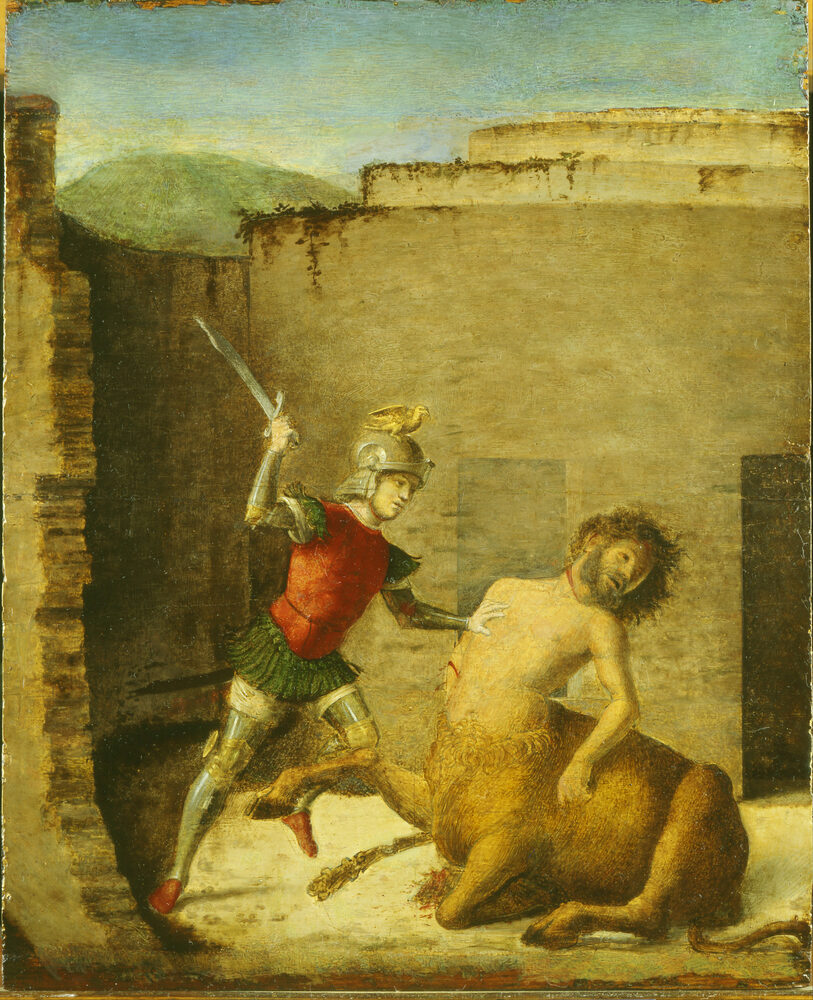
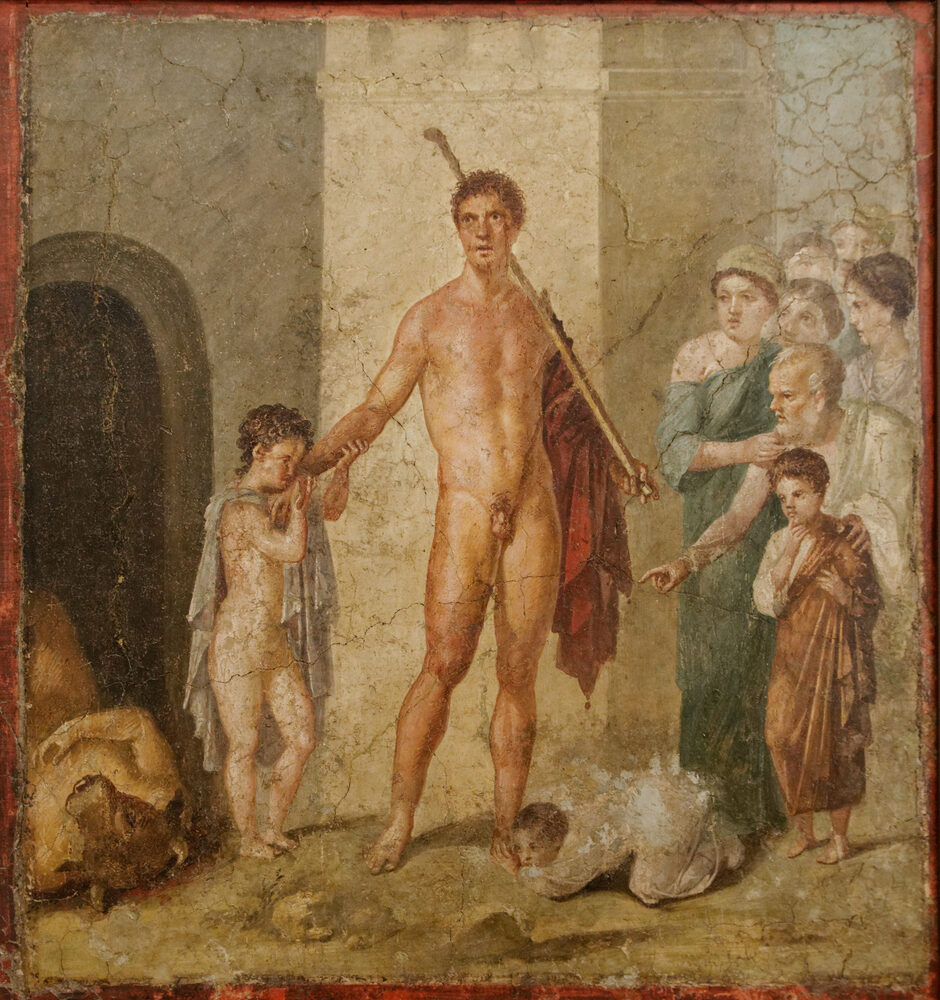
Theseus
First Appearance
Theseus is already an old hero by Homer's day, glimpsed only in passing: the Odyssey's catalogue of the dead names Ariadne, whom "Theseus once tried to carry off from Crete," and later has Odysseus wish he might have seen "Theseus and Peirithous, glorious children of the gods." His deeds were told at length only in later epic and Attic tradition — above all in the lost Theseid, in Bacchylides, and in the full biographies of Plutarch and Apollodorus.
— Homer, Iliad 1.265 (a disputed line) and Odyssey 11.321–325, 631
Who They Are
Theseus (THEE-see-us) is the great hero of Athens, the city's founder-king and the mythical author of its civic order — the Attic answer to the Dorian Heracles, and, like him, a monster-slayer, road-clearer, and bringer of order out of savagery. Where Heracles labours across the whole Greek world for a distant taskmaster, Theseus labours for a city: he clears the roads of the bandits who prey on travellers, he kills the Minotaur that devours Athens' children, and at the last he gathers the scattered towns of Attica into a single polis. He is the hero as statesman, remembered less for raw strength than for the founding of a community.
His parentage is itself a statement of what a hero is. He is the double-fathered son of two fathers at once — of Aegeus, the mortal king of Athens whose sword and sandals he lifts from beneath a rock to claim his birthright, and of Poseidon, the god of the sea and of the earthquake, who lay with his mother the same night and gave him a divine strain to match his royal one. To be at once the son of a king and the son of a god is the very definition of the Greek hero, and Theseus wears both fathers openly: he inherits a throne from the one and, when he must prove himself, calls on the other from the depths of the sea.
Yet his story darkens as it goes, as the stories of Greek heroes do. The young road-clearer who kills the Minotaur and sails home in triumph is the same man who abandons Ariadne on Naxos, forgets to change his black sail and so kills his own father, descends living into the land of the dead on a reckless friend's errand, and brings down his own house in the tragedy of Phaedra and Hippolytus. He ends not enthroned but exiled, murdered on a lonely island — until, centuries later, Athens brought his bones home and made him a god of the city he had founded.
Mythology
Two fathers and the sword beneath the rock
Theseus was born at Troezen, across the Saronic Gulf from Athens, to Aethra, daughter of King Pittheus. His father was Aegeus, king of Athens, who had lain with Aethra while a guest of Pittheus — but on the same night, one tradition holds, Aethra waded to a small island and was visited by Poseidon, so that the child was conceived of a mortal king and the god of the sea together, and belonged to both. This is the paradox the Athenians embraced: Theseus is the son of Aegeus, from whom he takes his throne and his patronymic (Aegeides), and the son of Poseidon, from whom he takes the divine strength that makes him a hero. Before leaving Troezen, Aegeus hid his sword and his sandals beneath a great rock and told Aethra that if the boy could one day move the stone and lift out these tokens, she should send him to Athens as his heir. When Theseus came of age he rolled the rock aside, took up the sword and sandals, and set out to claim his father — choosing, against all advice, the dangerous overland road rather than the safe voyage by sea, precisely so that he might prove himself against the terrors that infested it.
The road to Athens and the clearing of the bandits
The coast road from Troezen to Athens was haunted by murderers, and Theseus dealt with each as each had dealt with travellers — the hero's rough justice of paying a man back in his own coin. He killed Sinis, the "Pine-bender," who bent two pine trees to the ground, bound his victims between them, and released the trees to tear them apart; Theseus destroyed him in the same fashion. He killed Sciron, who sat by the cliffs on the Megarian coast and forced passers-by to wash his feet, then kicked them off the rocks into the sea, where a great turtle waited to devour them; Theseus flung Sciron over the same cliff. And near Eleusis he met Procrustes, the "Stretcher," who offered travellers a bed and made them fit it exactly — racking the short until their joints tore and lopping the tall until they were the bed's length — and Theseus fitted Procrustes to his own murderous bed. Between these he overcame others as well: Periphetes the club-bearer, whose bronze club he took as his own emblem, and Cercyon the wrestler, whom he threw and killed. By the time he reached Athens he had made the road safe, and had announced himself as the new Heracles.
The recognition at Athens and the bull of Marathon
At Athens a danger subtler than any bandit waited. The sorceress Medea, now living with the aged Aegeus, knew by her arts who the young stranger was and feared he would displace her own son; she persuaded Aegeus that the newcomer was a threat and prepared a cup of poison for him at the welcoming feast. But as Theseus drew his sword to carve the meat, Aegeus recognised the blade he had left beneath the rock at Troezen, struck the poisoned cup from his son's hand, and acknowledged him as his heir; Medea fled. To prove himself to the city, Theseus then went out against the Bull of Marathon — the same great bull, once brought from Crete, that had ravaged the plain — captured it alive, and sacrificed it, freeing the countryside of its terror and setting the stage for his greatest deed against a creature that was half bull itself.
Crete, the Minotaur, and the thread
Athens lay under a terrible tribute. Years before, the son of King Minos of Crete had been killed while in Attica, and in vengeance Minos had made war and compelled the city to send, every ninth year (some say every year), seven youths and seven maidens to be shut in the Labyrinth — the vast maze built by Daedalus beneath the palace at Knossos — and devoured by the Minotaur, the bull-headed monster born to Minos's queen. (The Minotaur has his own tale, told elsewhere.) When the tribute came due, Theseus volunteered to go among the victims, vowing to kill the monster and end the tribute forever. At Knossos, Ariadne, daughter of Minos, saw him and loved him; she gave him a ball of thread — the clew — and told him to tie one end at the entrance and unwind it as he went, so that having killed the beast he could follow the thread back out of the inextricable maze. Theseus went into the dark heart of the Labyrinth, found the Minotaur, and killed it with his bare hands or a hidden sword, then wound his way out along Ariadne's thread and freed the surviving Athenians. He fled Crete by night with Ariadne and his rescued companions.
Naxos: the abandoning of Ariadne
On the voyage home the ships put in at the island of Naxos, and there Theseus left Ariadne behind — sailing away while she slept, or setting her ashore and departing without her. The reasons the poets give differ: some say he simply abandoned the woman who had saved him, an act of faithlessness the tradition never quite forgave; others, gentler to the hero, say the god Dionysus claimed Ariadne for his own and commanded or compelled Theseus to give her up. Either way she was left on the shore of Naxos, and there — in the tradition that redeems the story — Dionysus found her, married her, and set her bridal crown among the stars as the constellation Corona. Whatever moved him, the abandonment marks the turn in Theseus's fortunes: the hero who forgets the woman who saved him is about, through another forgetting, to destroy his own father.
The black sails and the death of Aegeus
When Theseus had sailed for Crete, his ship went under black sails of mourning, for its passengers were bound for death. Aegeus had given his son a white sail to carry aboard, and made him promise that if he returned alive he would hoist the white in place of the black, so that his father, watching from the headland, might know from far off that his son still lived. But Theseus — grieving, or forgetful, or (the poets hint) still stricken by the loss of Ariadne — sailed home under the black sail he had forgotten to change. Aegeus, keeping his long watch from the cliffs (some say from the Acropolis, some from the shore at Sunium), saw the black sail on the horizon, believed his son was dead, and in his grief flung himself from the height into the sea — which from that day, the Athenians said, was called the Aegean after him. So Theseus came home victorious to find that his triumph had killed his father, and took up the kingship of Athens over a father's grave.
The founding of Athens: the synoikismos
Theseus's greatest work was not a monster but a city. Attica in his day was a scatter of independent towns, each with its own council and magistrates, often at odds with one another. Theseus dissolved the separate governments and gathered them into a single community centred on Athens — the synoikismos, the "dwelling-together" — establishing one council-chamber and one town-hall for all, so that the many villages became a single polis. He is said to have instituted the festival of the Synoikia to mark the union and the Panathenaea for all Attica together, to have divided the citizens into their orders, and even (the democratic tradition claimed) to have laid down the beginnings of a commonwealth in which he ruled as leader rather than as absolute king. In this founding the Athenians saw the mythical charter of their whole civic life: Theseus was the man who had made them one people.
The descent to the underworld with Pirithous
Theseus's closest friend was Pirithous, king of the Lapiths, and their friendship drew him into his most reckless adventure. The two had sworn to help each other each win a daughter of Zeus for a bride; together they carried off the young Helen for Theseus (later recovered by her brothers), and then Pirithous set his heart on a bride no mortal could take — Persephone herself, the queen of the dead. Bound by their oath, Theseus went down with him living into the underworld to demand her from her husband. Hades received them with a show of hospitality and bade them sit — but the seats were the Chair of Forgetfulness, and the moment they sat their limbs grew fast to the stone and their memories dimmed, so that they could neither rise nor recall why they had come. There they remained fixed and helpless, until Heracles, descending on his own labour to fetch the hound Cerberus, found them; he tore Theseus free from the chair (leaving part of him behind, the Athenians joked, to explain a certain leanness of that stock), but the earth quaked when he reached for Pirithous, and him he was forced to leave forever below. Theseus came back to the light diminished, having overreached the boundary between the living and the dead.
The tragedy of Phaedra and Hippolytus
(Content note: this myth turns on a false accusation of sexual assault, a father's curse, and the violent death of an innocent son.) In his later years Theseus married Phaedra, another daughter of Minos and sister to the Ariadne he had abandoned. But Aphrodite, angered that Theseus's son Hippolytus — born of the Amazon Antiope — scorned love and devoted himself chastely to Artemis and the hunt, afflicted Phaedra with a consuming, unwilling passion for her own stepson. Hippolytus rejected her in horror. In shame and despair Phaedra hanged herself, leaving behind a letter that falsely accused Hippolytus of having assaulted her. Theseus, believing the lie and mad with grief, called down upon his son one of the three curses his divine father Poseidon had granted him. As Hippolytus drove his chariot along the shore, Poseidon sent a monstrous bull from the sea; the horses bolted in terror, the chariot shattered, and the young man was dragged to his death, tangled in the reins. Only as he lay dying, the poets say, did Artemis reveal the truth to Theseus — that he had killed an innocent son on the strength of a lie, by the hand of the very father whose divine gift had proved his ruin.
Exile and the death on Skyros
Theseus's end matched the darkening of his story. In his absence, and amid the resentments his adventures and his rule had bred, Athens turned against him; the demagogue Menestheus stirred the people, and the city that Theseus had founded would no longer have him. Bitter and rejected, he set his curse on the Athenians and sailed away into exile, coming at last to the island of Skyros, where he had ancestral lands and where he trusted in the friendship of its king, Lycomedes. But Lycomedes, whether fearing the great hero or coveting his lands, led him up onto a high place on the pretext of showing him the island — and threw him down from the cliff to his death. So the founder of Athens died murdered and far from home, on a lonely island, with none of the honour his city owed him. It would take almost eight centuries, and the word of an oracle, before the Athenians came to bring him home.
Worship — Ancient
The founder-hero of Athens
Theseus was worshipped not as an Olympian god but as a hero — a mortal of the great age whose bones held power and whose cult was rooted in his tomb and his deeds. To Athens he was the founder-hero above all others, the mythical author of the city's unity and institutions, and his cult carried a powerful civic and patriotic charge. In the fifth century BCE, as Athens grew into the head of an empire and the home of the democracy, Theseus became the city's own hero in a way that set him beside — and pointedly apart from — the Dorian and Panhellenic Heracles. He was pictured on the Athenian treasury at Delphi, on the Painted Stoa, and in temple sculpture, and the cycle of his road-labours was told and retold as Athens' answer to the Twelve Labours of Heracles.
Cimon and the return of the bones
The great moment of his cult came in 476 BCE. The Delphic oracle had bidden the Athenians recover the bones of Theseus and give them honourable burial in the city. The general Cimon, having taken the island of Skyros, searched out and found a grave holding the bones of a man of great size, buried with a bronze spear and a sword; certain these were the remains of Theseus, he brought them home to Athens with great ceremony, the people going out to meet them as if the hero himself were returning alive. The bones were laid in a shrine at the heart of the city, the Theseion, which became both a sanctuary of the hero and a place of asylum for the endangered — for runaway slaves and the oppressed, fitting for the hero who had cleared the roads of tyrants and championed the weak.
The Theseia and the hero's days
The recovered bones were the centre of a reorganised and magnificent festival, the Theseia, held on the eighth of Pyanepsion, with sacrifices, torch-races, athletic and equestrian contests, and a public distribution of meat and porridge to the citizens. The number eight was sacred to Theseus as it was to his father Poseidon, and he received offerings on the eighth of every month. Several of the oldest Athenian festivals were woven into his legend as well — the Pyanepsia with its bean-stew and its eiresione bough, said to recall the meal and the suppliant branch of the returning crew; the Oschophoria, the grape-branch procession to Phaleron with its mingled cries of joy and mourning for the rescue of the youths and the death of Aegeus. In all of these the Athenians renewed their memory of the hero who had made them one city.
Worship — Modern
Honouring Theseus today
Theseus is honoured not as a god but as a hero — one of the mighty dead of the great age, close to mortals because he was once one, and worthy of the reverence owed to a founder and protector. A modern devotee keeps his memory in the way the Greeks kept the memory of their heroes: with a small shrine or a set-apart place bearing a token of him — a sword, a ship, a coil of thread, or a sprig of olive for the city he founded — and with offerings made in gratitude and respect rather than petition to a god. He is a fitting patron for city-dwellers and citizens, for travellers and wayfarers, for the young coming into their strength, and for anyone taking up a hard road on purpose rather than the easy way around.
Offerings
Hero-cult had its own character, distinct from the worship of the Olympians, and a devotee today can echo it simply. Pour a libation — wine, or honey mixed with water, or milk — into a bowl or onto the ground set aside for him, poured downward toward the earth where the heroic dead abide. Offer barley cakes, olive oil, or the first-fruits of a garden; the olive, sacred to his city, is especially apt. Because Theseus is a hero of contest and coming-of-age, an act done in his honour — a race run, a feat attempted, a hard journey undertaken and finished — is as true an offering as anything laid on a shelf.
Memory and reflection
Where the gods are called on for aid, a hero like Theseus is honoured chiefly by remembrance — by keeping and telling his story whole, the triumphs and the failures together. To honour Theseus is to hold in one mind the road-clearer and the man who abandoned Ariadne, the founder of Athens and the father who cursed his innocent son, the youth who chose the dangerous road and the exile murdered on Skyros. His is a story about the making of a city and the cost of a hero's recklessness, and the devotee who remembers him honestly — as the Athenians did, bringing home even the bones of a man their own city had cast out — keeps faith with what the Greeks meant by a hero: not a perfect man, but a great and flawed one whose deeds outlast him.
Epithets & Cult Titles
- Synoikistes — The Unifier (descriptive) — the hero credited with the synoikismos, the gathering of the scattered Attic towns into the single city of Athens
- The second Heracles — A traditional literary tag (descriptive), Plutarch's phrase for the hero who consciously modelled his labours on those of Heracles and became Athens' answer to the Dorian strongman
- Aegeides — Son of Aegeus — the patronymic that names him heir of the Athenian king, even as a second tradition made him son of Poseidon
- Ktistes / Oikistes — Founder (descriptive) — the founder-hero of the Athenian polis, honoured as the ancestral author of its institutions
- Ephebos — The Young Man (descriptive) — patron of the Athenian ephebes, the youths whose coming-of-age his own journey to manhood prefigured
Sources & Variants
- Plutarch, Life of Theseus (the fullest ancient biography: birth at Troezen and the tokens beneath the rock, the road-bandits, the Minotaur and Ariadne, the synoikismos, Phaedra and Hippolytus, the exile and death on Skyros, and Cimon's recovery of the bones)
- Apollodorus, Bibliotheca 3.15.6–3.16.2 and Epitome 1.1–1.24 (Theseus's parentage, the labours of the road, Crete and the Labyrinth, Naxos, the death of Aegeus, the descent with Pirithous, Phaedra and Hippolytus)
- Bacchylides, Ode 17 (Theseus and the ring of Minos — the hero dives into the sea and Poseidon's realm to prove his divine paternity) and Ode 18
- Euripides, Hippolytus (the tragedy of Phaedra, the false accusation, Theseus's curse, and Poseidon's bull from the sea)
- Homer, Odyssey 11.321–325 (Ariadne) and 11.631 (Theseus and Peirithous among the dead)
- Ovid, Metamorphoses 7.404–424 (Medea's attempt to poison Theseus) and 8.152–182 (the Minotaur, Ariadne, and the crown of Naxos) — Roman retellings
- Pausanias, Description of Greece 1.17.2–6 (the Theseion, the recovery of the bones, and the painted deeds of Theseus)
- Diodorus Siculus 4.59–63 (a connected narrative of the deeds of Theseus)
Gallery