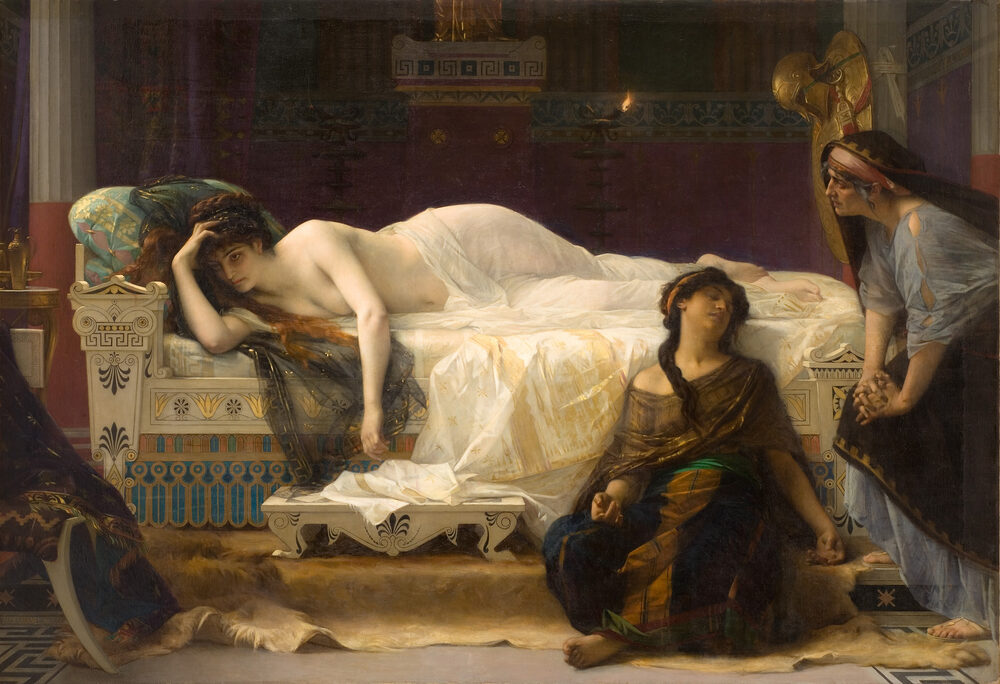
Phaidra
First Appearance
Phaedra's name appears already in Homer: in the catalogue of famous women whose ghosts Odysseus sees in the house of Hades (Odyssey 11.321), "Phaidra and Prokris" are named alongside "fair Ariadne, daughter of baleful Minos" — so the poet sets the two Cretan sisters almost side by side among the dead. But she is scarcely more than a name there. It is the Athenian tragic stage that gave Phaedra her story and her voice: above all Euripides' surviving Hippolytus of 428 BC, where her consuming, shame-stricken, divinely-sent love for her stepson is unfolded with a psychological depth almost without parallel in Greek drama.
— Homer, Odyssey 11.321 (named among the heroines Odysseus sees in the underworld); Euripides, Hippolytus (428 BC) — the central and defining source
Who They Are
Phaedra (FEE-druh) is the Cretan princess who became queen of Athens and whose name Greek tragedy made a byword for love turned to ruin — the wife of the hero Theseus who conceived a consuming, shameful passion for her own stepson, Hippolytus, and whose struggle against that passion destroyed them both. She is counted here among the heroes as a mortal of the great heroic age, a daughter of kings and wife of a king, caught up in a story that the tragedians raised to the height of their art. Hers is not a tale of quest or monster-slaying but of the interior war between desire and shame — and of what happens when a goddess, offended, bends a human heart to her purpose.
She was born into the most famously cursed house of all Greek myth: the royal line of Crete. Her father was Minos, the great king and lawgiver who after death became a judge of the dead; her mother was Pasiphaë, daughter of the Sun, whom Poseidon had afflicted with a monstrous love for a bull — so that Phaedra's own doomed passion for Hippolytus echoes, in a quieter and more human key, the unnatural love that had already shamed her mother and produced the Minotaur. Her sister was Ariadne, who gave Theseus the thread that led him out of the Labyrinth and was then abandoned by him; and it was Theseus, the man who had taken one daughter of Minos and left her, who later took the other to be his wife.
(Content note: Phaedra's story turns on a false accusation of sexual assault and on a suicide, and the ancient sources treat her sometimes with pity and sometimes with blame. This page follows the oldest and fullest telling — Euripides' Hippolytus — which is at pains to show her passion as a sickness sent by a goddess and not a fault freely chosen, and to give her, even in her ruin, a tragic dignity. It keeps to that understanding, and handles the tragedy with the weight the tragedians gave it.)
Mythology
The daughter of the Cretan kings
Phaedra was a princess of Crete, daughter of Minos son of Zeus and of Pasiphaë, the daughter of Helios the Sun (Apollodorus, Bibliotheca 3.1.2; Epitome 1.18–19). Hers was a house marked by strange and terrible loves: her mother Pasiphaë, cursed by a slighted god, had conceived a passion for a bull and borne the Minotaur, the bull-headed monster hidden in the Labyrinth; her sister Ariadne had loved the Athenian hero Theseus, given him the clue of thread by which he killed the Minotaur and escaped the maze, fled Crete with him — and been left behind by him on the island of Naxos. Into this lineage, between the monstrous love of the mother and the betrayed love of the sister, Phaedra was born; and the Greeks who told her story felt the weight of that inheritance pressing on her own.
When, in time, Theseus came to take a lawful wife and queen for Athens, he took Phaedra, the second daughter of Minos — so that the man who had abandoned one Cretan princess married the other. She bore him two sons, Akamas and Demophon, who would themselves become figures of the later Trojan legends. But Theseus had an elder son already: Hippolytus, born to him by an Amazon (named by the sources as Antiope or Hippolyta). It is upon this young man, her husband's son by another woman, that Phaedra's tragedy turns.
Hippolytus and the anger of Aphrodite
Hippolytus was a youth of fierce purity. He scorned the bed and all the works of love, and gave himself wholly to Artemis, the virgin huntress — ranging the woods in the chase, keeping himself chaste, honouring her above all gods and holding Aphrodite, goddess of desire, in open contempt. In Euripides' Hippolytus the goddess herself speaks the play's opening words and declares her anger plainly: because Hippolytus alone of the people of Troizen calls her the vilest of divinities and will have nothing to do with love, she will punish him this very day — and the instrument of her vengeance will be Phaedra. For Aphrodite does not strike Hippolytus directly; she strikes through the heart of an innocent woman, kindling in the stepmother a helpless, consuming love for the stepson, so that the destruction of the one is bought with the ruin of the other. This is the engine of the whole tragedy: a passion sent from heaven, laid on Phaedra not for any fault of hers but to serve a goddess's revenge upon someone else.
The wasting sickness
In the surviving Hippolytus (428 BC), Phaedra's love is from the first a torment she fights with all her strength. She tells no one; she starves herself; she wastes away upon her couch, sick with a malady her household cannot name, longing for death rather than dishonour. Euripides gives her one of the most searching speeches in all Greek drama, on aidōs (shame, the sense of honour) and on the ruin that comes when knowing the good is not enough to do it: she knows her desire is monstrous, she is resolved to die rather than yield to it or shame her husband and children, and her whole effort is to carry her secret silently to the grave. It is her old Nurse who destroys that resolve. Drawing the secret out of her by degrees and horrified by what she hears, the Nurse — meaning, she says, to save her mistress's life — goes behind Phaedra's back to Hippolytus and tells him, first binding him by an oath of silence.
The recoil of Hippolytus, and the false letter
Hippolytus receives the revelation with revulsion and a torrent of rage — a famous, bitter outburst against women and against the whole business of love — though, held by the oath the Nurse extracted, he keeps (just) from betraying the secret aloud. But Phaedra, who overhears him, is now doubly destroyed: her shameful love is known, her honour (as she sees it) is gone, and she cannot bear to live disgraced or to have her sons grow up as the children of a mother so shamed. She resolves on death — but on a death that will take Hippolytus with her and guard her own name. She hangs herself, and leaves behind a writing-tablet, a false letter, bound to her hand, which accuses Hippolytus of having assaulted her — making herself in death the victim rather than the one who loved. In the older, pre-Euripidean shape of the legend the charge was that he had tried to force her; the lie is the same.
The curse and the bull from the sea
Theseus returns to find his wife dead and the letter in her hand. Believing it, maddened with grief and fury, he does not pause to question his son but turns at once to the terrible gift he holds: Poseidon, the sea-god (Theseus's divine father in one tradition), had granted him three wishes, three curses that must be fulfilled. Theseus spends one of them upon his own child, calling on Poseidon to destroy Hippolytus before the day is out. He drives the young man into exile; and as Hippolytus rides his chariot along the shore, a monstrous bull rises from the sea — Poseidon's answer to the curse — and terrifies the horses, which bolt and shatter the chariot and drag their master, tangled in the reins, to his death among the rocks. Only as the broken, dying Hippolytus is carried back does Artemis appear to reveal the truth: that Phaedra's passion was Aphrodite's doing, that the letter was false, that the son was innocent and the father had killed him on a lie. Theseus is left to grieve both wife and son, and father and son are reconciled only at the moment of Hippolytus's death. The goddess Artemis promises Hippolytus lasting honour in cult at Troizen — a grief answered, as so often in tragedy, only after the ruin is complete.
The two versions: the brazen Phaedra and the shame-stricken one
There were two faces of Phaedra on the Athenian stage, and it is worth keeping them apart. Euripides' surviving Hippolytus (the Hippolytos Stephanephoros, "Hippolytus the Garland-Bearer," 428 BC) is the gentler and more sympathetic version: here Phaedra never speaks to Hippolytus at all, struggles nobly against her love, is betrayed by the Nurse, and dies to preserve her honour — a woman more sinned against than sinning. But this was Euripides' second treatment. His first Hippolytus (the Hippolytos Kalyptomenos, "Hippolytus Veiled," now lost) seems to have shown a far more brazen Phaedra who approached Hippolytus directly and propositioned him herself, to the scandal of the Athenian audience — Hippolytus veiling his face in horror at her words is thought to give the lost play its name. Sophocles too wrote a Phaedra (also lost), which likewise appears to have had her make the advance in person. The shameless Phaedra of these earlier plays caused such offence that Euripides, it is generally held, rewrote the story into the nobler surviving version — so that the Phaedra the world remembers, the one who fights her passion and dies of shame, is a deliberate softening of a figure the Athenians first found monstrous. Both Phaedras are genuinely ancient and Greek; the difference between them is one of the clearest windows we have onto how the tragedians reshaped a myth to move an audience.
Phaedra after death
Homer already placed Phaedra among the dead: in the Odyssey (11.321) her ghost is among the famous heroines Odysseus sees in the underworld, named beside her sister Ariadne. The tragedians made her, with Hippolytus, the centre of a story that stood for the ruin love can work when a god wills it — the clear-eyed knowledge of the good that still cannot save us from the evil, the lie told in extremity that destroys the innocent, the father's rash curse that cannot be unspoken. Hers became one of the most retold tragedies of the ancient world, and her name a shorthand for the fatal, forbidden passion of the stepmother.
Worship — Ancient
A heroine of cult at Troizen
Phaedra had no great Panhellenic worship — she was a figure of tragedy, not a goddess — but her memory was kept in local heroic cult at Troizen in the Argolid, the city where her story was set and where Hippolytus himself received an important hero-cult. The traveller Pausanias, who saw the place in the second century AD, records (2.32.1–4) that the grave of Phaedra was shown at Troizen, standing near the tomb and the sanctuary of Hippolytus, so that the two figures of the tragedy lay close together in the sacred landscape of the town. In that same precinct stood a sanctuary of Aphrodite Kataskopia — "Aphrodite the Spy" or "the Peering-Down" — whose strange title the Troizenians explained by the myth: from this spot, they said, the lovesick Phaedra had watched Hippolytus as he exercised and hunted below.
The pierced myrtle
Pausanias also records (2.32.3) a vivid relic of the legend: by the sanctuary of Aphrodite Kataskopia grew a myrtle-tree — the myrtle being sacred to Aphrodite — whose leaves were pierced with small holes. The Troizenians told that Phaedra, in the restless agony of her hidden love, had pricked the leaves one by one with the pin of a brooch or hairpin as she waited and watched, and that the tree bore the marks of her torment ever after. It is a tender, melancholy detail of local cult-memory, turning the great tragedy into a thing one could still see growing by a shrine.
Athens and Hippolytus
At Athens, where Theseus was the national hero, there was also a precinct of Hippolytus below the Acropolis, and Pausanias (1.22.1–2) connects it with the story: he reports that the Athenians knew the tomb of Phaedra near the shrine of Hippolytus. (The famous rite in which maidens before marriage dedicated a lock of their hair to the dead youth belonged not to Athens but to Troezen, Hippolytus's own city — Euripides, Hippolytus 1423–1430; Pausanias 2.32.1.) It was a cult of mourning for the chaste young man destroyed by love, within which Phaedra's name was inevitably remembered as the cause of his death. Her "worship," such as it was, was thus always the shadow-side of the cult of Hippolytus: she was remembered where he was honoured, bound to him in death as in the myth.
On the tragic stage
Above all, Phaedra lived in the theatre. The yearly dramatic festivals of Athens, the Great Dionysia, were themselves acts of worship of Dionysus, and it was there that Euripides' and Sophocles' plays about her were performed before the assembled city. Euripides' surviving Hippolytus won first prize at the Dionysia of 428 BC — a rare victory for that poet — so that the definitive telling of Phaedra's tragedy was crowned in the very religious festival that gave tragedy its being. In this sense her story reached far more Greeks through the sacred theatre than through any altar.
Worship — Modern
A figure to approach with gravity
Phaedra is not a goddess, and she is not a figure one petitions for favour; she is remembered rather as one of the great tragic images of the human heart at war with itself. A thoughtful modern engagement with her treats her story with the weight the tragedians gave it — not as a tale of a wicked stepmother, but as Euripides meant it: the study of a decent woman destroyed by a passion she never chose and fought with all her strength, caught between desire and honour, and ruined by the one lie she told to save her name. She stands, if for anything, for the terrible truth at the centre of her most famous speech — that to know the good is not always to be able to do it — and for compassion toward those undone by compulsions not of their making.
The enduring tragedy
Her afterlife has been immense. The Roman philosopher-playwright Seneca rebuilt the story in his Phaedra, giving us a more openly passionate heroine who confronts Hippolytus directly; through Seneca the tale passed to the modern stage, above all to Jean Racine's Phèdre (1677), one of the summits of French drama, and onward to countless operas, poems, novels, and films down to the present day. The name "Phaedra" has become, in Western culture, the very emblem of forbidden, self-consuming love — so that a story first set beside a myrtle-tree at Troizen is still being retold wherever art looks at the ruin that desire can work. To read or watch her tragedy with attention is the truest form of remembrance she asks.
The light in the name
There is a last, quiet irony worth keeping. Her name, Phaidra, means "the bright one," "the radiant" — a name of shining light, from the same root that names the sun-god's own brilliance. It was a fitting name for a princess of the house of the Sun; it became a bitter one for a woman whose story ends in darkness, shame, and the grave. To hold both at once — the radiance the name promises and the ruin the myth delivers — is to feel the particular pity the Greeks built into her tragedy.
Epithets & Cult Titles
- daughter of Minos (Μίνωος θυγάτηρ) — Her defining lineage — child of Minos, king of Crete, and of Pasiphaë; sister of Ariadne and of the monstrous Minotaur's half-kin, born into the doomed, love-cursed house of the Cretan kings
- wife of Theseus — Her station at Athens — queen beside the great Athenian hero, the second of his wives, married into the royal house she would help to ruin
- stepmother of Hippolytus (μητρυιά) — The relation that becomes her tragedy — the stepmother who conceives a forbidden love for her husband's son; the Greek word mētruiā already carried a shadow of menace, the proverbial dangerous stepmother, which her story deepened into myth
Sources & Variants
- Homer, Odyssey 11.321 (Phaedra's ghost among the famous heroines in the underworld, named beside Ariadne)
- Euripides, Hippolytus (Hippolytos Stephanephoros, 428 BC) — the central surviving source: Aphrodite's prologue and vengeance, Phaedra's shame-stricken struggle, the Nurse's betrayal, Hippolytus's recoil, Phaedra's suicide and false letter, Theseus's curse and the bull from the sea, Artemis's revelation of the truth
- Euripides, Hippolytos Kalyptomenos ('Hippolytus Veiled', first version, now lost) — the earlier, more brazen Phaedra who propositions Hippolytus directly
- Sophocles, Phaedra (lost) — a separate tragedy likewise appearing to show Phaedra making the advance in person
- Apollodorus, Epitome 1.18–19 (Phaedra daughter of Minos, wife of Theseus; her love for Hippolytus, the false accusation, his death by the bull from the sea, and Theseus's curse)
- Pausanias, Description of Greece 2.32.1–4 (the grave of Phaedra at Troizen near the sanctuary of Hippolytus; Aphrodite Kataskopia 'the Peering-Down'; the pierced myrtle-leaves)
- Pausanias, Description of Greece 1.22.1–2 (the Athenian precinct of Hippolytus and the tomb of Phaedra); 2.32.1 (the pre-marriage hair-offering to Hippolytus, a rite of Troezen)
- Seneca, Phaedra (1st century AD) — Roman tragedy, a more openly passionate heroine who confronts Hippolytus directly; the main channel by which the story reached the modern stage
- Ovid, Heroides 4 (Phaedra's verse-letter declaring her love to Hippolytus) — Roman
Gallery