Cheirōn (Chiron)
First Appearance
Chiron enters Greek literature already as the fountainhead of the healing art. In Iliad 4.219 the physician Machaon treats the wounded Menelaus with soothing drugs "which of old Cheiron had given to his father [Asclepius] with kindly thought"; and in Iliad 11.831–832 the hurt Eurypylus begs Patroclus for the healing simples "which men say you learned from Achilles, whom Cheiron taught, the most just of the Centaurs." In his very first appearances he is defined by the two things that mark him ever after — his justice, alone among the centaurs, and his knowledge of medicine, which he passes down to the heroes.
— Homer, Iliad 4.219 and 11.831–832
Who They Are
Chiron (KY-ron; Greek Χείρων, Cheirōn) is the great exception among the centaurs — and to understand him at all, you have to hold him against them. The centaurs as a race are creatures of pure appetite: half-man and half-horse, wild, drunken, and lawless, given to violence and to seizing women, the very image of what happens when the animal in a nature is not governed by the man. Chiron is their opposite in every respect. He is wise, just, gentle, immortal, and civilized — a physician, a musician, a prophet, and above all the teacher to whom gods and kings sent their sons to be raised. Where the centaurs destroy, Chiron builds; where they are ruled by their bellies, he is master of every art. The Greeks felt the contrast so sharply that they gave him a different birth altogether.
For Chiron is not descended from the same stock as the other centaurs. The wild herd sprang from Ixion and a cloud; Chiron was born of the Titan Cronus and the Oceanid nymph Philyra — Cronus having taken the form of a horse to lie with her, which is why her child came out with a horse's body. That parentage makes Chiron a son of a Titan and a half-brother of Zeus himself, a being of an entirely older and higher order than the rabble he is grouped with by shape alone. He is immortal from birth, and his cave high on Mount Pelion in Thessaly is not a lair but a school, the place where the healing art and the education of heroes are imagined to begin.
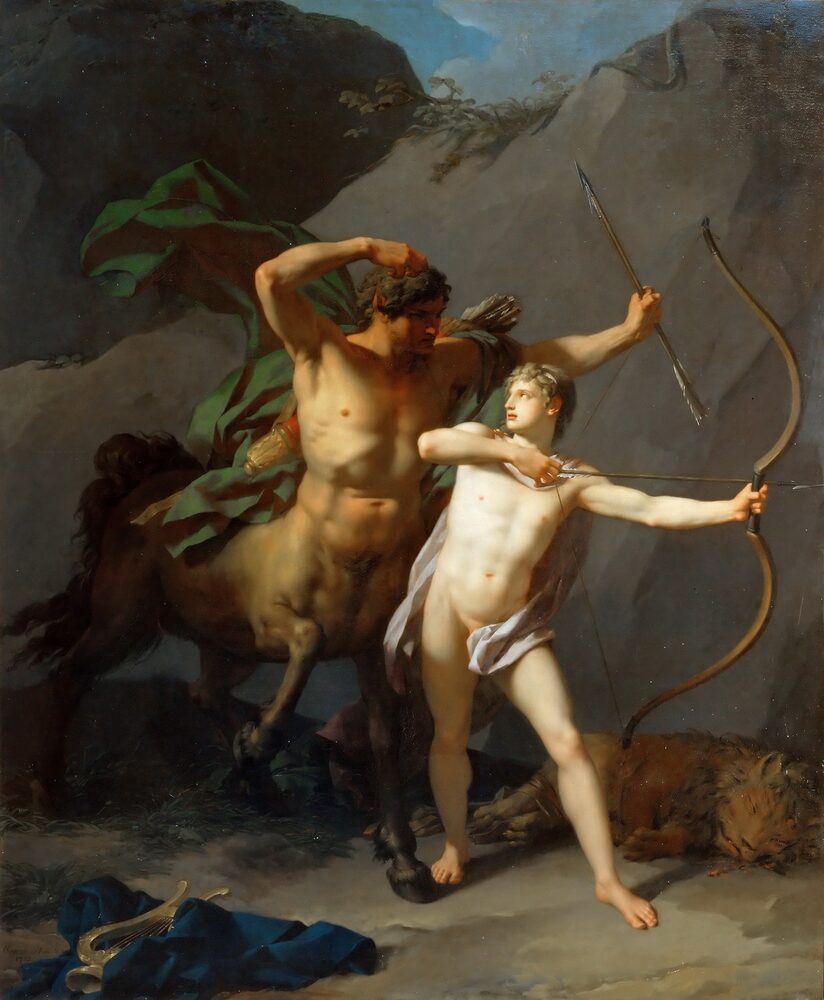
His pupils are a roll-call of the heroic age — Asclepius, who became the god of medicine; Jason, who led the Argonauts; Achilles, the greatest of the warriors at Troy — and through them Chiron stands quietly at the root of nearly every major myth. His own story ends in one of the most moving paradoxes in all of Greek legend: the immortal healer, accidentally wounded by a poisoned arrow that no medicine of his could cure, choosing at last to lay down the deathlessness that had become a torment, and passing into death and into the stars. He is the teacher of the heroes who himself could find no cure — the physician who could not heal his own wound.
Mythology
Two kinds of centaur: the wild herd and the wise exception
The Greeks told two quite separate origins for the horse-men, and kept them carefully apart. The ordinary centaurs (Kentauroi) were born of an act of violence and delusion. Ixion, king of the Lapiths, was purified by Zeus and brought up to Olympus, and there he repaid the kindness by lusting after Hera herself. Zeus, to test and trap him, shaped a cloud, Nephele, into Hera's exact likeness; Ixion embraced the phantom, and from that union of a mortal's crime and a cloud was born Centaurus, a misshapen thing, who in turn mated with the wild mares of Magnesia to father the whole tribe of centaurs. So the race carried its origin in its nature: born of lust, illusion, and a beast's coupling, they were creatures of appetite — wild, drunken, unable to hold their wine, quick to violence, a standing Greek image of the animal side of man let off its leash. Pindar tells this grim genealogy in his Second Pythian.
Chiron shares their shape and nothing else, because his birth is wholly different — and the poets stress the difference precisely to explain his nobility. He is the son of the Titan Cronus and the beautiful Oceanid Philyra, a daughter of Ocean. Cronus lay with her in the form of a stallion (in some tellings to hide the affair from his wife Rhea, who came upon them and startled him into the horse-shape), and so their child was born of double nature, a man to the waist and a horse below — but a Titan's son, immortal, and heir to none of the wild herd's vices. Apollodorus records the birth plainly (1.2.4): "Cronus in the shape of a horse consorted with Philyra, daughter of Ocean, and therefore begat Chiron, a centaur of double form." This is the single most important fact about him: alone of the centaurs, he is not really one of them at all.
The cave on Pelion and the school of heroes
Chiron lived in a cave high on Mount Pelion, the wooded mountain of Thessaly, with his wife the nymph Chariclo and his daughters, and there he became the teacher of the age. He had mastered every civilized art — medicine and surgery, the knowledge of healing herbs and drugs, music and the lyre, hunting, gymnastics, and the reading of the future — and to his cave the gods and heroes sent their sons to be raised and taught. The list is extraordinary. He fostered Asclepius, whom Apollo entrusted to him as an infant, and taught him the healing craft so completely that the boy grew into the god of medicine himself (Pindar tells this in the Third Pythian). He raised Jason, the future leader of the Argonauts, from boyhood. He took in the young Achilles when the boy's mother left him, and taught him to run and hunt and fight and play the lyre, feeding him (the poets liked to say) on the marrow of lions and boars to make him fierce — Pindar's Third Nemean paints the small Achilles on Pelion, running down stags without hounds. A lost early poem, the Precepts of Chiron (Cheirōnos Hypothēkai), once collected the moral maxims the centaur was imagined to have taught his pupils, wise sayings for a young man's conduct. Chiron is, in a real sense, the shared teacher standing behind the whole heroic generation.
The healer who founded medicine
Above all Chiron was the master of medicine, and the Greeks made him the source from which the whole art flowed down to men. The chain runs through Homer himself: Chiron taught Asclepius, Asclepius taught his sons the battlefield physicians Machaon and Podalirius, and their drugs healed the wounded before Troy (Iliad 4.219). He taught Achilles the same lore, and Achilles passed it to Patroclus (Iliad 11.831–832). The plant centaury (kentaurion) was said by the ancients to bear his name because he had used it as a remedy — Pliny reports the tradition that Chiron discovered its healing power, and that it was with this very herb that he tried, in vain, to treat his own fatal wound. To honour Chiron was, for a Greek physician, to honour the origin of his craft.
The brawl at the wedding of the Lapiths
The wildness of the ordinary centaurs found its most famous expression at a wedding — and the story is told partly to throw Chiron's difference into relief. (Content note: this episode turns on drunken violence and the attempted abduction and rape of women; the account here is frank but not graphic.) Pirithous, king of the Lapiths and himself a kinsman of the centaurs, married Hippodamia, and out of courtesy invited the centaurs to the wedding feast. But the centaurs could not hold their wine. Unused to it, they grew drunk and savage, and at the height of the feast one of them, Eurytion, seized the bride herself, while the others each laid hold of whatever woman or boy was nearest and tried to carry them off. The Lapith men sprang to defend their women, and the hall erupted into the great battle the Greeks called the Centauromachy — Lapiths against centaurs, tables and torches and mixing-bowls turned to weapons, a chaos of stabbing and trampling that Ovid describes at length and with relish (Metamorphoses 12). The Lapiths, with the hero Theseus fighting among them, at last drove the surviving centaurs from Thessaly. The Greeks loved this scene above almost any other and carved it everywhere — on the metopes of the Parthenon, on the west pediment of the Temple of Zeus at Olympia — because to them it meant something plain: it was civilization against savagery, reason against appetite, the ordered human world against the beast that would tear it down. Chiron has no part in the brawl. He is the answer to it.
The wound that would not heal
Chiron's death came, with terrible irony, from the hand of a hero and the venom of a monster, and by pure accident. In the course of his labours Heracles came to the country of the centaurs and was received by the gentle centaur Pholus; but the smell of opened wine drew the wild centaurs down in a rage, and Heracles drove them off with his arrows — the arrows he had dipped in the black, incurable poison of the Hydra's blood. The routed centaurs fled to Chiron's protection, and as Heracles loosed his shafts among them, one arrow passed through the arm of the centaur Elatus and lodged in Chiron's knee (Apollodorus 2.5.4). Heracles ran to him in horror, drew out the shaft, and applied a salve at Chiron's own direction — but against the Hydra's venom no medicine could avail, not even the medicine of the man who had founded medicine. The healer of every wound could not heal his own.
The immortal who chose to die
Now came the paradox that made his story unforgettable. The wound was agony beyond bearing, but Chiron could not die of it, for he was immortal — the deathlessness that was his birthright had become an endless torture. And so he chose to give it up. In the version Apollodorus and others preserve, the Titan Prometheus was at that time bound for having stolen fire, and one condition of his release was that an immortal must consent to die in his place. Chiron, longing for the release that death would bring, offered his own immortality: he laid it down, and Prometheus was freed, and Chiron at last was allowed to die (Apollodorus 2.5.4). It is one of the quiet marvels of Greek myth — the wisest and kindest of all the horse-men, and the teacher of the heroes, ending his deathless life as a deliberate gift, trading eternity for rest and for the freeing of another. Zeus, honouring him, set him among the stars.
Among the stars — with a caution about which star
Chiron was catasterized, placed in the sky as a constellation, and Ovid tells the version most often linked to his name in the Fasti (5.379–414): there the young Achilles is present in the cave, Heracles is Chiron's guest, and it is while the centaur handles the hero's weapons in admiration that a poisoned arrow slips and falls upon his foot — the same venom, Ovid notes, that will one day kill Heracles himself — and dying, Chiron is raised to become the constellation Centaurus. A caution is worth flagging here: the sky holds two centaur-figures, and popular tradition often attaches Chiron's name to Sagittarius, the Archer, as well. Most of the ancient handbooks in fact identify Sagittarius not as Chiron but as Crotus, a bow-inventing companion of the Muses, and reserve Centaurus for Chiron — but the two were confused even in antiquity, and the modern habit of calling Sagittarius "Chiron" is a later blurring of the older distinction.
Worship — Ancient
Not a god of cult, but the founder of an art
Chiron had no temple, no priesthood, and no festival day. He was not worshipped in the way an Olympian was, nor even, in any developed form, in the way a hero was; the honest picture is that his "cult" was really his memory, and that memory lived inside a profession. To the Greek physician, Chiron was the origin of the healing art — the teacher who had trained Asclepius, from whom the whole line of doctors descended. When the medical tradition looked back to its beginnings, it looked to the cave on Pelion. In that sense Chiron was honoured continuously, not with sacrifice but with the practice of the craft he was believed to have founded, every time a physician mixed a drug or dressed a wound in the tradition traced back to him.
Mount Pelion and the herb-lore of Thessaly
His memory was rooted in a real landscape. Mount Pelion in Thessaly, thick with medicinal plants, was remembered as Chiron's mountain, and its reputation for healing herbs kept his name attached to the place. The herb centaury carried his name into every physician's pharmacopeia, the ancients repeating that it was Chiron who first discovered its powers. This is the true shape of his ancient reception: not an altar to be petitioned, but a mountain, a plant, and a body of herb-lore and healing knowledge that the Greeks believed had come down from him — the founder-figure of medicine remembered through the medicine itself.
A hero's reception in reflected honour
Where Chiron received any observance resembling hero-cult, it came in the reflected light of the greater figures bound to him — the healing god Asclepius, whose sanctuaries at Epidaurus and elsewhere drew the sick from all over the Greek world, and who owed his art to Chiron's teaching. To trace Asclepius back was to arrive at Chiron, and the reverence paid to the healing tradition carried something of its master with it. But the honest reframing is this: Chiron's standing in Greek religion was that of a benevolent culture-hero, the civilized source of an art, honoured in memory and in practice rather than in any cult of his own.
Worship — Modern
A teacher remembered, not a god revived
Chiron was never an object of Olympian cult, and modern Hellenic practice keeps him in the same honest register the ancients did: not a deity to petition, but a revered figure of wisdom, healing, and teaching whose memory is kept. A person drawn to him today might honour him as a patron of the healing professions, of mentorship, and of the patient teaching of the young — pouring out a simple libation of wine to the earth in his memory, or keeping his story, in the way the ancients believed a benevolent hero most wished to be remembered. Because his myth turns on gentleness, on the giving of knowledge, and on the laying-down of his own life for another's freedom, acts of care, teaching, and self-giving sit naturally as a living tribute to him.
In the sky and in the language of medicine
Chiron's clearest survivals are the ones the ancients themselves gave him. He stands in the southern sky as the constellation Centaurus — home to Alpha Centauri, the nearest star system to our own — and his name is popularly (if, strictly, by a later confusion) attached to the zodiac's Sagittarius, the Archer as well. In 1977 astronomers discovered a small icy body orbiting between Saturn and Uranus and named it 2060 Chiron; it gave its name to a whole new class of solar-system objects, the "centaurs," bodies that cross the orbits of the giant planets — a fitting modern echo of a creature who belonged fully to no single world. And his name lives, quietly, every time we speak of a surgeon: the Greek kheirourgos, "one who works with the hand," carries the same kheir that the Greeks heard in Cheirōn, binding the wise centaur to the healing craft he was said to have founded.
Legacy in story
Beyond sky and etymology, Chiron endures as one of the most beloved figures of the myths — the good teacher at the heart of the heroic age, the gentle immortal who chose death, the wounded healer who could not heal himself. That last image, the physician undone by an incurable hurt, has resonated far beyond mythology into psychology and literature, where the "wounded healer" became a lasting way of describing those whose own suffering equips them to help others. From Renaissance painting to modern fantasy, Chiron remains the archetype of the wise mentor — the one who trains the hero and sends him out, and asks nothing for himself.
Epithets & Cult Titles
- Cheiron (Χείρων) — His own name, from kheir ('hand') — heard by the Greeks as the sign of the skilled and healing hand; the same root gives kheirourgos ('worker by hand'), the ancestor of the word 'surgeon,' tying him to the craft of medicine he was said to have founded
- the most just of the Centaurs (dikaiotatos Kentaurōn, δικαιότατος Κενταύρων) — Homer's own phrase for him (Iliad 11.832), setting him apart from the lawless herd of his kind — the one centaur defined by justice rather than appetite
- the wisest of the Centaurs — A descriptive title for the teacher whose cave on Pelion was a school for heroes — master of medicine, music, hunting, gymnastics, and prophecy, and instructor of Asclepius, Jason, and Achilles
- the kindly centaur — The gentle, hospitable Chiron of the poets — foster-father and host, who took in the children of gods and kings and raised them; the opposite in temper of the wine-maddened centaurs of the Lapith brawl
- tutor of heroes — A descriptive title for his defining role: the teacher to whom the great heroes were sent as boys, the shared master at the root of the whole heroic age
Sources & Variants
- Homer, Iliad 4.218–219 (the healing drugs Chiron gave to Asclepius) and 11.831–832 (Chiron 'the most just of the Centaurs,' teacher of Achilles' healing lore)
- Hesiod, Theogony 1001–1002 (Chiron son of Philyra rearing Medeus); and the lost pseudo-Hesiodic Precepts of Chiron (Cheirōnos Hypothēkai), the maxims he taught his pupils
- Pindar, Pythian 3 (Chiron foster-father of Asclepius, the founding of medicine) and Nemean 3 (the boy Achilles raised in Chiron's cave on Pelion); Pythian 2.21–48 (Ixion, the cloud Nephele, and the birth of the wild centaurs)
- Apollodorus, Bibliotheca 1.2.4 (Cronus in horse-form and Philyra beget Chiron, 'a centaur of double form') and 2.5.4 (Heracles, the centaurs, the arrow through Elatus into Chiron's knee, and Chiron's death after Prometheus takes his immortality)
- Ovid, Fasti 5.379–414 (the death of Chiron by Heracles' fallen poisoned arrow, with the young Achilles present, and his catasterism as the constellation Centaurus) — Roman retelling
- Ovid, Metamorphoses 12.210–535 (the battle of Lapiths and Centaurs at the wedding of Pirithous and Hippodamia, the Centauromachy) — Roman retelling
- Apollonius of Rhodes, Argonautica 1.553–558 (Chiron and Chariclo on Pelion holding up the infant Achilles to wave the Argonauts farewell) and 2.1231–1241 (the birth of Chiron — Cronus as a stallion and the Oceanid Philyra on Philyra's island)
- Pliny, Natural History 25.66 (the herb centaury named for Chiron, who discovered its healing power and used it on his own wound)
Gallery