Hēra
First Appearance
Hera first appears as one of the six children of the Titans Cronus and Rhea — "Hestia, Demeter, and gold-shod Hera" among them — whom Cronus swallowed each in turn as they came from the womb, fearing the prophecy that one of his own offspring would overthrow him. She is thus born into captivity in her father's belly, later disgorged full-grown when Zeus compelled Cronus to give up the children he had devoured. In a second and older strand (Iliad 14.200–204) the infant Hera is spared this fate: Rhea gives her to Oceanus and Tethys at the world's edge, who foster her while Zeus drives Cronus beneath the earth.
— Hesiod, Theogony 453–467
Who They Are
Hera is the queen of the gods and the greatest goddess of the Greek pantheon after none — wife and sister of Zeus, and the divine embodiment of marriage itself. Where Zeus is the sky-king, Hera is the sky-queen: enthroned beside him on Olympus, crowned with the diadem and holding the sceptre, she is Basileia, the sovereign consort whose consent legitimises his rule. But her true and abiding domain is the wedded bond. As Teleia, "the Fulfilled," she presides over the whole arc of a woman's life toward and within marriage; as Zygia she yokes bride to groom; and every Greek wedding was, in a sense, an act of her worship.
Yet the Greeks did not imagine her as a serene matron. Hera is the wronged and furious wife, and much of her mythology turns on her jealousy — a jealousy that is really the outrage of the goddess of legitimate marriage against Zeus's endless infidelities. Her wrath falls not so much on Zeus himself, who is beyond her reach, as on the women he seduces and the children they bear: Io hounded across the earth, Leto barred from any land in which to give birth, and above all Heracles, whose very name ("glory of Hera") marks him as the lifelong object of her hatred. To read Hera's cruelty is to read the anger of the marriage-goddess at a world that will not honour the marriage-tie.
She is, too, an ancient and independent power in her own right, older in cult than many of the Olympians and worshipped in colossal temples long before the classical age. At Argos and at Samos her sanctuaries were among the largest in the Greek world, and the myths told there give her a strange, cyclical dignity: at Argos she bathes each year in a secret spring and is a maiden again; on Samos she was born beneath a willow. Furious, wounded, sovereign, and endlessly renewed, Hera is the queen who will not be set aside.
Mythology
Fostered at the world's edge and won by a cuckoo
Two strands account for Hera's beginning. In Hesiod she is swallowed at birth by Cronus with her siblings and later disgorged; but Homer preserves an older tale in which Rhea, as Zeus was overthrowing Cronus, carried the infant Hera to the ends of the earth and gave her to Oceanus and Tethys, who raised her kindly in their house (Iliad 14.200–204). Her courtship with Zeus is set in the Argolid: as Hera walked alone on Mount Thornax, Zeus raised a storm and turned himself into a bedraggled, shivering cuckoo; the goddess, taking pity, caught the bird and warmed it against her breast beneath her cloak — whereupon Zeus resumed his form. From this the cuckoo perched on Hera's sceptre, and the mountain was renamed Kokkygion, from kokkyx, "cuckoo" (Pausanias 2.17.4, 2.36.1–2). Their union became the divine model of the wedding, the sacred marriage (hieros gamos) claimed and re-enacted by rival sanctuaries — Argos, Samos, and Euboea each insisting the marriage of the god and goddess was theirs.
The jealous queen: Io, Leto, and the persecutions
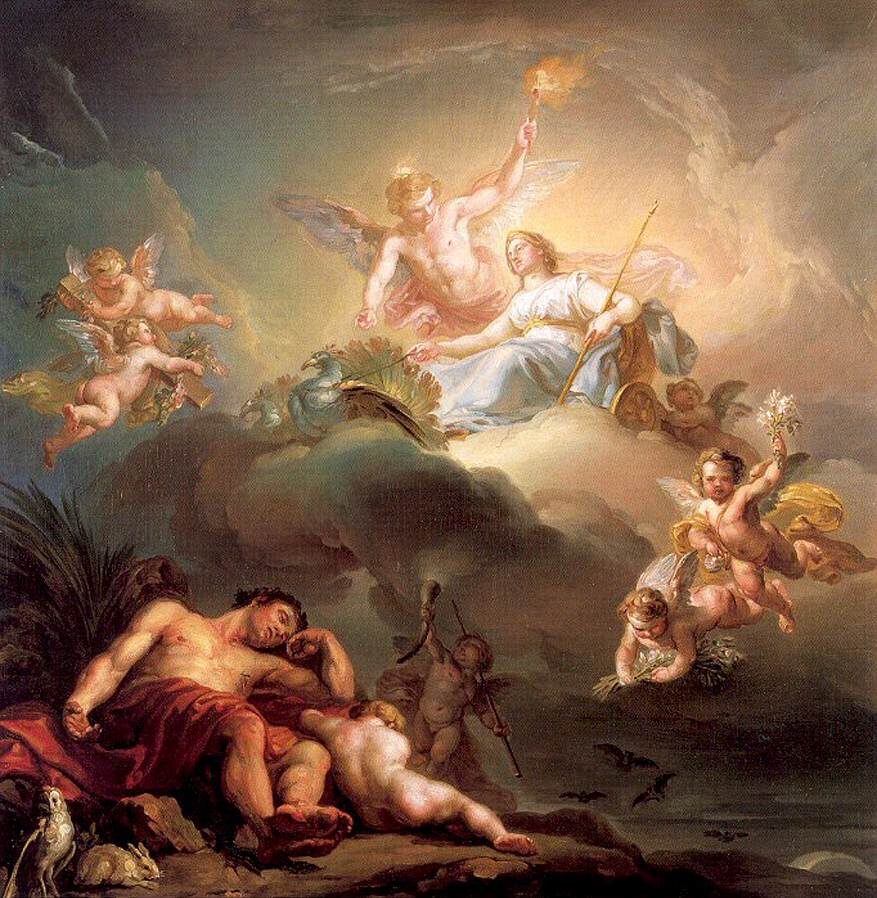
Hera's wrath is the engine of many of the greatest myths. When Zeus loved the Argive priestess Io, Hera's suspicion drove him to hide his mistress by turning her into a white heifer; Hera demanded the heifer as a gift and set the hundred-eyed giant Argus Panoptes, whose eyes never all slept at once, to guard her — until Hermes lulled and slew him — and Hera, in memory of her faithful watchman, set his hundred unsleeping eyes in the tail of the peacock, her sacred bird (a tradition told fully by the Roman poet Ovid, Metamorphoses 1.720–723). She then sent a maddening gadfly to chase Io in torment across the world, from Greece to Egypt (Apollodorus 2.1.3). When Zeus's lover Leto came to term, Hera forbade any land under sun to receive her in her labour and detained Eileithyia, goddess of birth-pangs, so that Leto wandered in agony until the floating island of Delos at last dared to take her. Above all she hated Heracles, son of Zeus by Alcmene: she sent two serpents into his cradle, which the infant strangled; she afterward struck him with the madness in which he killed his own children; and it was through her contrivance that he was bound to serve Eurystheus and perform the Twelve Labours. His name itself — "the glory of Hera" — binds the greatest hero of the Greeks to the goddess who tormented him.
Births without a father: Hephaestus and Typhaon
Twice Hera answered Zeus's own solo act of creation — his birth of Athena from his head — with a defiant parthenogenesis of her own. Enraged that her husband had brought forth a child without her, "without union with Zeus," she conceived and bore Hephaestus alone, the master-craftsman of the gods, greatest in skill of all the sons of heaven (Hesiod, Theogony 927–929). A darker mirror of the same wound appears in the Homeric Hymn to Apollo (305–355): furious at Zeus for the birth of Athena, Hera prayed to Earth and the Titans and struck the ground, and bore by herself the monster Typhaon — a scourge to mortals, "like neither the gods nor men" — which she gave to the she-dragon at Delphi to nurse, until Apollo slew the serpent beside the spring at Pytho. In these paired births Hera is not the passive queen but a primordial mother-power, capable of creating life and monstrosity alike in answer to a husband who would make gods without her.
The Judgement of Paris and the wrath against Troy
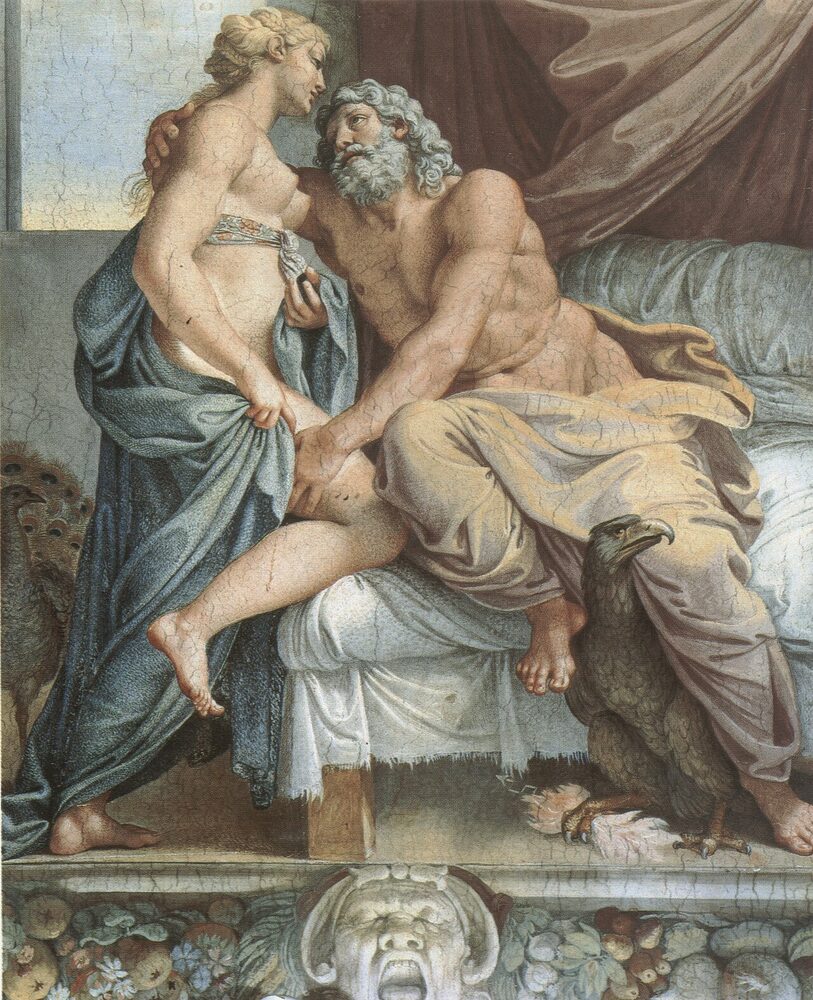
At the wedding of Peleus and Thetis, Strife cast among the goddesses a golden apple inscribed "for the fairest," and Hera, Athena, and Aphrodite each claimed it. Zeus sent them to be judged on Mount Ida by the Trojan prince Paris. Each goddess offered a bribe: Hera promised him kingship over all Asia and the widest dominion; Athena, victory and wisdom in war; Aphrodite, the most beautiful woman in the world. Paris awarded the apple to Aphrodite — and so won Helen, and so brought the ruin of Troy. Hera never forgave the slight. Throughout the Iliad she is the tireless enemy of the Trojans, scheming for their destruction; in one famous episode (the Deception of Zeus, Iliad 14) she borrows Aphrodite's girdle and seduces her husband into sleep so that the Greeks may prevail on the field. Her hatred, born of a beauty-contest, becomes one of the driving forces of the war.
Worship — Ancient
Cult centres
Hera's worship was ancient and monumental, centred on some of the largest sanctuaries in the Greek world. The Heraion of Argos, set between Argos and Mycenae, was her chief mainland shrine — so bound to her that she is Hera Argeia, "of Argos," and the region's history was reckoned by the succession of her priestesses (Pausanias 2.17). The Heraion of Samos, in the marshy plain of the Imbrasos river, claimed to be her very birthplace: she was said to have been born there beneath a lygos (willow / chaste-tree), and her temple was among the first of the colossal Ionic temples of Greece. At Olympia the oldest temple in the sacred grove, the Altis, was hers, not Zeus's — the Doric Heraion standing generations before the great temple of Zeus rose beside it. She had further famous cult at Plataea in Boeotia, at Euboea (a rival claimant of the sacred marriage), and at Sparta, where as Hera Aigophagos she uniquely received goats.
Rites
The central offering to Hera was cattle — cows and heifers, fitting for the "cow-eyed" queen — burnt in the Olympian manner with the thighbones wrapped in fat while the worshippers shared the meat. Her festivals dramatised the stages of the wedded life she governed. At Olympia the Heraia were run every four years: the college of Sixteen Women wove Hera a new robe and organised foot-races for unmarried girls in three age-groups, the winners crowned with olive and given a portion of a cow sacrificed to the goddess (Pausanias 5.16). On Samos the Tonaia bound her ancient wooden image in willow-branches and bathed it in the sea. At Argos her priestess processed to the temple in an ox-cart, and at the nearby spring of Kanathos the goddess was believed to renew her virginity each year in a secret rite — Hera Parthenos, the perpetual bride (Pausanias 2.38.2–3). At Plataea the Daedala re-enacted her reconciliation with Zeus: a wooden bride was bathed, veiled, and drawn in a wedding-wagon, then in the Great Daedala burnt upon Mount Cithaeron (Pausanias 9.3).
Worship — Modern
Honouring Hera today
A modern devotee in the Hellenic revival can give Hera a place with a simple shelf-altar kept clean and dignified, as befits a queen. An image of the goddess crowned and enthroned, a cuckoo or a peacock, a diadem or a spray of willow or pomegranate, and a lamp or candle are enough to mark her presence. Approach her standing, with hands raised toward the sky as to the Olympians, and address her with the respect owed to the sovereign of the gods and the guardian of the marriage-bond. She is especially honoured by married people and by those preparing for marriage, but her queenship and her care for women's lives belong to all who reverence her.
Offerings
In place of the ancient cattle-sacrifice, a household devotee today offers libations and shared food. Pour a libation of wine — or of spring water, milk, or honey — into a bowl set aside for her, and present barley cakes, fruit (the pomegranate is especially hers), flowers such as the lily, olive oil, and incense. A sprig of willow recalls her birth-tree at Samos. Speak a few words of praise and thanks, and afterward pour out or set aside what was given, so that the offering is truly hers.
Prayer & epithets
Call on Hera by the epithet suited to your need. Invoke Hera Teleia, the Fulfilled, and Hera Zygia, of the marriage-yoke, at a wedding or in the keeping of a marriage. Turn to Hera Basileia, the Queen, in matters of dignity, sovereignty, and rightful order. Honour Hera Argeia, throned at her ancient sanctuary, in general reverence for the great goddess. And remember Hera Parthenos, the ever-renewed maiden of Kanathos, as the sign that even the long-wedded queen is made new — a fitting emblem for renewal and fresh beginnings within a lasting bond.
Epithets & Cult Titles
- Teleia — The Fulfilled — Hera of the completed marriage, patroness of the fully wedded woman
- Argeia — Of Argos — the queen enthroned in her great Argive sanctuary
- Boôpis — Cow-eyed, ox-eyed — the Homeric epithet praising her wide, lustrous gaze
- Basileia — Queen — sovereign consort of Zeus and mistress of Olympus
- Zygia — Of the yoke — she who binds bride and groom under the marriage-yoke (also Gamelia, 'of the wedding')
- Parthenos — The Maiden — the Argive Hera who renews her virginity each year bathing at the spring Kanathos
- Aigophagos — Goat-eater — the Spartan Hera whose distinctive rite was the sacrifice of goats
Sources & Variants
- Hesiod, Theogony 453–467 (birth and swallowing by Cronus), 921–923 (marriage to Zeus; Hebe, Ares, Eileithyia), 927–929 (Hephaestus born to Hera alone)
- Homer, Iliad 14.200–207 (fostered by Oceanus and Tethys), 14.153–353 (the Deception of Zeus), 24.25–30 (the Judgement of Paris)
- Homeric Hymn 3 to Apollo 305–355 (Hera bears Typhaon alone and gives him to the Delphic she-dragon)
- Apollodorus, Bibliotheca 2.1.3 (Io, Argus Panoptes, and the gadfly); 2.4.8 and 2.4.12 (the serpents in Heracles' cradle and his madness); Epitome 3.2 (Judgement of Paris)
- Pausanias, Description of Greece 2.17 (Heraion of Argos); 2.36.1–2 (Zeus as cuckoo on Mount Thornax); 2.38.2–3 (Hera's renewed virginity at Kanathos); 5.16 (the Heraia and the Sixteen Women at Olympia); 9.3 (the Daedala at Plataea)
Gallery