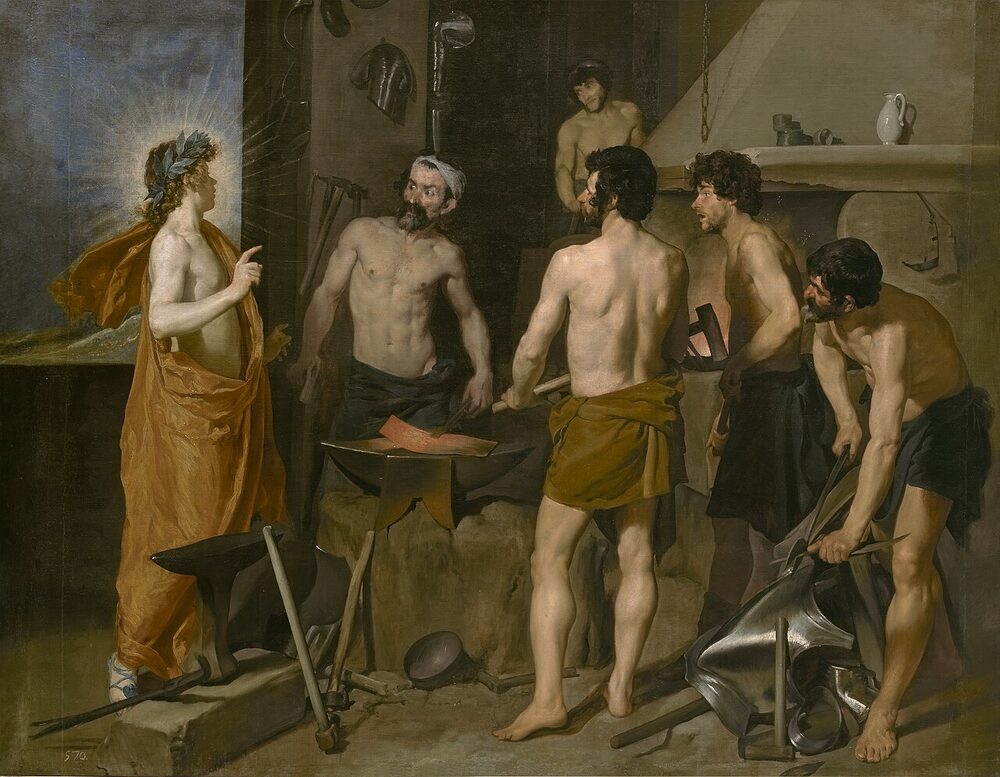
Hephaestus
First Appearance
Hephaestus first appears not as a child of Zeus but as Hera's answer to him. Angry that Zeus had brought forth Athena from his own head without her, Hera conceived and bore Hephaestus alone, "without union in love" with her mate — and he grew to be the most skilled in craft of all the sons of Heaven, the divine smith who would outdo every other god with his hands.
— Hesiod, Theogony 927–929
Who They Are
Hephaestus (huh-FES-tus) is the Greek god of fire, the forge, and craftsmanship — the master smith of Olympus and the only one of the great gods who works with his hands. Where the other Olympians embody beauty, power, or war, Hephaestus embodies skill: the intelligence that shapes raw metal into wonders. Everything of surpassing make in the myths — the thunderbolt-bright armour of heroes, the palaces of the gods, the very sceptre of Zeus — comes in the end from his anvil. He is at once the humblest of the Olympians in station and, in a real sense, the maker of their world.
He is also the god marked by difference. Lame in both feet, cast out of heaven and broken by the fall, laughed at even by his own family, Hephaestus is the outsider among the immortals — and the Greeks did not hide it. His limp, his sweat, and his soot are part of who he is, and his myths turn again and again on the tension between his disfigured body and his matchless craft. That his skill is his answer to his rejection — that the rejected son forges the treasures the gods cannot live without — is the quiet dignity at the centre of his story.
His domain is fire in its useful, transforming aspect: not the wildfire of destruction but the tamed flame of the smithy that turns ore into tools and beauty. So he stands close to civilisation itself. The Homeric Hymn to Hephaestus remembers him, alongside Athena, as the god who taught glorious crafts to men who once lived like beasts in caves, so that now they "live at ease the whole year through." He is the divine artisan who made humanity's arts possible.
Mythology
Born of Hera alone
Hephaestus is Hera's child by parthenogenesis — born of the queen of the gods without a father. Hesiod is explicit: enraged that Zeus had produced Athena from his own head, Hera answered him in kind and bore Hephaestus alone, "without union in love" (Theogony 927–929). He is, in this oldest telling, her son and no one's else. (Homer, by contrast, once names Zeus as his father — the variant this site preserves — but the Hesiodic tradition of the motherless-fathered smith, Hera's solitary work, is the dominant Greek story.)
The fall from Olympus
Two traditions tell how Hephaestus came to be lame, and they disagree on who threw him. In the primary telling, it is his mother: ashamed of a son born imperfect, Hera cast him out of heaven herself, and he fell to the sea, where the Nereid Thetis and the Okeanid Eurynome caught him and hid him in a sea-cave, tending him for nine years while he made them jewellery in secret (Iliad 18.394–405). In the second, briefer tradition, it is Zeus who hurls him: when Hephaestus took his mother's side in a quarrel and tried to free her, Zeus seized him by the foot and flung him from the divine threshold, and he fell a whole day until at sunset he crashed onto the island of Lemnos, barely alive, and was nursed by the Sintians who lived there (Iliad 1.590–594). In both, the fall and the lameness are bound together — the god's broken body is the mark of his casting-out.
The golden throne and the Return of Hephaestus
Hephaestus did not forget being thrown from heaven, and his revenge was a craftsman's revenge. He forged a golden throne of exquisite beauty and sent it to Hera as a gift; but when she sat in it, invisible bonds sprang shut and held her fast, and no god could free her — only the maker knew the trick of the chains. The gods sent for him, and he refused to come. Ares tried to drag him back by force and was driven off by his firebrands. In the end it was Dionysus who succeeded: he made Hephaestus drunk on wine and led him back up to Olympus, slumped on the back of a mule, in a reeling, laughing procession of satyrs. This "Return of Hephaestus," with the tipsy smith on his donkey, was a favourite scene of archaic vase-painters (it fills a whole frieze of the François Vase). Restored to heaven, he freed his mother — reconciliation bought with wit and wine.
The works of the forge
Hephaestus is defined above all by what he makes. The greatest set-piece is the arming of Achilles: at Thetis's plea he abandons his other labours and in a single night hammers out a new panoply, above all the great Shield of Achilles, its five layers worked with the whole cosmos — earth, sky and sea, cities at peace and at war, ploughland and vineyard and dancing-floor — the most famous description of a made thing in all of Greek literature (Iliad 18.368–617). His forge is served by marvels of his own making: golden handmaidens shaped like living girls, with sense and speech and strength in them, who move to support their limping master, and twenty self-moving tripods on golden wheels that roll of themselves into the gathering of the gods and back again (Iliad 18.372–379 and 417–421). At Zeus's command he moulded the first woman, Pandora, shaping her from earth and water into the likeness of a modest maiden for Athena to dress and adorn (Theogony 570–589). The same living craft runs through his other works: for the palace of King Alcinous he wrought watchdogs of gold and silver, immortal and unageing, to stand guard at the doorway for ever (Odyssey 7.91–94), and on Olympus it was he who built the bronze-floored houses of the gods themselves, raising a dwelling for each immortal (Iliad 1.607–608). To him tradition also credits the necklace of Harmonia, and, in some tellings, the bronze giant Talos who guarded the shores of Crete, circling the island and hurling rocks at intruders.
The net, and the war of the giants
Two further stories show his two sides. When the Sun told Hephaestus that his wife Aphrodite lay with Ares, he forged a net of chains finer than spiderweb and invisible, hung it over his own bed, and caught the lovers fast in the act; then he called the gods to come and see, and the immortals stood in the doorway laughing an unquenchable laugh at the trapped pair (Odyssey 8.266–366) — the outsider's revenge, again, worked through craft rather than strength. And in the Gigantomachy, the war of the Olympians against the earthborn Giants, Hephaestus fought with the only weapon truly his: he killed the giant Mimas by pelting him with missiles of red-hot molten metal straight from the forge (Apollodorus 1.6.2).
Worship — Ancient
Lemnos, the smith's island
No place belonged to Hephaestus as Lemnos did. It was here, in the Iliad, that he fell when he was thrown from heaven, and here that his oldest and strongest cult was rooted. The volcanic island — its ancient peak Mosychlos smoking with subterranean fire, its ground yielding the famous medicinal "Lemnian earth" gathered once a year with solemn rite — was a natural home for a fire-god, and one of the earliest metalworking centres of the Aegean. His great city there was Hephaistia, named for him, and dependent on it lay the sanctuary of the Kabeiroi, mysterious daimones of fire and metal counted as his sons, who received secret initiatory rites like those of neighbouring Samothrace. In Lemnian ritual the island's every fire was once a year extinguished and left dead for nine days, then rekindled from new flame brought by ship — a re-enactment, it seems, of the fire-god's own fall and return.
Athens: the Hephaisteion and the craftsmen's festivals
At Athens, city of potters and bronze-workers, Hephaestus was honoured as patron of the crafts and paired with Athena Ergane, "Athena the Worker." His temple, the Hephaisteion, still stands above the Agora on the hill of Kolonos Agoraios — the best-preserved Greek temple anywhere — and held bronze cult-statues of Hephaestus and Athena together; Pausanias saw them and noted Athena's grey eyes and the story of Erichthonius that linked her to the smith (Description of Greece 1.14.6). Two festivals bound the god to the working city: the Hephaisteia, reorganised by decree in 421/0 BCE with sacrifice, contests, and a night-time torch-race in which runners bore living fire through Athens; and the Chalkeia, the old holiday of the smiths and artisans, shared with Athena Ergane, which also opened the weaving of the goddess's sacred robe.
Rites
As an Olympian, Hephaestus received the standard sacrifices — oxen burnt on the altar with libations of wine, barley, and incense — but his worship kept a distinctive flavour drawn from his element. Fire itself was central: the torch-race of the Hephaisteia and the Lemnian rekindling both made living flame the heart of the ritual, honouring the god who first gave men the tamed fire of the forge. His worshippers were, fittingly, the people who worked with their hands — the smiths, foundrymen, and potters whose craft was his gift and whose livelihood he protected.
Worship — Modern
Honouring Hephaestus today
A modern Hellenic devotee can honour Hephaestus wherever things are made. A small shrine — a shelf bearing a hammer or a piece of worked metal, an image of the forge, and above all a lamp or candle for his living fire — gives the god a place. He is well suited to the workshop, the studio, the kitchen, or any space where skill turns raw stuff into something finished, and a maker may simply light his flame before beginning work and dedicate the labour of the hands to him. Cleanliness and honest effort suit him better than grandeur; he was never a god of ceremony but of work.
Offerings
Where the ancients gave burnt sacrifice, a household devotee today most naturally offers fire, drink, and the work itself. Light a candle or lamp for him as the simplest and most fitting gift. Pour a libation of wine — or of water, milk, or honey — and set out barley, olive oil, or incense (frankincense is traditional). Most in his spirit of all is to offer something you have made: the first or best product of your own craft, given with thanks. Present the offering with a few words, and afterward pour out or set aside what was given so that it is truly the god's.
Prayer & epithets
Call on Hephaestus by the epithet that fits the moment. Invoke Hephaestus Klytotechnes, the famed craftsman, at the start of any work of the hands, that the making go well and true. Turn to Hephaestus Chalkeus, the smith, as patron of every trade that shapes metal, wood, stone, or clay. Honour him as Amphigyeeis, the lame god, remembering that skill and worth are not undone by a broken body — his is the quiet patron-godhood of everyone the world has counted less and who answers with what they can make. And light his flame in reverence to Hephaestus the fire-giver, whose tamed fire first raised humankind from the caves.
Epithets & Cult Titles
- Amphigyeeis (Ἀμφιγυήεις) — The lame one, halting on both feet — Homer's standing epithet for the smith who limps at his own forge
- Kyllopodion (Κυλλοποδίων) — Of the crooked foot, the foot-dragging one — Hera's name for him in the Iliad
- Klytotechnes (Κλυτοτέχνης) — Famed craftsman, renowned artificer — the maker whose skill is glorious among gods and men
- Chalkeus (Χαλκεύς) — The bronze-smith, worker in metal — patron and namesake of every coppersmith
- Polymetis (Πολύμητις) — Of many devices, resourceful — a Homeric epithet of his cunning craft (Iliad 21.355), more often given to Odysseus
- Aitnaios (Αἰτναῖος) — Of Etna — a later Sicilian aspect, his forge set beneath the fires of the volcano
Sources & Variants
- Hesiod, Theogony 927–929 (Hera bears Hephaestus alone, without union with Zeus); 570–589 (Hephaestus moulds Pandora at Zeus's command)
- Homer, Iliad 1.571–600 (Hephaestus reconciles his quarrelling parents and pours the wine; recalls Zeus hurling him a whole day to Lemnos, 1.590–594; the houses he built for the gods on Olympus, 1.607–608); 18.368–617 (Thetis in the bronze house, the self-moving tripods 18.372–379 and golden handmaidens 18.417–421, the making of the Shield of Achilles, and his rescue by Thetis and Eurynome after the fall, 18.394–405); 21.355 (the epithet polymetis)
- Homer, Odyssey 7.91–94 (the immortal gold and silver watchdogs Hephaestus made to guard the palace of Alcinous); 8.266–366 (the song of Demodocus: the net over Ares and Aphrodite and the laughter of the gods)
- Homeric Hymn 20 to Hephaestus (with Athena he taught glorious crafts to men who once lived like beasts)
- Apollodorus, Bibliotheca 1.3.5 (birth and the fall from Olympus); 1.6.2 (kills the giant Mimas with red-hot metal in the Gigantomachy)
- Pausanias, Description of Greece 1.14.6 (the Hephaisteion at Athens and the joint cult with Athena)
- IG I³ 82 (the decree of 421/0 BCE reorganising the Hephaisteia, with its torch-race)
Gallery