Perseus
First Appearance
Perseus first appears in early Greek epic as the son of Danaë and of Zeus. Hesiod's Theogony (280–283) tells of the moment the deed is done: when Perseus cut the head from Medusa, the winged horse Pegasus and the warrior Chrysaor sprang from her severed neck. The pseudo-Hesiodic Shield of Heracles (216–237) then describes him in flight, the Gorgon's head in the wallet on his back and the cap of Hades upon him, the shrieking Gorgon-sisters in pursuit. Homer (Iliad 14.319–320) names him simply as the son Zeus fathered on Danaë, "the most renowned of men."
— Hesiod, Theogony 280–283; Shield of Heracles 216–237; Homer, Iliad 14.319–320
Who They Are
Perseus (PUR-see-us) is the eldest and cleanest of the great Greek heroes — the Gorgon-slayer, the rescuer of a chained princess, and the founder of the royal house of Mycenae from which almost every later hero descends. He stands a full generation before Heracles (who is in fact his great-grandson), and he set the pattern all the others would follow: a hero born of a mortal woman and a god, marked from birth by a prophecy, sent on an impossible quest by a treacherous king, and carried through it by the favour of the Olympians and the gifts they lend him.
What sets Perseus apart is that his story is, almost uniquely among the heroes, a story with a happy ending. He is not torn apart by his own excess like Heracles, nor wrecked by hubris like Bellerophon, nor undone by a curse like the house of Thebes. He kills the monster, saves and marries the woman he loves, punishes the men who wronged his mother, and lives to found a city and a dynasty and die old. The Greeks remembered him as the model of the favoured hero — brave, faithful, and lucky in the truest sense, that the gods were with him.
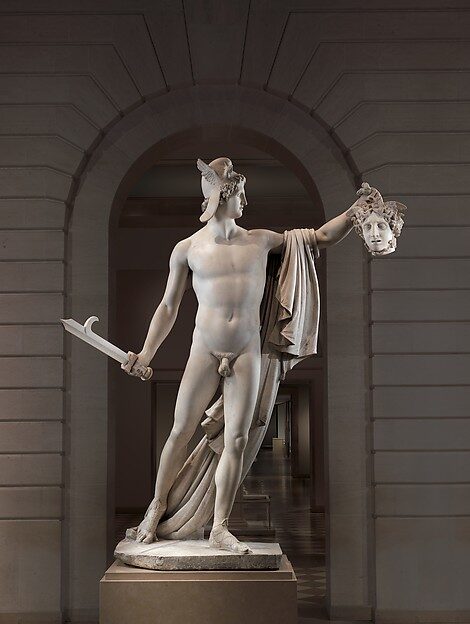
His defining deed gives him his enduring symbol: the severed head of Medusa, whose gaze turns the living to stone even in death. Perseus carries that petrifying head through the second half of his myth as both weapon and warning, and it follows him into the sky, where he stands as a constellation with the Gorgon's head in his hand, marked by the baleful winking star the Arabs named Algol, "the Demon's head." To tell his story is to trace the whole arc of the Greek hero — prophecy, exile, quest, monster, rescue, homecoming, and the terrible, ironic keeping of a doom that no cleverness could escape.
Mythology
The prophecy, the bronze chamber, and the shower of gold
(Content note: this origin turns on imprisonment and on a god's union with a mortal woman.) Acrisius, king of Argos, had one daughter, Danaë, and no son. When he asked the oracle at Delphi how he might get a male heir, the god gave him no comfort: he would have no son, and worse, the son his daughter bore would one day kill him. To cheat the prophecy, Acrisius shut Danaë away where no man could reach her — in some tellings a chamber of bronze, in others an underground vault roofed with bronze, sunk into the courtyard of his palace and sealed under guard. But the walls that could keep out a mortal man could not keep out Zeus. The king of the gods came to Danaë as a shower of golden rain, pouring down through the roof of the chamber and into her lap, and from that union she conceived and bore a son, Perseus.
Mother and infant cast upon the sea
When Acrisius discovered the child — hearing, some say, the infant at play behind the sealed doors — he would not believe the tale of the golden god, and he dared not kill his own daughter and grandson outright for fear of the pollution and of the gods. Instead he chose a crueller mercy: he had Danaë and the baby Perseus shut together into a wooden chest, or larnax, and cast out upon the open sea, leaving their lives to the waves and the will of heaven. The lyric poet Simonides preserves the most beautiful moment of the whole myth here — Danaë in the dark of the pitching chest, the salt spray breaking over them, singing over her sleeping child as he slumbers untroubled through the terror: "sleep, my baby, sleep the sea, sleep the measureless deep." The chest did not sink. It drifted at last to the little island of Seriphos, where it was hauled from the water in the net of a kindly fisherman named Dictys ("the netter"), brother of the island's king. Dictys took the castaways in and raised the boy as his own, and Perseus grew to manhood under his roof.
Polydectes and the impossible gift
Dictys's brother was Polydectes, king of Seriphos, and he came to desire Danaë — who wanted nothing to do with him. The grown Perseus stood in his way, a protector Polydectes could not simply push aside. So the king devised a trap. He gave out that he meant to seek the hand of another woman, Hippodameia, and called his friends and the young men of the island to a feast at which each was expected to bring the customary gift of a horse. Perseus, having no horse, rashly declared that he would deny the king nothing, even the head of the Gorgon Medusa if that were asked. Polydectes seized on the boast at once and held him to it: the others might keep their horses, but from Perseus he would take the Gorgon's head, and nothing else — a demand meant to send the young man to certain death and leave Danaë unprotected.
The Gorgon and the gathering of the tools
Medusa was one of the three Gorgon-sisters, and alone of them mortal; her face was so terrible — the tusks, the writhing snakes for hair — that any living thing that met her gaze was turned to stone. To behead such a creature was beyond any mortal, and Perseus could not even have found her. But he was Zeus's son, and the gods came to his aid: Athena and Hermes took him in hand and set him on his road. First he had to learn where the Gorgons lived, and only the Graeae knew — the three grey sisters, old from birth, who shared a single eye and a single tooth between them, passing them from hand to hand. Perseus crept upon them and, at the moment the eye was being handed across, snatched it away, and would not give it back until they told him the road to the nymphs who guarded the things he needed. From the nymphs he received three treasures: the winged sandals that would carry him through the air, the kibisis, a magic wallet or pouch that would fit whatever was put in it, and the cap of Hades, the helm of invisibility that hid its wearer even from the eyes of the gods. Hermes gave him the harpe, an adamantine sickle-sword curved for the cut, and Athena gave him the great bright shield and the crucial counsel: he must never look at Medusa directly, but watch only her reflection in the polished bronze, and so strike by her image and not her deadly face.
The beheading, and what sprang from the wound
Guided to the Gorgons' lair at the edge of the world, Perseus found the three sisters sleeping. Wearing the winged sandals and the cap of invisibility, and turning his face away to watch Medusa only in the mirror of Athena's shield — with the goddess herself, some say, guiding his hand — he struck once with the harpe and cut the head clean from her neck. From the severed neck, in the same instant, sprang the two children Medusa had conceived by Poseidon: the winged horse Pegasus (who would carry the thunderbolts of Zeus and, later, the hero Bellerophon, and whose own story is told elsewhere) and the golden-sworded warrior Chrysaor. Perseus swept the head into the kibisis, where its gaze could do no harm, and fled on his sandals as Medusa's two immortal sisters woke shrieking and gave chase — but the cap of Hades hid him, and they could not find him, and he escaped into the sky with his terrible trophy on his back.
Andromeda and the sea-monster
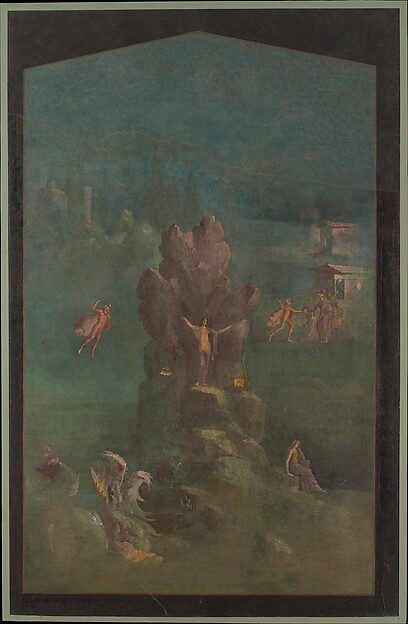
Flying homeward with the Gorgon's head, Perseus passed over the coast of Aethiopia and saw below him a sight that stopped him: a young woman chained naked to a rock at the sea's edge, so still that he took her at first for a statue. She was Andromeda, and her plight was her mother's fault. Her mother, Queen Cassiopeia, had boasted that she — or her daughter — was more beautiful than the Nereids, the sea-nymphs; and the offended Nereids appealed to Poseidon, who sent a flood and a sea-monster, Cetus, to ravage the coast. The oracle declared that the land would only be freed if Andromeda were given to the monster, and so her own parents had chained her to the rock as a sacrifice. Perseus, struck at once with love, made his bargain with her father King Cepheus — that if he saved her, she would be his wife — and when the great beast came surging through the water he swooped down upon it. In the older telling he fought and killed Cetus with the harpe, hacking at it from the air; in the version made famous by Ovid he showed the Gorgon's head to the monster and turned it to stone. Either way he freed Andromeda from her chains and claimed her as his bride.
The wedding-fight and the head that ends it
The marriage nearly ended in a massacre. Andromeda had been promised before to her uncle Phineus, and at the wedding feast he burst in with an armed band to claim her, and a pitched battle broke out in the hall, Perseus badly outnumbered. When he saw he could not win by the sword alone, Perseus called out to any friend of his to turn away and hide his eyes — and lifted the head of Medusa high above the crowd. Phineus and his warriors, caught mid-charge, were turned to stone where they stood, a hall full of grey statues frozen in the postures of the fight; Ovid lingers on Phineus petrified in the very attitude of a coward's plea. So Perseus won his wife outright, and took Andromeda home with him.
The reckoning on Seriphos
Perseus came back at last to Seriphos, to find that all his mother's fears had come true in his absence. Polydectes had never meant him to return; with Perseus gone, the king had pressed his suit on Danaë by force, and she and the faithful Dictys had been driven to take refuge as suppliants at an altar, clinging to sanctuary against the king's men. Perseus went straight to the palace, where Polydectes sat at feast with the men of his party, still mocking the idea that the young fool had brought back the Gorgon's head. Perseus told them to look — and raising the head from the kibisis, he turned the king and his whole court to stone in an instant, a banquet-hall of the dead frozen at their table. He set the good Dictys on the throne of Seriphos in the tyrant's place, freed his mother, and, his quest fully accomplished, gave back the borrowed tools of the gods — the sandals, the wallet, and the cap of Hades returned by Hermes to the nymphs — and gave the Gorgon's head itself to Athena, who set it forever upon her aegis, so that the face that turned men to stone now guards the breast of the goddess.
The prophecy fulfilled
One thing remained, and it was the one thing Perseus never sought. Wishing to be reconciled with his grandfather, or simply to see the land of his birth, Perseus travelled toward Argos — and Acrisius, hearing that the grandson the oracle had cursed him with was coming, fled the city in fear and went north to Larissa in Thessaly. There the king of the place was holding funeral games, and Perseus, passing through, entered the contests. When his turn came at the discus, he made his throw — and the heavy disk went wide, or was caught by a gust of wind, and struck an old man among the spectators, killing him. The old man was Acrisius. So the prophecy was fulfilled exactly and by pure accident: Perseus had killed his own grandfather, without knowing him, without meaning it, and without any way it could have been prevented — the perfect Greek image of a doom that runs to its appointed end no matter how far a man flees from it. In grief and shame at having shed the blood of his own house, Perseus would not take up the throne of Argos that was now his by right.
The founding of Mycenae and the Perseid line
Because he could not bear to rule in the kingdom of the man he had killed, Perseus made an exchange: he traded Argos to his kinsman Megapenthes and took in its place the neighbouring realm of Tiryns, and there, the tradition says, he founded the great citadel of Mycenae — the Cyclopes building its mighty walls for him, and its name drawn (the storytellers said) from the cap, the mykes, of his scabbard, or the mushroom he found at the spot. From Perseus and Andromeda came a line of sons and daughters — among them a daughter named Gorgophone and a son, Electryon, whose daughter Alcmene would in time bear Heracles to Zeus. So the greatest of all Greek heroes was the great-grandson of Perseus, and the royal house of Mycenae that Homer would set at the head of the Greek host at Troy traced its founding to the boy cast out to sea in a wooden chest. Perseus lived to old age and, with Andromeda, was set at last among the stars, where the whole family — Perseus, Andromeda, Cassiopeia, and Cepheus — still stands together in the northern sky.
Worship — Ancient
Hero, not god
Perseus was worshipped in the manner proper to a hero rather than an Olympian god — that is, with cult centred on his tomb or shrine (a heroon) and directed to a powerful dead man who could help or harm the living, rather than with the sky-facing sacrifices given to the immortals. Hero-cult of this kind was local and particular, attached to a place that claimed the hero's presence or protection, and it typically involved offerings poured or burnt at ground level and honours renewed at his precinct. Perseus's status as a son of Zeus and the founder of a royal dynasty made him an especially natural object of such honour in the lands that traced their kings to him.
The Argolid and beyond
His worship clustered where his myth was rooted, in the Argolid — Argos, Tiryns, and above all Mycenae, the citadel he was said to have founded, whose kings claimed descent from him. Pausanias, travelling the region, records local memorials of Perseus: shrines and landmarks tied to his story, and the tradition of his founding of Mycenae with its great walls. Beyond the Greek mainland his cult reached surprisingly far. Herodotus (2.91) describes a sanctuary of Perseus at Chemmis in Upper Egypt, where the inhabitants claimed him as their own, held athletic games in his honour, and said that he appeared to them from time to time — a striking instance of a Greek hero drawn into a foreign cult. The Persians, too, were sometimes said (by the Greeks) to derive their name and descent from Perseus through his son Perses, a genealogical link the historians noted.
The manner of his honours
Where a heroon of Perseus stood, worshippers would have brought the customary hero-offerings — libations of wine, and animal sacrifice of the chthonic sort given to a hero of the earth — and observed the games and gatherings that kept his memory. As a founder-hero (an oikistes-figure for Mycenae), he belonged to the class of mighty ancestors whose continued goodwill a city courted for its safety, and whose deeds its people recited as the charter of their own beginnings.
Worship — Modern
A hero, honoured differently
Perseus is a hero rather than a god, and modern Hellenic practice honours heroes in a distinct key from the Olympians: not as a deity to be petitioned for the ordering of the world, but as a great and favoured ancestor-figure whose memory is kept and whose example is invoked. A devotee drawn to Perseus might set a small remembrance — an image of the winged sandals, the curved harpe, or the hero standing with the Gorgon's head — and honour him as a patron of courage, of deliverance from danger, and of the faithful protection of one's family, the values his whole story embodies.
Offerings and remembrance
Following the ancient shape of hero-cult, offerings to a hero are traditionally poured out at ground level rather than raised to the sky-gods: a libation of wine poured onto the earth, given wholly and not taken back, is the simplest and most fitting gift. A candle lit in his memory, a few words recalling his deeds, or the telling of his story keep his name alive in the way the ancients believed a hero most wanted — to be remembered. Because Perseus's tale honours the mother who protected him and whom he protected in turn, acts of loyalty and care within one's own family sit well as a living tribute to him.
Legacy in sky and story
More than through formal cult, Perseus lives on today in the two places the ancients set him. He stands in the northern sky as the constellation Perseus, sword raised and the Gorgon's head in his hand, marked by the eerie winking star Algol — the "Demon's Head," the eye of Medusa — whose regular dimming was noticed as strange for millennia before it was understood as an eclipsing binary; and every August the Perseid meteor shower appears to stream from his constellation, the most watched meteor shower of the year, named for the hero. And he lives in story: the first and cleanest of the Greek heroes, the pattern of the young man sent to fetch an impossible thing and brought home by the gods' favour, whose myth — the prophecy, the monster, the mirror-shield, the chained princess, the petrifying head — has been retold in art and poetry and film from antiquity to the present day.
Epithets & Cult Titles
- Eurymedon (Εὐρυμέδων) — Wide-ruling — an attested byname of Perseus (used by Apollonius of Rhodes), fitting the founder-king of a wide realm
- Gorgophonos (Γοργοφόνος) — Slayer of the Gorgon — a descriptive title marking his defining deed, the killing of Medusa (his daughter also bore the feminine form Gorgophone as a name)
- Perseus the Constellation — The Hero set among the stars — the northern constellation Perseus, shown holding the Gorgon's head at the winking star Algol, 'the Demon's head'
- Perseides / founder of the Perseidai — Progenitor of the Perseid dynasty — a descriptive title for the ancestor of the royal line of Mycenae and Tiryns, down to Heracles
Sources & Variants
- Hesiod, Theogony 270–283 (the Gorgons, and Pegasus and Chrysaor springing from Medusa's neck)
- Pseudo-Hesiod, Shield of Heracles 216–237 (Perseus in flight with the Gorgon's head, the kibisis, and the cap of Hades)
- Homer, Iliad 14.319–320 (Perseus, son of Zeus and Danaë, most renowned of men)
- Simonides fr. 543 PMG (Danaë's lament in the chest at sea)
- Pherecydes fr. 10–12 (the fullest early narrative of the quest, source for Apollodorus)
- Apollodorus, Bibliotheca 2.4.1–5 (the complete myth: Acrisius' prophecy, Danaë and the shower of gold, the chest and Seriphos, Polydectes, the Graeae and the nymphs, the beheading of Medusa, Andromeda and Cetus, the petrifying of Polydectes, and the death of Acrisius at Larissa)
- Ovid, Metamorphoses 4.604–5.249 (the flight, Andromeda and the sea-monster, the wedding-battle with Phineus, and the petrifactions) — Roman retelling
- Pindar, Pythian 10.31–48 and Pythian 12 (Perseus among the Hyperboreans; the Gorgon's head and the origin of the flute-tune)
- Herodotus 2.91 (the cult and games of Perseus at Chemmis in Egypt); 7.61, 7.150 (Perseus as claimed ancestor of the Persians)
- Pausanias, Description of Greece 2.15–2.16 (Mycenae, its founding by Perseus, and memorials of him in the Argolid)
Gallery