Charites / the Graces
First Appearance
The Charites first appear as a named three in Hesiod's Theogony (907–911), where Eurynome, the lovely-formed daughter of Ocean, bore to Zeus "the three fair-cheeked Graces, Aglaea and Euphrosyne and lovely Thalia — and from their eyes, as they glanced, flowed love that unnerves the limbs, and beautiful is their glance from beneath their brows." Homer knows them too, though not always by these names: in the Iliad (18.382–383) a Grace called Charis is the wife of Hephaestus and keeps his house on Olympus, and elsewhere (14.267–276) the youngest of the Graces, Pasithea, is promised by Hera to the god Sleep as his bride — so that from the very first the Graces are both the daughters of Zeus and the givers of every married and social delight.
— Hesiod, Theogony 907–911; Homer, Iliad 18.382–383 and 14.267–276
Who They Are
The Charites (KAR-ih-teez; singular Charis, KAR-iss), whom the English-speaking world knows as the Graces and the Romans called the Gratiae, are the goddesses of everything that makes life sweet — grace and beauty, festivity and joy, the charm of good company, and the warm exchange of kindness that the Greeks called charis. They are usually three, and Hesiod gives them their classic names: Aglaea ("Splendour" or "Radiance"), Euphrosyne ("Good Cheer" or "Mirth"), and Thalia ("Festivity" or "Good Blossom"). To meet them is to feel the gladness that beauty gives: Hesiod says that from their glancing eyes flows a love that loosens the limbs. They are the goddesses you thank for a lovely day, a good feast, a kind word, a graceful dancer, a beautiful poem.
Their single Greek name holds the whole of their meaning. Charis (plural charites) is one of the richest words in the language: it means grace and charm and beauty, but also favour, kindness, and the gratitude that answers a kindness — the whole gracious circle of giving and thanking that binds people warmly together. The Graces are that word made divine. This is why they turn up wherever life is at its most delightful: at weddings and banquets, in the company of the Muses (whose songs they make lovely) and of Aphrodite (whose beauty they tend), in the dance, and in the giving of gifts. The Greeks even placed statues of the three Graces at the entrances to temples and gymnasia, as a reminder that grace and gratitude should govern all human dealings.
The Charites are seen two ways in the old stories, and the Golden Thread keeps them both. They are the daughters of Zeus by the Oceanid Eurynome — great goddesses in their own right, sisters who dance on Olympus and pour charm into the world. And they are the constant attendants of Aphrodite, the handmaids who bathe and anoint and clothe the goddess of love, weaving beauty and desirability into her and, through her, into all lovely things. Both pictures are ancient and true at once: the Graces are the daughters of the sky-king and the servants of beauty, the makers of the gleam on the surface of a happy life.
Mythology
The three fair-cheeked daughters of Zeus
The oldest full account is Hesiod's (Theogony 907–911), and it fixes the standard version that later poets follow. Zeus took as one of his wives Eurynome, the "lovely-formed" daughter of Ocean (Okeanos) — an Oceanid, one of the three thousand sea-and-river daughters of the great encircling river — and she bore him "the three fair-cheeked Graces": Aglaea (Splendour), Euphrosyne (Good Cheer), and Thalia (Festivity). Hesiod dwells on their beauty in a single unforgettable line — that from beneath their brows, as they glanced, flowed a love "that unnerves the limbs" — and this is the essence of the Charites: not a story so much as a quality, the melting charm of grace itself. Because they are the daughters of Zeus and an Oceanid, they belong on the family tree as children of Zeus; their mother Eurynome, being a sea-goddess of the older generation, is remembered here in the telling.
What the Graces are: the meaning of charis
To understand the Charites you have to understand their name. Charis (χάρις) is the Greek word for grace in nearly all its English senses at once: the physical grace and charm of a beautiful person or thing; the "grace" of a favour freely given; the answering gratitude that a kindness deserves; and the sheer gladness and pleasure that beauty brings. The Graces personify this whole warm circle — the giving of delight and the delight received, the charm that draws people together and the thankfulness that keeps them bound. This is why the ancients felt their presence in so many different places: in the shine of a lovely face, in the pleasure of a feast, in the graceful turn of a dance, in the gift given and the thanks returned. The Graces are the goddesses of the gracious life.
The handmaids of Aphrodite
Alongside their role as daughters of Zeus, the Charites are everywhere the attendants and handmaids of Aphrodite, the goddess of love and beauty — and this is one of their two great faces. It is the Graces who tend Aphrodite herself: in the Odyssey (8.362–366), when Aphrodite flees to her sanctuary at Paphos on Cyprus, "there the Graces bathed her and anointed her with the divine oil that gleams upon the immortals, and clothed her in lovely garments, a wonder to behold." They are the ones who make beauty beautiful — who weave charm and desirability into the goddess of desire, and through her into all the loveliness of the world. In the Cypria and in later poetry it is the Graces (with the Horae, the Seasons) who make Aphrodite's robes, dyeing them in spring flowers, and who deck out brides and gods alike. Where Aphrodite is the power of beauty and love, the Charites are the grace and sweetness that beauty gives off — her constant companions, so closely tied to her that the poets can barely picture one without the others.
Companions of the Muses, and gods of the feast
The Graces keep company with the Muses as naturally as with Aphrodite, for the Greeks felt that grace and charm were exactly what turned mere skill into beauty. On Olympus the Charites and the Muses dwell and dance together (Hesiod, Theogony 64), and it is charis — grace — that makes a song lovely, a poem delightful, a dance a joy to watch. Pindar, the great poet of victory, opens his fourteenth Olympian Ode with a radiant hymn to the Graces of Orchomenus, calling them the queens of all delight and saying that without the Charites nothing among gods or mortals is sweet — no feast, no dance, no song: "for with the Graces' help come all things sweet and pleasant to mortals, whether a man be wise, or beautiful, or glorious." The Graces are what makes the good things good. They preside over the banquet, the komos (the joyful revel), the dance, and every gathering where people take pleasure in one another's company — the goddesses of festivity and delight.
Aglaea, Euphrosyne, and Thalia — the standard three
The three names Hesiod gives became canonical, and each names one facet of grace. Aglaea ("Splendour, Radiance") is the gleam and brilliance of beauty, festal splendour; she is the youngest, and in Hesiod she becomes the wife of Hephaestus, the smith-god (Theogony 945–946) — so that the plainest and most laborious of the gods is married to grace itself. Euphrosyne ("Good Cheer, Mirth") is the merry heart, the inward gladness and good spirits of the feast. Thalia ("Festivity, Good Blossom") is blooming abundance and the flourishing revel — her name comes from thallein, "to bloom." (One caution the careful reader should keep: this Grace Thalia shares her name with one of the nine Muses, also called Thalia, the Muse of comedy. They are two entirely separate goddesses who happen to bear the same lovely name — "Blooming" — and the tradition never confuses them. The Grace is one of the three daughters of Zeus and Eurynome; the Muse is one of the nine daughters of Zeus and Mnemosyne.)
The variants — different numbers, different names, an older pair
The three of Hesiod are the standard, but they should be flagged as one version among several, for the Graces are among the goddesses the Greeks counted and named most differently from place to place. Homer knows a single Grace, Charis, as the wife of Hephaestus who welcomes Thetis into his house (Iliad 18.382–383) — where Hesiod has Aglaea in that role, so that the "youngest Grace" and the smith-god's wife are the same idea told two ways. Elsewhere Homer names another Grace, Pasithea, whom Hera promises to the god Sleep (Hypnos) as his bride in return for a favour (Iliad 14.267–276), and the youngest of the Graces is again Pasithea in later lists — a fourth name outside the Hesiodic three. Older still are the local cults that counted only two Graces. At Sparta they were worshipped as Cleta ("the Renowned") and Phaenna ("the Shining"), and at Athens as Auxo ("Increase") and Hegemone ("Leader") — the two by whom young Athenians swore their civic oath. And at their oldest and most famous shrine, at Orchomenus in Boeotia, the Graces were honoured under aniconic stones said to have fallen from the sky, a cult so ancient that (Pausanias reports) their first names and number were no longer remembered there at all. The number of the Graces, in short, was never quite fixed: Homer's one, the old pairs of Sparta and Athens, and Hesiod's classic three, with Pasithea sometimes making a fourth name. The Golden Thread follows Hesiod's three as the standard while keeping the older and variant Graces in view.
The Graces in art — the dancing three
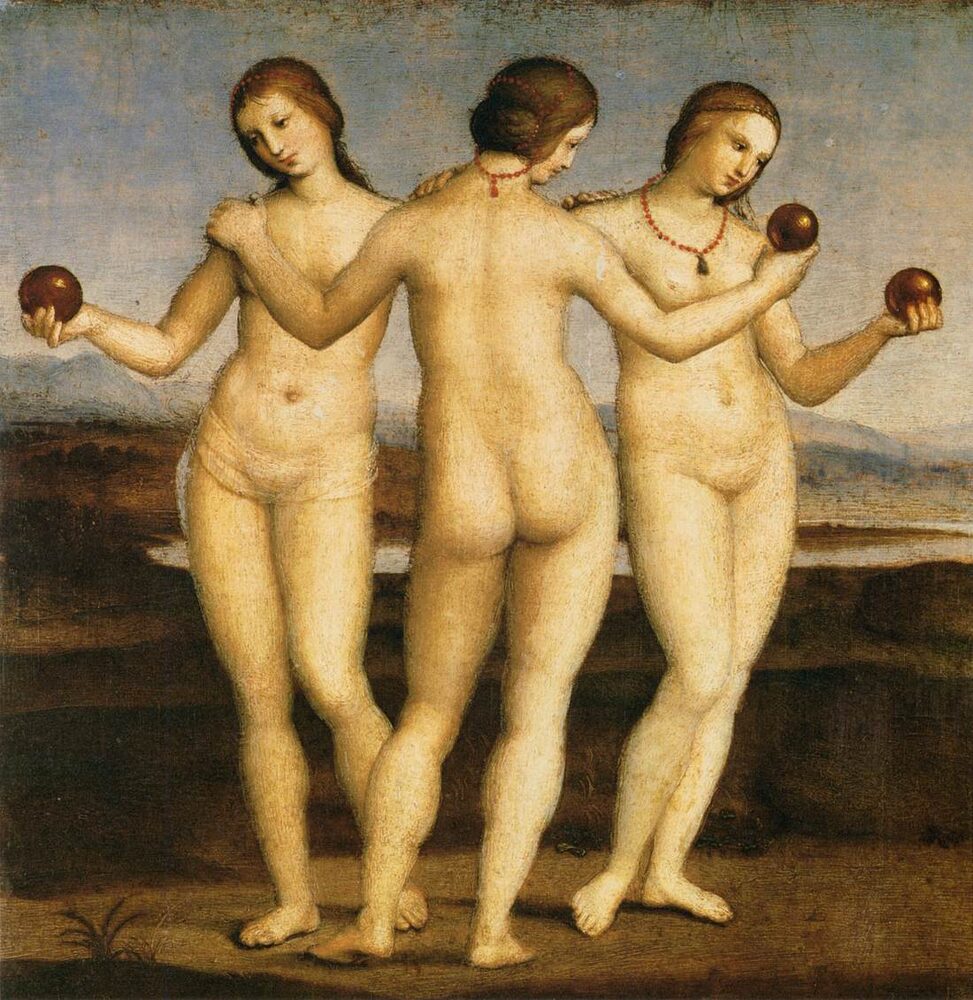
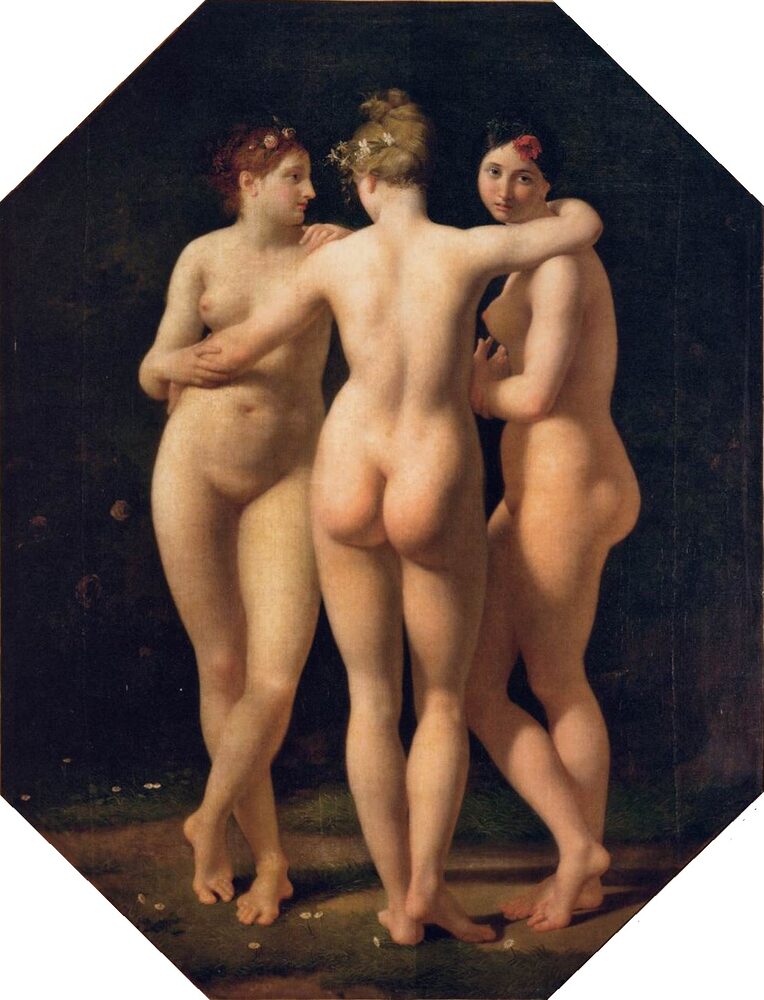
Out of all this the Greeks and after them the Romans settled on one enduring image: three young women, hands linked, dancing in a ring. In the oldest art the three Graces are shown clothed, often with the god Hermes; from the Hellenistic age onward they became the famous group of three nude women, the two outer ones facing us and the middle one turned away, arms resting on one another's shoulders — a composition copied endlessly in ancient sculpture and painting and revived with tremendous fame in the Renaissance (Botticelli's Primavera sets the three dancing Graces beside Venus; Raphael and Rubens and Canova each made their own). The linked ring of the three Graces became the very emblem of grace, generosity, and friendship: the ancient philosophers read the group as an image of the circle of kindness — one Grace giving, one receiving, one returning the favour — the whole gracious round of charis frozen in a dance.
Worship — Ancient
The oldest cult — the Graces of Orchomenus
The Charites were truly worshipped, not merely written about, and their oldest and most famous shrine stood at Orchomenus in Boeotia, on the river Cephisus. Pausanias, touring Greece in the second century AD (Description of Greece 9.35.1–7), reports that the Orchomenians honoured the Graces above all other gods, and that their cult was the most ancient in the land. Its holy objects were not statues but stones — aniconic tokens said to have fallen from the sky in the days of the old king Eteocles, who (the tradition said) was the first man to sacrifice to the Charites. These sky-fallen stones were the original cult-image; only much later were proper statues added. Pausanias notes that he could not learn for certain the names or number of the Graces the Orchomenians first worshipped — a sign of how old and how local the cult was, older than Hesiod's tidy three.
The festival of the Graces — the Charitesia
At Orchomenus the Graces had their own festival, the Charitesia (Χαριτήσια), held in their honour with games and above all with contests of music and poetry — fitting for the goddesses who make song lovely and who dwell with the Muses. Inscriptions found at Orchomenus record victors in the Charitesia — competitors in flute-playing, in singing to the lyre, in poetry and in the recitation of drama — so that we know the festival was a real and enduring event, a musical and artistic contest offered to the goddesses of grace and delight. It is one of the clearest cases in Greek religion of a cult whose character exactly matches its gods: the Graces, who give charm to art, were honoured with the arts.
The Graces everywhere in Greek worship
Beyond Orchomenus the Charites were honoured widely, usually alongside other gods rather than alone — a fitting arrangement for goddesses whose whole nature is to accompany and to grace. They shared in the worship of Aphrodite (whose handmaids they are), of the Muses, of Apollo, of Hermes, and of Dionysus, and their statues stood in many sanctuaries. Pausanias saw images of the three Graces in cities across Greece — at Athens before the entrance to the Acropolis, at Elis, at Sparta, and elsewhere — and notes that the older sculptors showed them draped, while it was the artists of his own later age who first made them nude. At Sparta the Graces were said to have been worshipped from the time of the early king Lacedaemon, who built them a sanctuary; there they were honoured as only two, Cleta ("the Renowned") and Phaenna ("the Shining"), another echo of the older, non-Hesiodic count. The Athenians, too, worshipped Graces of their own — Auxo and Hegemone — swearing their civic oath of citizenship partly by them.
Grace, gratitude, and the oath
Because charis means kindness given and gratitude returned as much as it means beauty, the Graces had a moral and social place in Greek life beyond the festival and the sanctuary. Statues of the three were set at the entrances to temples and to gymnasia (the schools of body and mind) as a standing reminder that grace and gratitude should govern all human dealings — that a favour deserves thanks, that beauty and kindness are owed a return. Aristotle (Nicomachean Ethics 1133a) notes that men set up a shrine of the Graces in a public place precisely to encourage the returning of good for good, "for this is the special mark of grace — that we should serve in return one who has been gracious to us." The Graces, then, were honoured not only as the goddesses of beauty and the feast, but as the divine guardians of the whole gracious circle of giving and thanking on which a friendly society runs.
Worship — Modern
Honouring the goddesses of grace today
In modern Hellenic practice — the living revival of the old Greek religion — the Charites are honoured as the gentle, gladdening goddesses of grace, beauty, joy, and gratitude, the ones who make life sweet and company warm. A devotee might turn to the Graces at any moment of festivity or thanksgiving: at a wedding or a celebration, before a work of art or music, or simply in gratitude for beauty and good company. Because their oldest gifts were flowers and stones fallen from the sky, and because they love the myrtle and the rose, simple offerings suit them well — fresh flowers set on a shrine, a sprig of myrtle, a libation of wine or honey, and above all the offering they were given at their own festival: song, dance, and the making of something lovely. To create beauty, and to give and receive kindness gracefully, is itself a devotion to the Charites.
The Graces in art and language
Far more than through formal cult, the Charites live on in Western art and speech. The image of the three Graces dancing in a ring, hands linked, is one of the most enduring in all of art — carried from ancient sculpture through Botticelli's Primavera, Raphael, Rubens, and Canova down to the present, wherever grace, beauty, and generosity are given a face. Their name is woven into the English language itself: a "grace" is a charm or a kindness or a blessing; we speak of the "social graces," of a "gracious" host, of doing something "with good grace," of saying "grace" in thanks before a meal — every one of these an unwitting echo of the Charites, the goddesses of charis, favour and delight. The word "charisma," too, and "charity," grow from the same Greek root: the grace that a person gives off, and the kindness given freely to others.
The circle of giving and thanking
What the modern world inherits from the Charites, in the end, is an idea as much as an image — the ancient reading of the three linked Graces as the circle of kindness. The philosophers said the three Graces stand for the giving of a favour, the receiving of it, and the returning of it — the whole gracious round by which people bind themselves to one another in generosity and gratitude. It is a picture worth keeping: that beauty and joy are gifts to be received with thanks and passed on, that a kindness done should come round again, and that grace — the gleam on the surface of a happy life — is not a thing one keeps but a thing one shares. The Graces dance in a ring because grace has no end: it goes round and round, giving and thanking, and makes the whole of life a little sweeter.
Epithets & Cult Titles
- αἱ Χάριτες (hai Charites) — "the Graces" — The name proper, the plural of charis ("grace, favour, delight"): the goddesses who are grace itself. Hesiod names the three as Aglaea, Euphrosyne, and Thalia (Theogony 907–909), and it is charis — the gleam and gladness that beauty gives — that they pour over everything they touch
- Ἀγλαΐα (Aglaia) — "Splendour, Radiance" — The youngest of the three in Hesiod, whose name means the bright gleam of beauty, brilliance, festal splendour; in Homer's Iliad a Grace named Charis, and in Hesiod Aglaea herself, is the wife of Hephaestus the smith-god
- Εὐφροσύνη (Euphrosyne) — "Good Cheer, Mirth" — The Grace of the glad and merry heart, from eu- ("well") and phrēn ("mind, heart"): the joy felt within, the good spirits of the feast and the dance
- Θάλεια / Θαλία (Thaleia / Thalia) — "Festivity, Good Blossom, Abundance" — The Grace of blooming plenty and the flourishing feast, from thallein ("to bloom, to flourish"). She shares her name with one of the nine Muses, but is a wholly separate goddess — a Grace, not a Muse — and the two should not be confused
- Χάριτες Ὀρχομένιαι (Charites Orchomeniai) — "the Graces of Orchomenus" — The Graces as worshipped at Orchomenus in Boeotia, their oldest and most famous cult, where they were honoured under aniconic stones said to have fallen from the sky — a rite so ancient that their first names and number were no longer remembered there
Sources & Variants
- Hesiod, Theogony 907–911 (Eurynome, daughter of Ocean, bears to Zeus the three Graces Aglaea, Euphrosyne, and Thalia, from whose glancing eyes flows limb-loosening love)
- Hesiod, Theogony 64 and 945–946 (the Graces dwelling and dancing with the Muses on Olympus; Aglaea, youngest of the Graces, as the wife of Hephaestus)
- Homer, Iliad 18.382–383 (Charis, a Grace, as the wife of Hephaestus, welcoming Thetis); Iliad 14.267–276 (Pasithea, youngest of the Graces, promised by Hera to Sleep)
- Homer, Odyssey 8.362–366 (the Graces bathe, anoint, and clothe Aphrodite at Paphos)
- Homeric Hymn to Aphrodite (5) 58–63 (the Graces bathe and anoint Aphrodite on Cyprus)
- Pindar, Olympian 14 (the hymn to the Graces of Orchomenus — Aglaia, Euphrosyne, and Thalia — queens of all delight, without whom nothing is sweet to gods or mortals)
- Cypria fr. 4 (the Graces and Horae make and dye Aphrodite's flower-scented robes) — early epic fragment
- Pausanias, Description of Greece 9.35.1–7 (the cult of the Graces at Orchomenus; the sky-fallen stones; king Eteocles the first to sacrifice to them; the varying names and numbers; the two Graces Cleta and Phaenna at Sparta, and Auxo and Hegemone at Athens)
- Aristotle, Nicomachean Ethics 1133a (the shrine of the Graces set up in public to encourage the returning of kindness for kindness)
- Seneca, De Beneficiis 1.3.2–5 (the three Graces read as the circle of giving, receiving, and returning a favour) — Roman philosophical reading
Gallery