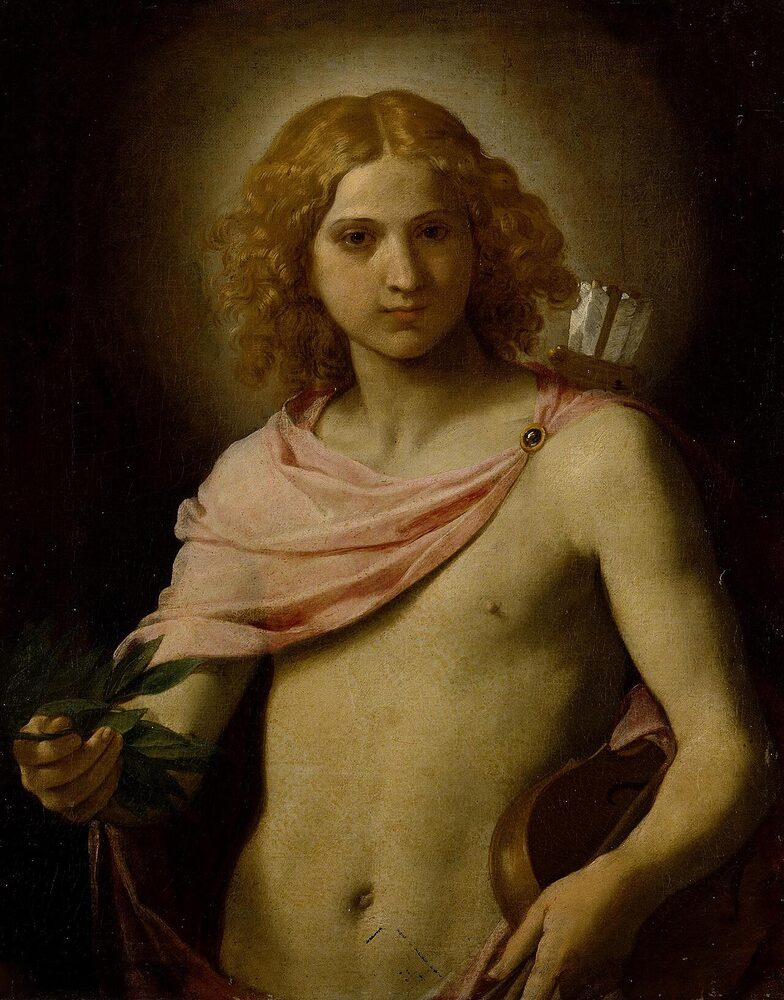
Apollon
First Appearance
Apollon first appears fully in the great Homeric Hymn that bears his name, which opens with the gods trembling as he strides into the hall of Zeus with his bow drawn, and then tells how his mother Leto, driven from land to land by the jealousy of Hera, at last found refuge on the small floating island of Delos, where she clung to a palm tree and brought forth the far-shooting god. Hesiod records the same birth in brief (Theogony 918–920): to Zeus, Leto bore Apollon and the archer Artemis, the loveliest of the children of heaven.
— Homeric Hymn 3 to Apollo (Delian portion, esp. 1–139; Pythian portion, 179–546)
Who They Are
Apollon (uh-POL-ohn; the familiar Latin form is Apollo) is the most Greek of the gods and the hardest to hold in a single image — lord of prophecy and of music, of healing and of plague, of archery and of the pure light of order. He is the far-shooter with the silver bow, the leader of the Muses' dance, the voice behind the Delphic oracle, and the physician who is also the sender of sickness. Where his father Zeus rules by the thunderbolt and his uncle Poseidon by the sea, Apollon rules by the clarity and the ambiguity of the word: he is the god who tells the truth and yet is called Loxias, "the oblique," because his truths arrive at a slant.
The Greeks felt his double nature keenly, and it is the key to him. The same far-shooting arrows that open the Iliad by raining plague upon the Greek camp can also be turned to cure; he is at once Smintheus, "the mouse-god" who brings pestilence, and Paian, "the healer" whose name became the very word for a song of thanksgiving. This unity of opposites — the bow that kills and the lyre that heals held in the same hands — is not a contradiction the Greeks tried to explain away but the truth they saw at the centre of him.
He is inseparable from his twin, Artemis, born with him on Delos to the same wandering mother; the two archer-siblings move through myth as a matched pair, he presiding over young men and she over young women, both swift, both deadly, both unmarried and fiercely protective of their mother's honour. And he is inseparable from Delphi, the sanctuary at the navel of the world where he seated his oracle after slaying the earth-serpent Python. To understand Apollon is to hold together the singer and the killer, the healer and the plague, the bright god and the god of shadowed speech.
Mythology
Birth on Delos and the bond with Artemis
When Leto was pregnant by Zeus, the jealous Hera drove her across the earth and forbade any land to give her rest, so that she wandered in labour with no place to bear her children. Every country feared to receive her — until she came to Delos, a small, barren island said still to be floating unanchored on the sea. Leto promised the island that her son would build his first and greatest temple there and make it rich with the offerings of pilgrims, and Delos, poor and rocky, consented. There, kneeling in the soft meadow with her arms flung about a palm tree, Leto first bore Artemis, and then — with the newborn Artemis herself said in some tellings to have helped as midwife — brought forth Apollon, while the goddesses attending cried out and the whole island blazed with gold. Fed on nectar and ambrosia, the infant god burst his swaddling-bands, called at once for the lyre and the curved bow, and declared that prophecy and the will of Zeus would be his. From that first moment the twins are a pair: Apollon and Artemis, the two archers, share not only their parents but a temperament — remote, exact, swift to defend Leto, and terrible when their honour is touched, as the doomed queen Niobe learned when she boasted of her many children against Leto's two, and the twins shot down all of hers in an afternoon.
Delphi, the Python, and the succession of the oracle
The oracle at Delphi was not always Apollon's. In the oldest tradition it belonged first to Gaia, the Earth herself, the first prophetess; from her it passed to her daughter Themis, and from Themis to the Titaness Phoebe, who at last gave it as a birth-gift to her grandson — from whom, the poets said, he took the name Phoebus (Aeschylus preserves this fourfold succession, Gaia to Themis to Phoebe to Phoebus, at the opening of the Eumenides). But the place was guarded by Python, a monstrous serpent, offspring of the Earth. The young Apollon came and killed the great snake with his arrows, claiming the sanctuary as his own; in expiation of the killing — for even a god's blood-guilt must be purged — he was said to have gone into exile and servitude, and he founded the Pythian Games in the serpent's memory. He seated his prophetess, the Pythia, on a tripod over the sacred cleft, and through her the god spoke to the whole Greek world. At the centre of the sanctuary stood the omphalos, the "navel-stone" that marked the middle point of the earth — the very stone, one tradition held, that Rhea had wrapped in swaddling-clothes and given to Cronus to swallow in place of the infant Zeus, later set down at Delphi as the world's centre. Pausanias, walking the site centuries later, still saw the stone and recorded the temple's legendary succession of forms.
The loves that ended in grief
Apollon's loves are among the most beautiful and the saddest stories told of any god, and nearly all of them end in death or transformation. (Content note: these myths turn on grief, unwanted pursuit, and the deaths of the beloved.) His first love was the nymph Daphne, who wanted nothing of him; she fled his pursuit and, at the edge of her strength, prayed to be delivered — and was changed into the laurel tree, whose leaves Apollon took ever after as his sacred wreath, so that he wears the sign of the one who refused him. He loved the youth Hyacinthus, and while the two were throwing the discus together the bronze disk struck the boy and killed him; from the blood of Hyacinthus Apollon raised the flower that bears his name, marked (the poets said) with the letters of a cry of grief. He loved Coronis, who was unfaithful to him; in his anger — or by the hand of Artemis — she was killed, but as her body burned on the pyre Apollon snatched their unborn son from the flames and gave him to the centaur Cheiron to raise. That son was Asclepius, who became so great a healer that he could raise the dead — until Zeus, fearing the order of mortality itself was threatened, struck him down with a thunderbolt. And he gave the Trojan princess Cassandra the gift of true prophecy to win her love; when she refused him, he could not take the gift back, but he laid a curse upon it, so that she would always foresee the truth and never be believed — a torment that runs through the whole fall of Troy.
Hyacinthus, the west wind, and the flower
Of all Apollon's loves the dearest was Hyacinthus, a beautiful youth of Amyclae in the vale of Sparta, whom the god loved above every other and for whose sake he was said to have laid aside his lyre and his bow to follow the boy through the hunt and the games. But Apollon was not the only immortal to love him: Zephyrus, the West Wind, loved Hyacinthus too, and when the youth gave his heart to Apollon and turned from the wind, Zephyrus was consumed with jealousy. One day the god and the boy stripped to throw the discus together, and as Apollon hurled the bronze disk, Zephyrus — in his jealous rage that the boy should be another's — caught it on his breath and drove it off its course, so that it struck Hyacinthus full on the head and laid him dead upon the ground. Apollon, for all his healing arts, could not call him back; but that his beloved should not pass wholly into the dark, he raised from the spilled blood the flower that bears the boy's name, the hyacinth, upon whose petals the Greeks read the letters AI AI — the sound of the cry "alas," so that the god's grief is written on the flower for ever. The tradition of the wind's jealousy is old and Greek: Lucian tells it in the Dialogues of the Gods, where Apollon names Zephyrus the cause of the death, and Philostratus paints the same scene. At Amyclae, where Hyacinthus was buried beneath the great throne-statue of Apollon that Pausanias saw and described (Description of Greece 3.19.3–5), the Spartans kept the Hyacinthia each year — three days that opened in mourning for the dead youth, with no garlands and no paeans, and then broke into the joyful worship of the god (the three-day structure is preserved by Athenaeus, Deipnosophistae 4.139d–f), grief and gladness bound together as they are in the whole story of the boy and the flower.
Marsyas and the god's harder edge
The gentleness of the singer sits beside a capacity for merciless justice. The satyr Marsyas found the flute that Athena had thrown away and grew so skilled that he dared to challenge Apollon and his lyre to a contest, the winner to do as he wished with the loser. The Muses judged, Apollon won — in some tellings by turning his lyre upside down and singing at the same time, which the flute could not match — and he took his victor's right to the utmost: he had Marsyas flayed alive for his presumption. It is the cruellest of Apollon's punishments and the clearest window onto his darker aspect, the same god who kills Python and sends plague, the reminder that the god of measure and clarity does not suffer a mortal or a satyr to rival him.
Servitude, the Muses, and the far northern winters
When Apollon killed the Cyclopes in revenge for the thunderbolting of his son Asclepius, Zeus would have hurled him into Tartarus; at Leto's pleading the sentence was softened to a year of servitude to a mortal, and so the god went to serve King Admetus of Pherae as a herdsman, tending his cattle and, out of gratitude for good treatment, making every cow bear twins. In his brighter role he is Apollon Musagetes, "leader of the Muses," who sets the song and dance of the nine goddesses on Parnassus and Helicon and gives poets their art. And every winter, the tradition held, he left Delphi silent and travelled to the land of the Hyperboreans, a blessed people beyond the north wind who lived in endless sunshine and honoured him above all gods; there he passed the cold months, returning to Greece each spring in a chariot drawn by swans, so that the oracle fell quiet in winter and woke again with the year.
The far-shooter at Troy
In the Iliad the whole epic opens on Apollon's wrath. When Agamemnon dishonours the god's priest Chryses, the old man prays to Apollon Smintheus, and the god comes down from Olympus "like the night," and for nine days his arrows fall upon the Greek camp — first the mules and dogs, then the men — until the funeral pyres burn without ceasing (Iliad 1.43–52). Throughout the war he stands with Troy against the Greeks, and at its climax it is Apollon who guides the arrow of Paris — an unremarkable archer on his own — to the one vulnerable point of Achilles, bringing down the greatest of the Greek heroes. The god who heals is also, here, the god who deals death from afar; the plague and the killing arrow are the shadow-side of the same silver bow that, turned the other way, brings the cure.
Worship — Ancient
Cult centres
Three sanctuaries stood at the heart of Apollon's worship. Delphi, on the slopes of Parnassus, was the most famous oracle in the Greek world: here the Pythia, seated on her tripod in the temple, delivered the god's answers to questions of war, colony-founding, cult and private life, and here the Pythian Games were held every four years. Kings and cities sent lavish offerings, and the sanctuary grew so rich that its treasuries became a museum of the Greek states; the omphalos-stone at its centre marked what the Greeks called the navel of the earth. Delos, the island of his birth, was the great cult centre of the Ionian Greeks, who gathered there for the Delia with choral song and games, and which later became so sacred that no one was permitted to be born or to die on the island. And at Sparta, Apollon was honoured with two of the Dorians' most important festivals — the Karneia, a solemn martial rite during which the Spartans would not go to war, and the Hyacinthia at nearby Amyclae, which mourned the dead youth Hyacinthus before it turned to celebration.
Rites
Apollon received the standard Olympian sacrifice — oxen and other animals burnt on the altar, with the great public offering of a hundred beasts called a hecatomb reserved for the largest festivals — accompanied by libations of wine and the first-fruits of the harvest. His distinctive rite was the paean, a choral hymn of thanksgiving and supplication sung to him (and to his son Asclepius) especially in time of plague or in gratitude for deliverance from it, so that the god's own healing title became the name of a whole genre of song. Consultation of the oracle at Delphi had its own procedure: the enquirer paid a fee, offered a sacrifice, and put the question to the Pythia, whose utterances were rendered into verse. Because Apollon presided over purification, those stained by bloodshed came to his sanctuaries to be cleansed — a role that grew from his own legendary need to purge the killing of the Python.
Worship — Modern
Honouring Apollon today
Modern Hellenic polytheists honour Apollon without any of the ancient blood-sacrifice, keeping instead a practice of reverence, offering and song. A simple home shrine — a clean shelf bearing an image of the lyre, the bow, or a sprig of laurel, with a lamp or candle for his light — gives the god a place in the house. Because Apollon is the god of clarity and purity, devotees often approach him with clean hands and a settled mind, and many keep his shrine especially tidy and bright. He is a natural patron for musicians, poets, healers and physicians, students, and anyone seeking guidance or a clear head in a hard decision.
Offerings
Where the ancients gave burnt sacrifice, a devotee today most fittingly offers libations and shared food together with things sacred to the god. Pour a libation of wine — or of spring water, milk, or honey — into a bowl set aside for him. Laurel is his plant above all: a wreath, a few leaves, or laurel burned as a fragrant offering is traditional. Olive oil, honey, barley cakes, and frankincense are all suitable, as are first-fruits of a garden. Most characteristic of all, an offering of music or poetry — a song sung, a piece played, a poem written or read aloud — is welcome to the god of the Muses in a way it is to no other.
Prayer & epithets
Call on Apollon by the title that suits your need. Invoke Apollon Paian, the Healer, in sickness or when praying for the health of another. Turn to Apollon Musagetes, leader of the Muses, when beginning any work of music, poetry, or art, that he may lend inspiration. Seek Apollon Pythios or Loxias when you long for guidance or clarity, remembering that his truths come slant and ask to be pondered. Honour Phoebus, the Bright and Pure, in daily reverence as the god of light and order — and, if you keep his festivals, remember his twin Artemis alongside him, for the two archer-children of Leto are rarely honoured wholly apart.
Epithets & Cult Titles
- Phoebus (Φοῖβος) — The Bright, the Pure — his most familiar title, marking the god of radiant clarity, inherited by name from his grandmother Phoebe
- Pythios — Of Pytho — the lord of the Delphic oracle, named for the place where he slew the serpent Python
- Loxias — The Oblique, the Ambiguous — the oracular god whose truths come slant, riddling and open to misreading
- Musagetes — Leader of the Muses — who sets the dance and song of the nine on Parnassus and Helicon
- Hekatebolos — The Far-Shooter — who strikes from a distance with his silver bow, whether in wrath or mercy
- Hekaergos — The One who Works from Afar — a kindred title to the far-shooter, of power reaching over great distance
- Lykeios — Of the Wolf, or of Light — an ancient and disputed epithet joining the wolf-god to the god of brightness
- Paian (Paean) — The Healer — the physician-god and the name of the hymn of thanksgiving sung to him
- Smintheus — Of the Mouse — the plague-sender first invoked in the Iliad, master of the vermin that carry sickness
- Delios / Delphinios — Of Delos (his birthplace) and Of Delphi (or 'of the dolphin', the form he took to guide his first priests)
Sources & Variants
- Homeric Hymn 3 to Apollo (Delian birth on Delos, 1–139; the slaying of Python and founding of the Delphic oracle, 179–546)
- Hesiod, Theogony 918–920 (Leto bears Apollon and Artemis to Zeus)
- Homer, Iliad 1.9–52 (Chryses' prayer to Apollon Smintheus and the plague of arrows on the Greek camp); 22.359–360 (Hector foretells Achilles' death by Paris and Apollon)
- Aeschylus, Eumenides 1–8 (the succession of the Delphic oracle: Gaia, Themis, Phoebe, Phoebus)
- Apollodorus, Bibliotheca 1.4.1 (Python and Tityos), 1.4.2 (Marsyas), 3.10.1–4 (Coronis, the birth of Asclepius, the slaying of the Cyclopes, and the servitude to Admetus)
- Apollodorus, Epitome 5.3 (the death of Achilles by the arrow of Paris guided by Apollon)
- Pausanias, Description of Greece 10.5–10.24 (Delphi: the legendary succession and temples of the oracle, the omphalos, and the sanctuary)
- Lucian, Dialogues of the Gods 16 (Hermes and Apollo — Hyacinthus loved by both Apollon and Zephyrus, and killed when the jealous West Wind drove the discus off course)
- Philostratus the Elder, Imagines 1.24 (Hyacinthus — the death by the discus and the flower)
- Pausanias, Description of Greece 3.19.3–5 (the throne of Apollon at Amyclae, the tomb of Hyacinthus beneath it, and the Hyacinthia)
- Athenaeus, Deipnosophistae 4.139d–f (the three-day structure of the Hyacinthia — mourning for Hyacinthus giving way to festal joy)
- Callimachus, Hymn 2 (to Apollo) and Hymn 4 (to Delos)
- Ovid, Metamorphoses 1.452–567 (Daphne and the laurel), 6.382–400 (the flaying of Marsyas), 10.162–219 (Hyacinthus and the flower) — Roman retellings
Gallery