Leto
First Appearance
Leto first appears in the catalogue of the Titans' offspring as the daughter of the Titan Coeus and the Titaness Phoebe. Hesiod names her among the children of the "bright" pair, and marks her at once by her defining gentleness — she is, he says, "always mild, kindly to men and to the deathless gods, mild from the beginning, the gentlest in all Olympus." From the first she is characterised not by power or dominion but by a serene and benevolent temper.
— Hesiod, Theogony 404–408
Who They Are
Leto (LEE-toh; Greek Λητώ, Latin Latona) is a Titaness of the second generation, daughter of the Titans Coeus and Phoebe, and best known as the mother of the twin archer-gods Apollo and Artemis, whom she bore to Zeus. Among the often turbulent and imperious figures of Greek myth she stands out for her mildness: Hesiod calls her the gentlest of all who dwell on Olympus, and her worship reflects this — she is honoured above all as a mother, a protectress of the young, and a model of dignified endurance.
Her name's meaning is disputed. The ancients and many moderns have connected it to the Greek root lēth- / lanth- ("to be hidden, to escape notice"), fitting for the goddess who wandered concealed and homeless while she carried her divine children; others trace it to a Lycian word lada, "wife" or "mother," which would root her deep in the Anatolian coast where her cult was strongest. Both readings point to the same figure: the modest, veiled mother who suffers hidden and then brings forth glory.
Leto's story is essentially the story of a birth — but a birth won against relentless opposition. Pregnant by Zeus, she was driven across the whole earth by the jealousy of Hera, denied any place to rest until the floating island of Delos received her. From that ordeal came two of the greatest of the Olympians, and Leto's standing among the gods was fixed forever as their mother. Gentle to her friends, she is nonetheless not to be scorned: those who insulted her — the boastful queen Niobe, the churlish peasants of Lycia — learned that a mother's mildness has a limit, and that the wrath of Apollo and Artemis stands always at her side.
Mythology
Hera's persecution (told in full on the Apollo and Artemis pages)
When Leto conceived the twins by Zeus, the king's jealous wife Hera turned all her anger upon her. Hera forbade any land under the sun to give the labouring Leto a place to bear her children, and in her wandering the goddess found every shore and island shrinking from her in fear of Hera's wrath. In some tellings Hera also sent the great serpent Python to pursue her across the earth, and detained Eileithyia, the goddess of childbirth, on Olympus so that Leto's labour could not be brought to its end. Homeless and heavy with child, Leto roamed the length of the Greek world seeking any ground that would dare to receive her. (This persecution is recounted more fully on the pages for Apollo and Artemis, whose births it frames.)
The floating island of Delos
At last only one place would take her: Delos — a small, barren, rocky island, so poor and insignificant that it had nothing to lose by defying Hera, and which in the oldest accounts drifted unmoored upon the sea (later tradition — Pindar, Callimachus's Hymn to Delos, Apollodorus — identified the wandering island with Ortygia and with Leto's transformed sister Asteria). Leto came to Delos and pleaded with it, promising that if it received her it would become the birthplace of a god and be honoured above all other lands, its rocky soil enriched forever by the pilgrims and offerings that would come. Delos, fearful but tempted by the promise, agreed — asking only Leto's oath that Apollo would not despise it once he was born.
There, clinging to a single palm tree (and, in some versions, an olive) beside the round Delian lake, Leto laboured. For nine days and nights she was gripped by hard birth-pangs, for Eileithyia had been kept from her; only when the other goddesses sent Iris to bring the birth-goddess down from Olympus with the gift of a great amber-and-gold necklace could the labour end. Leto bore Artemis first — who, myth says, then served as midwife at the birth of her twin — and after long travail Apollo. At the moment of the god's birth Delos blazed with gold, and thereafter the once-drifting island was fixed with pillars in the sea and became one of the holiest sanctuaries in all Greece.
The vengeance of Leto: Niobe
Leto's mildness did not extend to those who insulted her motherhood. Niobe, queen of Thebes and daughter of Tantalus, bore many children — traditionally seven sons and seven daughters — and in her pride she boasted that she was worthier of worship than Leto, who had borne only two. She mocked the goddess and told the Theban women to cease their offerings to her. In answer, Leto's twins took up their bows: Apollo shot down all of Niobe's sons and Artemis all her daughters, until the queen was left childless amid the bodies of her children. Overwhelmed by grief, Niobe wept without ceasing until she was turned to stone — a weeping rock on Mount Sipylus in Lydia from which water still seemed to trickle like tears. Homer has Achilles tell this tale in the Iliad to the grieving Priam, reminding him that even Niobe, in the depth of her sorrow, remembered at last to eat.
The vengeance of Leto: Tityos
A still older outrage against Leto is avenged in the deepest layer of Greek myth. As the goddess journeyed toward Pytho (Delphi), passing through Panopeus in Phocis, the earth-born giant Tityos — a monstrous son of Gaia (Earth) — seized her in a fit of lust and tried to force her. Leto cried out to her children, and Apollo and Artemis loosed their arrows and struck the giant down. His punishment did not end with death: in the Underworld Tityos lies stretched over nine pelethra (some nine acres) of ground while two vultures tear ceaselessly at his liver, plunging their beaks into the very caul, and he cannot beat them off — an everlasting penalty for laying hands on the honoured consort of Zeus. Odysseus beholds him so among the great sinners of the dead (Odyssey 11.576–581), and the mythographers confirm that it was Leto's own children who avenged her (Apollodorus, Bibliotheca 1.4.1).
The Lycian peasants turned to frogs (Ovid)
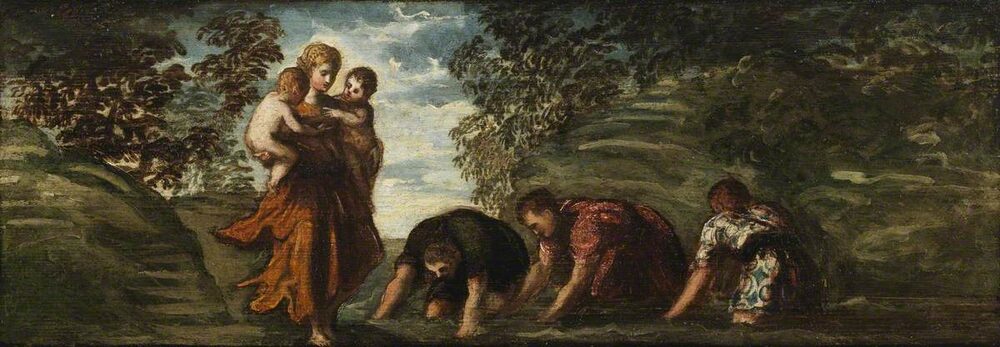
A second tale of Leto's vengeance is told most fully by the Roman poet Ovid, and should be taken as the Roman-era elaboration it is. As Leto wandered with her newborn twins, parched with thirst under a burning sun, she came upon a clear pool in Lycia where peasants were gathering reeds and rushes. She begged only for a drink of water for herself and her infants, appealing to their pity. But the peasants cruelly refused her, and — worse — waded into the pool and stirred up the mud with their hands and feet to foul the water and make it undrinkable. Angered at last, Leto raised her hands and cursed them to live forever in that pool: their voices grew hoarse and croaking, their necks vanished, their backs turned green, and they became frogs, condemned to squabble and croak in the muddy water for all time. The story gives a mythic origin both to the frog and to the goddess's protective fury on behalf of her children.
Worship — Ancient
Cult centres
Leto's worship was ancient and widespread, but it was strongest along the southern coast of Asia Minor, in Lycia, which many regarded as her true homeland — a fact that squares with the possible Lycian derivation of her name. Her greatest sanctuary was the Letoon near Xanthos, a federal shrine of the Lycian League where she was worshipped as the leading deity of the region alongside Apollo and Artemis; the trilingual inscription found there (Lycian, Greek and Aramaic) attests to the sanctuary's importance. In the Greek Aegean her cult was inseparable from that of her children on Delos, the island of their birth, where she had her own precinct, the Delian Letoon, and was honoured as the mother whom the holy island had sheltered. She was also venerated in Crete (at Phaistos, as Leto Phytiē, "the Nurturer") and at many sites across the Greek world wherever Apollo and Artemis were worshipped.
Rites
In cult Leto was very often honoured not alone but as one of a divine triad — "Leto and her children" — receiving worship jointly with Apollo and Artemis, so that her offerings and festivals were commonly folded into theirs. As a goddess of motherhood and the kourotrophos ("nurse of the young"), she was invoked by women in childbirth and by parents on behalf of their children, sharing this sphere with her daughter Artemis and with Eileithyia. Offerings suited to her gentle nature — barley cakes, honey, first-fruits, and libations of wine and water — were more characteristic of her worship than grand blood-sacrifice, though at her great festivals such as the Lycian Letoia she was honoured with the full apparatus of games and public sacrifice. Her sacred palm and the round lake of Delos remained enduring focal points of pilgrimage into Roman times.
Worship — Modern
Honouring Leto today
A modern devotee drawn to Leto honours her most fittingly as the archetype of the enduring, protective mother and as the gentle Titaness who bore the light of Apollo and the wildness of Artemis into the world. A simple home shrine — a clean shelf bearing an image or symbol of the palm tree, a small bowl of water, and a lamp or candle — gives her a place. Because her myth is one of homelessness finally granted refuge, she is naturally invoked by those seeking shelter, safe passage through a hard passage of life, or protection for a mother and child. Approach her quietly and with respect, honouring her patience and her dignity in adversity as much as her power.
Offerings
Offerings in keeping with Leto's mild and nurturing character are best kept gentle and pure. Pour a libation of clean spring water — especially apt for the goddess who was once denied a drink — or of wine, milk, or honey. Barley or a small barley cake, honey, olive oil, and the first-fruits of the season are all fitting, as are fresh flowers or a palm or olive leaf laid on the shrine. Present what you give with a few words of thanks and let it be truly the goddess's, poured out or set aside afterward rather than taken back.
Prayer & devotion
Call on Leto as the gentle mother and Kourotrophos, nurse of the young, when praying for the safety of children, for a mother in childbirth, or for the protection of the vulnerable. Honour her as Leto Phytiē, the Nurturer, in matters of growth, fertility, and new beginnings; and remember her as the veiled wanderer, Leto Kyanopeplos, when you seek the strength to endure hardship with dignity and to find at last a place of refuge. Devotion to Leto is often paired with reverence for her children — to honour the mother is to stand within the light of Apollo and Artemis, who guard her still.
Epithets & Cult Titles
- Leto Phytiē — Leto the Nurturer, the bringer-forth — honoured at Phaistos as the tender of growth and childbirth
- Kourotrophos — Nurse of the young — protectress and rearer of children, the aspect she shares with her daughter Artemis
- Eukomos — Lovely-haired — Hesiod's and the Homeric Hymn's standing epithet for her gentle beauty
- Kyanopeplos — Dark-veiled, of the dark robe — the shrouded mother, veiled in modesty and in grief
Sources & Variants
- Hesiod, Theogony 404–408 (daughter of Coeus and Phoebe; her gentleness), 918–920 (bears Apollo and Artemis to Zeus)
- Homeric Hymn 3 to Apollo, esp. 25–126 (Leto's wandering, the floating island of Delos, the palm tree, and the birth of Apollo)
- Homer, Iliad 24.602–617 (the tale of Niobe, told by Achilles to Priam)
- Homer, Odyssey 11.576–581 (Tityos punished in Hades for assaulting Leto on her way to Pytho)
- Ovid, Metamorphoses 6.146–381 (Niobe and the Lycian peasants turned to frogs — Roman elaboration)
- Callimachus, Hymn 4 to Delos (the wandering of Leto and the fixing of the island)
- Apollodorus, Bibliotheca 1.4.1 (Leto, Hera's persecution, Python, and the birth on Delos)
- Pausanias, Description of Greece 1.44.10, 2.21.9, 8.53.1–3 (cults and images of Leto)
Gallery