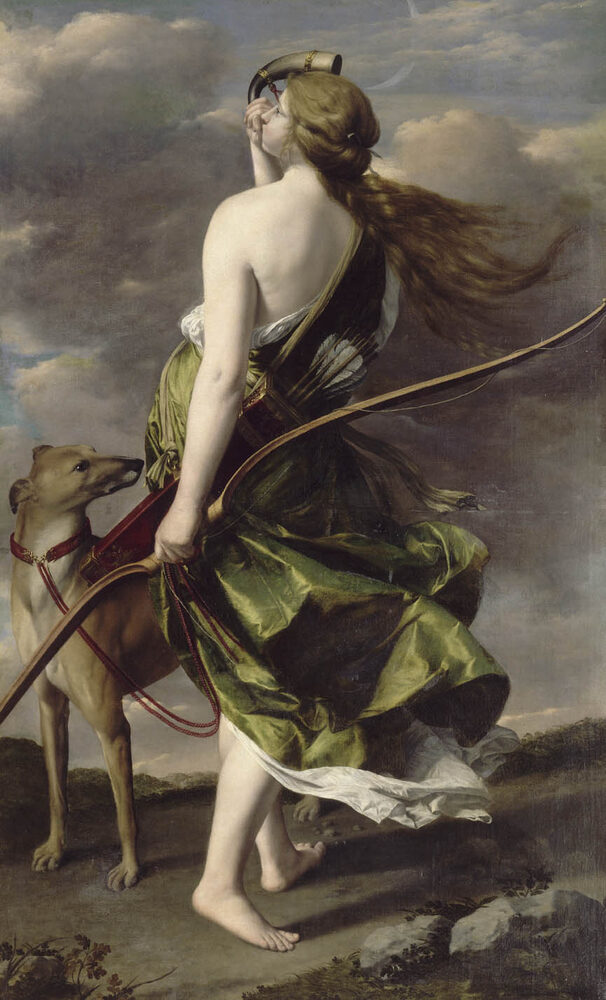
Artemis
First Appearance
Artemis first appears in the roll of Zeus's divine children: "And Leto was joined in love with Zeus who holds the aegis, and bore Apollo and Artemis delighting in arrows, children lovely above all the sons of Heaven." From her first mention she is already the archer-goddess, twin to Apollo and, with him, the most radiant of Zeus's offspring.
— Hesiod, Theogony 918–920
Who They Are
Artemis (AR-tuh-miss) is the Greek goddess of the hunt, of wild places and wild things, of childbirth, and of the young — the virgin huntress who ranges the mountains with her bow and her band of maiden nymphs. Twin sister of Apollo, daughter of Zeus and the Titaness Leto, she is one of the twelve Olympians, and among the most vividly drawn of all: swift, unmarried, and fiercely her own, a goddess of the untamed edges of the world beyond the ploughed field and the city wall.
Her bow is of gold and its arrows bring painless death; Homer names her Agrotera, the huntress of the wild (Iliad 21.471), while the Homeric Hymn calls her the one "delighting in arrows," whose passage sets the mountain-peaks trembling and the forests echoing with the cry of beasts. Yet the same goddess who fills the hills with slaughtered game is the guardian of everything young and growing — of the fawn and the cub, of children, and above all of girls on the threshold of womanhood. She is Potnia Theron, Mistress of Animals, holding in a single nature both the hunter and the protector of the hunted.
Two things define her more than any deed. The first is her chastity: as a small child, the poet Callimachus tells, she sat on her father's knees and begged to keep her maidenhood forever, and Zeus granted it — she is Parthenos, the Maiden, and woe to any who threatens that vow. The second is her closeness to birth and the young. Born first of the twins, she is said to have served as midwife to her own mother at Apollo's birth, and from that day she was called upon by women in the danger of labour. Wild and virgin, deadly and nurturing, she is the goddess of the boundary between the tame and the wild, and of every crossing from one stage of life to the next.
Mythology
Born first, midwife to her twin
Leto, pregnant by Zeus, was hounded across the earth by the jealous Hera, who forbade any land to give her rest. At last the small floating island of Delos (linked in myth with Ortygia, "Quail Island") dared to receive her, and there, clutching a palm tree, Leto came to term. In the version the Greeks loved best, Artemis was born first, swiftly and without pain — and then, still newborn, turned at once to help her labouring mother through the long and difficult birth of Apollo. From this the goddess took her lasting role over childbirth: the maiden who never bears children became the one women cry out to in their labour, as Lochia, "she of childbed." The bond between the twins runs through all her myths — she and Apollo hunt together, avenge their mother together, and again and again act as two halves of a single divine will, he of the sun and civic order, she of the moon-lit wild.
The eternal maiden and her nymphs
Callimachus imagines Artemis as a child asking Zeus for her gifts: eternal virginity; a bow and arrows, which the Cyclopes forge for her; the mountains for her domain; and a company of sixty young ocean-nymphs and twenty river-nymphs to run at her side, all sworn like her to maidenhood. This band of virgin huntresses is central to her: to run with Artemis is to renounce marriage, and any nymph who breaks the vow is cast out or worse. Her own chastity she guards without mercy, and the danger of coming near it echoes down her stories. The clearest case is the hunter Hippolytus, her most devoted mortal, who scorned love and sex entirely to serve her in the wild — and so insulted Aphrodite, who in revenge drove his stepmother Phaedra to a fatal passion for him and engineered his death (Euripides, Hippolytus). Artemis came to him as he died, honoured him, and vowed to repay Aphrodite in kind, but as a goddess she could not save her worshipper — a stark picture of the cost of standing wholly on her side of the line between chastity and desire.
Orion
Orion, the great hunter, was Artemis's companion in the chase, and the two grew close — closer, some said, than the maiden goddess should allow. In the telling this page follows, Apollo, jealous of his sister's fondness for the mortal, saw Orion swimming far out to sea with only his head above the water, a distant dark speck. He challenged Artemis, proud of her aim, to strike it — and she, not knowing what it was, loosed a perfect shot and killed her own friend. Grief-stricken, she set Orion among the stars as the constellation that still bears his name. Other traditions give a darker Orion: Homer's Odyssey (5.121–124) says Artemis simply slew him in Ortygia when the Dawn-goddess took him as a lover; and Apollodorus reports the famous version in which the boastful hunter offended the goddess and she sent a scorpion against him, so that hunter and scorpion alike were raised into the sky.
Callisto
Callisto was a nymph of Arcadia who ran in Artemis's train and shared her vow — until Zeus desired her and lay with her, and she conceived a son, Arcas. When her secret was discovered, she was turned into a bear; but the sources cannot agree on whose hand did it, and this page sets the three tellings side by side rather than choosing. In one, jealous Hera transforms her in fury at Zeus's affair. In another, it is Artemis herself who, betrayed by a companion who broke the maiden vow (the pregnancy revealed as the band bathed), strikes her into beast-shape. In a third, it is Zeus who changes her, hiding the affair from his wife. In every version she becomes a bear and, in the end, is set in the heavens as the Great Bear — Ursa Major — with her son near her as the lesser Bear.
Actaeon
(Content note: a myth of transformation and violent death.) Actaeon was a young Theban hunter, trained by the centaur Chiron, who met a terrible end: he was turned into a stag and torn apart by his own pack of hounds, who no longer knew their master. The reason varies. In the best-known telling he stumbled upon Artemis bathing naked in a forest pool, and the outraged goddess, unwilling that any man should see her, transformed him on the spot. In another he boasted that he was the finer hunter, or presumed to rival the goddess. Apollodorus (3.4.4) preserves an older reason attributed to the poet Acusilaus: that Zeus was angry with Actaeon for courting Semele, whom the god desired. Whatever the cause, the shape of the story is constant — a mortal crossed a divine boundary, and the wild he loved to hunt turned on him and destroyed him.
Niobe's children
Niobe, queen of Thebes, was the mother of many children — seven sons and seven daughters, in the usual count — and in her pride she boasted that she was greater than Leto, who had borne only two. Leto, stung, set her twins upon Niobe's family: Apollo shot down the sons as they hunted and exercised, and Artemis killed the daughters with her arrows (Apollodorus 3.5.6). Niobe was left childless and weeping, and was at last turned to stone, a rock face still wet with running water. The tale is the twins' fiercest defence of their mother's honour, and a warning against measuring oneself against the gods.
Iphigenia at Aulis
(Content note: threatened human sacrifice of a young woman.) When the Greek fleet gathered at Aulis to sail for Troy, the winds died — sent still, it was said, by an Artemis angered at Agamemnon. The seer declared that only the sacrifice of the king's own daughter, Iphigenia, would free the fleet. Here the tradition splits, and both endings deserve to stand. In the older and darker version, the knife falls: Iphigenia is truly killed at the altar to buy the wind for Troy. In the version Euripides made famous (Iphigenia in Tauris), Artemis herself takes pity at the last instant, snatches the girl away in a cloud, and leaves a deer dying on the altar in her place — carrying Iphigenia off to distant Tauris to serve as her priestess. Two irreconcilable memories of the same goddess: the one who demands a daughter's blood, and the one who reaches out to save her.
Worship — Ancient
A goddess of thresholds and the wild
Artemis was worshipped everywhere in the Greek world, but her sanctuaries cluster at the edges — in mountains, marshes, and coastal groves, at the boundary between the settled land and the wilderness she ruled. Her cult was above all a cult of transitions: she watched over children as Kourotrophos, over women in the mortal danger of childbirth as Lochia, and over girls as they left childhood behind. At Brauron in Attica — and at Mounichia near the Piraeus — girls on the threshold of marriage served her as arktoi, "little bears," in the rite of the Arkteia. Women who came safely through childbirth dedicated their clothing at Brauron in thanks; those who died in labour were remembered there too.
The little bears of Brauron
Artemis's most famous rite of passage was the arkteia, "the playing of the bear," performed at her sanctuaries at Brauron on the east coast of Attica and at Mounichia by the harbour of the Piraeus. Before an Athenian girl of good family could marry, she was expected at some point in her childhood to have "been a bear" for the goddess — to have served, dressed in a saffron-yellow robe (the krokotos), as one of the arktoi, the little she-bears of Artemis, dancing and running in her honour. The comic poet Aristophanes has his chorus of Athenian women count it among the sacred stages of a well-born girl's upbringing: at seven she carried the secret things, at ten she ground the grain for the goddess, "and then, in the saffron robe, I was a bear at the Brauronia" (Lysistrata 641–647) — and the ancient commentators on the passage preserved the story behind the rite.
That story told of a tame she-bear kept at the sanctuary, so gentle it lived among the people — until it scratched a girl who provoked it, and her brothers killed the beast in revenge. Artemis, angered at the death of her creature, sent a plague upon the Athenians, and the oracle declared it would lift only if their daughters "played the bear" for the goddess in atonement before they married. So in the rite the wildness taken from the bear was briefly given back: the girls became she-bears themselves, and shed that wildness when they set the saffron robe aside and crossed into womanhood. Much of what we know of the ceremony comes not from the poets but from the ground — the krateriskoi, small votive mixing-bowls found at Brauron and Mounichia, painted with girls, some robed and some running naked, circling an altar, at times with a figure in a bear's mask among them.
Sparta, Ephesus, and the many faces of Artemis
At Sparta she was worshipped as Artemis Orthia, in one of the oldest and strangest of her cults. Pausanias (3.16.7–11) records that her altar once demanded human blood by lot, until Lycurgus replaced the killing with a scourging of the young men — the ordeal in which Spartan boys endured whipping at the altar as a test of endurance, the priestess standing by with the little wooden image, which was said to grow heavy if the beating was too soft. Far to the east, at Ephesus, stood the goddess the Greeks called Artemis but who was really something else: the Lady of Ephesus, a many-breasted (or many-gourded) mother-goddess descended from an ancient Anatolian Great Mother akin to Cybele. Greek settlers gave her Artemis's name, but her image, rites, and fertile, maternal character remained her own — a distinct, syncretic deity best understood as Greek Artemis and Anatolian mother fused into one. Her temple was among the Seven Wonders of the world.
Rites and offerings
As Agrotera, "the Huntress," Artemis received the first-fruits of the hunt and was honoured before battle — the Athenians vowed her a goat for every enemy slain at Marathon. Hunters dedicated their catch, their horns and skins, to her; herdsmen and fisherfolk sought her favour over the creatures of hill and shore. Her sacrifices ranged from goats and deer to cakes moulded in the shape of stags or the crescent moon, and her groves were hung with the garments and small images of the girls and women in her care. Because she governed the perilous passages of life — birth, and the coming-of-age of the young — much of her worship was quietly practical: the prayers of those crossing from one state to the next, asking the goddess of the threshold to bring them through.
Worship — Modern
Honouring Artemis today
A modern Hellenic devotee can honour Artemis simply and sincerely, with no need for the animal sacrifice of the ancients. A small shrine — a shelf or a corner of a garden will serve — set with an image of a deer, a bow, or a crescent moon, a candle or lamp, and something living or wild (a sprig of cypress or laurel, a wildflower, a stone or feather found outdoors) gives the goddess a place. Many who feel drawn to her keep that connection outdoors: a walk in woods or hills, time spent with animals, or care for wild creatures is itself a fitting devotion to the Mistress of Animals. Cleanliness, respect, and a genuine love of the wild matter far more than elaborate ritual.
Offerings and prayer
Where the ancients burnt offerings, a household devotee today most naturally gives a libation and a share of food. Pour out clean spring water, wine, or milk into a bowl set aside for the goddess, or leave a cake, a little honey, or fresh fruit; incense is welcome. Present it with a few words of praise — to Artemis the huntress, the maiden, the light-bringer — and afterward set the offering aside or pour it onto the earth so that it is truly hers. Prayers to Artemis often ask for protection: for children and the young, for women through pregnancy and birth, for animals, and for safe passage through the changes and thresholds of a life.
By her many names
Call on the goddess by the aspect that fits the need. Invoke Artemis Agrotera in the wild, or before any pursuit that asks focus and a steady aim. Turn to Artemis Lochia and Kourotrophos for the protection of women in childbirth and of children as they grow. Honour Artemis Parthenos, the Maiden, in reverence for independence and self-possession, and for the right to belong to oneself. And under the night sky, many modern worshippers greet her as Phosphoros, the light-bringer — mindful that the ancient Artemis was distinct from Selene the Moon and Hecate of the crossroads, and that the blending of the three into one lunar goddess was a later development, honoured but understood as such.
Epithets & Cult Titles
- Potnia Theron (Πότνια Θηρῶν) — Mistress of Animals — Homer's title (Iliad 21.470) for the goddess who holds power over every wild beast
- Agrotera (Ἀγροτέρα) — The Huntress, She of the Wild — goddess of the open country, the chase, and the untamed land beyond the farm
- Parthenos (Παρθένος) — The Maiden, the Virgin — her chosen and unbroken chastity, the core of her nature
- Phosphoros (Φωσφόρος) — Light-bringer, Torch-bearer — she who carries fire through the night; later drawn toward her lunar aspect
- Lochia (Λοχία) — Of childbed — the helper of women in labour, invoked in the pains of birth
- Kourotrophos (Κουροτρόφος) — Rearer of the young — nurse and guardian of children through their perilous early years
- Orthia (Ὀρθία) — The Upright (meaning obscure) — her fierce ancient cult-title at Sparta, home of the boys' bloody endurance-rite
- Brauronia (Βραυρωνία) — Of Brauron — patroness of Athenian girls in their passage from childhood to marriage
- Ephesia (Ἐφεσία) — Of Ephesus — the great many-breasted Anatolian mother-goddess whom the Greeks merged with Artemis (a distinct, syncretic figure)
Sources & Variants
- Hesiod, Theogony 918–920 (birth of Artemis and Apollo to Leto and Zeus)
- Homeric Hymn 27 to Artemis (the huntress Agrotera and her chief epithets); Homeric Hymn 9 to Artemis
- Callimachus, Hymn 3 to Artemis (her wish for eternal maidenhood, the bow forged by the Cyclopes, her band of nymphs)
- Homer, Iliad 21.470–471 (Potnia Theron, Mistress of Animals); Odyssey 5.121–124 (Artemis slays Orion in Ortygia)
- Apollodorus, Bibliotheca 1.4.3–5 (Orion and the scorpion), 3.4.4 (Actaeon and its variant causes), 3.5.6 (Niobe's children), 3.8.2 (Callisto)
- Euripides, Iphigenia in Tauris (the deer-substitution and Iphigenia as Artemis's priestess); Hippolytus (Aphrodite's revenge on Artemis's devoted hunter)
- Pausanias, Description of Greece 3.16.7–11 (Artemis Orthia and the Spartan scourging); 1.33.1 (Brauron and the Tauric image of Artemis)
- Aristophanes, Lysistrata 641–647 with the ancient scholia (the arkteia: Athenian girls as arktoi, 'little bears,' in saffron robes at Brauron, and the myth of the tamed bear); the krateriskoi vases from Brauron and Mounichia (the rite's archaeological witness)
- Ovid, Metamorphoses 2.401–530 (Callisto) and 3.138–252 (Actaeon) — later Roman retellings, cited as such
Gallery