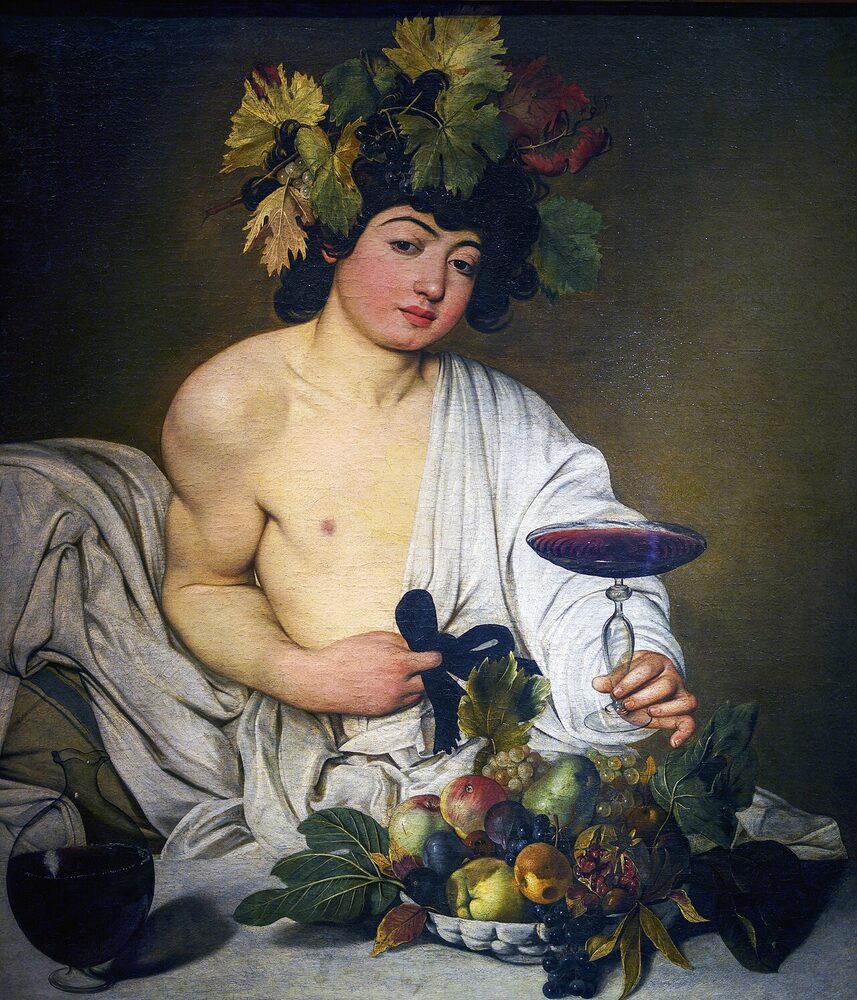
Dionysus
First Appearance
Dionysus first appears in Hesiod's catalogue of Zeus's divine children, where Semele, daughter of Cadmus of Thebes, is joined with Zeus in love and bears him "a splendid son, joyous Dionysus — a mortal woman an immortal son." Hesiod adds that both mother and child were made deathless, marking Dionysus from the very first as the god who crosses the boundary between mortal and divine.
— Hesiod, Theogony 940–942
Who They Are
Dionysus (dye-uh-NYE-sus) is the Greek god of wine, of ecstasy, and of the theatre — the immortal born of a mortal mother, forever half a stranger among the Olympians and forever the god who dissolves the line between the human and the divine. He is the loosener of care and the bringer of joy, the presence in the shared cup and the crowded festival; and he is, in the same breath, the god of frenzy and madness, whose gifts turn to terror in the hands of those who refuse him. No other Olympian holds these two faces so tightly together.
His name reaches far back: it is written already in the Bronze Age, in the Linear B tablets of Mycenaean Greece, centuries before Homer. The Greeks themselves sometimes treated him as a latecomer, a god arriving from the mountains or from the East to claim his worship — yet his cult was among the oldest and most widespread they had. He is the twice-born son of Zeus, snatched living from the ashes of his mother and carried to term in his father's own body, and this double birth is the key to everything about him: the god who has already died once, and come back.
Where Zeus rules from the bright order of Olympus, Dionysus belongs to the wild edges — the vineyard, the mountain by night, the ivy and the pine, the roving band of maenads and satyrs who follow him with drum and pipe. He is honoured for wine's power to release and to unite, and feared for its power to unmake; he is the god of the mask and the stage, of rebirth and the promise of a blessed lot beyond death. To meet him is to be changed, for better or for worse — and the surest way to disaster, his myths insist again and again, is to pretend he is not a god at all.
Mythology
The twice-born god
The central and best-known telling of his birth is Theban. Zeus loved Semele, a princess of Thebes and daughter of Cadmus, and came to her in secret. Jealous Hera, learning of the affair, disguised herself and coaxed Semele into a fatal doubt: was her lover truly the king of the gods? Semele extracted from Zeus an unbreakable oath to grant whatever she asked, and then asked him to come to her as he came to Hera — in his full divinity. Bound by his oath and unable to refuse, Zeus came to her chamber in his chariot amid lightning and thunder, and the mortal woman was consumed by the fire. But Zeus snatched the unborn child from the flames and sewed him into his own thigh, and when the months were complete he loosed the stitches and brought Dionysus forth a second time. From this comes his title Eiraphiotes, "the sewn-in," and his deepest identity: the god born twice, once of a mother and once of a god, who has passed through death before he ever drew breath.
The hidden childhood: Nysa and Ino
To keep the infant from Hera's wrath, Zeus had him carried far away and raised in secret. In the primary tradition — the one the Homeric Hymns tell — he was given to the rain-nymphs of the mythical mountain of Nysa, who nursed and hid him in a fragrant cave and crowned him with ivy and laurel; and, as Apollodorus adds, for their faithful care Zeus later set them among the stars as the Hyades, the rain-cluster on the brow of Taurus. A second, darker strand runs alongside it. Here the child was entrusted to his mortal aunt Ino, Semele's sister, and her husband Athamas, who raised him disguised as a girl to fool Hera. The disguise did not hold. (Content note: what follows turns violent.) A vengeful Hera struck the couple with murderous madness, and in their frenzy the household was destroyed — a first warning, in the god's own family, of what his power does when it is turned to punishment.
Wine, ivy, and the thiasos: joy and madness
At the heart of Dionysus is wine, and wine's double nature is his core theme. It is the loosener — Lyaeus, the god who unties — the gift that eases grief, warms company, and lifts the drinker for a while out of the narrow self. It is also the destroyer, the drink that unmakes judgement and looses the frenzy that ends in ruin. The same god gives both, and the Greeks never pretended otherwise. Around him moves his ecstatic following, the thiasos: the maenads or bacchae, women caught up in his rapture, dancing on the mountains with the ivy-wreathed wand called the thyrsus; the goat-legged satyrs, unruly and lustful; and old Silenus, his fat, drunken, wise foster-father, forever slipping from his donkey. To follow the god is to leave the ordered city behind and, for a night, to belong wholly to him.
The god who must be recognised: Pentheus, Lycurgus, and the pirates
Again and again the myths tell of rulers who deny Dionysus and are broken by him. The greatest of these is dramatised in Euripides' Bacchae. Returning to Thebes, his mother's city, the god finds his divinity denied and his rites forbidden by the young king Pentheus, Semele's own nephew. (Content note: the ending is graphically violent.) Dionysus drives the women of Thebes into ecstasy on Mount Cithaeron and lures the prying king to spy on them from a tree; the maenads, led by Pentheus's own mother Agave and believing they hunt a mountain lion, tear him apart with their hands, and Agave carries her son's head home in triumph before the madness lifts and she sees what she has done. The Thracian king Lycurgus met a kindred fate: he attacked the god and his nurses and drove Dionysus to take refuge in the sea, and for it he was struck mad, killing his own son with an axe in the delusion that he pruned a vine. Gentler in tone but the same in lesson is the tale of the Tyrrhenian pirates, told in the seventh Homeric Hymn: seizing the young god at sea and mistaking him for a wealthy prince to be sold, the crew found their ropes falling away, wine streaming across the deck, vines and ivy climbing the mast, and a lion rising amidships — and in terror they leapt overboard, and were changed into dolphins.
Ariadne and the descent for Semele
Not all his myths are punishment. On the island of Naxos, Dionysus found Ariadne, the Cretan princess whom Theseus had abandoned after she saved him from the Labyrinth, and took her as his bride; Hesiod says Zeus made her deathless and unaging for his son's sake, and her wedding-crown was set in the heavens as the Corona Borealis, the Northern Crown. And in one of the tenderest of his stories, Dionysus went down into the underworld itself to reclaim the mother he had never known. Descending — the Argives said — through the bottomless Alcyonian lake near Lerna, he brought Semele up out of death, raised her to godhood, and gave her the divine name Thyone, leading her up to dwell among the immortals.
Midas and the golden touch
(This tale survives fully only in the Roman poet Ovid, Metamorphoses 11, and is his most famous telling of the god.) When King Midas of Phrygia found the lost, wine-sodden Silenus and returned him safely, Dionysus offered any reward he wished. Midas asked that all he touched turn to gold — and the god granted it, sorry that the man had not chosen better. The gift became a curse the moment his food and drink hardened to metal in his mouth, and the starving king begged to be freed. Dionysus sent him to wash in the river Pactolus, whose sands (the story explains) have run bright with gold ever since.
The Orphic Dionysus: the myth of Zagreus
A wholly separate birth-story belongs to the Orphic and mystery tradition, and stands apart from the Theban telling above. In it Dionysus is Zagreus, the horned child of Zeus and his own daughter Persephone, whom Zeus meant to make heir of the cosmos. (Content note: this myth centres on the killing of a child.) The jealous Titans lured the infant with toys, seized him, and tore him apart, devouring the pieces — but his heart was rescued (by Athena, in the common version) and brought to Zeus, who from it begot the god anew. So the Orphics spoke of "two Dionysoi": the first who suffered dismemberment, and the son of Semele who is his rebirth. From the Titans' punishment, they taught, humankind arose, carrying both a Titanic taint and a spark of the god — the seed of the Orphic hope of purification and rebirth.
Worship — Ancient
The god of the city and the wild
Dionysus was worshipped everywhere in the Greek world, and his cult held together two things that seem opposite. On the mountains and in the biennial night-rites, women worshipped him as maenads in the ecstatic Oreibasia, dancing his frenzy far from the ordered town. Within the city, by contrast, he was a great civic god, honoured with processions, wine, and drama, his ivy and grape everywhere in Athenian art. His emblems were the thyrsus, the ivy wreath, the drinking-cup, the panther and the bull; his gifts to mortals were the vine and the knowledge of wine.
The birth of theatre
From the worship of Dionysus, and from nothing else, Western theatre was born. At the City Dionysia in Athens the god's image was carried into the great theatre on his southern slope, and over several days the tragedies, comedies, and satyr-plays were staged in competition before the whole citizen body — the setting in which Aeschylus, Sophocles, Euripides, and Aristophanes made their works. Tragedy is thought to have grown out of the dithyramb, the ecstatic choral hymn to Dionysus, and comedy out of his revel; the mask that transforms the actor was itself a Dionysian thing. To this day the theatre remains, at its root, his sanctuary.
Festivals of the wine and the dead
Alongside the Dionysia stood the ancient Anthesteria, the spring festival of the new wine — three days that began by broaching the year's jars and drinking together, and ended by turning to the dead, whose spirits were held to walk abroad before being sent away again. The winter Lenaia brought its own dramatic contest. In these festivals the god's two faces meet once more: the same wine that gladdens the living opens, for a moment, the door to the dead.
The mysteries and the Orphic promise
Dionysus was also a god of mystery-cult and of hope beyond the grave. Initiates of the Bacchic and Orphic rites were promised a blessed lot in the afterlife, and were buried with small inscribed gold-leaf tablets — the "Orphic gold tablets" found in graves across Greece and southern Italy — that gave the soul passwords and instructions for the road through the underworld, declaring the initiate a child of Earth and starry Heaven bound for the company of the blessed. In this aspect the twice-born god, who had himself passed through death and returned, offered his followers the promise of doing the same.
Worship — Modern
Honouring Dionysus today
Modern Hellenic polytheists honour Dionysus as a living god of joy, release, and transformation, and the practice can be kept simple and sincere. A small shrine — a clean shelf will serve — with an image of a vine or an ivy wreath, a wine-cup, and a candle gives him a place in the home. He is well met in company and celebration, and equally in the quieter work of the theatre, the arts, and any passage of grief into renewal. Because his gifts include both freedom and excess, devotees often pair his worship with a mindful respect for wine's double nature rather than mere indulgence.
Offerings
The natural offerings to Dionysus are his own: a libation of wine poured out to him, or grape juice for those who prefer it, along with grapes and other fruit, ivy, honey cakes, and incense. Present the offering with a few words of praise and thanks, and afterward pour out or set aside what was given so that it is truly the god's. A cup shared in his honour, poured first for him, is among the most fitting of all his rites.
Prayer & epithets
Call on Dionysus by the epithet that suits the moment. Invoke Lyaeus or Lysios, the Loosener, when you seek release from care or grief. Turn to Eleutherios, the Liberator, for freedom and for the courage to step beyond your ordinary self. Hail Bromios, the Roarer, in celebration and in the fullness of the festival. Remember Eiraphiotes and the twice-born god when honouring rebirth, recovery, or a new beginning after loss. And when you raise a cup among friends, name him simply as the god of the vine, who gives both the joy of the wine and the wisdom to know its measure.
Epithets & Cult Titles
- Bakcheus (Βακχεύς) — The frenzied one — god of the bacchic ecstasy (baccheia) he inspires; the source of the Roman name Bacchus
- Bromios (Βρόμιος) — The Roarer, the Thunderer — the loud-shouting god of the tumultuous rites and of the storm of his own birth
- Lyaeus / Lysios (Λυαῖος / Λύσιος) — The Loosener, the Releaser — who unbinds mortals from care, restraint, and grief
- Eleutherios (Ἐλευθέριος) — The Liberator — freer from the ordinary self; also linked to Eleutherae, the town from which his cult statue came to Athens
- Dithyrambos (Διθύραμβος) — A cult-title and the name of his ecstatic choral hymn — popularly read as 'twice through the door,' a nod to his double birth
- Eiraphiotes (Εἰραφιώτης) — The Sewn-in, He of the Thigh — born a second time from the thigh of Zeus (Homeric Hymn 1)
- Nyktelios (Νυκτέλιος) — Of the Night — god of the nocturnal mountain rites and the torchlit mysteries
- Iacchos (Ἴακχος) — The Cry — his name in the Eleusinian procession, personified as the shout that led the initiates toward Demeter
Sources & Variants
- Hesiod, Theogony 940–942 (birth of Dionysus from Semele), 947–949 (his marriage to Ariadne)
- Homeric Hymn 7 to Dionysus (the Tyrrhenian pirates); Homeric Hymn 26 to Dionysus (the nymphs of Nysa); Homeric Hymn 1 to Dionysus, fragmentary (the birth and 'Eiraphiotes')
- Euripides, Bacchae (the god's return to Thebes; Pentheus and Agave)
- Apollodorus, Bibliotheca 3.4.3 (birth and the thigh; Ino and Athamas), 3.5.1 (Lycurgus), 3.5.3 (the pirates; the descent for Semele and her deification as Thyone)
- Pausanias, Description of Greece 2.37.5 (the descent through the Alcyonian lake near Lerna to bring up Semele)
- Ovid, Metamorphoses 11.85–145 (Midas and the golden touch) — a Roman source, and the fullest surviving telling
- Orphic fragments and the Bacchic-Orphic gold-leaf tablets (the dismemberment of Zagreus by the Titans, his rebirth, and the promise to initiates)
Gallery