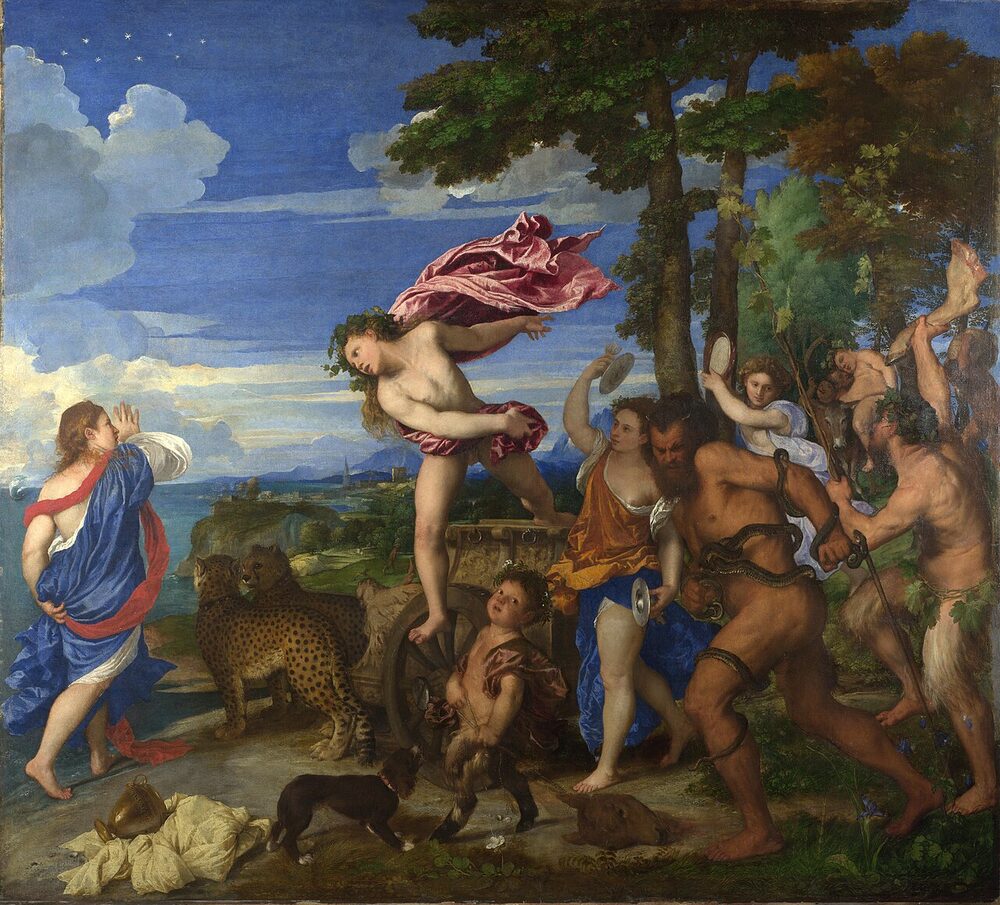
Ariadnē
First Appearance
Ariadne enters Greek poetry already trailing two different endings. In the Underworld catalogue of famous women in the Odyssey (11.321–325), Odysseus sees "Ariadne, the daughter of cruel Minos," and is told how Theseus once tried to carry her from Crete to Athens, "but he had no joy of her, for Artemis slew her first in sea-girt Dia, on the word of Dionysus" — the dark, older variant in which she dies. Hesiod's Theogony (947–949) preserves the bright ending that would win out: "golden-haired Dionysus made blonde Ariadne, the daughter of Minos, his buxom wife, and the son of Kronos made her deathless and unageing for him" — the mortal princess raised to be the immortal bride of the god.
— Homer, Odyssey 11.321–325; Hesiod, Theogony 947–949
Who They Are
Ariadne (a-ree-AD-nee) is the Cretan princess whose ball of thread runs through the most famous maze in the world — the woman who loved a foreign hero, saved him from the monster at the heart of the Labyrinth, was abandoned by him on a lonely island, and was found there and wed by a god. Her name means "the most holy" or "the utterly pure," and it is older and stranger than the tidy princess of the storybooks: beneath the daughter of King Minos lies an ancient Cretan goddess, worshipped on Crete and Cyprus long before the Athenians made her a chapter in the adventures of their hero Theseus.
Her story has two halves that pull in opposite directions, and the Greeks kept both. In the first she is the clever, generous helper — the king's daughter who falls in love with the captive Theseus and gives him the thread that lets him walk into the maze, kill the Minotaur, and walk out again alive. In the second she is the one left behind: carried off from Crete and then deserted while she sleeps on the shore of the island of Naxos, waking alone to find the hero's sails already small on the horizon. It is one of the most painful images in all of myth — and it is not where her story ends.
What redeems Ariadne, and what the ancients loved best about her, is the rescue that comes after the desertion. Onto that same shore comes Dionysus, the god of wine and wild joy, who finds the weeping woman, loves her, and takes her as his wife — not a passing fancy but a true and lasting marriage, and one that makes her immortal. As a wedding-gift he gives her a crown, and that crown he sets among the stars, where it shines still as the Corona Borealis, the Northern Crown. So Ariadne's arc bends, uniquely, from abandonment upward into the sky: the mortal girl deserted on a beach becomes the deathless bride of a god and a constellation that never sets.
Mythology
The house of Minos
Ariadne was born into the most powerful house in the sea. Her father was Minos, the great king of Crete, lord of a hundred cities and master of the strongest fleet of the age; her mother was Pasiphaë, herself a daughter of the Sun. It was a house shadowed by a famous curse. Minos had refused to sacrifice a beautiful bull that the sea-god Poseidon sent him, and in punishment Poseidon made Pasiphaë fall in love with the animal; from that monstrous union came the Minotaur — the "bull of Minos," a creature with the body of a man and the head of a bull, Ariadne's own half-brother by her mother. Ashamed and unwilling to kill it, Minos had the craftsman Daedalus build a vast winding maze, the Labyrinth, to hide the creature away; and into that maze, at the maze's dark centre, the Minotaur was shut to be fed on human flesh. All of this was the world Ariadne grew up inside — a palace of bewildering corridors above, and beneath it a brother who was a monster.
The tribute of Athens
A quarrel between Crete and Athens had given the Minotaur its terrible diet. Minos's son Androgeos had died on Athenian soil, and in revenge — after war and plague — Minos laid a cruel tribute on the city: every ninth year (or every year, in some tellings) Athens must send seven young men and seven young women to Crete to be put into the Labyrinth and devoured by the Minotaur. Twice the ship with its black sail of mourning had already sailed. On the third sending, the young Athenian prince Theseus volunteered to go as one of the fourteen, swearing to kill the monster and end the tribute for good. When the ship reached Crete and the captives were led before the royal house, Ariadne saw Theseus among them — and fell at once in love.
The ball of thread
Here is the deed for which the world remembers her. Ariadne knew what no captive could know: that the Labyrinth was not merely a prison but a trap of corridors so cunning that even one who killed the Minotaur would wander lost in the dark until he starved. So she went secretly to Theseus and struck a bargain — she would give him the means to escape the maze if he swore to take her away from Crete and make her his wife. He swore it. And she gave him a simple, brilliant gift: a ball of thread, called in the old word a clew (from which our word "clue" for the answer to a puzzle in fact descends). Theseus tied one end at the entrance of the Labyrinth and paid the thread out behind him as he went in, deeper and deeper along the winding ways, until he came to the centre and the waiting monster. In some tellings Ariadne had also gotten a sword to him. There in the dark Theseus killed the Minotaur — struck it down with his bare hands or with the blade — and then, gathering up Ariadne's thread and following it back turn by turn, he retraced his path out of the maze and into the light, the surviving youths and maidens with him. The full account of the fight and the escape belongs to the story of Theseus; but without Ariadne's thread there is no way out, and the hero dies in the maze with the monster. The rescue is hers.
Flight and abandonment on Naxos
That same night Theseus fled Crete by sea, taking Ariadne with him as he had sworn, the freed Athenians aboard and the black ship running north through the dark. And then comes the cruelty. On the island the Greeks called Naxos (older poets call it Dia), the ship put in — and there, while Ariadne slept on the shore, Theseus sailed away and left her. She woke to an empty beach and saw his sails already far out on the water, dwindling, gone. Why he did it the ancient writers could never agree, and their disagreement is itself a kind of mercy to the hero: some said he was faithless and simply tired of her; some that a storm drove him off; some that the god Dionysus came to Theseus in a dream and commanded him to give the woman up, because she was meant for the god himself; and later poets — the Roman Catullus above all, in his great poem 64, and Ovid — dwelt on Ariadne alone on the shore, crying out against the man who had used her thread to save his life and then deserted her sleeping. However it happened, the picture is the same: the woman who saved the hero, left behind on a strange island with the sea between her and everything she had given up for him.
Dionysus finds her
But the shore was not empty for long, and this is the turn that makes Ariadne's story unlike any other abandonment in myth. Onto that same island came Dionysus — the god of the vine, of wine and ecstasy and wild joy — with his train of dancing followers. He found the weeping, deserted woman on the sand, and he loved her. Not for a night: he took her as his true wife, and their marriage was one of the few in all of Greek myth that is simply, wholly happy. Where Theseus had abandoned her, the god cherished her; where a mortal husband had failed her, an immortal one raised her up. Hesiod records the crown of it plainly: Zeus made Ariadne "deathless and unageing" for Dionysus's sake, so that the mortal princess became a goddess and the god's undying bride. She bore him sons — among them Oenopion ("wine-face") and Staphylos ("cluster of grapes"), names heavy with the vine — and passed wholly out of the human world of Crete and Athens into the divine world of her husband.
The crown among the stars
For his bride Dionysus made a wedding-gift of surpassing beauty: a golden crown, wrought (some said) by Hephaestus and set with gems, or gleaming with the fire of Indian gold. And when their wedding was done — or, in another telling, after Ariadne's death, in grief and honour — Dionysus took that crown and flung it up into the heavens, where its jewels became stars. There it remains: the constellation Corona Borealis, the Northern Crown, a neat half-circle of stars in the northern sky, called by the Greeks simply Stephanos, "the Crown," and remembered as the crown of Ariadne. So the woman abandoned on a beach was answered, in the end, with a diadem of stars that wheels round the pole and never sinks below the sea — the most durable of all wedding-gifts, and the sky's own memorial to a rescued bride.
The darker thread: the variant of her death
It would be dishonest to leave out the other ending, for it is older than the happy one. In the oldest surviving mention of her, Homer's Odyssey (11.321–325), Ariadne does not become a radiant goddess at all: as Theseus tries to carry her from Crete to Athens, "Artemis slew her in sea-girt Dia, on the testimony of Dionysus" — killed on the island before she ever reached Athens, at the god's word, for some cause the poet does not explain (later writers guessed she had profaned a sacred place, or already belonged to Dionysus and so could not go with Theseus). Other local traditions had her die on the island in childbirth, alone and grieving, as the sorrowful rite at Cypriot Amathus remembered her. These darker versions sit alongside the shining one and were never fully erased; the Greeks let Ariadne be both the deathless bride crowned with stars and the woman who died on the lonely shore, and kept festivals of both joy and mourning for her on the same island.
The goddess beneath the princess
Behind all the versions stands something older than the story of Theseus. Ariadne's name — "the most holy," "the utterly pure" — is the name of a goddess, not a girl, and the evidence suggests she was worshipped on Crete as a divine figure of the old Minoan world long before Athenian storytellers folded her into their hero's adventure. Her cult-title Aridela, "the very bright," her worship as "Ariadne Aphrodite" on Cyprus, and her deep association with Crete and with the ecstatic god Dionysus all point the same way: she began as a Cretan goddess of vegetation, love, and perhaps the dance of the labyrinth itself, and was only later demoted in the myths to a mortal princess who is loved, used, and abandoned before a god restores her to the divinity she may have had all along. Read this way, her marriage to Dionysus is less a rescue than a homecoming — the goddess returning to the heaven she came from.
Worship — Ancient
A goddess older than her myth
Ariadne is one of those figures in whom a very old divinity shows through a later story. Though the myths make her a mortal princess of Crete, her cult and her name both point back to a goddess — very likely a deity of the Minoan world of Crete, honoured with dance and vegetation-rites long before she was written into the Athenian legend of Theseus. The scholar of Greek religion Karl Kerényi and others read her as a "mistress of the labyrinth" — and strikingly, a Linear B clay tablet from Bronze-Age Knossos records an offering of honey to just such a figure, da-pu-ri-to-jo po-ti-ni-ja, "the Lady of the Labyrinth," which may stand behind the goddess Ariadne became. Her divine aspect never wholly vanished, and in several places she received worship not as a heroine but as a goddess in her own right.
Naxos: the two festivals
The island of Naxos, where the myths set both her abandonment and her divine marriage, was the great centre of her cult, and it kept the double truth of her story in its rites. Plutarch (Life of Theseus 20) records that the Naxians honoured two different Ariadnes with two different festivals: for one they held a feast of gladness and rejoicing, celebrating the immortal bride of Dionysus; for the other a rite of grief and mourning, lamenting the mortal woman deserted and dead. The same island wept for her and rejoiced over her, keeping both her endings alive side by side — a rare and moving instance of a cult that refused to simplify its goddess.
Cyprus, Crete, and the mourning-rites
Her worship reached beyond Naxos. At Amathus on Cyprus, Plutarch (again in Theseus 20, citing the local historian Paeon) describes a grove of "Ariadne Aphrodite" and a sorrowful festival for an Ariadne said to have died there in childbirth after Theseus left her — a women's mourning-rite in which a youth lay down and imitated the cries of a woman in labour. On Crete, her homeland, her association with the ecstatic and vegetative powers ran deep, tying her to the wine-god Dionysus and to the old fertility religion of the island. Everywhere the pattern is the same: joy and grief tangled together, a goddess of the vine and the dance who is also the woman who suffered and was mourned.
Bride of the god
Above all, Ariadne was honoured as the immortal wife of Dionysus, and much of her later cult came in his company. Where Dionysus was worshipped with wine and ecstatic dance, his star-crowned bride stood beside him, the mortal woman raised to share his divinity — a comfort, perhaps, to ordinary worshippers, since her story promised that even one abandoned and undone could be lifted by the god into deathless joy.
Worship — Modern
The star-crown overhead
Ariadne's surest presence today is written in the sky. The Corona Borealis, the Northern Crown — the small, graceful half-ring of stars that the Greeks called simply "the Crown" — is her bridal diadem, the wedding-gift Dionysus flung into the heavens, and it still wheels around the northern pole where the ancients set it. To look up and find that neat curve of stars is to see Ariadne's answer to her abandonment: the crown that never sets, the sky's memorial to a rescued bride. Modern devotees who honour her often begin there, under the actual stars of her actual crown.
How she is honoured
Ariadne belongs, in modern Hellenic practice, to the circle of Dionysus, and those drawn to her most often honour her as his bride and as a figure of endurance — the one who was betrayed and abandoned and yet was found, loved, and raised to the stars. A simple remembrance suits her: a libation of wine poured out (her husband's gift and her domain), a length of red thread or a small woven clew set on a shrine in memory of the gift that saved the hero, an image of the Northern Crown, or the telling of her story. Because her tale runs straight through the depths of desertion and out the far side into joy, she is honoured as a patron of those who have been left behind and are waiting to be found — a goddess of the turn that comes after grief.
The oldest guiding thread
Beyond any formal cult, Ariadne survives in the language and imagination of the whole world through her ball of thread. The "clew" she gave Theseus — the thread that let him find his way out of the maze — is the direct ancestor of our word "clue": every time we speak of following a clue out of a mystery, we are unknowingly repeating her gift. Her thread has become the universal image of the thing that guides us through a bewildering place, and "Ariadne's thread" is still the name given, in logic and in life, to the patient method of finding one's way through a labyrinth of choices. The princess who solved the deadliest maze in the world lent her name to the very idea of a solution — and her story, from the thread in the dark to the crown in the stars, remains one of the most retold in all of Greek myth.
Epithets & Cult Titles
- Aridela (Ἀριδήλα) — "The very bright" or "the clearly seen" — a Cretan cult-title marking her shining, goddess-like aspect; some ancient writers said this was her older, truer name before it softened into Ariadne
- Ariagnē (Ἀριάγνη) — "The utterly pure" — a form of the name that shows its likely root in hagnē ("holy, chaste"), underlining her original character as a sacred, worshipped figure of Crete
- Ariadne Aphrodite — A cult-title recorded on Cyprus (at Amathus), where she was honoured as a goddess of love and fertility with her own rites — a trace of the Cretan goddess beneath the princess of the myths
- Bride of Dionysus / the Star-Crowned — A descriptive title for her ending: the mortal woman raised to be the immortal wife of the wine-god, whose bridal crown Dionysus set among the stars as the Corona Borealis, the Northern Crown
Sources & Variants
- Homer, Odyssey 11.321–325 (Ariadne daughter of Minos; Theseus carries her off, but Artemis slays her in Dia on the word of Dionysus — the dark variant)
- Hesiod, Theogony 947–949 (Dionysus makes golden-haired Ariadne his wife, and Zeus makes her deathless and unageing)
- Plutarch, Life of Theseus 19–20 (the thread and the escape; the abandonment on Naxos; the two Naxian festivals of joy and mourning; the rite of Ariadne Aphrodite at Amathus on Cyprus, citing Paeon)
- Apollodorus, Bibliotheca, Epitome 1.7–1.9 (Ariadne gives Theseus the clew of thread on Daedalus's advice; the Minotaur killed; abandonment on Naxos; Dionysus carries her off and sets her crown among the stars)
- Diodorus Siculus 4.61, 5.51 (Ariadne, Theseus, and Dionysus; her marriage on Naxos and her sons Oenopion and Staphylos)
- Catullus 64.50–266 (the lament of Ariadne abandoned on the shore, and the arrival of Dionysus with his revel-rout) — Roman
- Ovid, Metamorphoses 8.169–182 (the crown set among the stars as the Corona Borealis) and Heroides 10 (Ariadne's letter to Theseus from Naxos) and Ars Amatoria 1.525–564 — Roman
- Pausanias, Description of Greece 1.20.3, 2.23.7–8, 9.40.3 (traditions and memorials of Ariadne; her burial claimed at Argos; the crown of Ariadne)
- Knossos Linear B tablet Gg 702 (an offering of honey to da-pu-ri-to-jo po-ti-ni-ja, 'the Lady of the Labyrinth') — Bronze-Age cult evidence
Gallery