Priapos
First Appearance
Priapus comes relatively late into the record of Greek gods: he is not named in Homer or Hesiod, and his worship rises to prominence only in the Hellenistic age, radiating from the city of Lampsacus on the Asian shore of the Hellespont, which claimed him as its own. The traveller Pausanias (9.31.2) reports that Priapus was honoured especially by those who keep goats and sheep and bees, and set among the things of the countryside; and Diodorus Siculus (4.6) gathers the traditions of his birth and his place among the gods of generation and abundance, naming Lampsacus as the chief seat of his honours.
— The Hellenistic cult of Lampsacus on the Hellespont; Pausanias, Description of Greece 9.31.2; Diodorus Siculus, Library of History 4.6
Who They Are
Priapus (pry-AY-pus) is the rustic god of fertility and abundance — the protector of gardens, orchards, vineyards, beehives and flocks, whose weather-beaten wooden image stood among the vegetable beds of the ancient countryside as its guardian. He is a lesser god, bound not to the heights of Olympus but to the smallholding, the farm and the kitchen-garden, and his worship belonged to the people who worked the land: gardeners, vine-dressers, beekeepers and herdsmen, who thanked him for the yield of growing things and trusted his figure to keep thieves and ill-luck away.
Priapus is best known for a single, striking feature — he is always shown with a permanent, greatly exaggerated phallus. This is not, in its origin, a crude joke but a serious religious sign. In the ancient understanding the phallus was a symbol of generative power, of fertility and increase, and also an apotropaic emblem — a ward that turned away evil, barrenness and the envious "evil eye." Priapus' image was, in effect, a sacred scarecrow: set up at the edge of a garden, its very form was believed to frighten off thieves and birds and to turn aside harm, so that what grew within would flourish. To understand him rightly is to see past the later Roman taste for bawdy jokes at his expense and recover the figure the farmers knew — the humble, reliable guardian of the fruitful earth.
His parentage is told most often as the son of Dionysus, god of the vine and of fertile abundance, and Aphrodite, goddess of desire and generation — a union from which a god of swelling fruitfulness fittingly springs. A widely told strand explains his unusual form as the work of Hera's jealousy, who touched the unborn child in the womb so that he came into the world malformed. From these beginnings he grew into the patron of the garden and the orchard, a god small in rank but close to daily life, present wherever things were planted and tended and brought to harvest.
Mythology
The son of Dionysus and Aphrodite
The commonest account makes Priapus the son of Dionysus, the god of the vine, of wine and of teeming natural abundance, and Aphrodite, the goddess of desire, love and generation (Diodorus Siculus 4.6). The pairing is fitting: from the god of fruitful increase and the goddess of generative desire comes a god who embodies the swelling fertility of the garden and the orchard. Other traditions name different fathers — he is sometimes called the son of Zeus, or of Hermes, or of other gods, and his mother too is occasionally given as a nymph rather than Aphrodite — but the Dionysus-and-Aphrodite descent is the one most often repeated and the one that best explains his nature as a god of vine, fruit and fertility. His cult and his legend alike rose on the Asian shore of the Hellespont, and he seems to have come into the Greek world from that Anatolian borderland, taking on a Greek genealogy as his worship spread.
Hera's jealousy and the god's strange form
Priapus' defining feature — his permanent, greatly enlarged phallus — was explained by a myth of divine jealousy. In the account preserved by the scholia on Apollonius of Rhodes (1.932) and the Suda, Hera, the queen of the gods, was angered (in the usual telling, by Aphrodite, or by the circumstances of the child's conception) and took her revenge upon the unborn Priapus: she touched or cast a spell upon him in his mother's womb, so that he was born malformed, with the exaggerated body for which he became known. Ashamed, in some versions his mother exposed the infant, who was found and raised by shepherds in the countryside — which is why he belongs forever to the rustic world of herdsmen and gardeners rather than to the gleaming company of Olympus. The myth frames his form not as something comic but as a wound, a mark of a goddess's anger; and the people who worshipped him turned that very form into a source of protective power, making the sign of his affliction into a ward against the harm of others.
The gardener-god and the sacred scarecrow
Whatever the story of his birth, Priapus' living role was as the guardian of the garden. His image — most often a rough wooden figure or a herm, a post topped with a head and bearing his characteristic form — was set up at the boundary of gardens, orchards, vineyards and farm-plots across the countryside. There it served two purposes at once. It was a scarecrow in the plainest sense, a startling figure meant to frighten off birds and, above all, human thieves who might rob the ripening fruit. And it was an apotropaic guardian in the religious sense: the phallus was, to the ancient mind, a powerful sign that turned away the evil eye (the envious, blighting glance believed to wither crops and bring misfortune) and warded off barrenness and ill-luck. Set among the growing things, Priapus kept the plot safe and made it fruitful — the humble divine watchman of everything that was planted and tended. Farmers hung simple garlands on his figure and laid the first-fruits of the season before it in thanks.
Priapus and the nymph Lotis
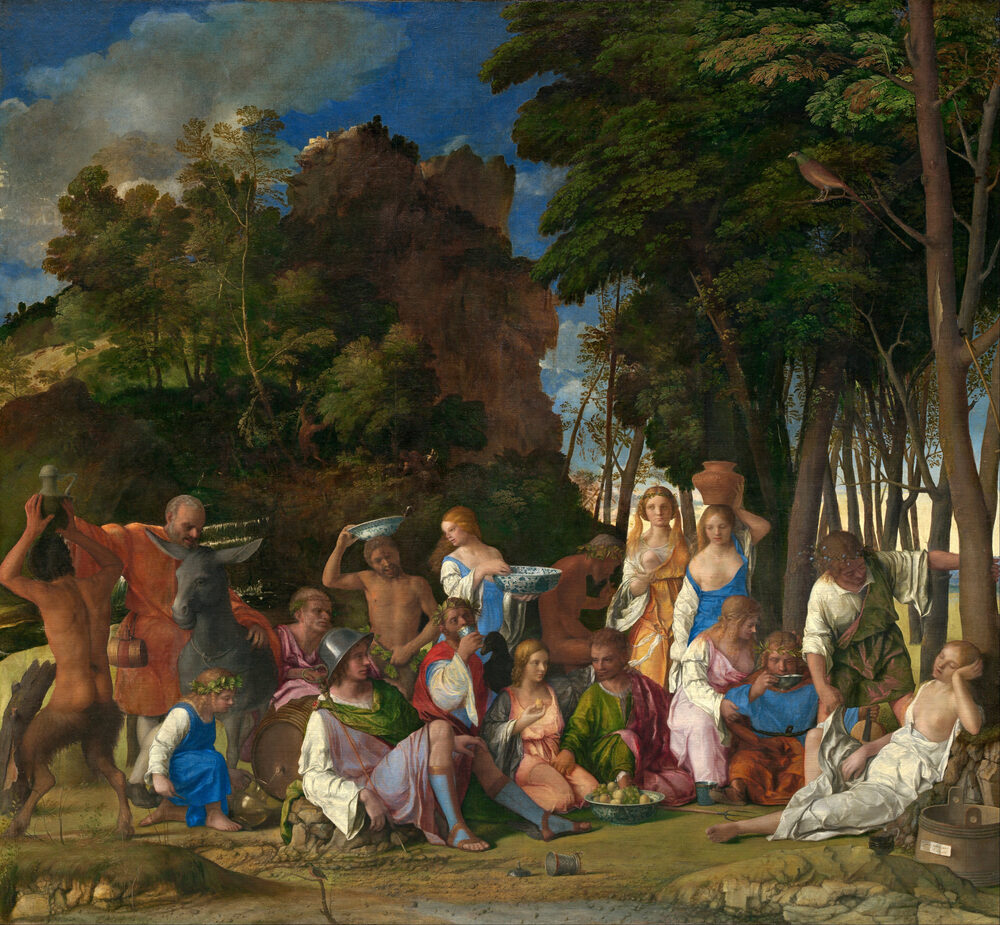
The best-known tale told of Priapus himself is the story of the nymph Lotis, which is preserved for us only in a later Roman source — the poet Ovid, in his Fasti (1.391–440; the poet gives a closely parallel braying-ass episode at 6.319–348, but there the sleeping goddess is Vesta, not Lotis) — and so should be read as a Roman literary treatment rather than an early Greek myth. In it, the gods and rustic spirits are gathered at a country feast. Night falls, and the company sleeps; Priapus, taken with the beautiful nymph Lotis, creeps silently toward her as she lies resting, hoping to approach her unseen. But at the crucial moment the donkey of old Silenus (Dionysus' companion) lets out a loud bray, startling the whole camp awake. Lotis springs up and flees, and Priapus is left exposed and laughed at before the assembled gods. Ovid offers the tale partly to explain why the donkey was sacrificed to Priapus in certain rites, and why his image and his festivities carried the note of ribald laughter in Roman custom. Told with restraint, the story is a cautionary and comic episode rather than a solemn myth; its importance here is mainly as the Roman literary shape Priapus' legend eventually took, well after the dignified farmer's cult of the Greek Hellespont.
A god of the margins
Priapus remained, throughout antiquity, a god of the edges — of the garden wall, the orchard boundary, the farm-gate, the shoreline where fishermen worked. He was never admitted to the first rank of the gods, and the poets of Olympus largely passed him by. But precisely because his sphere was the smallholding and the daily labour of the land, he was close to ordinary people in a way the great gods often were not. Beekeepers, gardeners, vine-dressers, shepherds and fishermen all claimed his protection, and his weathered image was one of the most familiar sacred objects of the rural world — a reminder that the Greeks honoured not only the splendid powers of the sky but also the humble, indispensable god who watched over the plot of earth that fed them.
Worship — Ancient
The cult at Lampsacus
The heart of Priapus' worship lay at Lampsacus, a city on the Asian shore of the Hellespont (the narrow strait between the Aegean and the Sea of Marmara), near which stood the town that bore the god's own name. Lampsacus claimed Priapus as its special deity and honoured him with the standing of a true city-god, and it is from this Hellespontine region that his cult spread into the wider Greek and, later, Roman world. The traveller Pausanias (9.31.2) notes that Priapus was held in particular honour there and by those who keep flocks and bees, and Diodorus Siculus (4.6) names Lampsacus as the chief seat of his rites. His rise to prominence belongs to the Hellenistic age rather than to the older world of Homer and Hesiod, who do not mention him; he seems to have entered Greek religion from the Anatolian borderland and found his great home on the Hellespont.
The guardian of garden and farm
Away from Lampsacus, Priapus' worship was everywhere local, rustic and domestic. There were few grand temples; instead his rough image — a wooden figure or a herm, often painted red — was set up in gardens, orchards, vineyards, apiaries and farmyards throughout the countryside. He was honoured not with great sacrifices but with the humble gifts of the land he protected: the first-fruits of the garden and orchard, grapes and figs at the vintage, honey from the hive, milk, small fish from the shore, and simple garlands hung upon his figure. His was the religion of working people — of gardeners, vine-dressers, beekeepers, herdsmen and fishermen — who trusted his guardian image to keep thieves and the evil eye at bay and to make their ground fruitful. In this he stood close to other rustic powers such as Pan and the nymphs, a lesser but beloved god of the fertile, laboured earth.
The apotropaic sign
Central to his cult was the understanding of his form as an apotropaic emblem — a sign that turns away harm. To the ancient mind the phallus was a symbol of generative life-force and, as such, a potent ward against barrenness, blight, envy and the evil eye. Priapus' image was therefore not displayed for shock or ridicule but set up with serious intent, as a protective guardian over the vulnerable, growing wealth of the garden and the vine. The farmer who placed Priapus at the edge of his plot was doing what others did who hung protective charms at a doorway: invoking a power believed to keep evil out and increase in.
Worship — Modern
A patron of gardeners and growing things
Priapus is remembered today chiefly as the ancient patron of the garden — and it is in that character that a modern devotee or gardener most naturally turns to him. He sits well as a guardian of the vegetable plot, the orchard, the vineyard and the beehive: a god to invoke at planting and to thank at harvest, the keeper of the small, fruitful corner of earth that is tended by hand. To lay the first ripe fruit of a season before his name, or simply to honour him as the spirit of the productive garden, is to keep faith with the farmers and gardeners who were his truest worshippers.
Recovering the dignity of the figure
Later antiquity, and especially the Roman literary tradition, made Priapus a figure of bawdy comedy, and that reputation has clung to him. A thoughtful modern honouring looks past it to the older, graver truth: that his exaggerated form was, to those who first worshipped him, a sacred and protective sign — an emblem of fertility and of the power that wards off harm, not a joke. Understood this way, Priapus speaks of the generative abundance of the living earth, of the protection of what is vulnerable and growing, and of the honour the ancients paid to the humble, indispensable work of making things grow. He is a reminder that the sacred was not only found in the splendour of the great gods but also in the plot of earth at one's own door.
Epithets & Cult Titles
- ho kēpouros (ὁ κηπουρός) — The gardener / keeper of the garden — Priapus' plainest and most characteristic title, the rustic deity set among the vegetable beds and fruit-trees to watch over what grows
- phylax (φύλαξ) — Guardian, watcher — the protective office at the heart of his cult; his image stood as a guard set over gardens, orchards and vineyards to keep thieves and birds away and to turn aside the evil eye
- Lampsakēnos (Λαμψακηνός) — Of Lampsacus — the god's defining local title, for it was at Lampsacus on the Hellespont and its neighbouring territory that his worship was first and most ardently kept
- apotropaios (ἀποτρόπαιος) — The averter of evil — the word Greeks used for images and powers that turn harm away; Priapus' exaggerated form was understood as an apotropaic sign, a ward against ill-luck, barrenness and the envious glance rather than an object of mockery
Sources & Variants
- Pausanias, Description of Greece 9.31.2 (Priapus honoured especially by keepers of goats, sheep and bees, and set among the things of the countryside)
- Diodorus Siculus, Library of History 4.6 (the birth and parentage of Priapus, and Lampsacus as the chief seat of his cult)
- Scholia on Apollonius of Rhodes 1.932 and the Suda s.v. Priapos (Hera's jealousy deforming the unborn child)
- The Hellenistic cult of Lampsacus on the Hellespont (the city that claimed Priapus as its own deity; the geographic and historical centre of his worship)
- Ovid, Fasti 1.391–440 (the tale of Priapus and the nymph Lotis, foiled by the braying donkey); 6.319–348 (the parallel braying-ass episode, there with Vesta) — later Roman source, not early Greek
Gallery