Hermaphroditos
First Appearance
Hermaphroditos surfaces in the record of the Hellenistic Greek world rather than in the old epic: Theophrastus (Characters 16), writing late in the fourth century BC, already takes it for granted that small images of the god — he says "the Hermaphroditoi," in the plural, as of familiar household figures — stand in Greek homes and are crowned with garlands on set days of the month. Diodorus Siculus (Bibliotheca 4.6.5), drawing on earlier Greek learning, gives the first full account: born of Hermes and Aphrodite, Hermaphroditos "received a name compounded of both his parents'," and grew to a body "of double nature" (diphyēs), bearing the forms of man and woman together — a being whom some reckoned a god appearing among men and others a portent, but whose beauty and dual nature the Greeks held in wonder.
— Theophrastus, Characters 16 (the superstitious man garlands the Hermaphroditoi); Diodorus Siculus, Bibliotheca 4.6.5 (the fullest early account of his nature and name)
Who They Are
Hermaphroditus (her-maf-roh-DYE-tus) is the beautiful child of Hermes and Aphrodite — his very name is their two names joined into one — who became a divinity of a single body bearing both sexes at once, man and woman together. He is one of the Greeks' most striking attempts to think about a nature that is not one thing or the other but genuinely both, and they treated him not as a curiosity but as a god: a figure of beauty, of the joining that marriage makes of two into one flesh, and of a wholeness that holds opposites within itself.
His story has two faces in the ancient sources. In the older and plainer Greek learning, preserved by Diodorus Siculus (Bibliotheca 4.6.5), Hermaphroditos is simply a dual-natured divine being, child of the two gods whose union his name records, honoured by some as a god and wondered at by all. In the fuller and far more famous tale — told at length only by the Roman poet Ovid (Metamorphoses 4.285–388), and so a later elaboration of the Greek figure — he begins as a beautiful boy who, bathing in the spring of Salmacis in Caria, is seized by the naiad of that water, and the two are fused by the gods into one body of both sexes. The spring near Halicarnassus that carried his name was real, and its waters had a reputation the ancients argued over for centuries.
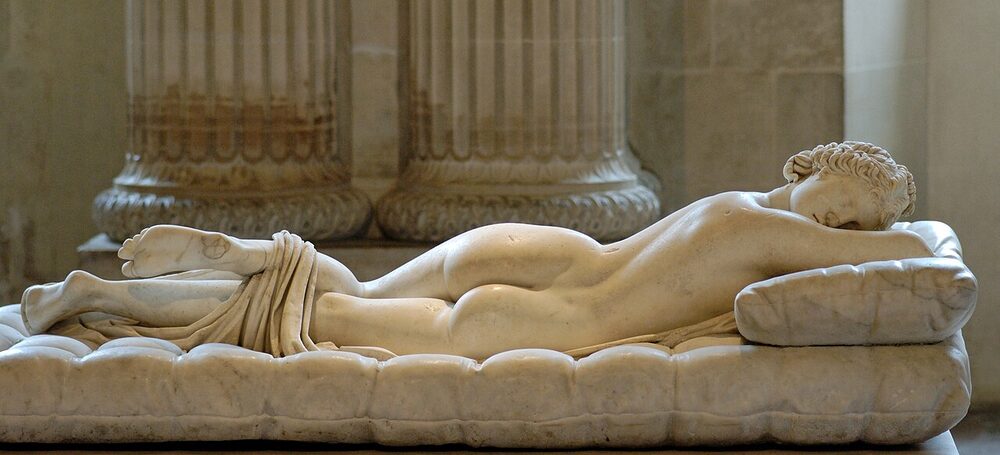
This page follows the ancient sources with the dignity the Greeks themselves gave the subject. To them Hermaphroditos was not a joke but a genuine object of thought and of modest worship — a divinity in whom the two natures the world usually keeps apart were held together in one beautiful form, and whose many serene statues, the famous "Sleeping Hermaphroditus," are among the most admired sculptures to survive from antiquity.
Mythology
The child whose name is his parents' names
Hermaphroditos was the son of Hermes, the swift messenger-god, and Aphrodite, the goddess of love and beauty — and the Greeks delighted in the fact that his name is quite literally the two of theirs set side by side, Hermês and Aphroditê fused into a single word. Diodorus Siculus records the genealogy plainly (Bibliotheca 4.6.5): the child "was called Hermaphroditos, a name compounded of both his parents'." The name was not given to describe his later nature; rather, the ancients felt, his nature answered his name, for the offspring of the god of boundaries and the goddess of union turned out to be a being who united in himself what is usually divided. From the first he was counted the fairest of children, carrying the beauty of his mother and the quickness of his father.
A being of double nature
In the oldest full Greek account — that of Diodorus (4.6.5), who drew on earlier learning — Hermaphroditos is simply diphyēs, "of double nature": a divine being born with a body that bears the forms of both man and woman together. Diodorus notes the range of ancient opinion about such a nature: some held Hermaphroditos to be a god who appears among men at certain times, his dual body a thing of wonder and beauty; others, more fearfully, counted the birth of a double-natured child among mortals a portent or sign. The Greeks had an older word for the condition too — androgynos, "man-woman" — and in Hermaphroditos they gave that nature a divine pattern and a face. Importantly, in this plain Greek telling there is no transformation and no spring: he is dual-natured from birth, by the gift of the two gods who made him. The famous story of how he became two-natured belongs to a later and more literary tradition.
The spring of Salmacis, in the later telling
The tale for which Hermaphroditus is best remembered is set at the spring of Salmacis in Caria, in southwest Asia Minor near Halicarnassus. Its fullest surviving form is the work of the Roman poet Ovid (Metamorphoses 4.285–388), writing in Latin at the turn of the first century AD — so although its roots are Greek and local to Caria, the elaborate narrative as we have it is a later Roman retelling, not early Greek myth, and is given here as such.
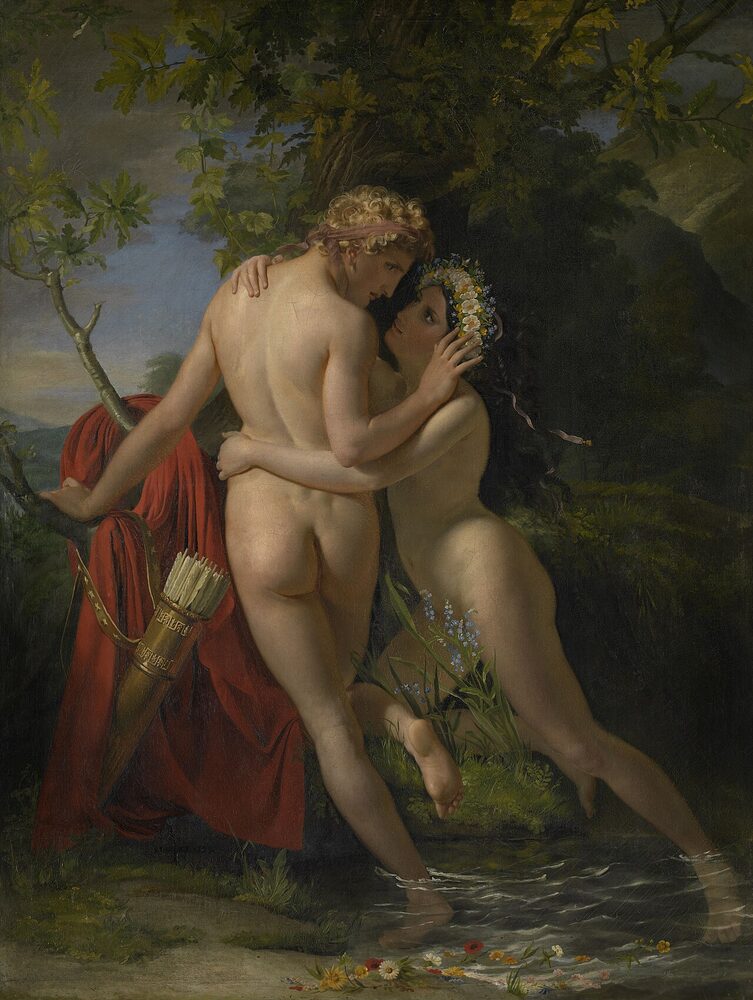
In Ovid's telling the boy Hermaphroditus, raised by naiads on Mount Ida and grown to a beauty in which both his parents could be seen, wandered at fifteen into Caria and came upon a clear, still pool. Its naiad, Salmacis, was unlike all other water-nymphs: she did not hunt with Artemis but idled by her own waters, bathing and combing her hair and gazing at her reflection. Seeing the boy, she was seized with desire and begged him to be hers; he, untouched and unwilling, refused and blushed her away. She pretended to withdraw into the woods, but hid and watched; and when the boy, thinking himself alone, stripped and slipped into the inviting water, she plunged in after him, wound herself about him though he struggled, and clung fast.
The two made one
As she held him, Salmacis prayed to the gods that the two of them might never be parted — that no day should ever separate her from him, nor him from her. The gods granted exactly the words of her prayer, though not in the way she had meant: the two bodies grew together and fused into a single form that was neither wholly woman nor wholly man but genuinely both at once, "no longer two, but a double shape that could not be called either and was called both," as Ovid renders it. The clinging embrace became one flesh. Thus, in this tradition, Hermaphroditos is not born dual-natured but made so, by the union of a nymph and a boy at the Carian spring — a different and later explanation than Diodorus's plain account of a double-natured child of the gods.
The spring's reputation, and the counter-prayer
Finding himself changed — his limbs now softer, his nature now twofold — Hermaphroditus prayed in his turn to his divine parents, Hermes and Aphrodite, that the spring which had transformed him should carry the same power forever: that any man who stepped into its waters should come out of them likewise softened and his nature doubled. His parents heard the prayer of their two-natured child and granted it, touching the pool with that quality (Ovid, Metamorphoses 4.383–388). This, the story explains, was the origin of the long reputation of the spring of Salmacis — that its waters "soften" those who bathe in them. The Greeks and Romans debated this reputation for centuries; some repeated the tale of the enervating water as fact, while others firmly denied it. The great inscription found at the spring itself (see below) was set up in part to defend Salmacis's good name — insisting that its water made men not soft but civilized, and that Hermaphroditos was a bringer of settled marriage, not of weakness.
The dual nature as a divine wholeness
Whichever origin the ancients preferred — the inborn double nature of Diodorus or the fused body of the Salmacis tale — the meaning they drew from Hermaphroditos was the same. He stood for the union of the two halves of humankind in a single form: the reconciliation in one body of what the world otherwise keeps apart. He was akin in the Greek mind to other androgynous or boundary-crossing figures — to Aphroditos, the male-formed Aphrodite worshipped on Cyprus, and to the broader idea that the divine might contain and exceed the division of the sexes. Far from being only strange, his nature spoke to the Greeks of completeness, of the joining that love and marriage seek, and of a beauty that belongs wholly to neither sex because it belongs to both.
Worship — Ancient
Household images and monthly garlands
Hermaphroditos was a god of the home and the small, regular devotion rather than of the great civic temple. The earliest clear evidence is also the most vivid: Theophrastus, in his sketch of the over-scrupulous, god-fearing man (Characters 16, late fourth century BC), reports that such a person "garlands the Hermaphroditoi on the fourth and seventh of the month" — crowning little images of the god, in the plural, as household figures that stood in Greek homes and received wreaths on set days. The casual, almost incidental way Theophrastus mentions it shows how ordinary such images and such honours had become in the Hellenistic Greek world.
Salmacis and the Halicarnassus inscription
The spring of Salmacis at Halicarnassus in Caria was the chief place associated with him, and it has left a remarkable witness. A long verse inscription set up at the spring (known from its rediscovery in the 1990s, and dating to about the second century BC) celebrates the water and its god and pointedly defends the spring's reputation: against the popular tale that its waters make bathers soft and unmanly, the inscription declares that Salmacis's stream civilizes rather than weakens, and praises Hermaphroditos — there nursed as an infant by the nymph — as the giver of ordered marriage and settled, law-abiding life to the people of the region. The inscription is precious evidence that Hermaphroditos had a genuine local cult tied to the bridal bond and to civic identity, and that the ancients themselves disputed the salacious version of the spring's fame.
God of the bridal chamber and the joined pair
Across the Greek world Hermaphroditos came to be honoured in connection with marriage — fittingly, since his single body made visible the joining of man and woman that the wedding enacts. His images were set up in gardens, baths, and gymnasia, and he was invoked at the bridal chamber as a patron of the union of the sexes. Statuary of him proliferated in the Hellenistic age, and the serene reclining type known as the "Sleeping Hermaphroditus" — a figure that appears from one side wholly a beautiful woman and reveals its double nature only as the viewer moves — was copied again and again; several ancient marbles survive, among them the celebrated examples now in the Louvre and in Rome, admired for their grace and their quiet play on expectation. That so many copies were made is itself evidence of how beloved and how widely displayed the figure was.
Worship — Modern
A patron of wholeness and of both natures
Hermaphroditos speaks directly to a modern devotee drawn to the idea of a divinity who holds both natures within one form. Honouring him today means meeting him as the Greeks did — not as a curiosity but as a god of wholeness, of the reconciliation of opposites, and of a beauty that belongs to neither sex alone because it belongs to both. He sits naturally as a patron of those who live between or beyond the ordinary division of the sexes, and more broadly of anyone seeking the union of parts of the self usually kept apart. A simple devotion might take his parents' domains as its frame: a word to Hermes for the crossing of boundaries and to Aphrodite for love, offered to the child in whom the two gods are joined.
The garland and the still water
The ancient forms carry over cleanly. As the Greeks hung garlands on his household images on set days of the month, so a small wreath or a flower set before his image keeps the oldest attested rite. And because his great story unfolds at a spring, still water suits him — a bowl of clear water, a pause beside a pool, a libation poured at the water's edge — recalling both the pool of Salmacis and the calm, reflective quality the ancients read into him. At the threshold of a marriage or a committed union he may be honoured as the god who makes two into one, the bringer (as the Halicarnassus inscription called him) of the ordered and settled bond.
The beauty that endures in stone
Above all Hermaphroditos endures through art. The "Sleeping Hermaphroditus" sculptures — the reclining figure whose double nature reveals itself only as one walks around it — are among the most admired survivals of ancient art, still drawing crowds in the Louvre, the Palazzo Massimo in Rome, and elsewhere; the most famous rests on a soft marble mattress carved later by Bernini. To stand before one of these is a kind of devotion in itself: a meeting with the Greeks' serene, dignified vision of a being who is genuinely both, and whom they chose to render not as a shock but as a thing of beauty and repose.
Epithets & Cult Titles
- diphyēs (διφυής) — Of double nature / two-formed — the standard Greek word for his condition, a single being in whom the natures of man and woman are joined; Diodorus uses it of him directly (Bibliotheca 4.6.5)
- androgynos (ἀνδρόγυνος) — Man-woman — the older Greek term for one bearing both sexes; the ancients applied it to Hermaphroditos as the divine pattern of that nature rather than as an insult
- the child of Hermes and Aphrodite — His defining identity, carried in the name itself — Hermaphroditos is quite literally Hermês-and-Aphroditê made one word, the son whose name is the sum of his parents'
- lord of Salmacis — His title at the spring in Caria that bore his story — the still pool near Halicarnassus whose waters were said to carry the mark of his transformation
Sources & Variants
- Diodorus Siculus, Bibliotheca Historica 4.6.5 (Hermaphroditos, child of Hermes and Aphrodite, named from both parents and of double nature — diphyēs; ancient opinion split between god and portent) — the fullest early Greek account
- Theophrastus, Characters 16 (the superstitious man garlands the Hermaphroditoi on the fourth and seventh of the month — earliest evidence of household images and cult)
- The Salmacis / Halicarnassus inscription (verse inscription from the spring at Halicarnassus, c. 2nd century BC, rediscovered 1990s): defends the spring's reputation and praises Hermaphroditos, nursed there, as giver of ordered marriage and civilized life
- Strabo, Geographica 14.2.16 (on the spring of Salmacis near Halicarnassus and the dispute over its reputed power to soften those who drink or bathe)
- Vitruvius, De Architectura 2.8.11–12 (on the spring of Salmacis and a rationalizing explanation of its 'softening' fame) — Roman
- Ovid, Metamorphoses 4.285–388 (the fullest Salmacis tale: the naiad's desire, the boy's refusal, the fusing of the two bodies into one of both sexes, and Hermaphroditus's counter-prayer giving the spring its power) — a later Roman retelling of the Greek local myth
- The 'Sleeping Hermaphroditus' statue type (Hellenistic original, many Roman copies: the Borghese/Louvre marble and the example in the Palazzo Massimo alle Terme, Rome; mattress by Gian Lorenzo Bernini, 1620)
Gallery