Aphrodite
First Appearance
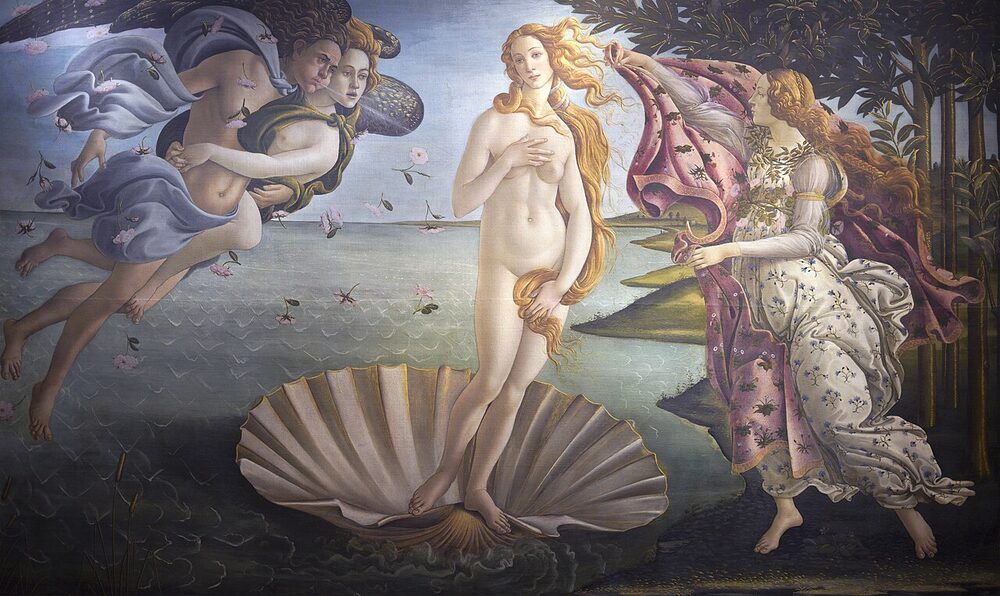
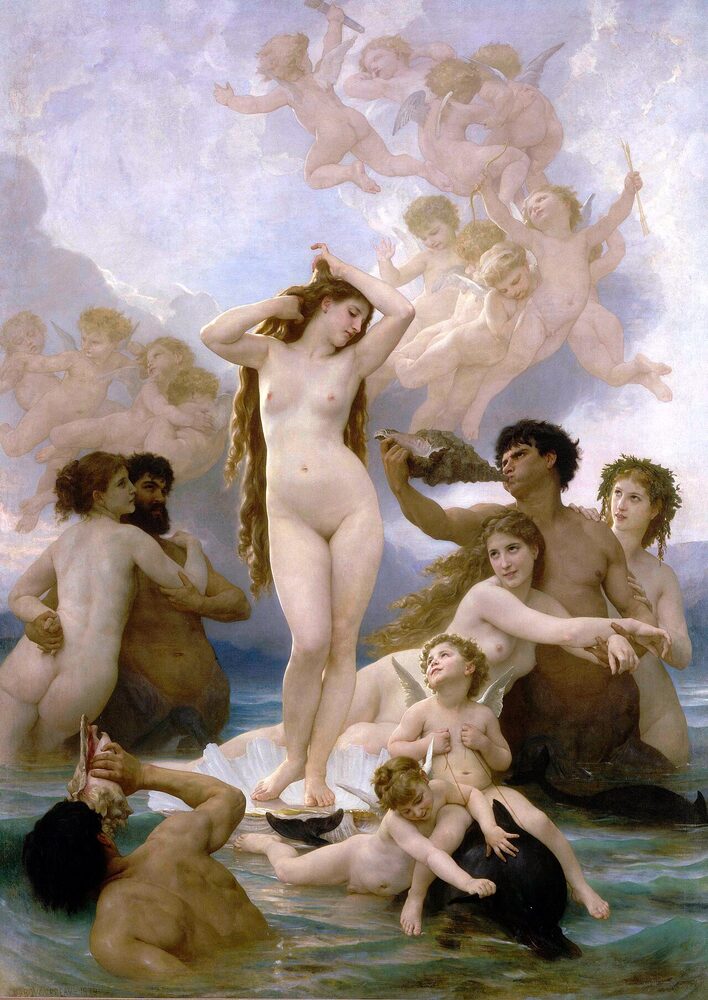
Aphrodite first appears as the foam-born goddess. When Cronus severed the genitals of his father Uranus and flung them behind him into the sea, an immortal white foam (aphros) gathered about the drifting flesh, and within it a maiden grew. She was carried first past holy Cythera and then to wave-washed Cyprus, where she stepped ashore a dread and lovely goddess, and soft grass sprang up beneath her slender feet.
— Hesiod, Theogony 188-206
Who They Are
Aphrodite (af-ro-DYE-tee) is the Greek goddess of love, beauty, desire, and sexual pleasure — the irresistible power that draws living things together, stirs the union of gods, mortals, and beasts, and so keeps the world peopled. Born of the sea, she is also a goddess of the deep and a protector of sailors, worshipped in harbours as Aphrodite Euploia, "of the fair voyage." The Greeks felt her not as a gentle sentiment but as a force: a compulsion that can bless a marriage or wreck a city, and that no one, save perhaps Athena, Artemis, and Hestia, can wholly resist.
Her name the Greeks explained as "foam-born," from aphros; the derivation is a folk etymology (her name is more likely pre-Greek, and her cult carries deep debts to the Near-Eastern goddesses Ishtar and Astarte), but it fixed her origin firmly in the myth of her sea-birth. From that birth flow her two most famous cult-titles, Kypris "the Cyprian" and Kythereia "the Cytherean," for the islands her foam-cradle drifted past and came ashore upon.
In myth she is laughter-loving and quick to charm, but also proud and dangerous when scorned: the same goddess who lends Hera the girdle that makes any wearer irresistible will drive a chaste prince to ruin, or curse a whole island of women with a stench, for the slighting of her honours. The Greeks worshipped her in two great aspects — Aphrodite Urania, the Heavenly, of pure and transcendent love, and Aphrodite Pandemos, the Common, of the whole people and of ordinary earthly desire — and knew that both, in their seasons, held sway over gods and men alike. (Her Roman name is Venus.)
Mythology
Born of the sea-foam
Hesiod gives Aphrodite the strangest and grandest of birth-stories. When Gaia, weary of Uranus's endless weight, armed her son Cronus with a sickle, he cut off his father's genitals and hurled them behind him into the sea. Around the immortal flesh a white foam (aphros) gathered, and in it a girl was nourished and grew. The waves bore her first past Cythera, then to Cyprus, where she came ashore at Paphos as a fully grown and awe-inspiring goddess, grass springing up beneath her feet, with Eros and Desire (Himeros) as her attendants from the first. Homer preserves an older and simpler tradition, in which Aphrodite is instead the daughter of Zeus and the goddess Dione (Iliad 5.370); the two accounts sat side by side in Greek thought, and Plato's Symposium even makes them two distinct goddesses. The two sit side by side in how she is remembered: the foam-birth is by far the more striking and more often pictured — the Anadyomene, the goddess rising from the waves — while Homer's is the plainer parentage that makes her simply one more daughter of Zeus, the version many still take for granted when they name her kin. This page follows Hesiod's foam-birth as the primary telling while giving Homer's parentage its full due.
Eros, the first of the gods
It is easy to picture Eros as Aphrodite's mischievous winged son, and later poets did make him so — the archer-child born of her union with Ares. But the oldest tradition is far stranger. In Hesiod's cosmogony (Theogony 116-122), Eros is one of the very first powers to come into being, alongside Chaos, Gaia, and Tartarus at the dawn of the cosmos — "fairest among the deathless gods, who loosens the limbs and overmasters the mind and wise counsel of all gods and all men." In this reckoning Desire is older than the gods it moves, a primal force woven into creation itself, not the child of any deity. This page follows Hesiod: Eros leads as a primordial first-force, with the familiar tale of Eros as Aphrodite's son and companion given as the later, secondary telling.
The judgement of Paris
When Eris, goddess of strife, threw a golden apple inscribed "to the fairest" among the wedding-guests of Peleus and Thetis, Hera, Athena, and Aphrodite each claimed it. Zeus, unwilling to judge, sent them to the Trojan prince Paris on Mount Ida. Each goddess offered a bribe: Hera empire, Athena victory and wisdom, and Aphrodite the most beautiful woman in the world. Paris chose Aphrodite — and so was given Helen, wife of Menelaus of Sparta. In carrying Helen home to Troy, Paris lit the ten-year Trojan War. Throughout the Iliad Aphrodite remains fiercely partisan for Troy, even snatching Paris from the battlefield in a mist and, when she ventures onto the field to rescue her son Aeneas, being wounded in the wrist by Diomedes so that her ichor flows; her mother Dione consoles her, and Zeus gently warns her that war is not her province (Iliad 5.311-430).
The girdle of desire
Aphrodite's chief instrument is the kestos himas, an embroidered girdle or breast-band into which are worked love, longing, and the sweet whispered persuasion that steals away the wits even of the wise. In the Iliad (14.214-223), Hera — scheming to lull Zeus to sleep and turn the war — coaxes the band from Aphrodite under a pretext, tucks it into her bosom, and so makes herself irresistible to her husband. The girdle is the perfect emblem of the goddess: her power is not force but an enchantment against which no will holds firm.
Ares and the net of Hephaestus
Though wedded to Hephaestus, the lame smith-god, Aphrodite loved Ares, the god of war, and the two met in secret. The tale is told most fully in the song the blind bard Demodocus sings at the Phaeacian court (Odyssey 8.266-366). Helios the Sun, who sees all things, catches the lovers together and reports them to Hephaestus. The wronged husband forges a snare of bronze links finer than a spider's thread and invisible even to the gods, drapes it about his bed, and announces that he is going away to Lemnos. Ares slips in at once; but as the lovers lie down the cunning net drops and binds them fast, unable to move. Hephaestus summons the other gods to witness the wrong done him, and they crowd to the doorway — the goddesses staying home for modesty — and break into unquenchable laughter at the sight, Apollo and Hermes jesting that Hermes would gladly lie so bound if it meant lying beside golden Aphrodite. At Poseidon's urging Hephaestus frees the pair; Ares flees to Thrace, and Aphrodite goes to her sanctuary at Paphos on Cyprus, where the Graces bathe and anoint her and clothe her in loveliness once more.
Anchises and the birth of Aeneas
Aphrodite delighted in bending the other gods to mortal loves, until Zeus turned her own weapon against her (Homeric Hymn 5). He cast desire into her heart for Anchises, a herdsman of noble blood tending cattle on the slopes of Mount Ida. Disguised as a mortal princess, she came to him and lay with him; from that union she bore Aeneas, who would survive the fall of Troy and, in Roman tradition, father the line of Rome. It was her one great humbling: the goddess who had laughed at gods enslaved to mortal beds now knew the same yoke, and could no longer boast of it. Anchises, who unwisely spoke of his divine lover, was struck lame or blind for the boast. (Aeneas belongs to the wider tradition and is not tracked as a node here.)
Adonis and the anemone
Aphrodite loved the beautiful mortal youth Adonis, whom she hid as an infant in a chest and gave to Persephone to keep. Persephone, too, came to love him, and the two goddesses quarrelled over him until Zeus (or Calliope, in one telling) ruled that Adonis should spend part of the year with each. But Adonis was gored to death by a wild boar while hunting, and from his spilled blood, or from Aphrodite's tears, sprang the short-lived red anemone. His yearly death and return made him a figure of the dying and reviving year, mourned by the women of Greece at the festival of the Adonia. (The fullest surviving narrative is Ovid's, Metamorphoses 10 — a Roman retelling.)
The wrath of the slighted goddess
Content note: these are tales of divine punishment, some harsh. Aphrodite's gifts are freely given, but her honours must not be scorned. When the young prince Hippolytus devoted himself wholly to chaste Artemis and spurned love, Aphrodite engineered his destruction, kindling in his stepmother Phaedra a ruinous passion that ended in both their deaths. When the women of Lemnos neglected her rites, she cursed them with a foul stench that drove their husbands away — with murderous consequences. And when Eos, or the daughters of Cinyras, offended her, she bent their desires to their undoing. To honour Aphrodite is to acknowledge a power that will not be denied its due.
Pygmalion's statue
The sculptor Pygmalion, disgusted with the women around him, carved an ivory statue of a woman so lovely that he fell in love with it. At her festival he prayed to Aphrodite for a wife like his ivory maiden; the goddess, understanding his true wish, brought the statue to life beneath his kiss, and the two were wed. It is one of the tenderest of her interventions — proof that the same goddess who wields the ruinous girdle also answers the sincere longing of the faithful. (The tale is told fully by Ovid, Metamorphoses 10, in Roman dress.)
Worship — Ancient
Cult centres
Aphrodite was worshipped throughout the Greek world, but her heart was in the east and on the islands. Her greatest sanctuary stood at Paphos on Cyprus, where by tradition she had come ashore and where her cult-image was not a statue but an aniconic conical stone. On Cythera, off the southern Peloponnese, Pausanias saw what he called the most holy and most ancient of all Aphrodite's Greek sanctuaries, dedicated to her as Urania and holding an armed wooden image of the goddess (Description of Greece 3.23.1). At Athens she was honoured both as Urania and, on the slopes below the Acropolis, as Pandemos, "of all the people," a goddess of the united citizen body.
Content note: the following is a disputed ancient claim. Of Corinth, the geographer Strabo reports (8.6.20) that the temple of Aphrodite on the summit of Acrocorinth was so wealthy it owned more than a thousand sacred servants (hierodouloi) dedicated to the goddess, and he links this to the city's reputation for courtesans. This lurid picture of temple "sacred prostitution" was long repeated, but modern scholarship treats it with deep skepticism: the Greek terms need not mean cult prostitutes, Strabo may be projecting later gossip back onto archaic Corinth, and there is no firm archaeological support. It is best read as an ancient exaggeration, not a documented rite.
The two Aphrodites and the armed goddess
Greek thought drew a lasting distinction between Aphrodite Urania, the "Heavenly," born of Uranus alone and standing for pure, celestial, transcendent love, and Aphrodite Pandemos, the "Common," daughter of Zeus and Dione and presiding over ordinary bodily desire — a contrast given its classic form in the speech of Pausanias in Plato's Symposium (180d-181c). Alongside these she kept, in a few old cults, a startling martial aspect: the armed Aphrodite, Aphrodite Areia, worshipped with an ancient wooden image at Sparta (Pausanias 3.15) and shown bearing weapons on Cythera — a memory, perhaps, of her Near-Eastern warlike forebears.
Rites and attendants
Aphrodite's worship was gentler in its offerings than most: incense, flowers (especially myrtle and roses), honey, and doves were laid before her, and at Paphos and her Urania sanctuaries her altars by custom received no blood sacrifice. In myth and cult she was attended by the Charites (the Graces), givers of beauty and charm, and by the Horae (the Seasons), who clothed and adorned her when she rose from the sea — the whole retinue an image of blossoming, ripening loveliness. Sailors invoked her as guardian of safe voyages, brides sought her blessing on their marriages, and the whole community honoured her at the Aphrodisia as the power that binds and renews human life.
Worship — Modern
Honouring Aphrodite today
A modern Hellenic devotee can honour Aphrodite simply and sincerely. A small shrine — a clean shelf will do — bearing a shell, a mirror, a fresh flower, and an image of a dove gives the goddess a place in the home. Keep the space beautiful and clean, for beauty is itself an offering to her. Approach her with a calm and open heart; she is honoured by self-care, by kindness in love, and by a genuine appreciation of beauty in the world, as much as by any formal rite.
Offerings
Where the ancients gave incense and flowers, a devotee today can offer the same: light incense (rose or myrtle are fitting), set out fresh flowers, and pour a small libation of sweet wine, or of honey-water or rosewater if wine is not wished. Sweet foods, honey, and fruit are welcome. In keeping with her ancient cult, Aphrodite's offerings are bloodless. Present each gift with a few words of praise and thanks, and afterward set aside or pour out what was given so that it is truly hers.
Prayer & epithets
Call on Aphrodite by the aspect that fits your need. Turn to Aphrodite Urania, the Heavenly, for deep, devoted, or spiritual love; to Aphrodite Pandemos for warmth and goodwill within a community or a partnership. Invoke Kypris or Kythereia, her sea-born titles, in gratitude for beauty and for safe passage, and Anadyomene, the sea-risen, for renewal and fresh beginnings. Ancient and modern practice should be kept distinct: this is living reverence offered in a modern spirit, not a reconstruction of any specific ancient ceremony. Honour her, above all, by treating love and beauty — your own and others' — with respect.
Epithets & Cult Titles
- Urania (Ourania) — Heavenly — Aphrodite of celestial, transcendent love; the elder goddess sprung from Uranus alone (Plato, Symposium 180d)
- Pandemos — Of all the people, Common — Aphrodite of the whole community and of ordinary, earthly desire; also a goddess of civic unity
- Kypris — The Cyprian — for Cyprus, the island where she first stepped ashore at Paphos
- Kythereia — The Cytherean — from Cythera, the isle the foam drifted past before reaching Cyprus
- Anadyomene (Ἀναδυομένη) — Rising from the sea — the goddess emerging from the waves and wringing the foam from her hair, made famous by the painter Apelles
- Philommeides (Φιλομμειδής) — Laughter-loving — Hesiod's standing epithet, punningly 'genital-loving' (philommedes) in memory of her birth from Uranus's severed flesh
- Areia — Warlike — the armed Aphrodite honoured with an ancient wooden image at Sparta and on Cythera
Sources & Variants
- Hesiod, Theogony 188-206 (birth from the sea-foam), 116-122 (Eros as a primordial power), 933-937 (children by Ares: Phobos, Deimos, and Harmonia)
- Homer, Iliad 5.311-430 (Aphrodite wounded by Diomedes; Dione her mother), 14.214-223 (the girdle lent to Hera)
- Homer, Odyssey 8.266-366 (the song of Demodocus: Ares and Aphrodite caught in the net of Hephaestus)
- Homeric Hymn 5 to Aphrodite (Anchises and the conception of Aeneas)
- Sappho, fragment 1 (the Ode / Hymn to Aphrodite)
- Plato, Symposium 180d-181c (Aphrodite Urania and Aphrodite Pandemos)
- Pausanias, Description of Greece 3.15 (armed Aphrodite Areia at Sparta); 3.23.1 (the ancient sanctuary of Aphrodite Urania on Cythera)
- Strabo, Geography 8.6.20 (Corinth and the disputed claim of temple 'sacred prostitution' — an ancient report modern scholars question)
- Apollodorus, Bibliotheca 1.3.1 and 3.14.3-4 (birth traditions; Adonis)
- Ovid, Metamorphoses 10 (Pygmalion; Adonis and the anemone — Roman retellings)
Gallery
Explore Related Figures
- Apollon
- Ares
- Arges
- Artemis
- Athena
- Briareus
- Brontes
- Calliope
- Charites / the Graces
- Clio
- Coeus
- Cottus
- Crius
- Cronus
- Dione
- Dionysus
- Dioskouroi / the Dioscuri
- Eileithyia
- Erato
- Erinyes / the Furies
- Euterpe
- Gigantes
- Gyes (Gyges)
- Harmonia
- Hebe
- Helenē
- Hephaestus
- Herakles
- Hermes
- Horai
- Hyperion
- Iapetus
- Kritai tōn Nekrōn / the Judges of the Dead
- Kyklopes
- Melpomene
- Mnemosyne
- Mousai / Muses
- Oceanus
- Persephone
- Perseus
- Phoebe
- Polyhymnia
- Rhea
- Steropes
- Terpsichore
- Tethys
- Thalia
- Theia
- Themis
- Urania
- Uranus
- Zeus