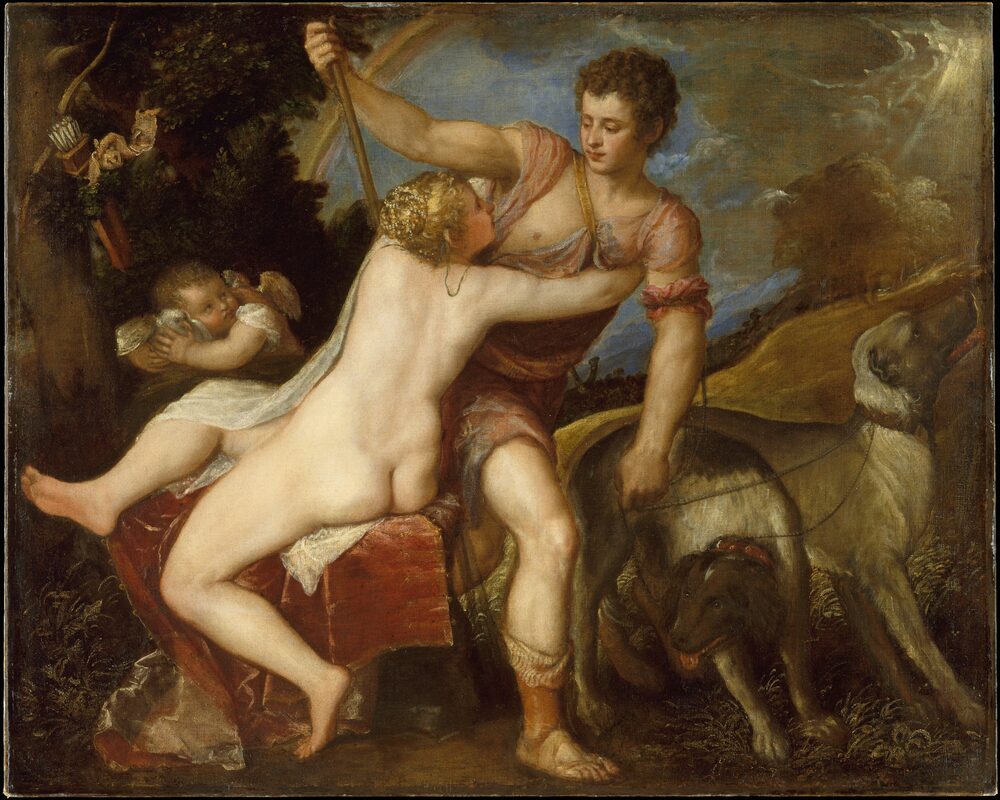
Adōnis
First Appearance
Adonis first cries out in Greek poetry already dead or dying, in the voice of mourning women. The earliest surviving mention is Sappho's (fr. 140): "He is dying, Kythereia, delicate Adonis — what are we to do?" / "Beat your breasts, girls, and tear your garments." From the very start, then, he enters the record not as an actor in his own story but as the object of a lament — the beautiful youth already lost, and the goddess Aphrodite (here called Kythereia) and her women weeping over him. The ritual cry "O for Adonis!" stands behind the surviving line, older than any connected narrative we possess.
— Sappho, fragments 140 and 168 (early 6th century BC)
Who They Are
Adonis (uh-DON-iss) is the beautiful mortal youth loved by Aphrodite and the great dying-and-rising vegetation god of Greek myth — the one figure the Greeks received, by way of the Semitic East, as a god who truly died and truly returned, year after year, with the dying-back and the greening of the growing world. His name is not Greek but Semitic, from ʾadōn, "lord," the title by which his worshippers in Phoenicia and then in Greece hailed and mourned him; and his whole myth turns on a dividing of the year, so that he belongs now to the world below and now to the world of light — the beloved lost in one season and found again in the next.
His story is woven of three strands. He is born, strangely and sorrowfully, out of a tree — the myrrh, into which his mother Myrrha (Smyrna) was changed. As an infant of unearthly beauty he becomes the prize in a quarrel between two goddesses, Aphrodite and Persephone, each unwilling to give him up; and the quarrel is settled by a sharing-out of the year that makes him a creature of the seasons, part of his time spent above with the goddess of love and part below with the queen of the dead. And he dies young and violently, gored by a wild boar on the hunt, his blood staining the ground — from which, the Greeks said, the anemone springs. Around that death grew the Adonia, the yearly festival of women who wept for him and set out the little "gardens" that bloom and wither in a few days as he did.
(Content note: the oldest sources make Adonis the child of an incestuous union, and later tellers dwell on it; this page follows the ancient line plainly but briefly, keeping the weight where the Greeks themselves placed it — on the birth from the weeping tree, the sharing of the seasons, and the mourning of a beauty too soon lost.)
Mythology
The custody of the seasons
The strand that most shaped Adonis as a god — not merely a beautiful mortal — is the quarrel over him as a child and the sharing of the year that settled it. In the fullest Greek account (Apollodorus, Bibliotheca 3.14.4), the infant Adonis was so surpassingly beautiful that Aphrodite, enchanted by him, hid him away in a chest (larnax) unseen by the other gods and gave the chest for safe-keeping to Persephone, queen of the underworld. But when Persephone opened it and looked upon the child, she too was taken with his beauty and would not give him back. The two goddesses — the one of love and the living light, the other of the dead and the world below — each claimed him, and the dispute was carried up for judgement.
In Apollodorus the case is tried before Zeus himself; in another well-known telling the god appointed the Muse Calliope to judge between them (a version preserved through Hyginus, Astronomica 2.7, drawing on earlier Greek sources). The ruling was the same either way: the year was divided into three parts, and it was ordained that Adonis should spend one third with Persephone below, one third with Aphrodite above, and one third wherever he himself chose — and Adonis, loving the goddess of love, gave his own free third also to Aphrodite, so that two parts of every year he dwelt in the light with her and only one in the dark. In this sharing-out the Greeks read the plain shape of the growing year: the beautiful youth who goes down into the earth and is kept there a season, then rises again into the warmth and the arms of love — the vegetation that dies back and returns, told as a story of two goddesses and a child too lovely to surrender.
Born from the myrrh tree
Adonis's birth is one of the strangest in Greek myth, and the ancient sources did not agree on his parentage. Hesiod (cited by Apollodorus) made him the son of Phoinix and Alphesiboia; Panyassis of Halicarnassus (the epic poet, likewise cited by Apollodorus, Bibliotheca 3.14.4) told the fuller and better-known tale, making him the son of Theias, king of Assyria, and of Theias's own daughter Smyrna — called Myrrha in the later Roman telling. In the standard version his mother conceived him in an incestuous union with her father (named as Theias, or as Kinyras, king of Cyprus), driven to it by the anger of Aphrodite, whom she had slighted. When the deed was discovered and her father pursued her with a sword, the gods in pity changed the fleeing girl into the myrrh tree (smyrna / myrrha) — and the fragrant resin that weeps from the bark of the myrrh was understood as her tears, shed forever. In due time the tree's trunk split, or was opened by the tusk of a boar, and from it the infant Adonis was born: beauty itself, brought out of a weeping tree. (The incest and the father's name belong to the oldest Greek strand through Panyassis; the richest surviving narrative of the transformation is Ovid's, Metamorphoses 10.298–518 — a later Roman elaboration, not an early Greek source.)
The boar and the anemone
Grown to a youth of matchless beauty, Adonis loved the hunt, and his death came from it. While he was hunting — against, some say, the warnings of Aphrodite, who feared for him — he was set upon and gored to death by a wild boar. The Greeks offered reasons for the beast: that it was sent by Ares, jealous of Aphrodite's love for the mortal; or by Artemis, in some grudge of her own; or by Apollo; but in the simplest telling it is only the plain peril of the hunt, the beautiful youth cut down young as such youths are. Aphrodite, hearing his cry, came too late, and gathered the dying Adonis in her arms. From his spilled blood, the Greeks said, sprang the anemone — the wind-flower, so called because the wind that opens its petals as swiftly scatters them, a bloom as short-lived as he was (the image is already in the Greek lament of Bion, the Epitaph on Adonis, where anemones rise from Adonis's blood and roses redden from the blood of the grieving goddess). So the youth who was born from a tree and shared out among the seasons passed, at the last, into a flower — and his dying and the mourning of it became the heart of his cult.
A god who dies and returns
Adonis is, with Persephone, the clearest Greek instance of the dying-and-rising divinity — the god bound to the vegetation, who perishes and comes back as the green world perishes and comes back. The pattern was not born in Greece: the Greeks received Adonis from the Semitic East, where the same figure was worshipped as the Phoenician and Syrian "Lord," kin to the Mesopotamian Tammuz (Dumuzi), the shepherd-god mourned by Ishtar, whose yearly descent and return the peoples of the Levant had lamented long before. His chief eastern home was Byblos in Phoenicia, and the river that ran down from the mountains there — the river Adonis — was said to run red each year in the season of his death, stained (the pious believed) with his blood, though the more sober observed it was the red earth washed down by the rains (so the Greek writer Lucian reports in On the Syrian Goddess 6–9). The custody of the seasons, the birth from the fragrant tree, the blood-red river and the blood-born flower — all of it circles the one truth his worshippers felt: that the beautiful thing dies, and is wept for, and comes again.
Worship — Ancient
The Adonia: a festival of women
Adonis was honoured less in grand civic temples than in the hands of women, and his great rite was the Adonia, kept in high summer across the Greek world — in Athens, in the islands, and splendidly at Alexandria. It was a festival of mourning, and strikingly a festival of the private house rather than the public calendar: the women of the household kept it, and the courtesans (hetairai) kept it with particular devotion, for the beautiful lost youth was dear to those whose world was love and its sorrows. The women set out on the rooftops the "gardens of Adonis" (képoi Adōnidos) — potsherds and baskets sown with wheat, barley, fennel and lettuce that sprang up green in the heat and, unrooted, as quickly withered, a deliberate little emblem of his swift-blooming, swift-dying beauty. They laid out images of the dead Adonis, sang shrill laments and beat their breasts in grief, and at the festival's end carried the withered gardens and the biers out to be thrown into the sea or into springs, giving the dead youth back to the water.
The lament in poetry
Because his cult was a cult of mourning, Adonis lived in Greek poetry chiefly as the subject of the lament. Sappho sang his dirge on Lesbos in the early sixth century BC ("He is dying, Kythereia, delicate Adonis — what are we to do?", fr. 140), and the ritual wail "O for Adonis!" echoes through the tradition after her. The most famous surviving piece is the Hellenistic Epitaph on Adonis of Bion, a sustained and musical cry of Aphrodite over her dead beloved. And Theocritus, in his fifteenth Idyll (the Adoniazousai, "Women at the Adonia"), gives a vivid and affectionate picture of the festival as it was kept at Alexandria under Queen Arsinoë — two ordinary women pushing through the holiday crowds to see the rich tableau of Adonis laid out beside Aphrodite, and to hear the hymn-singer's song of his death and promised return. Through these the Adonia comes down to us not as a dry rite but as a living scene of grief and festival together.
East and West
The cult reached Greece from Phoenicia and Syria, and its eastern centres kept their own older forms. At Byblos the death of Adonis was mourned with great public lamentation, and the reddening of the mountain river each spring was taken for the renewed flowing of his blood; the Greek satirist Lucian describes the Byblian rites and the red river in On the Syrian Goddess (6–9). Behind the Greek Adonis stands the whole Near Eastern family of mourned vegetation-gods — above all the Mesopotamian Tammuz (Dumuzi) — so that in weeping for Adonis the Greek women joined, without knowing it, a lament far older than their own tongue.
Worship — Modern
The pattern of the dying and returning
Adonis endures in the modern imagination first as a word — "an Adonis," any young man of striking beauty — a usage that keeps alive exactly the thing the Greeks fixed on: beauty at its brief height. For those who turn to the old gods devotionally, he is honoured most naturally as a god of the turning year and the cut-short bloom: a figure to remember at the height of summer when the grass burns brown, and again when the green returns, holding both the grief of loss and the promise of return in a single story. The little "garden of Adonis" is easily kept still — a shallow pot of quick seed set to sprout and wither — as a small yearly emblem of his myth.
A god of grief given its due
Because his cult was, at its heart, a permission to mourn — loudly, communally, and beautifully — Adonis speaks to anyone who needs a place for grief that the ordinary round of life leaves no room for. The women of the Adonia wept for the lost youth, but through him for every beautiful thing that does not last; and a thoughtful modern honouring of Adonis keeps that double sense, mourning the particular loss and the universal one together, and trusting, as the hymn at Alexandria promised, that the beloved will come again with the year. He stands too for the love of Aphrodite made tender and sorrowful — the goddess of desire taught grief by a mortal — and for the dignity the Greeks gave to lamentation itself.
Epithets & Cult Titles
- Adōn (Ἄδων) — 'The Lord' — the Semitic title from which his whole name is drawn; in the cry of his mourners the name was less a proper name than an invocation, the beloved hailed as lord even in death
- ho kalos (ὁ καλός) — 'The beautiful one' — the standing epithet of Adonis in poetry and at his festival, where the women called the fair youth beautiful as they laid out his image and wept; his beauty is the fixed note of every telling
- the thrice-mourned / pammetor pothos — A descriptive rather than a cult-title: the youth whose dying is mourned anew each year, the very pattern of the beloved lost and wept for — 'much-wept Adonis,' as the lament calls him
Sources & Variants
- Sappho, fragments 140 and 168 (the lament for 'delicate Adonis'; the ritual cry — earliest surviving Greek mention, early 6th century BC)
- Apollodorus, Bibliotheca 3.14.3–4 (the parentage of Adonis — Hesiod's Phoinix and Alphesiboia, Panyassis's Theias and Smyrna; the chest entrusted to Persephone; the quarrel of Aphrodite and Persephone; Zeus's division of the year into three; the death by the boar)
- Panyassis of Halicarnassus (cited by Apollodorus) — the birth of Adonis from Theias and his daughter Smyrna
- Hesiod (cited by Apollodorus) — Adonis as son of Phoinix and Alphesiboia
- Theocritus, Idyll 15 (the Adoniazousai, 'Women at the Adonia') — the festival of Adonis at Alexandria under Arsinoë, the tableau of the laid-out youth and the hymn of his death and return
- Bion, Epitaph on Adonis (the Hellenistic Greek lament of Aphrodite over the dead Adonis; the anemones from his blood and the roses from the goddess's)
- Lucian, On the Syrian Goddess (De Dea Syria) 6–9 (the mourning of Adonis at Byblos and the yearly reddening of the river Adonis) — later Greek
- Hyginus, Astronomica 2.7 (the Muse Calliope appointed by Zeus to judge between Aphrodite and Persephone, and the division of the year)
- Ovid, Metamorphoses 10.298–739 (Myrrha's incest and transformation into the myrrh tree; the birth of Adonis; his love for Venus and death by the boar; the anemone from his blood) — later Roman retelling, fullest surviving narrative but not an early Greek source
Gallery