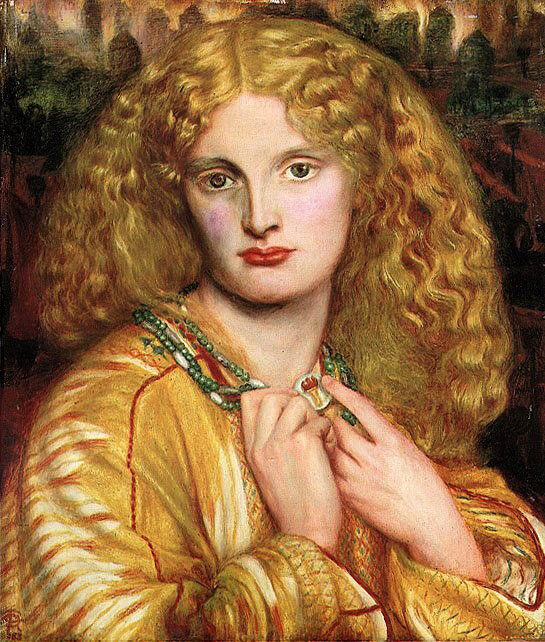
Helenē
First Appearance
Helen first appears in the Iliad on the walls of Troy. In the third book, as the two armies draw up for a duel between her first husband Menelaus and Paris who carried her off, the old men of Troy see her come to the wall and confess that no one could blame Greeks or Trojans for suffering so long over such a woman — and yet, they say, let her go home. There King Priam sits her beside him and asks her, gently and without reproach, to name the Greek captains below, and she names Agamemnon, Odysseus, Ajax, grieving and calling herself the cause. In the Odyssey (4.120–305) we meet her again, years later and wholly changed: back home in Sparta, a gracious queen beside Menelaus, quietly drugging the wine to ease old griefs and telling tales of the war as though it were another life.
— Homer, Iliad 3.121–244; Odyssey 4.120–305
Who They Are
Helen (HEL-uhn) is the most beautiful woman in the world and the most blamed — the face, as a much later poet put it, that launched a thousand ships. Daughter of Zeus and, in the version told here, of the mortal queen Leda, she was born (the Greeks said) from an egg, and she grew into a beauty so far beyond the human measure that it could not be looked at without desire and could not be possessed without war. Her carrying-off from Sparta by the Trojan prince Paris set the whole Greek world in motion against Troy, and for ten years the greatest heroes of the age killed and died over her. She stands at the very centre of the Trojan War, the still point around which the Iliad turns, and yet she never lifts a spear: her power is entirely the power of beauty, which in Greek thought is a divine and dangerous force, not a soft one.
What makes Helen far more than a prize or a scandal is that the Greeks themselves could never agree on what she was. Was she a willing runaway who betrayed a good husband, or a woman seized and carried off against her will, bewitched by a goddess's promise she had no power to refuse? Homer already treats her with a strange tenderness — she blames herself bitterly, and everyone around her refuses to blame her — and later poets went further still, insisting that the real Helen never went to Troy at all, that only a phantom made of cloud and air crossed the sea while the true Helen waited out the war, chaste and innocent, in Egypt. She is the great test-case of Greek myth for the question of a woman's guilt: how much of what is done to a woman, and through her beauty, can be laid at her own door.
And beneath the heroine of the poems there was a goddess. Long before Homer, and long after, Helen received real cult — not as a dead heroine only but as a bright divine power. At Sparta she and her husband Menelaus were worshipped at a shrine called the Menelaion; unmarried girls sang and danced for her and brought her the first offerings of their beauty; and on Rhodes she was honoured as Helen Dendritis, "Helen of the Tree," a title that seems to reach back to a very old divinity of light and growing things. To tell Helen's story is to hold two things at once: the woman blamed for the greatest war in myth, and the shining goddess-figure the same people knelt to and asked for the blessing of beauty and safe marriage.
Mythology
Born from the egg: Zeus, the swan, and the question of her mother
Helen's birth is one of the strangest in Greek myth, and the Greeks told it more than one way. In the version followed here, Zeus desired Leda, the mortal wife of Tyndareus king of Sparta, and came to her in the form of a swan — some say pretending to flee an eagle, so that she sheltered the bird in her arms. From that union Leda conceived, and in due time she brought forth not a child but an egg, and from the egg was hatched Helen, the most beautiful of women. (The same night Leda lay with her mortal husband Tyndareus, and so her children were famously of mixed fathering: Helen and one of the twins counted as children of Zeus and immortal in seed, the other twin and Helen's sister Clytemnestra as mortal children of Tyndareus. The sorting differs from teller to teller.) Her brothers were the Dioscuri — Castor and Polydeuces, the "Sons of Zeus," the horseman and the boxer, who would one day be set among the stars — and her sister was Clytemnestra, who married Agamemnon and became the darkest figure of the returning kings.
There is an older and stranger tradition about her true mother, and it should be told plainly. In the lost epic called the Cypria and in other early sources, Helen's real mother was not Leda at all but the goddess Nemesis — the great power of divine retribution and the anger of the gods at excess. In that telling Zeus pursued Nemesis, who fled from him changing shape through every kind of animal until, in the form of a goose or a swan, she was at last caught; from her came the egg, which was found (some say by a shepherd) and brought to Leda, who kept it warm in a chest until Helen hatched, and raised the child as her own. Leda, in this version, only fostered Helen; her true origin lay with Nemesis. It is a haunting detail, because it makes the most beautiful woman in the world the daughter of Retribution itself — as though the war she caused were folded into her from the moment of her making, the gods' vengeance on human pride given a human face.
The wooing of Helen and the oath of the suitors
When Helen came of age her beauty was already famous through all of Greece, and when Tyndareus made known that she would be married, the kings and princes of every Greek land came to Sparta to court her — so many, and so powerful, that Tyndareus grew afraid. Whichever man he chose, he feared the rest would be enraged and turn on the winner and on Sparta itself. The clever Odysseus, who was among the suitors (though he soon saw he had no chance and turned his sights to Penelope instead), gave Tyndareus the counsel that solved it: let every suitor swear a great oath, before the choice was made, that they would all stand by whichever man was chosen, and if anyone ever wronged him in the matter of his wife, they would all come to his aid. The suitors swore it — the Oath of Tyndareus — and only then was the choice made. Helen was given to Menelaus, brother of Agamemnon, and he became king of Sparta with her. That oath, sworn to keep the peace, is the hidden spring of the whole Trojan War: when Helen was later taken, every king of Greece was already bound by his own word to sail and win her back.
Paris, the judgement of the goddesses, and the carrying-off
(Content note: what follows is a carrying-off, told in the tradition that Helen was taken against her will and under a goddess's compulsion.) Far away, on the mountain above Troy, a Trojan prince named Paris (also called Alexander) had been made judge in a quarrel among three goddesses — Hera, Athena, and Aphrodite — over which of them was fairest. Each offered him a bribe: Hera power, Athena victory in war, and Aphrodite the most beautiful woman in the world for his wife. Paris chose Aphrodite, and the woman she had promised him was Helen — who was already married. When Paris came to Sparta as a guest, Menelaus received him with the full honour owed to a guest and then, unluckily, sailed away to Crete for a funeral, leaving the Trojan prince under his roof. And here the tradition told in this telling is firm: Helen did not run willingly to a lover and betray her husband. She was taken — carried off by Paris, and behind Paris the will of Aphrodite, whose promise bound the outcome and whose power over desire no mortal woman could resist. In the harshest readings she is a wanton; but the older and gentler current, which the Iliad itself leans toward, makes her a woman seized and swept across the sea by forces far larger than herself, a pawn between a scheming prince and an implacable goddess. She is carried to Troy, and with her (in many versions) treasure taken from Menelaus's house, and the war-fuse is lit.
The phantom Helen: the woman who was never at Troy
Here the Greeks told their most astonishing variant, and it must have its place. The lyric poet Stesichorus, the story goes, wrote a poem blaming Helen and was struck blind for the slander; understanding why, he composed a Palinode, a "taking-back," whose opening lines were remembered for centuries: "That story is not true — you never went in the well-benched ships, you never came to the towers of Troy." In this tradition the Helen who went to Troy was not Helen at all but an eidolon, a phantom, a breathing image made of cloud and air in her exact likeness — and the men of both armies fought and died for ten years over a ghost. The real Helen, meanwhile, chaste and untouched, had been spirited away by the gods to Egypt, where she waited out the whole war in the household of the good king Proteus, faithful to Menelaus the entire time. Herodotus (2.112–120), sifting the tale like a historian, reports that the Egyptian priests told him Helen and the treasure really had been kept safe in Egypt, and reasons that the Trojans would surely have given her back if they had ever had her — so, he concludes, she was never in Troy at all. And Euripides built a whole tragedy, the Helen, on this version: the play opens with the true Helen in Egypt, innocent and grieving, learning that thousands have died at Troy for a phantom wearing her face, until Menelaus is shipwrecked on the Egyptian shore and the husband and the real, faithful wife are at last reunited and escape together. It is the ancient world's great act of mercy toward Helen — the insistence that the woman herself was never guilty of anything at all.
Helen within Troy
Whether in the flesh or (in the phantom tradition) only in seeming, "Helen" spent the ten years of the war inside the walls of Troy, and Homer's portrait of her there is unforgettable and full of sorrow. She is not celebrated by the Trojans; she moves among them isolated and self-reproaching, calling herself a "dog" and a horror, wishing she had died before she ever came. Only old Priam and the noble Hector treat her with kindness. When Paris proves a coward in the duel and is whisked to safety by Aphrodite, Helen turns on him with contempt, and on the goddess herself with a flash of open defiance — one of the most remarkable moments in Homer, a mortal woman rounding on Aphrodite and refusing, for a moment, to go to the man the goddess has saved. When Paris is killed late in the war she is married, by Trojan custom, to his brother Deiphobus. And at the very end, in the sack of the city, when Menelaus finds her at last and comes with drawn sword to kill the wife who cost him ten years — he sees her, and (the poets say) the sword falls from his hand. Her beauty, or her innocence, or both, disarms him. He takes her back.
The homecoming and the reconciled marriage
Helen's story does not end in punishment. She and Menelaus sail home together — a long, storm-scattered voyage by way of Egypt in the Odyssey's telling — and are reconciled, restored as king and queen of Sparta. When Homer shows her to us again in the fourth book of the Odyssey, years have passed and the wound has healed: she is a gracious and commanding hostess, welcoming young Telemachus who has come seeking news of his father Odysseus, recognizing the boy at once by his likeness to his father, and reaching for a special drug — nepenthe, "the un-grief," a gift she brought from Egypt — which she slips into the wine to lift the sorrow of the guests as they remember the dead. She tells stories of the war frankly, including her own part in it, and Menelaus tells others, and the two of them together make a picture of a marriage that has come through the fire and out the other side. Because Menelaus was husband to a daughter of Zeus, the poem promises him no death but a translation to the Elysian Fields, the paradise at the world's end, and Helen with him. In other, harsher local traditions her afterlife was stranger — a tale from Rhodes had her hanged from a tree by a vengeful widowed queen, which is bound up with her tree-cult there — but the great current of the tradition, and the one followed here, is the Odyssey's: Helen, reconciled and honoured, a queen once more in her own hall.
Worship — Ancient
A heroine who was also a goddess
Helen's cult is one of the clearest cases in Greek religion of a figure worshipped as more than a hero — she received honours that shade unmistakably toward the divine, and many scholars believe that behind the Helen of epic stands a genuine old goddess, a power of light, beauty, vegetation, and (with her brothers) the saving of sailors, only later drawn down into the human story of Troy. Whatever her origins, in historical times she was a real and living object of cult, especially in her homeland of Laconia, and the character of that cult is warm and particular: she is the goddess-patron of a young woman's beauty and of marriage, the very things her myth turns on.
Sparta and the Menelaion
Her chief seat of worship was in Sparta. On a ridge above the Eurotas river, at a site now called the Menelaion, stood a shrine of Helen and Menelaus, and excavation there has turned up dedications — including one inscribed offering naming Helen — going back to the archaic age, confirming that the pair were honoured on that spot for centuries. Here Helen and Menelaus were worshipped together as a divine or heroic couple, and here unmarried girls in particular came to her. Our best glimpse of the cult is in a poem by the Spartan poet Alcman, whose choruses of maidens sang and danced in Helen's honour; and Theocritus preserves an Epithalamium (wedding-song) for Helen in which the girls of Sparta describe crowning a plane-tree in her honour, anointing it with oil, and hanging a garland on it with an inscription — "Revere me: I am Helen's tree." So at the heart of her Spartan cult stood a sacred plane-tree, tended and adorned by the young women who looked to Helen as the giver of the beauty and the good marriage they hoped for.
Rhodes and Helen of the Tree
On the island of Rhodes, Helen was worshipped under the striking title Helen Dendritis, "Helen of the Tree." Pausanias (3.19.9–10) preserves the local story that lay behind it: after Menelaus's death Helen was driven from Sparta and fled to Rhodes, where the widowed queen Polyxo, whose husband had died at Troy, took revenge on her by sending servants disguised as Furies who seized Helen at her bath and hanged her from a tree — and that the Rhodians thereafter worshipped her as Helen Dendritis, Helen of the Tree. Grim as the story is, the cult-title almost certainly preserves something far older than the tale invented to explain it: a tree-goddess, a divinity bound up with a sacred tree, of a very ancient type found across the eastern Mediterranean. It is one of the strongest signs that Helen was, at bottom, a goddess before she was ever a heroine.
The manner of her honours
Where Helen was worshipped she received the honours of a bright and gracious power: libations of wine, garlands and flowers, and — most characteristically — the tending and adorning of her sacred tree, with offerings hung upon its branches and the trunk anointed with oil. Choruses of girls sang and danced for her; brides and would-be brides sought her favour; and at the Menelaion she and Menelaus together were given the offerings owed to a divine couple who watched over Sparta. Her association with her brothers the Dioscuri, the great saviour-gods of seafarers, drew her too into the sphere of those invoked for safety on the sea.
Worship — Modern
Honouring Helen today
Helen occupies an unusual place for the modern devotee, because she was, in antiquity, honoured in two keys at once: as a heroine remembered from the great story of Troy, and as a genuine goddess-power of beauty, marriage, and the sacred tree. A person drawn to her today most naturally honours her in the second key — not as the blamed woman of the war, but as the shining figure the girls of Sparta sang for: a patron of beauty freely given, of the hope and the vulnerability of a young woman coming to marriage, and, through her tree-cult, of the quiet holiness of growing and living things.
Offerings and remembrance
The oldest and most fitting offerings to Helen are the ones her own cult prescribed: a garland or wreath of flowers, hung upon a tree in her honour; a little oil poured at the roots or rubbed on the bark of a chosen tree; a libation of wine given to the earth. A mirror set out in her memory recalls the beauty she embodied; a length of weaving or a token of the loom recalls the woven web that is her constant emblem in Homer, where she is forever at her great loom working the war itself into cloth. A candle lit and her story told — told with the mercy the ancients came to feel for her, remembering that the best of them insisted she was never guilty — keeps her name alive in the way a heroine most wants, which is to be remembered rightly.
What she carries into the present
More than through formal rite, Helen lives on as the West's oldest and deepest meditation on beauty and blame. Her story asks, and refuses to settle, the question of how much a woman may be held to account for what desire — her own or, far more, other people's — does in her name; and the ancient answer, at its most generous, was the phantom in Egypt: the insistence that the real woman was innocent all along, and that the war was fought over an image men made and then destroyed. To honour Helen now is partly to sit with that question honestly, and to remember that the same people who blamed her also knelt to her, sang for her, and asked her for the blessing of beauty and a good marriage — the goddess beneath the scandal, Helen of the Tree.
Epithets & Cult Titles
- Helen of Troy (Ἑλένη) — The name the world has kept — Helen as she was at Troy, the woman for whom the Greek and Trojan hosts fought ten years; less a title than the shadow her story casts, and in the older cult-cities a name spoken with unease
- Helen of Sparta / of Argos (Ἑλένη Λάκαινα) — Helen the Spartan — the queen of Menelaus in her own homeland, honoured with real cult in Laconia; 'Argos' in Homer stands broadly for the Peloponnese, so 'Helen of Argos' names the same Peloponnesian queen
- Helen Dendritis (Ἑλένη Δενδρῖτις) — 'Helen of the Tree' — her cult-title on Rhodes, where Pausanias records that she was worshipped bound to or hung upon a tree; a tree-goddess aspect that many take as a trace of a much older nature-divinity beneath the heroine of epic
- Helen Dioscura (Ἑλένη) — Descriptive — 'Helen sister of the Dioscuri,' the twin brothers Castor and Polydeuces (Pollux); like them she was born of the egg and, in some tellings, shared in their honour as a bright saving power invoked by sailors
Sources & Variants
- Homer, Iliad 3.121–244 (Helen on the walls of Troy, naming the Greek captains for Priam) and 3.383–420, 24.761–775 (Helen and Aphrodite; her lament over Hector)
- Homer, Odyssey 4.120–305 (Helen restored as queen in Sparta, the drug nepenthe, her welcome of Telemachus) and 4.561–569 (Menelaus and Helen destined for the Elysian Fields)
- Cypria fragments (in the Epic Cycle) — Helen as daughter of Nemesis and the egg fostered by Leda; the judgement of Paris and the carrying-off
- Apollodorus, Bibliotheca 3.10.5–3.11.2 and Epitome 3.1–3.5 (birth from the egg; the oath of the suitors; the marriage to Menelaus; Paris and the abduction)
- Stesichorus, Palinode fragments (PMG 192–193) — the recantation and the phantom Helen who never went to Troy
- Herodotus 2.112–120 (the Egyptian tradition: Helen kept safe in Egypt and never at Troy)
- Euripides, Helen (the whole tragedy built on the eidolon tradition — the true Helen faithful in Egypt) and Trojan Women 914–1032 (Helen's self-defence and Hecuba's accusation)
- Aeschylus, Agamemnon 681–698 (the pun on Helen's name — 'ship-destroying, man-destroying, city-destroying')
- Alcman, Partheneia (maiden-songs) fragments — choruses of Spartan girls in Helen's honour
- Theocritus, Idyll 18 (Epithalamium of Helen) — the girls of Sparta crowning and anointing Helen's sacred plane-tree
- Pausanias, Description of Greece 3.15.3, 3.19.9–10 (the cult at the Menelaion; Helen Dendritis and the tree on Rhodes)
- Isocrates, Encomium of Helen and Gorgias, Encomium of Helen (rhetorical defences arguing Helen was blameless — taken by force or by a god's compulsion)
Gallery